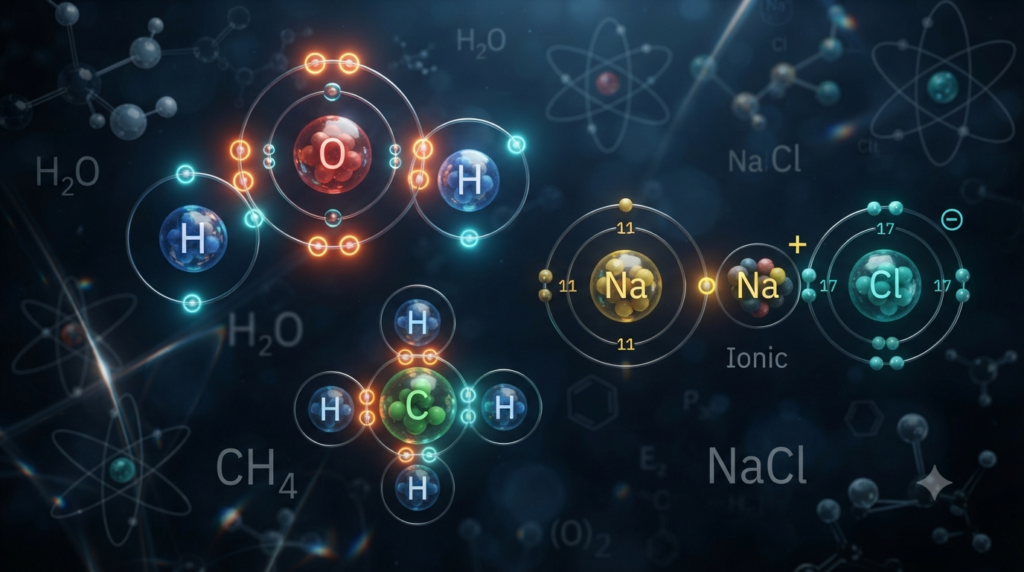

Chemistry often uses symbols, numbers, and formulas to describe substances that cannot be seen directly. A chemical formula tells us which elements are present in a substance and how many atoms of each element are represented. The mole concept then connects these microscopic particles with measurable amounts of matter. This connection is one of the most useful ideas in chemistry because it allows us to move between atoms and molecules and quantities that can be measured in the laboratory.
For example, the formula H₂O tells us that a water molecule contains two hydrogen atoms and one oxygen atom. But when we work with a glass of water, we are dealing with an enormous number of molecules. The mole concept gives us a practical way to count these particles by weighing a measurable amount of substance. Understanding how chemical formulas and the mole concept work together makes chemical calculations much easier and more meaningful.
What Does a Chemical Formula Tell Us?
A chemical formula is a symbolic representation of a substance. It uses chemical symbols and numerical subscripts to show the elements present and their relative numbers.
Consider the formula H₂O. The symbol H represents hydrogen, while O represents oxygen. The subscript ₂ tells us that there are two hydrogen atoms for every one oxygen atom in a molecule of water.
Similarly, CO₂ represents carbon dioxide. It contains one carbon atom and two oxygen atoms in each molecule.
A formula can therefore provide important information about the composition of a substance.
For example:
H₂O contains 2 hydrogen atoms and 1 oxygen atom.
CO₂ contains 1 carbon atom and 2 oxygen atoms.
NH₃ contains 1 nitrogen atom and 3 hydrogen atoms.
CH₄ contains 1 carbon atom and 4 hydrogen atoms.
CaCl₂ contains calcium and chlorine in a 1:2 ratio.
These numbers become especially important when we use the mole concept.
What Is the Mole Concept?
The mole is a counting unit used in chemistry. Just as a dozen represents 12 objects, a mole represents a very large number of particles.
One mole contains exactly 6.02214076 × 10²³ elementary entities. This number is called the Avogadro constant.
The particles represented by a mole can be atoms, molecules, ions, formula units, or other specified entities.
For example:
1 mol of hydrogen atoms contains 6.02214076 × 10²³ hydrogen atoms.
1 mol of water molecules contains 6.02214076 × 10²³ water molecules.
1 mol of sodium ions contains 6.02214076 × 10²³ sodium ions.
The mole therefore provides a bridge between the microscopic world of particles and the macroscopic quantities measured by chemists.
How Chemical Formulas Connect With Moles
The connection becomes clear when we look at the subscripts in a chemical formula.
Take H₂O as an example. One molecule of H₂O contains two hydrogen atoms and one oxygen atom.
Therefore, one mole of H₂O molecules contains:
2 moles of hydrogen atoms
1 mole of oxygen atoms
This does not mean that there are only two hydrogen atoms in one mole of water. Instead, it means that the ratio of hydrogen atoms to oxygen atoms remains 2:1 on the mole scale.
So:
1 mol H₂O → 2 mol H atoms + 1 mol O atoms
The chemical formula provides the ratio, while the mole concept allows us to apply that ratio to a measurable quantity of substance.
Subscripts Represent Mole Ratios
The subscripts in a chemical formula are directly related to mole ratios.
For example, consider CO₂.
The formula contains one carbon atom and two oxygen atoms. Therefore, in any amount of pure CO₂:
1 mol CO₂ contains 1 mol C atoms and 2 mol O atoms.
If we have 3 mol of CO₂, the number of moles of each type of atom becomes:
3 mol CO₂ → 3 mol C atoms + 6 mol O atoms
The formula has not changed. We are simply multiplying the atom ratio by the number of moles of compound.
The same idea works for more complicated formulas.
For example, Al₂(SO₄)₃ contains:
2 aluminium atoms
3 sulphur atoms
12 oxygen atoms
Therefore:
1 mol Al₂(SO₄)₃ contains 2 mol Al atoms, 3 mol S atoms, and 12 mol O atoms.
The formula gives us the particle ratio, and the mole concept extends that ratio to larger quantities.
Chemical Formulas and Molar Mass
Another important connection between chemical formulas and the mole concept is molar mass.
Molar mass is the mass of one mole of a substance. It is usually expressed in grams per mole (g/mol).
The chemical formula tells us which atomic masses must be added together to calculate the molar mass.
For water, H₂O:
Hydrogen has an atomic mass of approximately 1 g/mol.
Oxygen has an atomic mass of approximately 16 g/mol.
Therefore:
Molar mass of H₂O = 2(1) + 16 = 18 g/mol
This means that 1 mol of H₂O has a mass of approximately 18 g.
The formula is therefore not just a symbolic description. It also provides the information needed to calculate the mass of a mole of the substance.
From Mass to Moles
The mole concept allows us to convert between mass and amount of substance.
The basic relationship is:
n = m/M
where:
n = number of moles
m = mass of substance
M = molar mass
Suppose we have 36 g of water. The molar mass of H₂O is approximately 18 g/mol.
Therefore:
n = 36/18 = 2 mol
So 36 g of water contains 2 mol of H₂O molecules.
Once we know the number of moles, the chemical formula allows us to determine the amounts of individual elements present.
Because each H₂O molecule contains two hydrogen atoms and one oxygen atom:
2 mol H₂O → 4 mol H atoms + 2 mol O atoms
This demonstrates how mass, moles, and chemical formulas work together.
Chemical Formulas and Avogadro’s Number
The mole concept also allows chemical formulas to be connected to the actual number of particles.
For example, 1 mol of CO₂ contains 6.02214076 × 10²³ CO₂ molecules.
Each CO₂ molecule contains one carbon atom and two oxygen atoms.
Therefore, 1 mol of CO₂ contains:
1 mol of carbon atoms = 6.02214076 × 10²³ carbon atoms
and
2 mol of oxygen atoms = 2 × 6.02214076 × 10²³ oxygen atoms
Thus, the chemical formula tells us the relationship between different particles, while Avogadro’s number tells us how many particles are present in one mole.
Mole Concept in Ionic Compounds
The same principle applies to ionic compounds, although ionic substances are generally described using formula units rather than individual molecules.
Consider NaCl.
The formula NaCl represents a 1:1 ratio of sodium ions to chloride ions.
Therefore:
1 mol NaCl → 1 mol Na⁺ + 1 mol Cl⁻
If we have 2 mol of NaCl:
2 mol NaCl → 2 mol Na⁺ + 2 mol Cl⁻
Now consider CaCl₂. Its formula shows a 1:2 ratio.
Therefore:
1 mol CaCl₂ → 1 mol Ca²⁺ + 2 mol Cl⁻
The subscripts are essential because they determine the relative amounts of ions produced or present.
Parentheses in Chemical Formulas
Parentheses can make chemical formulas appear complicated, but they simply indicate that a group of atoms occurs more than once.
Consider Ca(OH)₂.
The subscript ₂ outside the parentheses applies to the entire OH group.
Therefore, one formula unit contains:
1 calcium atom
2 oxygen atoms
2 hydrogen atoms
So:
1 mol Ca(OH)₂ contains 1 mol Ca atoms, 2 mol O atoms, and 2 mol H atoms.
The total number of moles of atoms represented in one mole of Ca(OH)₂ is therefore 5 mol of atoms.
Understanding how parentheses work is important when using chemical formulas in mole calculations.
Chemical Equations and Mole Ratios
Chemical formulas become even more useful when they are combined into balanced chemical equations.
Consider the reaction:
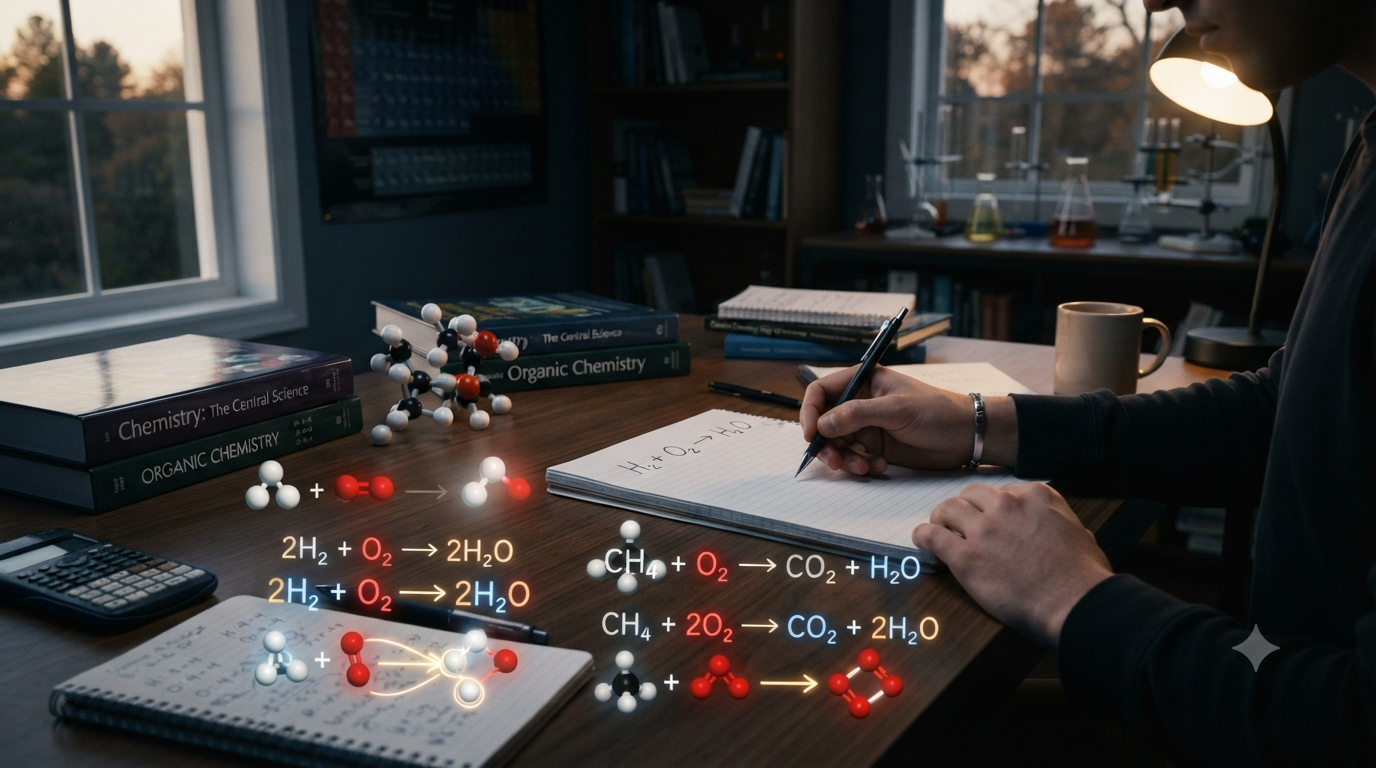
2H₂ + O₂ → 2H₂O
The coefficients in a balanced chemical equation represent mole ratios.
This equation tells us that:
2 mol H₂ react with 1 mol O₂ to produce 2 mol H₂O.
The subscripts tell us the composition of each substance, while the coefficients tell us the relative amounts of substances involved in the reaction.
This distinction is extremely important.
In H₂O, the subscript ₂ tells us that each water molecule contains two hydrogen atoms. In 2H₂O, the coefficient 2 tells us that two moles of water molecules are being considered in the reaction.
Difference Between Subscripts and Coefficients
Subscripts and coefficients have different meanings.
A subscript describes the composition of a single particle or formula unit.
For example:
H₂O
The subscript ₂ means each water molecule contains two hydrogen atoms.
A coefficient describes the quantity of particles or moles.
For example:
3H₂O
The coefficient 3 means three molecules, or three moles when using the mole scale, of H₂O are being considered.
Changing a subscript changes the substance itself. Changing a coefficient changes the amount of the substance.
For example, H₂O and H₂O₂ are different substances. But 2H₂O simply means two units of water.
Using Chemical Formulas to Calculate Elemental Composition
Chemical formulas can also be used to determine the amount of each element in a compound.
Consider CO₂. Its molar mass is approximately:
12 + 2(16) = 44 g/mol
The carbon contribution is 12 g, while oxygen contributes 32 g.
Therefore, in 1 mol of CO₂:
Carbon = 1 mol
Oxygen = 2 mol
This information can also be used to calculate the percentage by mass of each element.
Percentage of carbon:
(12/44) × 100 ≈ 27.3%
Percentage of oxygen:
(32/44) × 100 ≈ 72.7%
The chemical formula therefore provides the composition needed for quantitative chemical analysis.
Why This Connection Is Important
The relationship between chemical formulas and the mole concept is central to many areas of chemistry.
It allows chemists to:
Calculate the molar mass of compounds.
Convert mass into moles.
Convert moles into numbers of particles.
Determine the number of atoms or ions present.
Calculate amounts of individual elements in compounds.
Interpret mole ratios in chemical reactions.
Perform stoichiometric calculations.
Determine empirical and molecular formulas.
Calculate percentage composition.
Predict how much reactant is required for a reaction.
Without this connection, chemical formulas would mainly provide qualitative information. The mole concept turns that information into measurable quantities.
A Simple Way to Remember the Relationship
A useful way to think about the connection is:
Chemical formula → particle ratio → mole ratio → measurable amount
For example:
H₂O
The formula tells us:
2 H atoms : 1 O atom
The mole concept extends this to:
2 mol H atoms : 1 mol O atoms
If we know the mass of water, we can first calculate moles of water and then use the formula to determine the corresponding moles of hydrogen and oxygen atoms.
This creates a logical pathway from what is written on paper to what can actually be measured in a laboratory.
Conclusion
Chemical formulas and the mole concept are closely connected because both describe the composition and quantity of matter at different levels. A chemical formula shows the relative number of atoms or ions in a substance, while the mole concept allows those microscopic ratios to be applied to measurable amounts of material. The subscripts in formulas establish mole ratios within compounds, and molar mass connects those formulas to mass. When chemical formulas are used with balanced equations, they also provide the mole ratios needed for chemical reactions. Once this relationship is understood, many chemistry calculations become much more systematic because the formula provides the composition and the mole concept provides a practical way to count and measure matter.
FAQs
1. What does a chemical formula tell us about a substance?
A chemical formula tells us which elements are present in a substance and the relative number of atoms or ions of each element. For example, H₂O shows that each water molecule contains two hydrogen atoms and one oxygen atom. These subscripts also provide important mole ratios. One mole of H₂O contains two moles of hydrogen atoms and one mole of oxygen atoms. Therefore, chemical formulas are useful not only for identifying composition but also for performing quantitative calculations. By combining a chemical formula with the mole concept, we can determine molar mass, elemental amounts, particle numbers, and relationships between different substances.
2. What is the mole concept in chemistry?
The mole concept is a method of counting extremely large numbers of particles in chemistry. One mole contains exactly 6.02214076 × 10²³ specified elementary entities, such as atoms, molecules, ions, or formula units. This number is known as the Avogadro constant. The mole provides a practical connection between microscopic particles and measurable quantities such as mass. For example, one mole of water contains 6.02214076 × 10²³ water molecules. Chemists can use the mole concept to calculate the number of particles, determine amounts of elements in compounds, and establish quantitative relationships between reactants and products in chemical reactions.
3. How do subscripts in chemical formulas relate to moles?
Subscripts show the relative number of atoms of each element in a chemical formula. These ratios can also be interpreted on a mole scale. For example, H₂O contains two hydrogen atoms and one oxygen atom per molecule. Therefore, one mole of H₂O contains two moles of hydrogen atoms and one mole of oxygen atoms. Similarly, one mole of CO₂ contains one mole of carbon atoms and two moles of oxygen atoms. The subscripts remain fixed because they describe the composition of the substance. They provide the mole ratios needed to calculate the amount of each element present in a compound.
4. How is molar mass connected to a chemical formula?
Molar mass is the mass of one mole of a substance, usually expressed in grams per mole. A chemical formula provides the information needed to calculate it because it shows which atoms and how many of each are present. For example, H₂O contains two hydrogen atoms and one oxygen atom. Using approximate atomic masses, its molar mass is 2(1) + 16 = 18 g/mol. Therefore, one mole of water has a mass of approximately 18 grams. Once molar mass is known, the mole concept allows us to convert between the mass of a substance and its amount in moles.
5. How can a chemical formula be used to find the number of atoms?
A chemical formula gives the ratio of atoms within a substance, while the mole concept provides the total number of particles. For example, one molecule of CO₂ contains one carbon atom and two oxygen atoms. Therefore, one mole of CO₂ contains one mole of carbon atoms and two moles of oxygen atoms. Since one mole contains 6.02214076 × 10²³ particles, the number of atoms can be calculated using Avogadro’s constant. The same approach works for more complex compounds. First determine the number of moles of the compound, then use the subscripts to determine the corresponding moles of each type of atom.
6. What is the difference between a subscript and a coefficient?
A subscript tells us the composition of one molecule, formula unit, or other chemical entity, while a coefficient tells us the quantity of those entities being considered. For example, in H₂O, the subscript ₂ means that each water molecule contains two hydrogen atoms. In 2H₂O, the coefficient 2 means two water molecules or two moles of water, depending on the context. Changing a subscript can change the identity of a substance, whereas changing a coefficient changes only its amount. Understanding this difference is essential when interpreting chemical formulas and balanced chemical equations.
7. How do chemical formulas help with stoichiometric calculations?
Chemical formulas provide the composition of substances, while balanced chemical equations provide the mole ratios between substances participating in a reaction. For example, the equation 2H₂ + O₂ → 2H₂O shows that two moles of hydrogen react with one mole of oxygen to produce two moles of water. These coefficients are used as mole ratios in stoichiometric calculations. The formulas tell us what each substance contains, and the coefficients tell us how much of each substance participates in the reaction. Together, they allow chemists to calculate required reactant amounts and expected product amounts from known quantities.
8. How does the mole concept help convert mass into chemical quantities?
The mole concept provides a direct connection between mass and the number of particles in a substance. The relationship n = m/M is commonly used, where n represents moles, m represents mass, and M represents molar mass. For example, if 36 g of water is available and its molar mass is approximately 18 g/mol, then n = 36/18 = 2 mol. Once the number of moles is known, the chemical formula can be used to determine the amounts of individual elements or particles. This makes it possible to move systematically from a measurable mass to microscopic chemical quantities.
9. How do chemical formulas represent ionic compounds in mole calculations?
Ionic compounds are represented by formula units rather than individual molecules. Their formulas show the simplest whole-number ratio of ions in the compound. For example, NaCl represents a 1:1 ratio of sodium ions to chloride ions. Therefore, one mole of NaCl contains one mole of sodium ions and one mole of chloride ions. In CaCl₂, the ratio is one calcium ion to two chloride ions. Thus, one mole of CaCl₂ contains one mole of calcium ions and two moles of chloride ions. The subscripts in ionic formulas therefore provide the ion ratios needed for mole calculations.
10. Why is understanding chemical formulas and the mole concept important?
Understanding chemical formulas and the mole concept is important because together they allow qualitative chemical information to become quantitative. A formula identifies the elements present and shows their relative amounts, while the mole concept provides a practical way to count enormous numbers of particles. This relationship is used to calculate molar mass, convert between mass and moles, determine numbers of atoms or ions, calculate elemental composition, and interpret chemical equations. It is also fundamental to stoichiometry and laboratory calculations. Once the relationship is understood, many chemistry problems become easier because the formula provides the composition and the mole provides the quantity.
Related Posts
What information can be obtained from a chemical formula?
A chemical formula is a short and powerful way of representing a substance. It uses chemical symbols and numbers to […]
Read MoreWhat Is Acceleration in Physics?
Acceleration is one of the most important concepts in physics because it describes how the velocity of an object changes […]
Read MoreHow to Identify Variables in Physics Formulas
Physics formulas are mathematical statements that describe relationships between physical quantities. To use a formula correctly, you first need to […]
Read MoreWhat Are Significant Figures in Physics?
Physics is a science based on measurement. Whether a physicist measures length, time, mass, temperature, or electrical current, every measurement […]
Read MoreHow to Check Dimensions in a Physics Formula
Physics formulas connect different physical quantities through mathematical relationships. Before using a formula in a calculation, it is useful to […]
Read MoreHow to Name a Compound From Its Chemical Formula
A chemical formula tells us which elements are present in a compound and how many atoms of each element are […]
Read MoreHow to Build a Physics Formula Sheet
Physics involves many formulas, and remembering all of them can become difficult as you move from basic concepts to more […]
Read MoreMolecular Formula vs Empirical Formula
Chemical formulas give us a simple way to represent substances using the symbols of elements and numbers. However, not all […]
Read MoreHow can measurement errors be reduced?
Measurement is an essential part of science. Whether scientists are studying the motion of an object, measuring temperature, determining the […]
Read MoreWhy can different compounds have the same empirical formula?
An empirical formula gives the simplest whole-number ratio of atoms present in a compound. It is useful because it tells […]
Read MoreWhat Is a Reference Frame in Physics?
When we describe the motion of an object, we usually say whether it is moving, how fast it is moving, […]
Read MoreHow to Calculate the Total Number of Atoms in a Formula
Chemical formulas provide a compact way to show which elements are present in a substance and how many atoms of […]
Read MoreHow to Know Which Physics Formula to Use
Physics problems often seem difficult not because the mathematics is complicated, but because it can be hard to decide which […]
Read MoreScalar vs Vector Quantities: Key Differences
In physics, we use physical quantities to describe measurable properties such as mass, time, speed, force, and velocity. However, not […]
Read MoreWhat Is Force in Physics?
Force is one of the most important ideas in physics. We experience forces every day, even when we do not […]
Read MoreWhy are graphs so useful for understanding motion?
Motion is one of the most important ideas in physics. We see motion everywhere around us. A car travels along […]
Read MoreSI Unit of Mass Kilogram and Why It Is the Base Unit
Mass is one of the most important physical quantities in physics. It tells us how much matter an object contains […]
Read MoreWhat Are SI Units and Why Are They Important?

Imagine trying to measure the length of a table without using centimeters or meters. One person might say the table […]
Read MoreHow to Write Formulas for Polyatomic Ions
Writing chemical formulas becomes slightly more challenging when a compound contains a polyatomic ion. Unlike a single-atom ion, a polyatomic […]
Read MoreScientific Notation in Physics: A Beginner’s Guide
Physics deals with quantities that can be extremely large or incredibly small. The distance between stars, the mass of planets, […]
Read MoreWhat Are the Main Branches of Physics?
Physics is one of the fundamental sciences that helps us understand how the universe works. From the motion of planets […]
Read MoreCommon Valencies of Important Elements
Valency is one of the basic ideas in chemistry that helps us understand how atoms combine with one another. When […]
Read MoreHow to Write Formulas Using Ionic Charges
Writing chemical formulas becomes much easier when you understand how ions combine and how their charges are balanced. An ionic […]
Read MoreWhy Do Some Physics Problems Need More Than One Formula?
Physics problems often look simple at first. You may be given a few values, asked to find an unknown quantity, […]
Read MoreHow to Check Whether a Physics Formula Is Correct
A physics formula is more than a collection of symbols and numbers. It represents a relationship between physical quantities and […]
Read MoreCommon Polyatomic Ions and Their Formulas
Polyatomic ions are groups of two or more atoms that are chemically bonded together and carry an overall electrical charge. […]
Read MoreHow to Write Chemical Formulas From Chemical Names
Writing a chemical formula from a chemical name is one of the most useful basic skills in chemistry. A chemical […]
Read MoreWhat Are Physics Formulas and Why Are They Important?
Physics is the study of matter, energy, motion, forces, space, time, and the interactions that shape the natural world. To […]
Read MoreMass and Weight: What Is the Difference?
Have you ever wondered why an object can have the same amount of matter but weigh differently in different places? […]
Read MoreWhat Is Dimensional Consistency in Physics?
Physics uses mathematical equations to describe how different physical quantities are related. When scientists write an equation, every quantity in […]
Read More