Logical expressions are used in mathematics, computer science, digital electronics, programming, and many other technical fields. They help us describe conditions, make decisions, and determine whether a statement is true or false. However, logical expressions can sometimes become complicated, especially when they contain multiple conditions connected by AND, OR, and NOT operators. De Morgan’s laws provide a simple way to transform these expressions into equivalent forms that are often easier to understand, simplify, or implement.
De Morgan’s laws are particularly useful when we need to negate a logical expression, simplify a Boolean condition, design digital circuits, or rewrite conditions in programming languages. They help us understand how negation affects combined conditions and prevent common mistakes when working with logical operators. In this article, we will explore what De Morgan’s laws mean, how they work, and when they are useful in practical situations.
What Are De Morgan’s Laws?
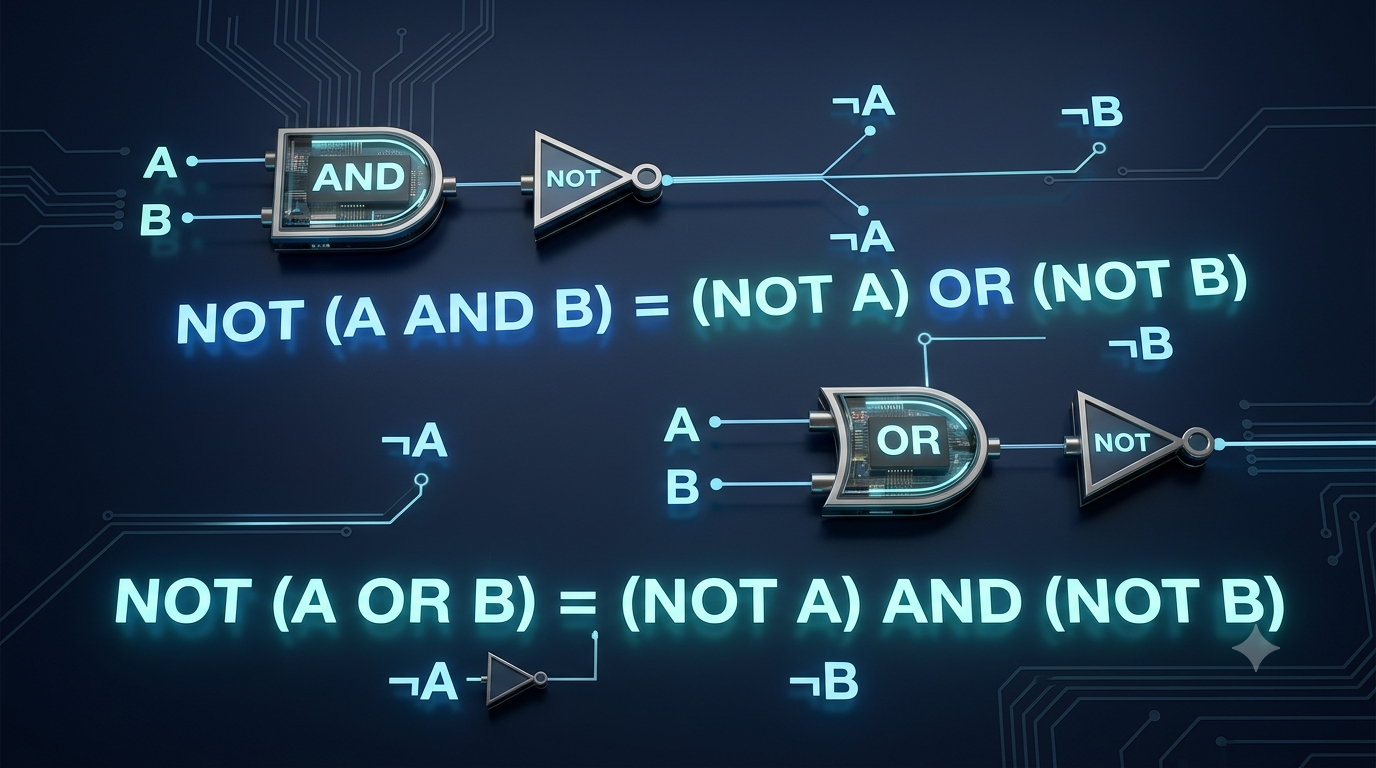
De Morgan’s laws are two fundamental rules of logic that describe how negation interacts with AND and OR operations. They allow us to move a NOT operation inside a logical expression by changing the operator connecting its conditions.
The two laws are:
First Law
NOT (A AND B) = (NOT A) OR (NOT B)
Second Law
NOT (A OR B) = (NOT A) AND (NOT B)
Here, A and B represent logical statements or conditions. Each statement can have a value of either true or false.
The first law tells us that the negation of an AND expression is equivalent to an OR expression containing the negations of its individual conditions. Similarly, the second law tells us that the negation of an OR expression is equivalent to an AND expression containing the negations of its individual conditions.
For example, consider the statement, “The computer is connected to the internet AND the server is available.” Negating the entire statement means that at least one of these conditions is false. Therefore, its negation becomes, “The computer is not connected to the internet OR the server is not available.”
This transformation is useful because it allows us to express the same logical meaning in a different form.
1. When Negating Complex Logical Expressions
One of the most important uses of De Morgan’s laws is negating a logical expression that contains multiple conditions.
Negation means reversing the truth value of a statement. If a statement is true, its negation is false. If a statement is false, its negation is true.
Consider the expression:
NOT (A AND B)
Without applying De Morgan’s law, the NOT operator applies to the entire expression. Using the first law, we can rewrite it as:
(NOT A) OR (NOT B)
This form makes it easier to understand why the original expression is false. An AND expression is false whenever at least one of its conditions is false.
Similarly, consider:
NOT (A OR B)
Applying the second law gives:
(NOT A) AND (NOT B)
This means that neither A nor B can be true.
For example, suppose a system requires both a valid username and a correct password. The condition for successful login is:
Valid username AND Correct password
The negation of successful login is:
NOT (Valid username AND Correct password)
Using De Morgan’s law, we obtain:
Invalid username OR Incorrect password
This expression clearly identifies two possible reasons for a failed login.
De Morgan’s laws are useful in such situations because they convert a negated combination of conditions into a form that directly identifies the individual reasons a statement may be false.
2. When Simplifying Boolean Expressions
Boolean algebra deals with variables that have only two possible values: 0 and 1, commonly interpreted as false and true.
In Boolean algebra, De Morgan’s laws are frequently used to simplify expressions and convert them into forms that are easier to work with.
The laws can be written as:
First Law
¬(A · B) = ¬A + ¬B
Second Law
¬(A + B) = ¬A · ¬B
In this notation, the dot represents AND, the plus sign represents OR, and the negation symbol represents NOT.
For example, consider:
¬(A · B)
Applying De Morgan’s first law gives:
¬A + ¬B
The original expression contains an AND operation inside a negation. The transformed expression contains an OR operation between the negated variables.
This transformation can be useful when simplifying Boolean equations for software, mathematical analysis, and electronic circuit design.
However, De Morgan’s laws do not necessarily reduce the number of variables or operators in every expression. Their main benefit is that they provide an equivalent form that may be easier to simplify or implement.
3. When Writing Conditions in Programming
De Morgan’s laws are particularly useful when writing conditional statements in programming languages such as Python, Java, C++, and JavaScript.
Programs often evaluate several conditions using logical operators. Sometimes, a programmer needs to reverse the meaning of an entire condition.
Consider the following Python expression:
if not (age >= 18 and has_id):
The condition checks whether the person does not satisfy both requirements for entry.
Using De Morgan’s law, the condition can be rewritten as:
if age < 18 or not has_id:
Both expressions have the same logical meaning, assuming the conditions use ordinary Boolean values and the comparisons are exact logical opposites.
The second version may be easier to read because it directly states the reasons entry is not allowed: the person is under 18, or they do not have identification.
Another example involves a system that allows access when a user is an administrator or has special permission.
The original access condition is:
is_admin or has_permissionIts negation is:
not (is_admin or has_permission)Applying De Morgan’s second law gives:
not is_admin and not has_permissionThis expression means that access is not permitted because the user is neither an administrator nor someone with special permission.
De Morgan’s laws help programmers write clearer conditions, reverse complicated tests, and reduce errors when changing the logic of a program.
4. When Checking Whether a Condition Is False
Sometimes, it is easier to identify when a condition fails than to describe when it succeeds. De Morgan’s laws make this approach possible.
Consider a student who passes an assessment only when both the theory test and practical test are passed.
The passing condition is:
Theory passed AND Practical passed
The negation is:
NOT (Theory passed AND Practical passed)
Using De Morgan’s first law:
Theory not passed OR Practical not passed
This means that a student fails the overall requirement if either test is not passed.
Now consider a different rule: a person receives a discount if they are a senior citizen or a registered member.
The eligibility condition is:
Senior citizen OR Registered member
Its negation is:
NOT (Senior citizen OR Registered member)
Using De Morgan’s second law:
Not a senior citizen AND Not a registered member
This means that the person is ineligible only when both conditions are false.
These examples show why De Morgan’s laws are useful when designing validation rules, eligibility tests, error conditions, and decision-making systems.
5. When Designing Digital Logic Circuits
Digital electronics relies heavily on Boolean algebra. Logic gates such as AND, OR, and NOT are used to build circuits that process binary information.
De Morgan’s laws help engineers transform logical expressions into circuit designs that use different combinations of gates.
For example, the expression:
NOT (A AND B)
describes the output of a NAND gate.
According to De Morgan’s first law, this expression is equivalent to:
(NOT A) OR (NOT B)
Therefore, a NAND gate can be represented logically by an arrangement involving NOT operations on the inputs followed by an OR operation.
Similarly:
NOT (A OR B)
is equivalent to:
(NOT A) AND (NOT B)
The original expression describes a NOR gate, while the equivalent expression uses inverted inputs connected through an AND operation.
These relationships are important because digital circuits can often be implemented using different combinations of gates. Depending on the available components and design requirements, an engineer may choose one implementation over another.
De Morgan’s laws are also useful in NAND-only and NOR-only circuit design. Since NAND and NOR gates are called universal gates, complete digital systems can be constructed using either type of gate.
By transforming logical expressions, engineers can develop alternative circuit arrangements and evaluate which one best suits their needs.
6. When Converting Between AND and OR Operations
Another important application of De Morgan’s laws is converting AND operations into OR operations, and vice versa, when a whole expression is negated.
The key principle is that negation changes both the individual conditions and the operator connecting them.
For example:
NOT (A AND B) = NOT A OR NOT B
The AND operator becomes OR, and both variables are negated.
Likewise:
NOT (A OR B) = NOT A AND NOT B
The OR operator becomes AND, and both variables are negated.
A common mistake is to change the operator without negating each condition.
For instance, writing:
NOT (A AND B) = NOT A AND NOT B
is incorrect.
The correct equivalent expression is:
NOT A OR NOT B
To understand why, suppose A is true and B is false. The original expression, A AND B, is false, so its negation is true. The correct transformed expression is also true because NOT B is true.
However, NOT A AND NOT B is false in this situation because NOT A is false.
De Morgan’s laws are therefore useful whenever a logical expression needs to be rewritten without changing its meaning.
7. When Working with Nested Logical Expressions
Logical expressions may contain several layers of parentheses and negation. De Morgan’s laws help transform these nested expressions step by step.
Consider:
NOT (A OR (B AND C))
The outer NOT operator applies to the complete expression. Applying De Morgan’s second law gives:
NOT A AND NOT (B AND C)
Now apply De Morgan’s first law to the remaining negated AND expression:
NOT A AND (NOT B OR NOT C)
The final equivalent expression is:
NOT A AND (NOT B OR NOT C)
This transformation shows that A must be false, and at least one of B or C must also be false.
Nested expressions appear in program conditions, database filters, digital circuits, and mathematical proofs. Applying De Morgan’s laws carefully can make such expressions easier to inspect and understand.
When transforming a complicated expression, it is best to handle one level of negation at a time. This reduces the chance of changing an operator incorrectly or forgetting to negate one of the conditions.
8. When Writing Database Queries and Filters
Database queries often use logical operators to select records that meet specific requirements. De Morgan’s laws can help when a query needs to select records that do not satisfy a combination of conditions.
Suppose a database contains products with two attributes: availability and category.
A query condition might select products that are available and belong to the electronics category.
The logical expression is:
Available AND Electronics
To select products that do not meet both requirements, we negate the complete expression:
NOT (Available AND Electronics)
Using De Morgan’s law, we get:
NOT Available OR NOT Electronics
This means that a product is selected if it is unavailable or does not belong to the electronics category.
A related example involves selecting customers who are neither premium members nor registered for a newsletter.
The condition is:
NOT (Premium member OR Newsletter subscriber)
Applying De Morgan’s second law gives:
NOT Premium member AND NOT Newsletter subscriber
This form directly describes the customers who meet the requirement.
In SQL, such transformations can help make filtering conditions more explicit. However, SQL uses three-valued logic, in which a condition can evaluate to TRUE, FALSE, or UNKNOWN when NULL values are involved. Therefore, equivalent-looking expressions may behave differently when NULL is present. Database developers should consider NULL handling when applying these laws to actual SQL queries.
9. When Proving Logical Equivalence
De Morgan’s laws are useful in mathematical logic when proving that two expressions have the same meaning.
Two logical expressions are equivalent when they produce the same truth value for every possible combination of their variables.
For example:
NOT (A OR B)
and
NOT A AND NOT B
are logically equivalent because both expressions are true only when A and B are both false.
This relationship can be demonstrated using a truth table.
| A | B | NOT (A OR B) | NOT A AND NOT B |
|---|---|---|---|
| True | True | False | False |
| True | False | False | False |
| False | True | False | False |
| False | False | True | True |
The final two columns contain identical truth values in every row. Therefore, the expressions are logically equivalent.
Truth tables are particularly useful for checking whether De Morgan’s laws have been applied correctly. They also help students understand the laws instead of memorizing them without understanding their meaning.
In formal logic, these transformations can simplify proofs by replacing a complicated negated expression with an equivalent expression that is easier to analyze.
10. When Working with Sets and Mathematical Statements
De Morgan’s laws are not limited to Boolean variables. They also apply to set operations and quantified mathematical statements.
In set theory, the complement of an intersection is equal to the union of the complements.
First Set Law
(A ∩ B)ᶜ = Aᶜ ∪ Bᶜ
Similarly, the complement of a union is equal to the intersection of the complements.
Second Set Law
(A ∪ B)ᶜ = Aᶜ ∩ Bᶜ
Here, A and B are sets, the intersection represents elements common to both sets, the union represents elements belonging to at least one set, and the superscript c represents the complement relative to a specified universal set.
For example, suppose A represents people who play cricket and B represents people who play football.
The complement of A ∩ B represents people who do not play both sports. This includes people who play neither sport as well as people who play only one of the two sports.
Using De Morgan’s law, this is equivalent to the union of the people who do not play cricket and the people who do not play football.
De Morgan’s laws also apply to quantified statements. For example:
NOT (For all x, P(x))
is equivalent to:
There exists an x such that NOT P(x).
In other words, denying that a statement is true for every element means that at least one element does not satisfy it.
Likewise, denying that there exists an element satisfying a condition means that no element satisfies that condition.
These transformations are useful in set theory, probability, mathematical reasoning, and formal proofs.
Common Mistakes to Avoid When Applying De Morgan’s Laws
Although De Morgan’s laws are simple, several mistakes can lead to incorrect expressions.
1. Changing the operator without negating the variables
When a NOT operator moves inside parentheses, every condition must be negated. Changing AND to OR alone is not sufficient.
2. Forgetting to change AND into OR, or OR into AND
Negating an AND expression changes the connecting operator to OR. Negating an OR expression changes the connecting operator to AND.
3. Applying the law to only part of an expression
If the NOT operator applies to a complete expression inside parentheses, the transformation must account for every condition within that expression.
4. Ignoring nested parentheses
In complex expressions, apply the laws one level at a time and check the resulting operators carefully.
5. Assuming that every programming language behaves identically
Ordinary Boolean logic follows the laws, but programming languages may have special considerations, such as NULL values, overloaded operators, or expressions with side effects. Logical equivalence should be checked in the context of the language being used.
Understanding these common mistakes makes it easier to use De Morgan’s laws accurately in both mathematical and practical applications.
Conclusion
De Morgan’s laws are useful whenever a logical expression needs to be negated, simplified, or converted into an equivalent form. They explain how NOT interacts with AND and OR, allowing us to rewrite complex conditions without changing their logical meaning.
These laws are widely applied in Boolean algebra, programming, digital circuit design, database filtering, mathematical proofs, and set theory. They are especially helpful when identifying why a condition is false, converting between logical operators, and understanding nested expressions.
The most important rule to remember is that when negation is distributed across a combined logical expression, each individual condition must be negated and the connecting operator must change. Practising these transformations with simple expressions and truth tables builds a strong foundation for working confidently with more complex logical expressions.
FAQs
1. What are De Morgan’s laws in logic?
De Morgan’s laws are two fundamental rules in logic that explain how negation works with AND and OR operations. The first law states that NOT (A AND B) is equivalent to (NOT A) OR (NOT B). The second law states that NOT (A OR B) is equivalent to (NOT A) AND (NOT B). These laws allow us to rewrite logical expressions without changing their meaning. They are widely used in Boolean algebra, programming, digital electronics, mathematics, and set theory to simplify conditions and understand the relationships between logical statements.
2. When are De Morgan’s laws most useful?
De Morgan’s laws are most useful when negating complex logical expressions, simplifying Boolean equations, and rewriting conditional statements. They help programmers express the opposite of a condition clearly and help engineers transform logic gate combinations. These laws are also valuable in mathematical proofs, database filtering, and set operations. For example, instead of writing NOT (A AND B), we can write (NOT A) OR (NOT B). This form clearly identifies when the original condition is false. Using these laws makes logical expressions easier to understand, verify, and implement in practical situations.
3. How do De Morgan’s laws simplify Boolean expressions?
De Morgan’s laws simplify Boolean expressions by transforming a negated combination of variables into an equivalent expression with negated variables and a different logical operator. For example, NOT (A AND B) becomes (NOT A) OR (NOT B). Similarly, NOT (A OR B) becomes (NOT A) AND (NOT B). These transformations can make an expression easier to analyze or implement in a digital circuit. Although they do not always reduce the number of operations, they provide alternative forms that may work better with other Boolean identities and simplification techniques.
4. How are De Morgan’s laws used in programming?
In programming, De Morgan’s laws help developers rewrite conditions involving logical AND, OR, and NOT operators. For example, not (age >= 18 and has_id) can be rewritten as age < 18 or not has_id in Python. Both expressions describe situations in which at least one entry requirement is not satisfied. These transformations are helpful when checking errors, validating user input, controlling access, and managing complicated conditional statements. They can improve readability and reduce logical mistakes. However, programmers should consider language-specific behavior, especially when conditions involve NULL values, overloaded operators, or expressions with side effects.
5. What is the difference between De Morgan’s first and second laws?
De Morgan’s first law explains how to negate an AND expression. NOT (A AND B) becomes (NOT A) OR (NOT B). The second law explains how to negate an OR expression. NOT (A OR B) becomes (NOT A) AND (NOT B). The main difference is the logical operator involved in the original expression and the operator used in its equivalent form. In both laws, every individual condition must also be negated. Remembering this pattern makes it easier to transform complex logical expressions accurately in mathematics, computer programming, and digital electronics.
6. How can truth tables verify De Morgan’s laws?
Truth tables verify De Morgan’s laws by comparing the truth values of the original and transformed expressions for every possible combination of inputs. For two Boolean variables, there are four combinations: both true, the first true and second false, the first false and second true, and both false. If the two expressions produce identical outputs in all four cases, they are logically equivalent. For example, NOT (A OR B) and (NOT A) AND (NOT B) are both true only when A and B are both false. This method provides a straightforward way to check logical transformations.
7. How are De Morgan’s laws used in digital electronics?
De Morgan’s laws help engineers transform Boolean expressions into alternative digital circuit designs. They explain the relationships between NAND, NOR, AND, OR, and NOT operations. For example, NOT (A AND B) represents a NAND operation and is equivalent to (NOT A) OR (NOT B). Likewise, NOT (A OR B) represents a NOR operation and is equivalent to (NOT A) AND (NOT B). These relationships are especially useful when designing circuits with NAND or NOR gates. Since both are universal gates, engineers can use them to construct many types of digital logic circuits.
8. Can De Morgan’s laws be applied to more than two variables?
Yes, De Morgan’s laws apply to logical expressions containing any number of variables. For example, NOT (A AND B AND C) is equivalent to (NOT A) OR (NOT B) OR (NOT C). Similarly, NOT (A OR B OR C) becomes (NOT A) AND (NOT B) AND (NOT C). The same principle applies regardless of how many conditions are present. Every variable must be negated, and each AND operation changes to OR or each OR operation changes to AND within the negated expression. This makes the laws useful for transforming complex Boolean expressions and nested logical conditions.
9. Are De Morgan’s laws used in set theory?
Yes, De Morgan’s laws are important in set theory. They describe the relationship between complements, intersections, and unions. The first set law states that the complement of an intersection equals the union of the complements: (A ∩ B)ᶜ = Aᶜ ∪ Bᶜ. The second states that the complement of a union equals the intersection of the complements: (A ∪ B)ᶜ = Aᶜ ∩ Bᶜ. These laws help determine which elements belong to a set or its complement. They are useful in mathematics, probability, statistics, and problems involving overlapping groups or collections.
10. What is the easiest way to remember De Morgan’s laws?
The easiest way to remember De Morgan’s laws is to follow two steps whenever a NOT operator applies to an expression inside parentheses. First, negate every individual condition. Second, change AND to OR or OR to AND. For example, NOT (A AND B) becomes (NOT A) OR (NOT B). Similarly, NOT (A OR B) becomes (NOT A) AND (NOT B). Practise these transformations using simple expressions and truth tables until the pattern becomes familiar. Always check that every condition has been negated and the connecting operator has changed before accepting the final expression.