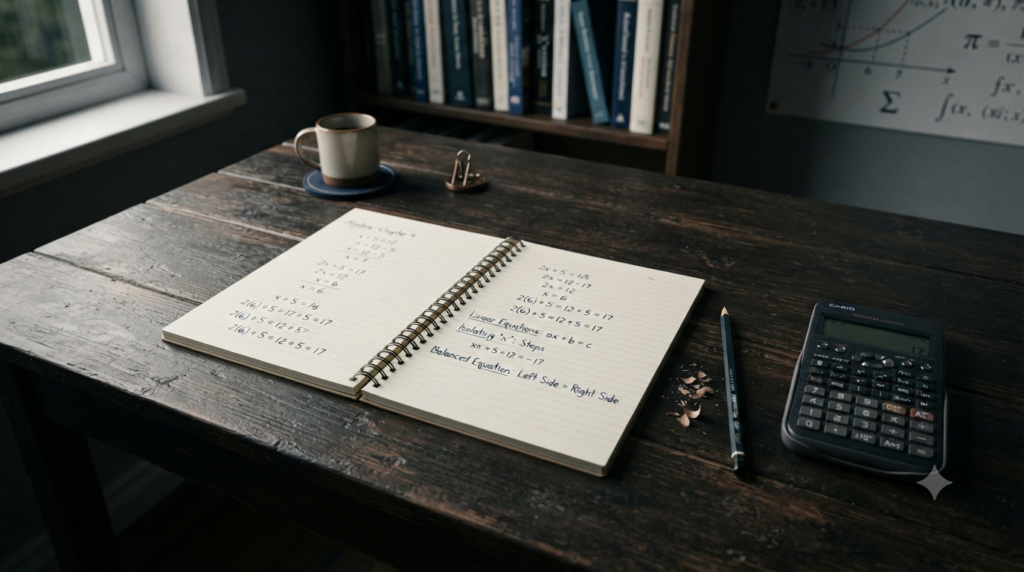
Mathematical formulas are compact ways of expressing relationships between numbers, quantities, shapes, and mathematical ideas. Instead of explaining a relationship through a long calculation every time, a formula provides a clear method that can be applied to different problems. Formulas are used in everyday calculations, school mathematics, science, engineering, economics, statistics, computer science, and many other fields.
Different mathematical formulas are designed for different purposes. Some help us calculate the area of a shape, while others describe motion, solve equations, find averages, calculate probabilities, or work with percentages. Understanding the different types of mathematical formulas makes mathematics easier to organize and apply because it helps us recognize which formula is appropriate for a particular problem.
This article explains the major types of mathematical formulas, their common examples, and the situations in which they are useful.
What Is a Mathematical Formula?
A mathematical formula is a rule or relationship written using numbers, symbols, and mathematical operations. It shows how one or more quantities are related and provides a systematic way to calculate an unknown value.
For example, the formula for the area of a rectangle is:
A = l × w
Here, A represents the area, l represents length, and w represents width. If the length and width are known, the formula can be used to find the area.
A formula can contain constants, variables, coefficients, and mathematical operations such as addition, subtraction, multiplication, division, powers, and roots.
Formulas are useful because they turn general mathematical relationships into practical calculation tools.
Why Are Mathematical Formulas Important?
Mathematical formulas help us solve problems efficiently and consistently. Rather than deriving the same relationship from the beginning every time, we can use an established formula.
They are important because they:
Simplify complex calculations
Provide a standard method for solving problems
Help identify relationships between quantities
Save time during calculations
Make mathematical ideas easier to communicate
Support calculations in science, engineering, economics, and technology
Help analyze real-world situations mathematically
For example, calculating the distance traveled by a moving object can involve measurements of speed and time. The relationship can be written simply as:
d = vt
where d is distance, v is speed, and t is time.
Types of Mathematical Formulas
Mathematical formulas can be grouped according to the type of problem they solve. Some formulas belong to basic arithmetic, while others are associated with algebra, geometry, trigonometry, calculus, probability, and statistics.
1. Arithmetic Formulas
Arithmetic formulas are among the simplest mathematical formulas. They are used for calculations involving numbers and basic operations.
Common arithmetic relationships include:
a + b = sum
a − b = difference
a × b = product
a ÷ b = quotient
Arithmetic formulas are used when working with quantities in everyday situations. Shopping, budgeting, counting objects, comparing prices, and calculating totals all involve arithmetic.
For example, if one book costs ₹250 and another costs ₹150, the total cost can be calculated as:
250 + 150 = ₹400
Arithmetic also provides the foundation for more advanced areas of mathematics.
2. Percentage Formulas
Percentage formulas are used to express a quantity as a fraction of 100. They are particularly useful for comparing quantities, calculating discounts, taxes, profits, losses, increases, and decreases.
The basic percentage formula is:
Percentage = (Part ÷ Whole) × 100
For example, if a person scores 45 marks out of 60:
Percentage = (45 ÷ 60) × 100 = 75%
Percentage formulas are widely used in finance, education, business, statistics, and everyday decision-making.
Other useful relationships include:
Percentage Increase = [(New Value − Original Value) ÷ Original Value] × 100
Percentage Decrease = [(Original Value − New Value) ÷ Original Value] × 100
3. Ratio and Proportion Formulas
Ratio formulas are used to compare two or more quantities. A ratio tells us how much of one quantity exists in relation to another.
A ratio can be written as:
a : b
For example, a ratio of 2:3 means that for every 2 units of one quantity, there are 3 units of another.
Proportion describes an equality between two ratios:
a/b = c/d
Cross multiplication can then be used:
ad = bc
Ratios and proportions are useful in maps, scale drawings, recipes, mixtures, construction, finance, and scientific calculations.
4. Algebraic Formulas
Algebraic formulas use variables to represent unknown or changing quantities. They are important because they allow mathematical relationships to be expressed generally.
For example:
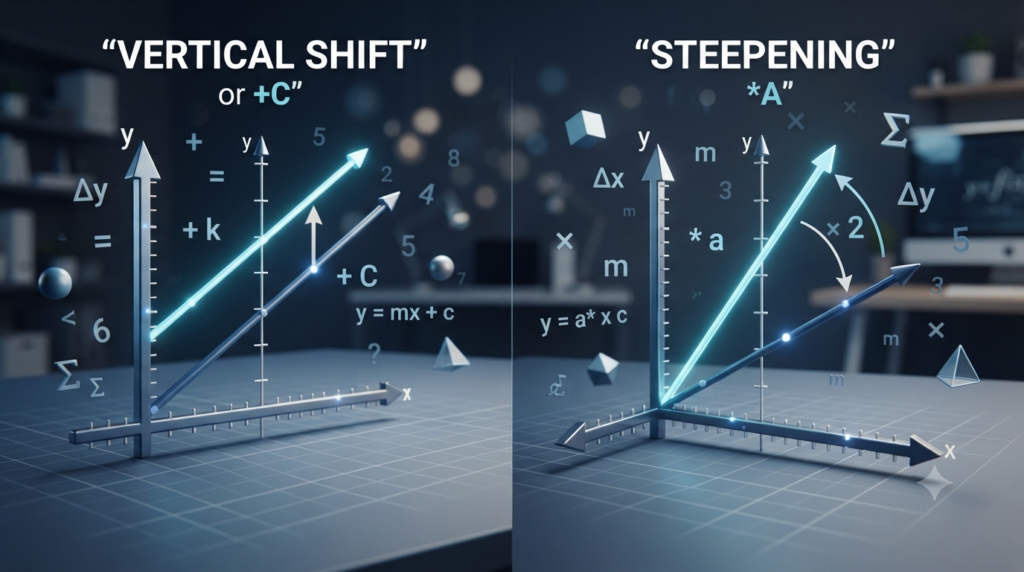
y = mx + c
is the equation of a straight line, where m represents the slope and c represents the y-intercept.
Another common algebraic formula is the quadratic formula:
x = [-b ± √(b² − 4ac)] ÷ 2a
It is used to solve quadratic equations of the form:
ax² + bx + c = 0
Algebraic formulas are used extensively in mathematics, physics, economics, engineering, and computer science.
5. Algebraic Identity Formulas
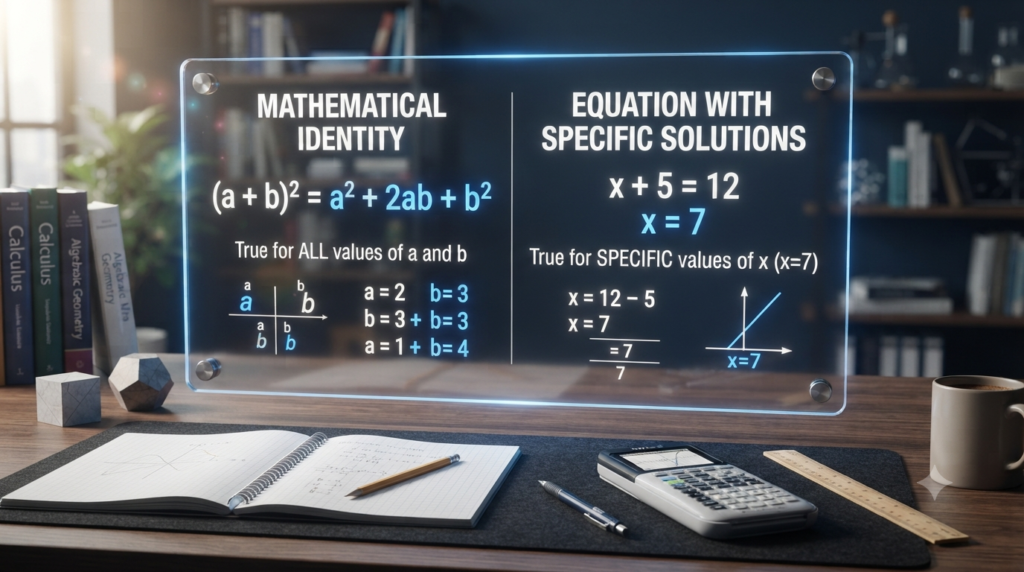
Algebraic identities are formulas that remain true for all permitted values of their variables. They are useful for simplifying expressions and performing calculations more efficiently.
Some common identities are:
(a + b)² = a² + 2ab + b²
(a − b)² = a² − 2ab + b²
(a + b)(a − b) = a² − b²
These identities are frequently used in algebraic manipulation, factorization, and equation solving.
6. Geometry Formulas
Geometry formulas are used to calculate measurements of shapes and figures. They can help determine length, perimeter, area, surface area, and volume.
For a rectangle:
Area = l × w
Perimeter = 2(l + w)
For a triangle:
Area = ½ × b × h
For a circle:
Area = πr²
Circumference = 2πr
Here, r is the radius and π is approximately 3.14159.
Geometry formulas are useful in architecture, construction, design, land measurement, engineering, manufacturing, and many everyday tasks.
7. Mensuration Formulas
Mensuration focuses on the measurement of geometric shapes and solids. Its formulas are especially useful for calculating areas, surface areas, and volumes.
For a cuboid:
Volume = l × w × h
For a cube:
Volume = a³
Surface Area = 6a²
For a cylinder:
Volume = πr²h
For a sphere:
Volume = 4/3 πr³
These formulas help calculate the amount of material, space, or surface involved in physical objects.
8. Trigonometric Formulas
Trigonometric formulas describe relationships between angles and sides of triangles. The basic trigonometric ratios are:
sin θ = Perpendicular ÷ Hypotenuse
cos θ = Base ÷ Hypotenuse
tan θ = Perpendicular ÷ Base
One of the fundamental identities is:
sin²θ + cos²θ = 1
Trigonometric formulas are useful for studying triangles, angles, heights, distances, waves, rotations, and periodic phenomena.
They are widely used in physics, engineering, astronomy, navigation, architecture, and computer graphics.
9. Coordinate Geometry Formulas
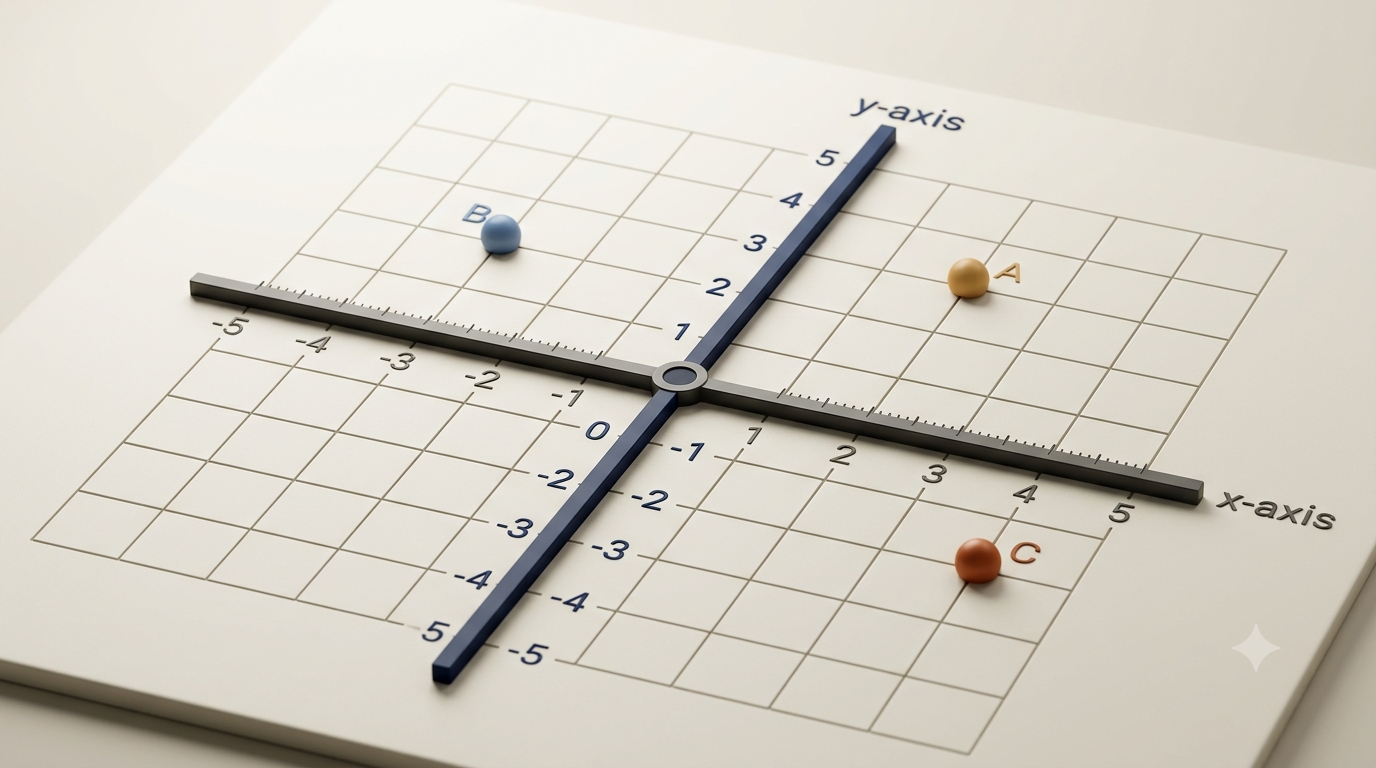
Coordinate geometry combines algebra with geometry by representing points and shapes on a coordinate plane.
The distance between two points can be calculated using:
d = √[(x₂ − x₁)² + (y₂ − y₁)²]
The midpoint of two points is:
M = ((x₁ + x₂)/2, (y₁ + y₂)/2)
The slope of a line is:
m = (y₂ − y₁)/(x₂ − x₁)
These formulas are useful for studying lines, distances, positions, graphs, and geometric relationships.
10. Sequence and Series Formulas
Sequences are ordered lists of numbers that follow a particular pattern. Series involve the addition of terms in a sequence.
For an arithmetic sequence, the nth term is:
aₙ = a + (n − 1)d
where a is the first term and d is the common difference.
The sum of the first n terms is:
Sₙ = n/2 [2a + (n − 1)d]
For a geometric sequence:
aₙ = arⁿ⁻¹
Sequences and series are useful in mathematics, finance, population models, computer science, and scientific analysis.
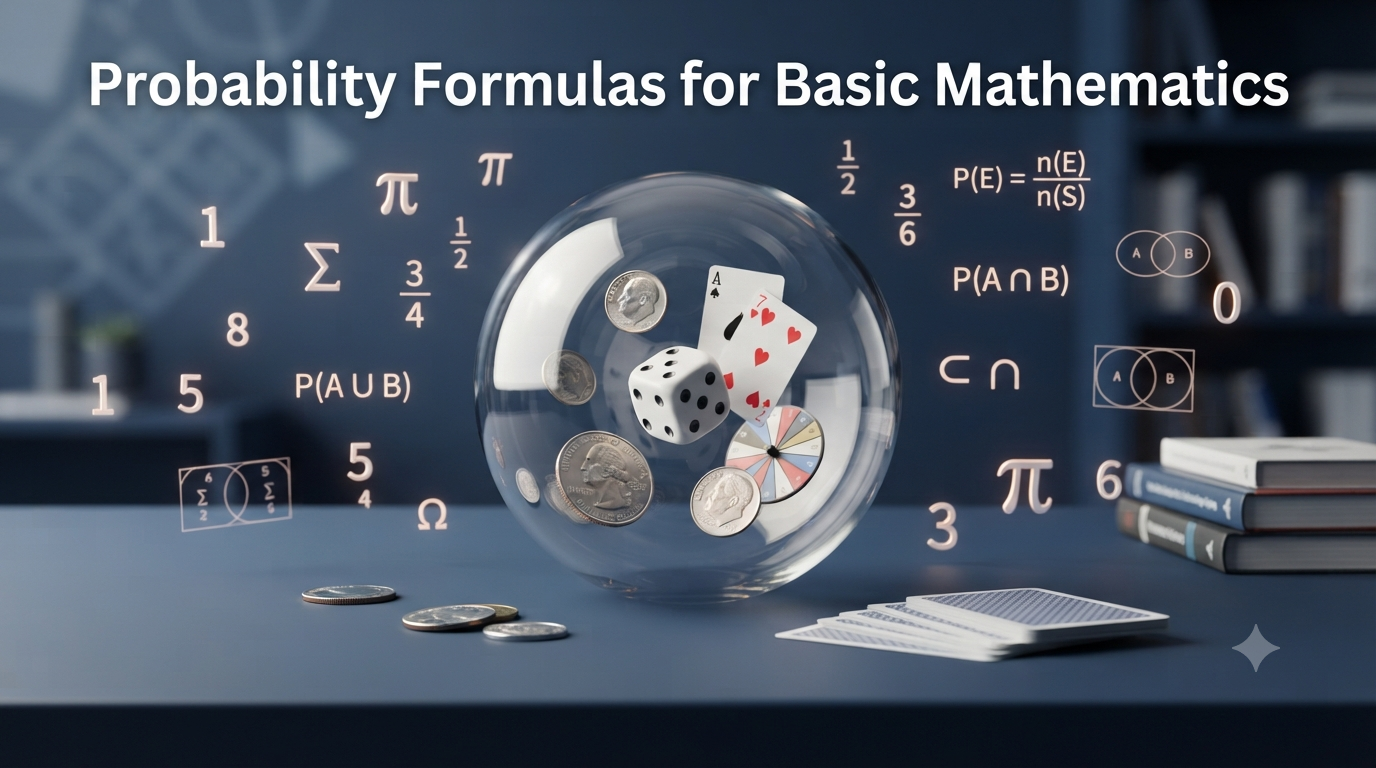
11. Probability Formulas
Probability formulas are used to measure the likelihood of events.
The basic probability formula is:
P(E) = Number of favorable outcomes ÷ Total number of possible outcomes
The value of probability ranges from 0 to 1, where 0 represents an impossible event and 1 represents a certain event.
For example, when a fair six-sided die is rolled, the probability of getting a 4 is:
P(4) = 1/6
Probability formulas are used in statistics, risk analysis, finance, science, games, insurance, and decision-making.
12. Statistics Formulas
Statistical formulas are used to collect, summarize, analyze, and interpret numerical data.
The arithmetic mean is:
Mean = Sum of observations ÷ Number of observations
For example, for the numbers 5, 10, and 15:
Mean = (5 + 10 + 15) ÷ 3 = 10
Other statistical formulas are used to calculate median, variance, standard deviation, correlation, and other measures.
Statistics formulas are important in scientific research, business, economics, medicine, education, and data analysis.
13. Financial Mathematics Formulas
Financial mathematics uses formulas to understand money, interest, investments, loans, and growth.
Simple interest can be calculated using:
SI = PRT/100
where P is the principal, R is the rate of interest, and T is the time.
The total amount is:
A = P + SI
Compound interest involves repeated growth of the principal and interest.
A commonly used compound amount formula is:
A = P(1 + r/n)ⁿᵗ
where r is the annual interest rate expressed as a decimal and n is the number of compounding periods per year.
These formulas are useful for banking, loans, savings, investments, and financial planning.
14. Calculus Formulas
Calculus formulas are used to study change, motion, accumulation, and relationships between changing quantities.
A basic differentiation relationship is:
d/dx (xⁿ) = nxⁿ⁻¹
Integration is closely related to finding accumulated quantities. A basic integration formula is:
∫xⁿ dx = xⁿ⁺¹/(n + 1) + C
where C is the constant of integration.
Calculus is widely used in physics, engineering, economics, computer science, biology, and mathematical modeling.
15. Exponential and Logarithmic Formulas
Exponential formulas describe quantities that grow or decrease according to powers.
A basic exponential relationship is:
y = abˣ
Logarithms provide the inverse operation of exponentiation.
For example:
logₐ(xy) = logₐx + logₐy
Exponential and logarithmic formulas are used in population growth, radioactive decay, finance, information theory, chemistry, sound measurement, and many scientific models.
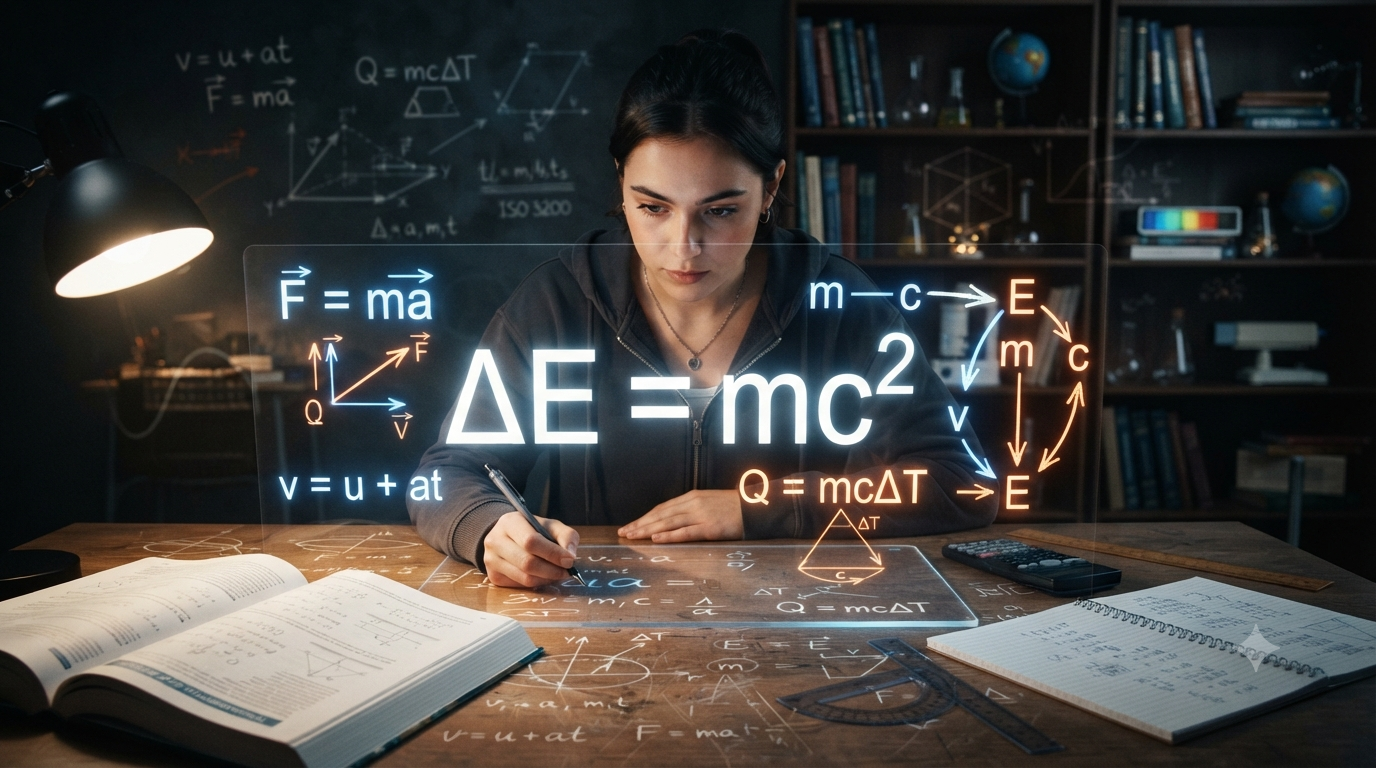
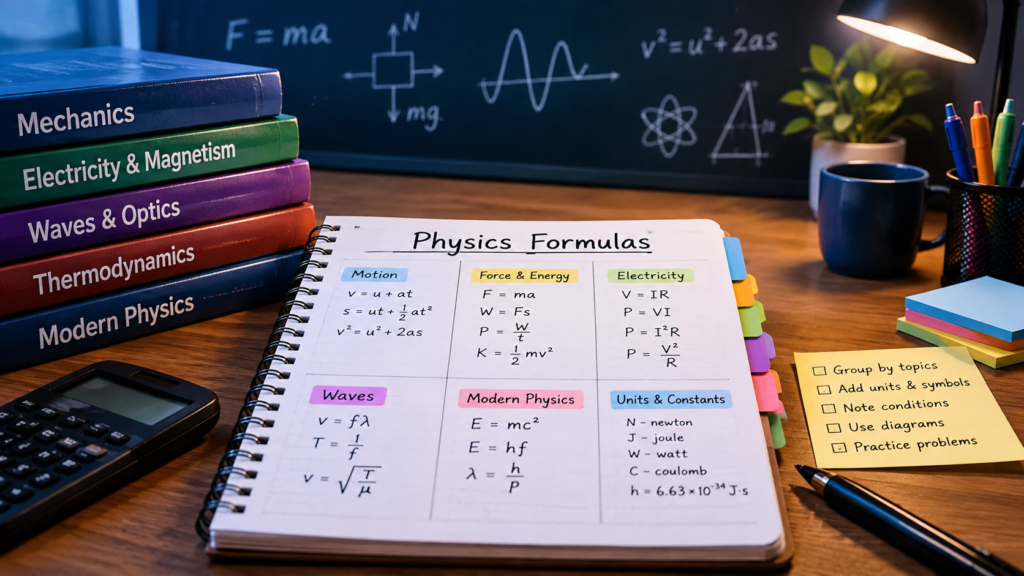
16. Mathematical Formulas Used in Physics
Many physical laws are expressed through mathematical formulas. These formulas connect measurable physical quantities.
For example, Newton’s second law is commonly written as:
F = ma
where F is force, m is mass, and a is acceleration.
The relationship between speed, distance, and time can be written as:
v = d/t
The kinetic energy of an object is:
KE = ½mv²
These formulas allow physical observations to be described quantitatively and used to solve practical problems.
How to Choose the Right Mathematical Formula
Knowing formulas is useful, but understanding when to use them is equally important. The first step is to identify what the problem is asking.
Read the problem carefully and determine:
What quantities are given?
What quantity needs to be found?
What mathematical relationship connects them?
Which formula contains the known and unknown quantities?
Are all quantities expressed in compatible units?
Does the final answer make sense?
For example, if a problem asks for the area of a circle and gives its radius, the appropriate formula is:
A = πr²
If a problem asks for the distance traveled when speed and time are known, a relationship such as:
d = vt
may be appropriate.
Choosing the formula based on the information provided is more useful than simply memorizing a large collection of formulas.
How to Use Mathematical Formulas Correctly
A reliable formula-solving process can be followed for most problems.
Step 1: Identify the Given Values
Write down the quantities provided in the problem.
Step 2: Identify the Unknown
Determine exactly what needs to be calculated.
Step 3: Select the Formula
Choose the formula that connects the known quantities with the unknown.
Step 4: Substitute the Values
Replace the variables in the formula with the appropriate numerical values.
Step 5: Perform the Calculation
Follow the correct order of mathematical operations.
Step 6: Check the Units
Make sure the final answer has the appropriate unit when the calculation involves a physical quantity.
Step 7: Check the Result
Consider whether the answer is reasonable and whether there may have been a calculation or substitution error.
Formula Memorization vs Understanding
Memorizing formulas can be useful, especially when many calculations need to be completed quickly. However, understanding what a formula represents makes it easier to use correctly.
For example, knowing that:
Area of rectangle = l × w
is more useful when you understand that area measures the amount of two-dimensional space covered by the rectangle.
Understanding the meaning of variables, units, and relationships can also help you remember formulas naturally and recognize when a formula should or should not be used.
Applications of Mathematical Formulas in Real Life
Mathematical formulas are not limited to classrooms or textbooks. They are part of many activities and technologies used every day.
Engineers use formulas to design structures and machines. Scientists use them to describe natural phenomena. Businesses use mathematical relationships to analyze costs, profits, and trends. Architects use geometry to design buildings. Computer scientists use mathematical formulas in algorithms, graphics, data analysis, and artificial intelligence.
Even ordinary activities such as calculating discounts, estimating travel time, measuring an area, comparing prices, or planning a budget can involve mathematical formulas.
Conclusion
Mathematical formulas provide a structured way to describe relationships between quantities and solve problems efficiently. From basic arithmetic and percentages to algebra, geometry, trigonometry, probability, statistics, calculus, and financial mathematics, each type of formula serves a particular purpose.
The most important skill is not simply memorizing formulas but understanding what they represent, what each variable means, and when the formula should be used. Once these ideas become familiar, formulas become practical tools rather than isolated expressions to remember.
By learning mathematical formulas according to their purpose and application, learners can build a stronger mathematical foundation and approach a wide range of numerical and real-world problems with greater clarity.