
How Are Derived Units Built From Fundamental Units?

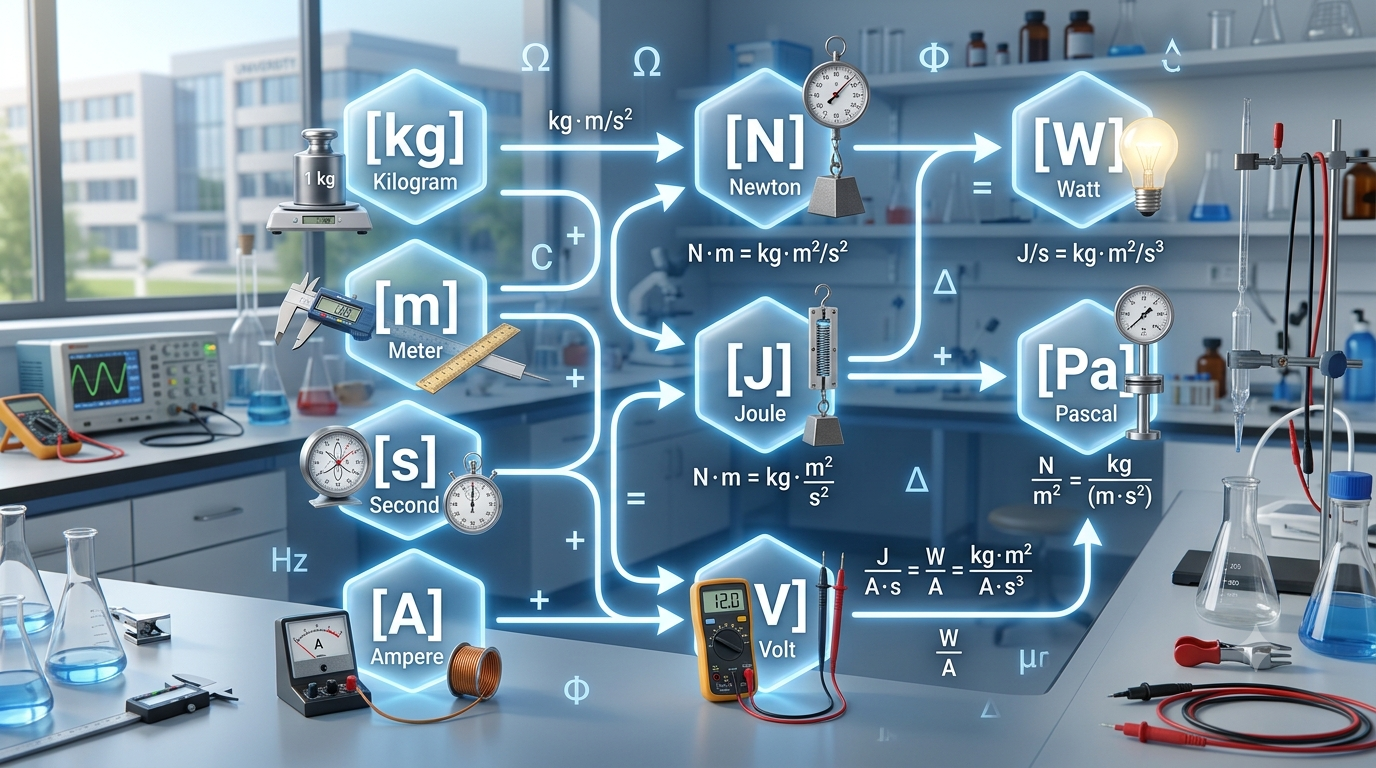
In a bright science lab, an educational physics illustration shows how the base SI units, such as the kilogram, meter, second, and ampere, are connected by blue mathematical arrows and formulas to form derived units, such as the newton, joule, watt, pascal, and volt.

Physics uses units to make measurements meaningful. Saying that a car travels at a speed of 20 does not tell us much unless we know whether the speed is 20 metres per second, 20 kilometres per hour, or something else. Units provide the language that connects numbers with physical quantities.

In the International System of Units, or SI system, measurements are organized around a small set of fundamental units. Other units are created by combining these fundamental units according to mathematical relationships between physical quantities. These are called derived units.

But how exactly are derived units built? Why does force have the unit newton, and why can a newton also be written as kg·m/s²? Understanding this process makes many physics formulas easier to interpret.

What Are Fundamental Units?

Fundamental units are the basic units used to measure seven fundamental physical quantities in the SI system. They are treated as independent starting points from which many other units can be constructed.

The seven SI base quantities and their units are:

Fundamental QuantitySI UnitSymbol
Lengthmetrem
Masskilogramkg
Timeseconds
Electric currentampereA
Thermodynamic temperaturekelvinK
Amount of substancemolemol
Luminous intensitycandelacd

These units form the foundation of the SI system. They are not normally expressed in terms of other SI units.

For example, length is measured in metres, mass in kilograms, and time in seconds. When these quantities are combined mathematically, they produce units for other physical quantities.

What Are Derived Units?

A derived unit is a unit formed by combining fundamental units through multiplication, division, or powers.

Many physical quantities are not independent. Their definitions and equations connect them to fundamental quantities.

For example, speed is defined as distance divided by time:

Speed = Distance / Time

Distance has the unit metre and time has the unit second. Therefore:

Unit of speed = metre / second

So the SI unit of speed is:

m/s

The unit metre per second is a derived unit because it is constructed from the fundamental units metre and second.

This same idea applies to acceleration, force, pressure, energy, power, density, and many other physical quantities.

Derived Units Come From Physical Relationships

The easiest way to understand derived units is to start with a physical equation.

Consider acceleration:

Acceleration = Change in velocity / Time

Velocity has the unit m/s, while time has the unit s.

Therefore:

Unit of acceleration = (m/s) / s

This becomes:

m/s²

Thus, the SI unit of acceleration is metre per second squared.

Notice that no new fundamental unit was needed. The unit was simply constructed from metre and second.

Building the Unit of Force

Force provides one of the most useful examples.

Newton’s second law gives:

Force = Mass × Acceleration

Mass is measured in kilograms:

Mass = kg

Acceleration is measured in:

m/s²

Therefore:

Unit of force = kg × m/s²

So:

Unit of force = kg·m/s²

This derived unit has a special name: newton, represented by N.

Therefore:

1 N = 1 kg·m/s²

The newton is not a fundamental unit. It is a derived SI unit with a special name.

This relationship also shows what a newton physically represents. A force of one newton gives a one-kilogram mass an acceleration of one metre per second squared.

Building the Unit of Pressure

Pressure is another good example.

Pressure is defined as force acting per unit area:

Pressure = Force / Area

The unit of force is:

kg·m/s²

Area is length multiplied by length:

m × m = m²

Therefore:

Unit of pressure = (kg·m/s²) / m²

Simplifying:

kg/(m·s²)

The SI unit of pressure has the special name pascal, written as Pa.

Therefore:

1 Pa = 1 N/m²

Since one newton is equal to kg·m/s²:

1 Pa = 1 kg/(m·s²)

This demonstrates how a named derived unit can ultimately be expressed using fundamental units.

Building the Unit of Energy

Energy can also be expressed using fundamental units.

Mechanical work is calculated as:

Work = Force × Distance

Energy has the same SI unit as work.

Force has the unit:

kg·m/s²

Distance has the unit:

m

Therefore:

Unit of energy = kg·m/s² × m

So:

kg·m²/s²

The SI derived unit of energy is called the joule, symbol J.

Therefore:

1 J = 1 kg·m²/s²

The joule is another example of a derived unit with a special name.

Building the Unit of Power

Power describes how quickly energy is transferred or work is done.

It is defined as:

Power = Energy / Time

Energy has the unit:

kg·m²/s²

Dividing by time, measured in seconds:

Unit of power = kg·m²/s³

The special SI unit for power is the watt, represented by W.

Therefore:

1 W = 1 kg·m²/s³

This means that a power of one watt corresponds to the transfer or use of one joule of energy per second.

Derived Units in Electricity

Derived units are also extremely important in electricity.

For example, electric charge is related to current and time:

Charge = Current × Time

Current is measured in amperes and time in seconds.

Therefore:

Unit of charge = A·s

This derived unit is called the coulomb, symbol C.

So:

1 C = 1 A·s

Similarly, voltage can be related to energy and charge:

Voltage = Energy / Charge

Using the fundamental-unit forms:

Energy = kg·m²/s²

and

Charge = A·s

Therefore:

Unit of voltage = kg·m²/(s³·A)

The special SI unit is the volt, symbol V.

This shows that even complicated electrical units can ultimately be traced back to the fundamental SI units.

Why Do Some Derived Units Have Special Names?

Some derived units are given special names because they appear frequently in science and engineering.

For example:

  • kg·m/s² = newton

  • kg·m²/s² = joule

  • kg/(m·s²) = pascal

  • kg·m²/s³ = watt

  • A·s = coulomb

  • J/C = volt

Using special names makes equations shorter and easier to read.

Instead of writing:

500 kg·m²/s²

we can write:

500 J

However, the underlying relationship has not changed. The joule is still fundamentally equivalent to kg·m²/s².

Derived Units Can Be Expanded

A useful feature of the SI system is that derived units can be expanded back into base units.

For example:

1 J = 1 N·m

Since:

1 N = 1 kg·m/s²

we get:

1 J = 1 kg·m²/s²

Similarly:

1 Pa = 1 N/m²

which becomes:

1 Pa = 1 kg/(m·s²)

This ability to expand units is extremely useful when checking equations.

How Unit Analysis Helps Check Formulas

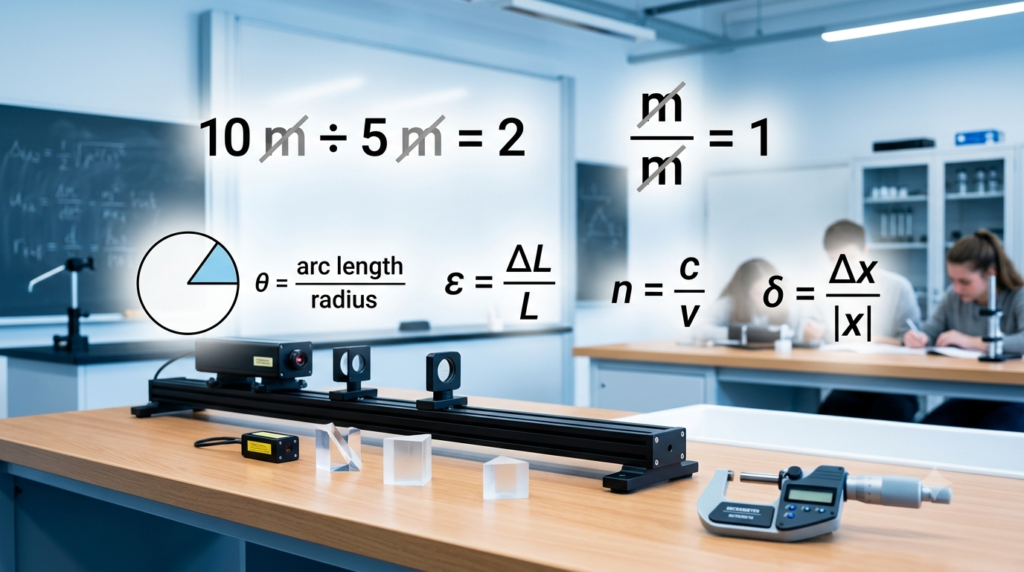
Derived units are not only useful for measurements. They also help physicists and students check whether equations are dimensionally consistent.

Suppose an equation claims that:

Distance = Speed × Time

The unit on the right side is:

(m/s) × s = m

The result is metres, which matches the unit of distance.

Therefore, the equation is dimensionally consistent.

If the units on the two sides did not match, the equation would contain a problem.

This method is called dimensional analysis.

Why Understanding Derived Units Matters

Learning how derived units are constructed gives a deeper understanding of physics. Instead of memorizing a long list of units separately, you can see how they are connected.

For example, remembering that:

Force = Mass × Acceleration

automatically gives:

N = kg·m/s²

Likewise:

Energy = Force × Distance

gives:

J = kg·m²/s²

The equations themselves help you reconstruct the units whenever you need them.

A Simple Way to Build Any Derived Unit

Whenever you encounter a new physical quantity, follow these steps:

Step 1: Find its definition or equation.

Step 2: Write the SI unit of every quantity in the equation.

Step 3: Substitute those units into the equation.

Step 4: Simplify the units mathematically.

Step 5: Check whether the resulting unit has a special SI name.

For example, if you want the unit of density:

Density = Mass / Volume

Mass has unit kg, while volume has unit m³.

Therefore:

Density = kg/m³

So the SI unit of density is kilogram per cubic metre.

Conclusion

Derived units are built by combining the fundamental SI units according to physical equations. They allow complex physical quantities such as force, energy, pressure, power, and voltage to be expressed using a common measurement system.

The key idea is simple: fundamental units provide the building blocks, while derived units are combinations of those building blocks.

Once you understand this relationship, many SI units become much easier to remember. More importantly, you gain a powerful tool for understanding physics equations and checking whether they make physical sense. Units are therefore not just labels attached to numbers. They reveal how different physical quantities are mathematically connected.

FAQs

What are derived units in physics?

Derived units are measurement units formed by combining two or more fundamental SI units according to mathematical relationships. They are used for physical quantities such as speed, acceleration, force, pressure, energy, and power. For example, speed is distance divided by time, so its unit is metre per second (m/s). Force is mass multiplied by acceleration, giving kg·m/s², which is called a newton (N). Derived units help organize measurements into a consistent system. Instead of treating every physical quantity as having an unrelated unit, the SI system shows how different quantities are connected through fundamental units and physical equations.

How are derived units formed from fundamental units?

Derived units are formed by using equations that define physical quantities. First, identify the equation for the quantity being measured. Then replace each physical quantity in the equation with its SI unit and simplify the resulting expression. For example, force is defined as mass × acceleration. Mass has the unit kilogram (kg), while acceleration has the unit metre per second squared (m/s²). Therefore, force has the unit kg·m/s². This unit is given the special name newton (N). The same process can be used to derive units for pressure, energy, power, density, electric charge, voltage, and many other quantities.

What is the difference between fundamental and derived units?

Fundamental units are the basic SI units used to measure seven fundamental physical quantities. These include metre for length, kilogram for mass, and second for time. Derived units, in contrast, are produced by combining fundamental units through mathematical operations such as multiplication, division, or powers. For example, metre and second are fundamental units, while metre per second (m/s) is a derived unit for speed. Similarly, newton is a derived unit for force because it can be expressed as kg·m/s². Fundamental units provide the basic building blocks, while derived units describe quantities created from relationships between those fundamental quantities.

Is the newton a fundamental or derived unit?

The newton is a derived SI unit used to measure force. It is not a fundamental unit because force is defined in terms of mass and acceleration. According to Newton’s second law, force equals mass multiplied by acceleration. Mass has the unit kilogram (kg), and acceleration has the unit metre per second squared (m/s²). Therefore, the unit of force is kg·m/s². This combination is given the special name newton, represented by N. Thus, one newton is equivalent to one kilogram metre per second squared. The newton demonstrates how a named derived unit can be traced directly back to fundamental SI units.

How is the unit of energy derived?

The SI unit of energy is the joule (J), which is a derived unit. Mechanical work, which is a form of energy transfer, can be calculated by multiplying force by distance. Force has the unit kg·m/s², while distance has the unit metre. Multiplying these units gives kg·m²/s². This combination is called a joule. Therefore, one joule is equal to one kilogram metre squared per second squared. Energy can also be expressed using other derived units, such as newtons and metres, because one joule is equal to one newton metre. This illustrates the connections between different physical quantities.

Why are some derived units given special names?

Some derived units are given special names because they are used frequently in science, engineering, and everyday measurements. Writing a complicated combination of fundamental units every time can make equations difficult to read. For example, force can be written as kg·m/s², but the shorter name newton (N) is much easier to use. Similarly, kg·m²/s² is called a joule (J), and kg·m²/s³ is called a watt (W). Special names improve communication while preserving the underlying relationship between units. Even when a special name is used, the derived unit can still be expanded back into its fundamental SI units.

Pressure is defined as force divided by area. Force has the SI unit newton, which can be expanded as kg·m/s². Area is measured in square metres, or m². Therefore, pressure has the unit (kg·m/s²)/m². Simplifying this expression gives kg/(m·s²). The special SI name for this derived unit is the pascal (Pa). Therefore, one pascal is equal to one newton per square metre and can also be expressed as one kilogram per metre per second squared. This relationship demonstrates how pressure ultimately depends on fundamental quantities such as mass, length, and time.

Can derived units be used to check physics equations?

Yes. Derived units are extremely useful for checking whether physics equations are dimensionally consistent. This process is called dimensional analysis. For example, consider the equation distance = speed × time. Speed has the unit m/s and time has the unit s. Multiplying them gives (m/s) × s = m, which matches the unit of distance. If the units on both sides of an equation do not match, the equation cannot be dimensionally correct. Dimensional analysis cannot prove that an equation is completely correct, but it can quickly identify many incorrect formulas and missing or inappropriate quantities.

What are some common examples of derived SI units?

Many familiar units are derived SI units. Speed has the unit metre per second (m/s), while acceleration has the unit metre per second squared (m/s²). Force is measured in newtons (N), pressure in pascals (Pa), energy in joules (J), and power in watts (W). Electric charge is measured in coulombs (C), while voltage is measured in volts (V). These units are constructed from fundamental SI units. For example, a joule equals kg·m²/s², a watt equals kg·m²/s³, and a coulomb equals A·s. Understanding these relationships makes it easier to interpret and reconstruct SI units.

Why is it important to understand derived units?

Understanding derived units helps you see how different physical quantities are connected rather than simply memorizing separate units. Once you know the equation for a quantity, you can often work out its unit yourself. For example, knowing that power equals energy divided by time allows you to derive the watt from the joule and second. Derived units are also useful in dimensional analysis, scientific calculations, laboratory measurements, and engineering. They provide a consistent way to describe complex physical quantities using a small set of fundamental units. Learning this concept therefore makes many physics formulas and measurements easier to understand.

Related Posts

Leave a Comment

Your email address will not be published. Required fields are marked *

Scroll to Top