
Valency is one of the basic ideas in chemistry that helps us understand how atoms combine with one another. When elements form compounds, their atoms interact by losing, gaining, or sharing electrons. The combining capacity of an atom is commonly described by its valency. Knowing the common valencies of important elements makes it much easier to understand chemical formulas, write compounds correctly, and study chemical reactions.
Different elements have different valencies. Some elements usually show one common valency, while others can show two or more valencies depending on the compound they form. For example, sodium commonly has a valency of 1, while magnesium has a valency of 2. Iron can commonly show valencies of 2 and 3, which is why compounds such as FeCl₂ and FeCl₃ exist.
Learning the common valencies of important elements provides a useful foundation for studying inorganic chemistry. It also helps when naming compounds, balancing chemical equations, understanding ions, and predicting how elements may combine.
What Is Valency?
Valency is the combining capacity of an atom with other atoms. It is related to the number of electrons an atom loses, gains, or shares while forming a chemical bond.
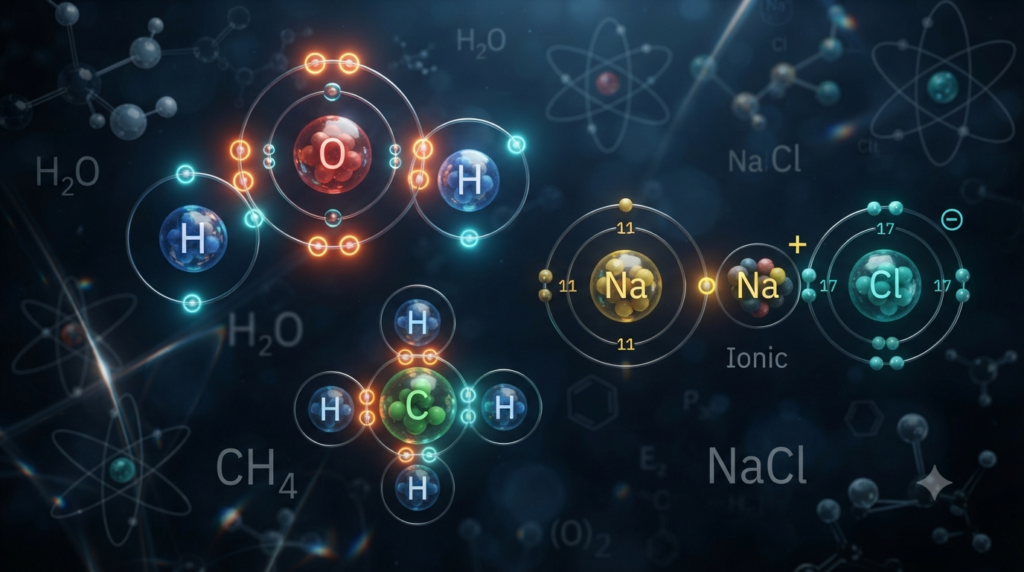
For example, sodium has one electron in its outermost shell. It can lose this electron to form a sodium ion, Na⁺. Therefore, the common valency of sodium is 1.
Magnesium has two electrons in its outermost shell and commonly loses both to form Mg²⁺. Its common valency is therefore 2.
Chlorine has seven valence electrons. It commonly gains one electron to complete its outer shell and forms Cl⁻. Thus, chlorine has a common valency of 1.
Valency is often written as a positive number without the charge sign. Therefore, the valency of Na⁺ is 1, Mg²⁺ is 2, and Cl⁻ is 1.
Why Are Common Valencies Important?
Knowing valencies is useful because chemical formulas depend on the combining capacities of the elements involved.
Suppose we want to form a compound between magnesium and chlorine. Magnesium has valency 2, while chlorine has valency 1. One magnesium atom combines with two chlorine atoms, giving the formula MgCl₂.
Similarly, aluminium has valency 3 and oxygen has valency 2. Their valencies are balanced by using two aluminium atoms and three oxygen atoms, producing Al₂O₃.
Common valencies are especially useful for:
Writing chemical formulas
Understanding ionic compounds
Naming chemical compounds
Predicting combinations of elements
Studying chemical reactions
Understanding ions
Learning oxidation states
Solving basic chemistry problems
Common Valencies of Important Elements
The following table contains many commonly encountered elements and their usual valencies.
| Element | Symbol | Common Valency |
|---|---|---|
| Hydrogen | H | 1 |
| Helium | He | 0 |
| Lithium | Li | 1 |
| Beryllium | Be | 2 |
| Boron | B | 3 |
| Carbon | C | 4 |
| Nitrogen | N | 3, 5 |
| Oxygen | O | 2 |
| Fluorine | F | 1 |
| Neon | Ne | 0 |
| Sodium | Na | 1 |
| Magnesium | Mg | 2 |
| Aluminium | Al | 3 |
| Silicon | Si | 4 |
| Phosphorus | P | 3, 5 |
| Sulfur | S | 2, 4, 6 |
| Chlorine | Cl | 1, 3, 5, 7 |
| Argon | Ar | 0 |
| Potassium | K | 1 |
| Calcium | Ca | 2 |
| Scandium | Sc | 3 |
| Titanium | Ti | 3, 4 |
| Vanadium | V | 2, 3, 4, 5 |
| Chromium | Cr | 2, 3, 6 |
| Manganese | Mn | 2, 4, 7 |
| Iron | Fe | 2, 3 |
| Cobalt | Co | 2, 3 |
| Nickel | Ni | 2, 3 |
| Copper | Cu | 1, 2 |
| Zinc | Zn | 2 |
| Gallium | Ga | 3 |
| Germanium | Ge | 2, 4 |
| Arsenic | As | 3, 5 |
| Selenium | Se | 2, 4, 6 |
| Bromine | Br | 1, 3, 5, 7 |
| Krypton | Kr | 0 |
| Rubidium | Rb | 1 |
| Strontium | Sr | 2 |
| Silver | Ag | 1 |
| Cadmium | Cd | 2 |
| Tin | Sn | 2, 4 |
| Iodine | I | 1, 3, 5, 7 |
| Xenon | Xe | 0 |
| Caesium | Cs | 1 |
| Barium | Ba | 2 |
| Platinum | Pt | 2, 4 |
| Gold | Au | 1, 3 |
| Mercury | Hg | 1, 2 |
| Thallium | Tl | 1, 3 |
| Lead | Pb | 2, 4 |
| Bismuth | Bi | 3, 5 |
These are common valencies encountered in basic and intermediate chemistry. Some elements can exhibit additional valencies or oxidation states in particular compounds.
Valencies of the First Twenty Elements
The first twenty elements are especially important when learning the fundamentals of chemistry.
| Element | Symbol | Common Valency |
|---|---|---|
| Hydrogen | H | 1 |
| Helium | He | 0 |
| Lithium | Li | 1 |
| Beryllium | Be | 2 |
| Boron | B | 3 |
| Carbon | C | 4 |
| Nitrogen | N | 3, 5 |
| Oxygen | O | 2 |
| Fluorine | F | 1 |
| Neon | Ne | 0 |
| Sodium | Na | 1 |
| Magnesium | Mg | 2 |
| Aluminium | Al | 3 |
| Silicon | Si | 4 |
| Phosphorus | P | 3, 5 |
| Sulfur | S | 2, 4, 6 |
| Chlorine | Cl | 1, 3, 5, 7 |
| Argon | Ar | 0 |
| Potassium | K | 1 |
| Calcium | Ca | 2 |
The noble gases helium, neon, and argon generally have valency 0 because their outer electron shells are stable. They usually do not need to gain, lose, or share electrons to achieve a stable electronic configuration.
Elements With Valency 1
Several important elements commonly have valency 1.
Hydrogen has a common valency of 1. Sodium, potassium, lithium, and other alkali metals also commonly show valency 1 because they tend to lose one outer electron.
Some metals can also show valency 1. Copper can have valency 1 or 2, while silver commonly has valency 1.
Examples include:
Hydrogen — 1
Lithium — 1
Sodium — 1
Potassium — 1
Silver — 1
Copper — 1
Gold — 1
Chlorine — 1
Bromine — 1
Iodine — 1
For example, sodium and chlorine combine to form NaCl. Sodium has valency 1 and chlorine has valency 1, so their ratio is 1:1.
Elements With Valency 2
Valency 2 is common among several elements, particularly alkaline earth metals.
Important examples include:
Beryllium — 2
Magnesium — 2
Calcium — 2
Strontium — 2
Barium — 2
Oxygen — 2
Zinc — 2
Copper — 2
Iron — 2
Mercury — 2
Lead — 2
For example, magnesium combines with oxygen to form MgO. Both magnesium and oxygen have valency 2, so one atom of each is sufficient to form the compound.
Calcium chloride provides another example. Calcium has valency 2, while chlorine has valency 1. Therefore, the formula is CaCl₂.
Elements With Valency 3
Several important elements commonly show valency 3.
Examples include:
Boron — 3
Aluminium — 3
Scandium — 3
Iron — 3
Chromium — 3
Gallium — 3
Cobalt — 3
Nitrogen — 3
Aluminium oxide is a useful example. Aluminium has valency 3 and oxygen has valency 2. Balancing these valencies gives Al₂O₃.
Iron can also have valency 3. Iron(III) chloride has the formula FeCl₃ because one Fe³⁺ ion combines with three Cl⁻ ions.
Elements With Valency 4
Some elements commonly show valency 4.
Important examples include:
Carbon — 4
Silicon — 4
Titanium — 4
Tin — 4
Lead — 4
Germanium — 4
Carbon is particularly important because its valency of 4 allows it to form a huge variety of compounds. Methane, CH₄, is a simple example. Carbon has valency 4, while each hydrogen atom has valency 1. Therefore, four hydrogen atoms combine with one carbon atom.
Silicon also commonly shows valency 4 and forms many important compounds in minerals and materials.
Elements With More Than One Valency
Not every element has only one common valency. Many elements, particularly transition metals, can show more than one valency.
Iron is a well-known example. It commonly shows valencies 2 and 3.
Fe²⁺ → valency 2
Fe³⁺ → valency 3
This gives rise to compounds such as:
FeCl₂ — iron(II) chloride
FeCl₃ — iron(III) chloride
Copper also commonly shows two valencies:
Cu⁺ → valency 1
Cu²⁺ → valency 2
Therefore, copper can form compounds such as CuCl and CuCl₂.
Tin commonly shows valencies 2 and 4, while lead commonly shows 2 and 4 as well.
Common Variable-Valency Elements
Some elements that frequently show more than one valency include:
| Element | Symbol | Common Valencies |
|---|---|---|
| Nitrogen | N | 3, 5 |
| Phosphorus | P | 3, 5 |
| Sulfur | S | 2, 4, 6 |
| Chlorine | Cl | 1, 3, 5, 7 |
| Iron | Fe | 2, 3 |
| Copper | Cu | 1, 2 |
| Mercury | Hg | 1, 2 |
| Tin | Sn | 2, 4 |
| Lead | Pb | 2, 4 |
| Gold | Au | 1, 3 |
| Chromium | Cr | 2, 3, 6 |
| Manganese | Mn | 2, 4, 7 |
These values should be treated as common valencies rather than a complete list of every possible oxidation state.
How Valency Helps in Writing Chemical Formulas
Valency can be used to determine the ratio in which elements combine.
Consider aluminium and oxygen.
Aluminium has valency 3.
Oxygen has valency 2.
To balance the combining capacities, we need two aluminium atoms and three oxygen atoms.
Therefore:
Al₂O₃
Now consider calcium and chlorine.
Calcium has valency 2.
Chlorine has valency 1.
One calcium atom needs two chlorine atoms.
Therefore:
CaCl₂
Another example is aluminium chloride. Aluminium has valency 3 and chlorine has valency 1, so the formula is:
AlCl₃
This method is commonly taught using the criss-cross method, although understanding why the subscripts balance the combining capacities is more useful than simply memorizing the procedure.
Valency and Ions
Valency is closely related to the formation of ions.
When an atom loses electrons, it usually forms a positively charged ion called a cation. When an atom gains electrons, it usually forms a negatively charged ion called an anion.
For example:
Na → Na⁺ + e⁻
Sodium loses one electron and forms Na⁺. Its common valency is 1.
Similarly:
Mg → Mg²⁺ + 2e⁻
Magnesium loses two electrons and forms Mg²⁺. Its common valency is 2.
Chlorine gains one electron:
Cl + e⁻ → Cl⁻
Therefore, chlorine commonly has valency 1.
The charge of an ion can help indicate its combining capacity, although valency and oxidation state are not identical concepts in all chemical situations.
Valency of Noble Gases
Noble gases generally have valency 0 in basic chemistry because their outer electron shells are already stable.
Important noble gases include:
Helium — 0
Neon — 0
Argon — 0
Krypton — 0
Xenon — 0
Helium has two electrons in its only electron shell, while the other common noble gases have stable outer shells. As a result, they generally do not readily form compounds under ordinary conditions.
Some heavier noble gases, particularly xenon, can form certain compounds under specific conditions. Therefore, valency 0 is best understood as their usual behavior in elementary chemistry.
A Simple Way to Remember Common Valencies
Instead of trying to memorize the entire periodic table at once, it is easier to learn elements in groups.
Many elements in Group 1 commonly have valency 1:
Li
Na
K
Rb
Cs
Many elements in Group 2 commonly have valency 2:
Be
Mg
Ca
Sr
Ba
Some main-group elements show predictable patterns, while transition metals often have variable valencies.
It is also useful to learn common elements through familiar compounds. For example:
NaCl shows Na valency 1 and Cl valency 1.
MgO shows Mg valency 2 and O valency 2.
CaCl₂ shows Ca valency 2 and Cl valency 1.
Al₂O₃ shows Al valency 3 and O valency 2.
FeCl₂ and FeCl₃ demonstrate the variable valencies of iron.
This approach connects memorization with actual chemical formulas.
Valency and Oxidation State
Valency and oxidation state are related but should not always be treated as exactly the same concept.
Valency generally describes the combining capacity of an element in a compound. Oxidation state describes the hypothetical charge assigned to an atom according to specific rules for assigning bonding electrons.
For simple ionic compounds, the two ideas may appear very similar. For example, sodium commonly has valency 1 and an oxidation state of +1 in NaCl.
However, oxidation states can take positive, negative, or zero values and can vary significantly in covalent compounds. Therefore, when studying more advanced chemistry, it is important to distinguish between valency and oxidation state.
Common Valencies at a Glance
A useful quick-reference list is:
Valency 1: H, Li, Na, K, Ag, Cu, Au, F, Cl, Br, I
Valency 2: Be, Mg, Ca, Sr, Ba, O, Zn, Fe, Cu, Hg, Pb
Valency 3: B, Al, N, Fe, Cr, Sc, Ga
Valency 4: C, Si, Ti, Sn, Pb, Ge
Variable valencies: N, P, S, Cl, Fe, Cu, Cr, Mn, Sn, Pb, Hg, Au
Usually valency 0: He, Ne, Ar, Kr, Xe
This list is useful for quickly checking the common combining capacities of many important elements.
Conclusion
Common valencies provide a simple way to understand how elements combine to form compounds. They help explain why sodium and chlorine form NaCl, why magnesium and oxygen form MgO, and why aluminium and oxygen form Al₂O₃. While many elements have a familiar common valency, some elements can show more than one valency depending on the compound and chemical environment.
Learning the common valencies of important elements is therefore more than memorizing a table. It creates a foundation for writing chemical formulas, understanding ions, studying chemical bonding, and exploring chemical reactions. As chemistry becomes more advanced, concepts such as oxidation states and electronic structure provide a deeper explanation of why elements exhibit particular combining behaviors.
FAQs
1. What is valency in chemistry?
Valency is the combining capacity of an atom with other atoms. It indicates how many electrons an atom can lose, gain, or share while forming chemical bonds. For example, sodium has one electron in its outermost shell and commonly loses it to form Na⁺, so its valency is 1. Magnesium commonly loses two electrons and forms Mg²⁺, giving it a valency of 2. Oxygen commonly gains two electrons and has a valency of 2. Valency is useful for understanding how elements combine and for writing chemical formulas. By knowing the valencies of elements, we can determine the relative numbers of atoms needed to form many compounds.
2. Why is it important to learn the common valencies of elements?
Learning common valencies makes many basic chemistry concepts easier to understand. Valency helps us determine how atoms combine and allows us to write chemical formulas correctly. For example, calcium has a valency of 2 and chlorine has a valency of 1, so calcium chloride is written as CaCl₂. Similarly, aluminium has a valency of 3 and oxygen has a valency of 2, producing Al₂O₃. Valencies are also useful when studying ions, chemical bonding, compound formation, and chemical reactions. Memorizing the most common valencies of frequently used elements can save time and provide a strong foundation for more advanced chemistry topics.
3. What is the valency of sodium?
The common valency of sodium is 1. Sodium belongs to Group 1 of the periodic table and has one electron in its outermost shell. It commonly loses this electron to achieve a more stable electronic configuration. When sodium loses one electron, it forms a positively charged sodium ion, Na⁺. Because one electron is involved in its usual combining behavior, sodium has a valency of 1. Sodium combines readily with elements such as chlorine and oxygen. For example, sodium combines with chlorine to form sodium chloride, NaCl. Understanding sodium’s valency helps explain why one sodium atom combines with one chlorine atom in this compound.
4. What is the valency of oxygen?
The common valency of oxygen is 2. Oxygen has six electrons in its outermost shell and commonly needs two additional electrons to achieve a stable outer shell. It can therefore gain two electrons or share electrons when forming chemical bonds. In ionic compounds, oxygen commonly forms the oxide ion, O²⁻. For example, magnesium has a valency of 2 and oxygen also has a valency of 2, so they combine in a 1:1 ratio to form MgO. Oxygen’s valency is important in many compounds, including water, metal oxides, and numerous organic substances. It is one of the most frequently encountered valencies in chemistry.
5. What are the common valencies of iron?
Iron commonly shows two valencies, 2 and 3. These are associated with Fe²⁺ and Fe³⁺ ions in many compounds. Because iron can have more than one common valency, its compounds may have different formulas. For example, iron(II) chloride contains Fe²⁺ and has the formula FeCl₂, while iron(III) chloride contains Fe³⁺ and has the formula FeCl₃. The Roman numerals II and III indicate the oxidation state of iron in these compounds. Iron’s variable valency is an important example of why some elements cannot be assigned a single common valency in all chemical compounds.
6. What is the valency of aluminium?
The common valency of aluminium is 3. Aluminium has three electrons in its outermost shell and commonly loses these electrons to form Al³⁺ ions. Its valency of 3 allows aluminium to combine with many other elements. For example, oxygen has a valency of 2. To balance the combining capacities of aluminium and oxygen, two aluminium atoms combine with three oxygen atoms, giving the formula Al₂O₃. Aluminium chloride provides another example. Since aluminium has valency 3 and chlorine has valency 1, the formula is AlCl₃. Aluminium’s common valency is therefore useful when writing formulas and understanding its chemical compounds.
7. Which elements commonly have valency 1?
Several important elements commonly have valency 1. Examples include hydrogen, lithium, sodium, potassium, silver, fluorine, chlorine, bromine, and iodine. Some metals, such as copper and gold, can also show valency 1 in certain compounds. Elements with valency 1 commonly lose, gain, or share one electron during bonding, depending on their chemical nature. For example, sodium has valency 1 and chlorine has valency 1, so they form NaCl in a 1:1 ratio. Learning the elements that commonly show valency 1 makes it easier to write formulas for many familiar ionic and molecular compounds.
8. Which elements commonly have valency 2?
Many important elements commonly show valency 2. Examples include beryllium, magnesium, calcium, strontium, barium, oxygen, zinc, and mercury. Iron and copper can also show valency 2 in some compounds. A valency of 2 means that the atom commonly participates in bonding with two units of combining capacity. For example, magnesium has valency 2 and oxygen has valency 2, so magnesium oxide has the formula MgO. Calcium has valency 2 while chlorine has valency 1, so calcium chloride has the formula CaCl₂. Recognizing common valency 2 elements is useful when constructing chemical formulas.
9. Do all elements have only one valency?
No. Some elements commonly show more than one valency. Iron, for example, commonly has valencies 2 and 3, while copper commonly has valencies 1 and 2. Other elements, including nitrogen, phosphorus, sulfur, chlorine, chromium, manganese, tin, and lead, can also show multiple valencies or oxidation states. The valency an element exhibits can depend on the compound and its bonding environment. Therefore, it is not always correct to memorize only one value for every element. For basic chemistry, learning the most common valencies is useful, while advanced chemistry requires understanding oxidation states and electronic structure.
10. How can I remember the common valencies of important elements?
A practical way to remember common valencies is to organize elements into groups instead of memorizing a long list randomly. Group 1 elements such as lithium, sodium, and potassium commonly have valency 1, while Group 2 elements such as magnesium and calcium commonly have valency 2. It is also helpful to learn familiar examples such as NaCl, MgO, CaCl₂, Al₂O₃, FeCl₂, and FeCl₃. Regularly writing chemical formulas can reinforce the patterns. Remember that some elements have variable valencies, so they should be learned separately. Understanding why atoms gain, lose, or share electrons can make memorization easier.
Related Posts
How to Determine Atomic Ratios From Chemical Formulas
Chemical formulas provide much more information than simply telling us which elements are present in a substance. The symbols and […]
Read MoreHow Atomic Ratios Differ From Mass Ratios in Compounds
When we study chemical compounds, we often use ratios to describe how their elements are combined. Two important types of […]
Read MoreWhy Chemical Formulas Use Whole Number Subscripts
Chemical formulas are one of the simplest ways scientists communicate information about substances. A formula such as H₂O tells us […]
Read MoreHow Whole Number Ratios Are Used in Chemical Formulas
Chemical formulas are a simple way of showing what a substance is made of. A formula tells us which elements […]
Read MoreHow to Identify the Simplest Ratio in a Chemical Formula
Chemical formulas do more than identify substances. They also show how atoms of different elements are combined. By looking carefully […]
Read MoreFormula Units vs Molecules in Chemistry
Chemistry uses formulas to describe the substances that make up the world around us. When we see formulas such as […]
Read MoreWhat Is the Meaning of Formula Units in Chemistry?
In chemistry, substances are often represented using chemical formulas. A chemical formula tells us which elements are present and, in […]
Read MoreHow Chemical Formulas Represent Fixed Composition
A chemical formula is much more than a short name for a substance. It gives important information about what a […]
Read MoreHow to Interpret the Ratio of Elements in a Compound
When a chemical compound is represented by a chemical formula, the symbols and numbers in that formula contain important information […]
Read MoreHow Chemical Formula Ratios Describe Compound Composition
A chemical formula is much more than a short way of naming a compound. It provides important information about what […]
Read MoreHow are chemical formulas used in stoichiometric calculations?
Chemical formulas are one of the most important tools used in chemistry. They tell us which elements are present in […]
Read MoreHow can chemical formulas be used to understand chemical reactions?
Chemical reactions are processes in which substances change into new substances. We can observe some reactions through changes in color, […]
Read MoreWhy do some substances have simple formulas while others have complex formulas?
Chemical formulas are one of the simplest ways to describe what a substance is made of. A formula such as […]
Read MoreHow can beginners memorize important chemical formulas without confusion?
Learning chemical formulas can feel confusing when you are just starting chemistry. There may be many formulas to remember, different […]
Read MoreWhich chemistry formulas are essential for beginners to learn first?
Chemistry becomes much easier when you understand the formulas used to represent substances, reactions, quantities, and relationships between different chemical […]
Read MoreHow should a student organize chemistry formulas for easy revision?
Chemistry involves many formulas, symbols, equations, ions, compounds, and numerical relationships. As the syllabus grows, simply memorizing formulas one after […]
Read MoreWhat is the difference between molecular and empirical formulas?
Chemical formulas give us a compact way to describe the composition of substances. Instead of writing the names and numbers […]
Read MoreWhy can different compounds have the same empirical formula?
An empirical formula gives the simplest whole-number ratio of atoms present in a compound. It is useful because it tells […]
Read MoreHow do parentheses affect the number of atoms in a formula?
Chemical formulas tell us which elements are present in a substance and how many atoms of each element are included. […]
Read MoreHow can you count atoms from a chemical formula?
A chemical formula tells us much more than the name of a substance. It also gives information about the types […]
Read MoreWhy is a subscript different from a coefficient?
When learning chemical formulas, two small numbers can appear next to chemical symbols and look surprisingly similar. One is called […]
Read MoreWhat does a coefficient mean in a chemical equation?
A chemical equation is a compact way of representing a chemical reaction. It tells us which substances take part in […]
Read MoreWhat does a subscript mean in a chemical formula?
A chemical formula is a short way of showing what a substance is made of. Instead of writing the names […]
Read MoreHow can you identify the elements present in a formula?
A chemical formula is a short way of showing what a substance is made of. Instead of writing the complete […]
Read MoreHow are element symbols used to write chemical formulas?
Chemical formulas are one of the simplest and most useful ways to represent substances in chemistry. Instead of writing the […]
Read MoreWhat is the difference between a chemical symbol and a chemical formula?
Chemistry uses a special language to describe elements, atoms, compounds, and chemical substances. Two of the most basic parts of […]
Read MoreWhat information can be obtained from a chemical formula?
A chemical formula is a short and powerful way of representing a substance. It uses chemical symbols and numbers to […]
Read MoreHow does a chemical formula represent a substance?
A chemical formula is a short and precise way of representing a substance using chemical symbols and numbers. Instead of […]
Read MoreWhy are chemical formulas important in chemistry?
Chemistry is the study of matter, its properties, composition, and the changes it undergoes. To understand and communicate these ideas […]
Read MoreWhat exactly is a chemical formula?
A chemical formula is a short way of representing a chemical substance using symbols and numbers. Instead of writing the […]
Read More