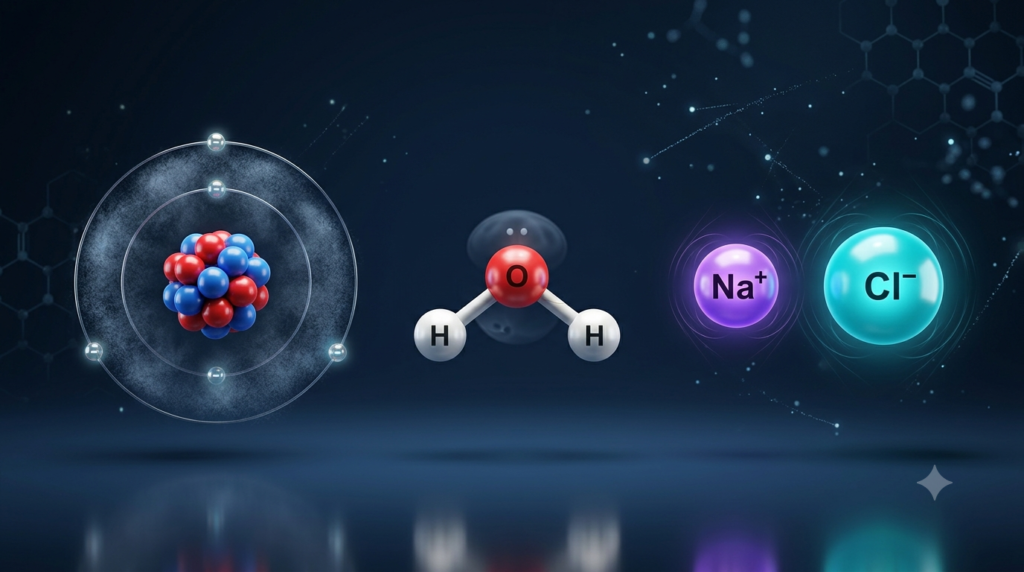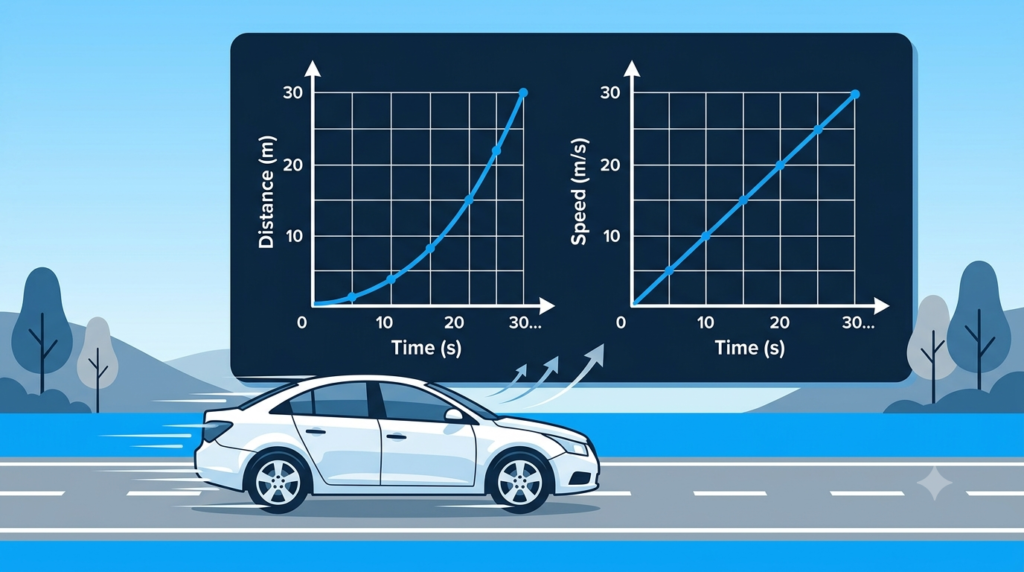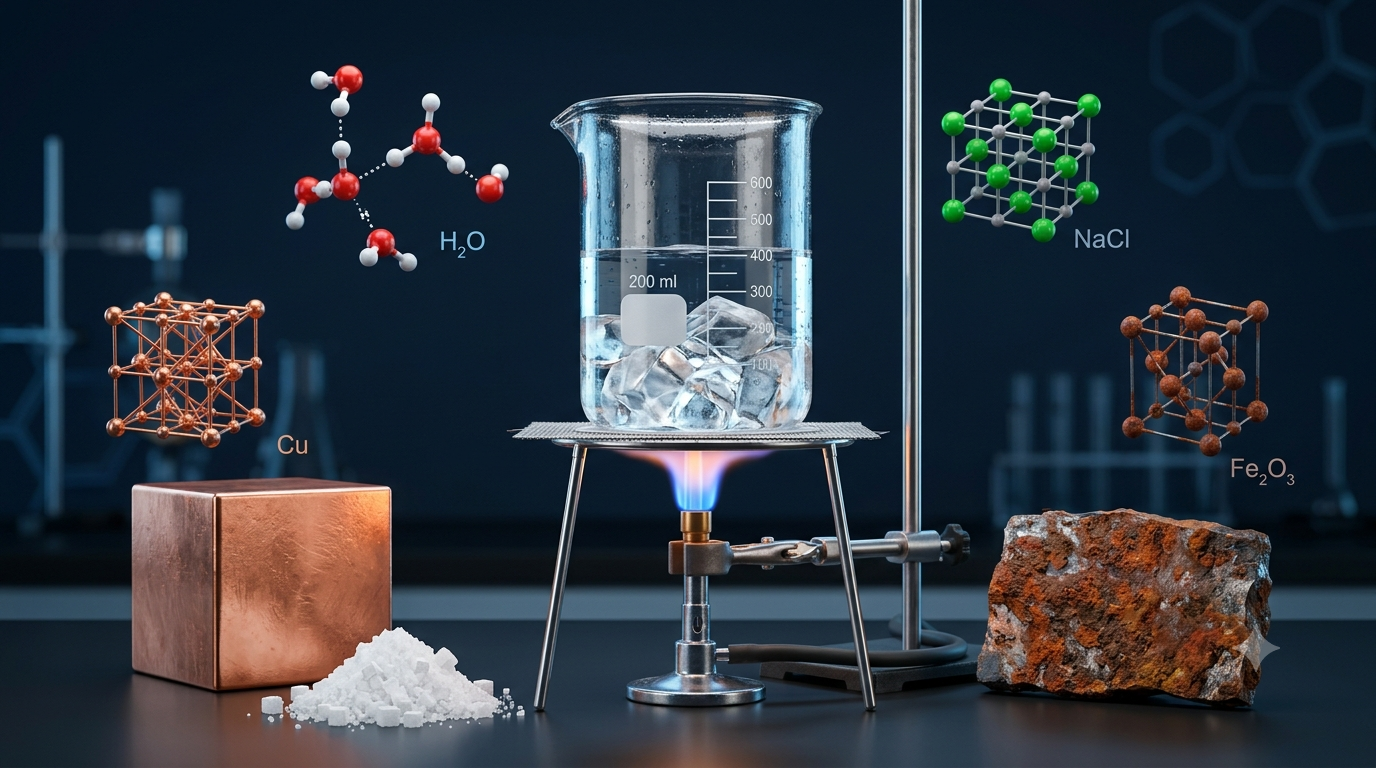
Everything around us is made of matter. The air we breathe, the water we drink, the food we eat, and the objects we use every day are all examples of matter. Matter has mass and occupies space, but different substances do not behave in the same way. Some substances are hard, while others are soft. Some dissolve in water, whereas others remain unchanged. Certain materials burn easily, while others resist burning.
To understand these differences, scientists study the physical and chemical properties of matter. These properties help us identify substances, compare materials, understand their behavior, and determine how they can be used in everyday life and industry. Although physical and chemical properties both describe matter, they differ in an important way: physical properties can generally be observed without changing a substance into a new substance, whereas chemical properties describe its ability to undergo chemical changes. Understanding these properties is an essential foundation for learning chemistry and other branches of science.
What Are the Properties of Matter?
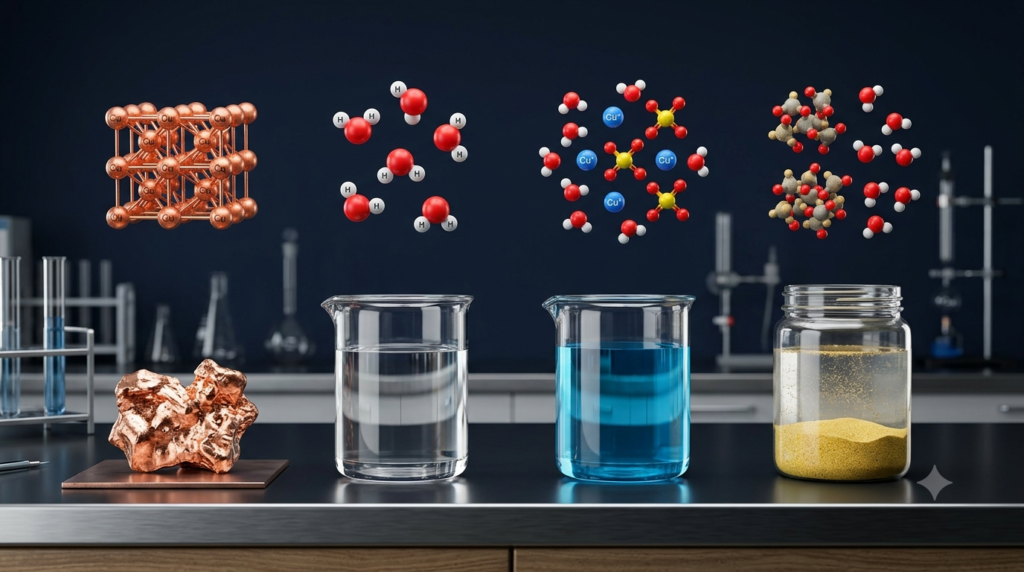
The properties of matter are the characteristics that help us describe, identify, and distinguish one substance from another. For example, copper is a reddish-brown metal that conducts electricity, while sulfur is a yellow solid that does not conduct electricity well under ordinary conditions. These differences arise from their physical and chemical properties.
Properties of matter are broadly divided into two categories:
Physical properties: Characteristics that can be observed or measured without changing the chemical identity of a substance.
Chemical properties: Characteristics that describe how a substance reacts or changes chemically to form new substances.
Both categories are important because they provide different kinds of information about a material. Physical properties help us understand what a substance is like, while chemical properties help us understand how it behaves during chemical reactions.
Physical Properties of Matter
Physical properties are characteristics of a substance that can be observed or measured without changing its chemical composition. For example, ice melts into liquid water when heated. Although its physical state changes, the substance remains water.
Physical properties can often be observed using our senses or measured using scientific instruments. They are useful for identifying materials, selecting substances for particular purposes, and studying changes in the states of matter.
1. Colour
Colour is one of the simplest physical properties to observe. Different substances may have different colours because they interact with visible light in different ways.
For example, copper is reddish-brown, sulfur is yellow, and pure water is colourless under ordinary conditions. Colour can help distinguish certain substances, although it is not always sufficient for identification because different substances may have similar colours.
The colour of a material may also change because of impurities, temperature, or chemical reactions. Therefore, scientists often examine colour alongside other properties.
2. State of Matter
Matter commonly exists in three familiar states: solid, liquid, and gas. Each state has characteristic physical properties.
Solids: Have a definite shape and a definite volume. Examples include ice, iron, and salt.
Liquids: Have a definite volume but take the shape of their container. Examples include water, milk, and cooking oil.
Gases: Have neither a definite shape nor a definite volume. They expand to fill their container. Examples include oxygen, nitrogen, and carbon dioxide.
The state of a substance can change when temperature or pressure changes. For example, ice melts into liquid water, and water boils to form water vapour. These are physical changes because the chemical identity of water remains unchanged.
3. Mass
Mass is the amount of matter in an object. It is a measurable physical property and is commonly measured in grams (g) or kilograms (kg).
For example, a small stone may have a mass of 200 grams, while a large stone may have a mass of several kilograms. Mass does not depend on the object’s location, although its weight can change with gravitational conditions.
Scientists use balances to measure mass accurately. This property is important in laboratory experiments, manufacturing, cooking, and many other activities.
4. Volume
Volume is the amount of space occupied by matter. It is commonly measured in cubic metres (m³), cubic centimetres (cm³), millilitres (mL), or litres (L).
For example, a bottle may contain 500 mL of water. A solid object with an irregular shape can have its volume measured by observing the change in water level when the object is fully submerged, provided it does not dissolve or react with the water.
Volume is especially important when measuring liquids, preparing chemical solutions, and calculating the density of materials.
5. Density
Density describes how much mass is contained in a given volume of a substance. It helps scientists compare materials and predict how they may behave in different situations.
Formula (Text Block):
Density = Mass / Volume
The SI unit of density is kilograms per cubic metre (kg/m³). It is also commonly expressed in grams per cubic centimetre (g/cm³).
For example, if an object has a mass of 100 g and a volume of 20 cm³, its density is:
Calculation (Text Block):
Density = 100 g / 20 cm³
Density can help identify substances and explain why some objects float in water while others sink. Under suitable conditions, an object less dense than a liquid tends to float, whereas a denser object tends to sink.
6. Melting Point
The melting point is the temperature at which a solid changes into a liquid at a specified pressure.
For example, pure ice melts at approximately 0°C under standard atmospheric pressure. Different substances have different melting points. Iron requires a much higher temperature to melt than ice.
Melting point is useful for identifying substances, testing purity, and selecting materials for applications involving heat.
7. Boiling Point
The boiling point is the temperature at which a liquid’s vapour pressure becomes equal to the surrounding pressure, allowing bubbles of vapour to form throughout the liquid.
Pure water boils at approximately 100°C at standard atmospheric pressure. However, its boiling point changes with pressure. At high altitudes, where atmospheric pressure is lower, water generally boils at a lower temperature.
Boiling point is important in cooking, distillation, chemical processing, and the separation of liquid mixtures.
8. Solubility
Solubility describes the ability of a substance, called the solute, to dissolve in another substance, called the solvent, under specified conditions.
For example, table salt dissolves in water, while sand does not dissolve appreciably in water under ordinary conditions. Sugar also dissolves in water, making it useful in beverages and food preparation.
Solubility depends on factors such as the nature of the solute and solvent, temperature, and, for gases, pressure. It is important in preparing medicines, making solutions, and separating substances.
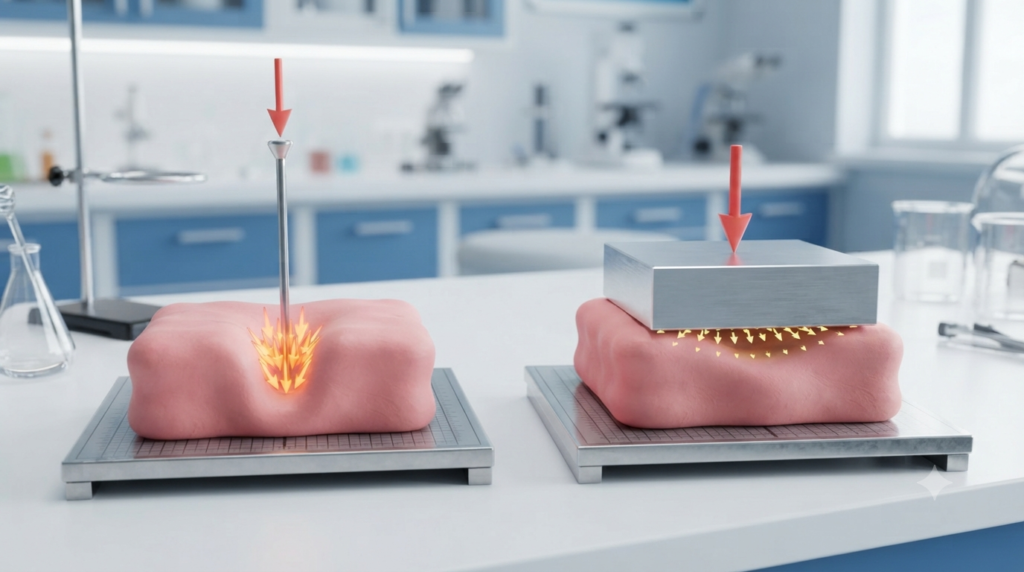
9. Hardness
Hardness refers to a material’s resistance to scratching, indentation, or deformation, depending on how it is measured.
For example, diamond is extremely hard and can scratch many other materials. Talc is much softer. The Mohs hardness scale compares minerals according to their resistance to scratching.
Hardness is useful when selecting materials for cutting tools, construction, jewellery, and protective surfaces.
10. Electrical and Thermal Conductivity
Electrical conductivity describes how easily electric charge flows through a material. Copper and aluminium are good electrical conductors, which makes them useful in electrical wiring. Rubber and many plastics are electrical insulators.
Thermal conductivity describes how easily heat passes through a material. Metals generally conduct heat well, while materials such as wood and many foams conduct heat relatively poorly.
These properties are important in electrical equipment, cooking utensils, building insulation, and electronic devices.
11. Malleability and Ductility
Malleability is the ability of a material to be hammered or rolled into thin sheets without breaking. Gold and aluminium are examples of malleable metals.
Ductility is the ability of a material to be drawn into wires. Copper is widely used in electrical wiring because it is both ductile and a good electrical conductor.
These properties make certain metals useful in manufacturing, construction, transportation, and electrical applications.
12. Magnetism
Magnetism describes how a material responds to a magnetic field. Iron, cobalt, and nickel are familiar examples of ferromagnetic materials under suitable conditions.
Magnetic properties are used in electric motors, generators, speakers, magnetic storage devices, and scientific instruments. However, not all metals are strongly attracted to magnets.
Magnetism is a physical property because observing a material’s magnetic response does not necessarily change its chemical identity.
Chemical Properties of Matter
Chemical properties describe a substance’s ability to undergo chemical reactions and form new substances. Unlike physical properties, these characteristics are usually demonstrated when the substance interacts with another substance or experiences conditions that cause a chemical change.
For example, the ability of iron to rust is a chemical property. Rusting involves reactions between iron, oxygen, and moisture that produce iron-containing corrosion products. The original iron does not simply change its shape or state; its chemical composition changes.
1. Flammability
Flammability is the ability of a substance to ignite and burn under suitable conditions.
For example, petrol, paper, and natural gas are flammable materials. Many metals can also burn under particular conditions, especially when finely divided.
Burning is a chemical reaction in which a substance reacts with an oxidizing agent, commonly oxygen, releasing energy. Depending on the material and conditions, combustion may produce heat, light, gases, and solid products.
Flammability is important when handling fuels, designing buildings, storing chemicals, and preventing fires.
2. Reactivity with Oxygen
Many substances react with oxygen, although the speed and products of these reactions vary.
Iron reacts with oxygen in the presence of moisture to form rust. Magnesium can burn with a bright white light and produce magnesium oxide. Some substances react with oxygen slowly, while others react rapidly.
A substance’s tendency to react with oxygen is a chemical property. These reactions are important in corrosion, combustion, industrial production, and biological processes.
3. Reactivity with Water
Some substances react strongly with water, while others show little or no reaction under ordinary conditions.
For example, sodium reacts vigorously with water to produce sodium hydroxide and hydrogen gas. Iron may rust when exposed to oxygen and moisture over time. Gold does not react readily with ordinary water.
Reactivity with water is important when determining how substances should be stored, transported, and handled safely. Highly reactive materials may require special storage conditions to prevent dangerous reactions.
4. Acidity and Basicity
Acidity and basicity describe chemical behaviour in reactions involving acids and bases.
Acids commonly react with certain metals, bases, and carbonates. For example, hydrochloric acid reacts with sodium hydroxide to form sodium chloride and water.
Bases can neutralize acids, and many water-soluble bases produce hydroxide ions in solution. The pH scale is commonly used to describe how acidic or basic an aqueous solution is. At approximately 25°C, a pH below 7 is generally acidic, a pH of 7 is neutral, and a pH above 7 is basic.
Acidity and basicity are important in agriculture, food production, medicine, environmental science, and industrial chemistry.
5. Corrosion
Corrosion is the gradual deterioration of a material through chemical or electrochemical reactions with its environment.
Rusting of iron is a familiar example. When iron is exposed to oxygen and moisture, corrosion products form on its surface. Other metals can also corrode, although their behaviour differs. Aluminium, for instance, forms a thin oxide layer that can protect the underlying metal under many conditions.
Corrosion can weaken bridges, pipelines, vehicles, machinery, and other structures. Painting, protective coatings, suitable material selection, and other prevention methods can reduce corrosion.
6. Chemical Stability
Chemical stability describes how resistant a substance is to undergoing chemical change under specified conditions.
Some substances remain unchanged for long periods under ordinary storage conditions. Others decompose, react with air, or break down when exposed to light or heat.
For example, hydrogen peroxide gradually decomposes into water and oxygen, with the rate influenced by conditions such as temperature and the presence of catalysts. Some compounds are stable at room temperature but decompose when heated strongly.
Chemical stability matters in medicine storage, food preservation, industrial processing, and the safe handling of chemicals.
7. Toxicity
Toxicity describes the capacity of a substance to cause harmful effects in living organisms. It depends on factors such as the dose, route of exposure, duration, and the organism involved.
For example, carbon monoxide is dangerous because it interferes with the blood’s ability to transport oxygen. Certain heavy-metal compounds can also cause serious health problems.
Toxicity is relevant to chemical safety and risk assessment. A substance’s toxicity does not always become apparent through its colour, smell, or appearance, so proper labelling, testing, and safe handling are essential.
8. Reactivity with Acids
Some substances react with acids to form new products. For example, many reactive metals react with dilute hydrochloric acid to produce a salt and hydrogen gas.
Chemical Equation (Text Block):
Zn + 2HCl → ZnCl₂ + H₂
This reaction demonstrates a chemical property of zinc. Its ability to react with an acid can help scientists compare the reactivity of different metals.
However, not all metals react with dilute hydrochloric acid in the same way. Gold and copper, for example, do not ordinarily release hydrogen through reaction with dilute hydrochloric acid.
9. Ability to Decompose
Some substances break down into simpler substances through chemical reactions. This behaviour is called chemical decomposition.
For example, calcium carbonate decomposes when strongly heated to produce calcium oxide and carbon dioxide.
Chemical Equation (Text Block):
CaCO₃ → CaO + CO₂
Decomposition may be caused by heat, electricity, light, or other conditions. It is used in industrial processes and helps scientists understand the stability and composition of compounds.
10. Reaction with Other Substances
A substance may react with another material to produce one or more new substances. These reactions can involve the transfer of electrons, the formation of precipitates, or the rearrangement of atoms.
For example, silver nitrate solution reacts with sodium chloride solution to produce silver chloride, a white solid precipitate, along with sodium nitrate in solution.
Chemical reactivity helps scientists predict how materials behave when mixed and how they may be used to produce useful compounds. It also explains why some substances must be kept separate during storage and laboratory work.
Difference Between Physical and Chemical Properties
Physical and chemical properties both help describe matter, but they provide different information.
| Physical Properties | Chemical Properties |
|---|---|
| Can be observed or measured without changing chemical identity. | Describe the ability to undergo chemical change. |
| Often observed without a chemical reaction. | Usually demonstrated through chemical reactions. |
| Include colour, density, mass, and melting point. | Include flammability, oxidation, and reactivity with acids. |
| Do not require the formation of a new substance. | Involve the potential to form new substances. |
| Can help identify materials through measurements. | Can help predict how substances behave in reactions. |
For example, the density and colour of iron are physical properties. Its ability to rust when exposed to suitable environmental conditions is a chemical property.
It is important to distinguish a property from a change. Melting is a physical change, whereas burning is a chemical change. A physical property describes a characteristic of a substance; a physical change describes an alteration that does not change its chemical identity.
Intensive and Extensive Physical Properties
Physical properties can also be classified as intensive or extensive.
Intensive Properties
Intensive properties do not depend on the amount of substance present, provided the material is in the same relevant state and conditions.
Examples include:
Density
Colour
Melting point
Boiling point at a specified pressure
Electrical conductivity
For instance, a small sample of pure water and a larger sample of pure water have the same density under the same conditions.
Extensive Properties
Extensive properties depend on the amount of matter present.
Examples include:
Mass
Volume
Total energy
If the quantity of a uniform material is doubled under the same conditions, its mass and volume will also double. This distinction is useful in laboratory measurements and scientific calculations.
Why Are the Properties of Matter Important?
The study of physical and chemical properties has many practical applications.
Identification of substances: Scientists can compare properties such as density, melting point, and chemical reactivity to help identify unknown materials.
Selection of materials: Engineers select materials according to their strength, conductivity, hardness, corrosion resistance, and other properties.
Manufacturing: Industries use chemical reactivity, melting points, and solubility to design processes for producing metals, medicines, plastics, fertilizers, and other products.
Environmental protection: Understanding the chemical properties of pollutants helps scientists study their reactions, movement, and possible effects on the environment.
Food and medicine: Solubility, stability, acidity, and other properties influence food preparation, medicine formulation, storage, and quality control.
Safety: Knowledge of flammability, toxicity, and reactivity helps people store and handle hazardous substances appropriately.
These applications show that the properties of matter are not merely theoretical concepts. They influence many decisions in science, technology, healthcare, construction, and everyday life.
How Can We Identify Physical and Chemical Properties in Daily Life?
Many familiar observations can help us understand the difference between physical and chemical properties.
When an ice cube melts, its shape and state change, but it remains water. Melting point and state are physical properties.
When sugar dissolves in water, it forms a solution. Under ordinary conditions, this is generally treated as a physical process because the sugar molecules remain chemically unchanged.
When wood burns, it reacts with oxygen and forms new substances, including gases and ash. Flammability is a chemical property, and burning is a chemical change.
When an iron gate develops rust, iron-containing corrosion products form through chemical reactions. The ability of iron to corrode is a chemical property.
When a copper wire conducts electricity, its electrical conductivity is being demonstrated. No chemical change is necessary for this ordinary observation.
By examining what happens to a substance and whether its chemical identity changes, we can classify many common examples correctly.
Conclusion
Physical and chemical properties are essential for understanding the characteristics and behaviour of matter. Physical properties, such as colour, mass, density, solubility, melting point, and electrical conductivity, can be observed or measured without changing a substance’s chemical identity. Chemical properties, such as flammability, corrosion, acidity, toxicity, and reactivity, describe how substances can participate in chemical reactions and form new products.
Both types of properties are valuable in identifying materials, conducting experiments, developing technologies, and solving practical problems. Learning to distinguish them also helps explain the difference between physical and chemical changes. By observing matter carefully and understanding its properties, we gain a clearer picture of the materials that make up our world and the scientific processes that transform them.
FAQs
1. What Are Physical Properties of Matter?
Physical properties of matter are characteristics that can be observed or measured without changing the chemical identity of a substance. These properties help us describe and identify different materials. Common examples include colour, mass, volume, density, melting point, boiling point, hardness, solubility, and electrical conductivity. For example, ice melts into liquid water when heated, but the substance remains water. Its chemical composition does not change during melting. Physical properties are useful in scientific experiments, material selection, manufacturing, and everyday activities. Scientists often measure several physical properties together to identify an unknown substance accurately.
2. What Are Chemical Properties of Matter?
Chemical properties describe the ability of a substance to undergo chemical reactions and form new substances. These properties help scientists understand how materials behave when they interact with other substances or experience particular conditions. Common examples include flammability, reactivity with acids, corrosion, acidity, and chemical stability. For instance, iron can react with oxygen and moisture to form rust. This behaviour demonstrates a chemical property because the reaction produces substances with different chemical compositions. Chemical properties are important in industries, medicine, environmental science, and laboratory research. Understanding them also helps people handle reactive and hazardous materials safely.
3. What Is the Main Difference Between Physical and Chemical Properties?
The main difference is that physical properties can be observed or measured without changing a substance’s chemical identity, whereas chemical properties describe its ability to undergo chemical changes. Colour, density, melting point, and electrical conductivity are physical properties. Flammability, rusting tendency, and reactivity with acids are chemical properties. For example, measuring the density of iron does not change the iron into another substance. However, when iron reacts with oxygen and moisture to form rust, chemical changes occur. Both categories help scientists identify substances, understand their behaviour, and determine suitable applications in science, technology, and everyday life.
4. Is Density a Physical or Chemical Property?
Density is a physical property because it can be measured without changing the chemical identity of a substance. It describes the mass contained in a given volume and is commonly used to compare materials. The formula for density is:
Formula (Text Block):
Density = Mass / Volume
Here, ρ represents density, m represents mass, and V represents volume. The SI unit is kilograms per cubic metre (kg/m³). For example, a substance with a mass of 100 grams and a volume of 20 cubic centimetres has a density of 5 g/cm³. Density is useful for identifying materials and predicting whether objects may float or sink in a liquid.
5. Is Flammability a Physical or Chemical Property?
Flammability is a chemical property because it describes a substance’s ability to ignite and undergo combustion under suitable conditions. During combustion, a substance reacts with an oxidizing agent, commonly oxygen, and produces new substances while releasing energy. For example, paper burns in air and forms ash, gases, and other products. Petrol and natural gas are also familiar flammable materials. Flammability is important in fire prevention, fuel selection, industrial operations, and chemical storage. It is different from the physical property of melting point, which can be measured without changing a substance’s chemical composition. Flammable substances must be handled with appropriate safety precautions.
6. Is Melting a Physical or Chemical Change?
Melting is a physical change because it changes a substance from a solid into a liquid without changing its chemical identity. For example, when ice melts, solid water becomes liquid water. Both contain H₂O molecules. The change occurs because the particles gain energy and move more freely as the solid structure breaks down. Melting point is therefore a physical property that can help identify substances. In contrast, burning wood is a chemical change because it produces new substances. Understanding the difference between melting and chemical reactions helps us classify everyday observations correctly and develop a stronger foundation in chemistry.
7. What Are Five Examples of Physical Properties of Matter?
Five common physical properties of matter are colour, density, melting point, solubility, and electrical conductivity. Colour describes how a substance appears, while density relates its mass to its volume. Melting point identifies the temperature at which a solid changes into a liquid at a specified pressure. Solubility describes how readily a substance dissolves in a particular solvent under specified conditions. Electrical conductivity indicates how easily electric charge flows through a material. For example, copper has high electrical conductivity, making it useful for wiring. These properties can be examined without necessarily producing a new substance, which makes them useful for identifying and comparing materials.
8. What Are Five Examples of Chemical Properties of Matter?
Five examples of chemical properties are flammability, reactivity with oxygen, reactivity with acids, corrosion tendency, and chemical stability. Flammability describes the ability of a substance to burn. Reactivity with oxygen explains how a material may react with oxygen under suitable conditions. Reactivity with acids describes how a substance behaves when it comes into contact with an acid. Corrosion tendency indicates whether a material is likely to deteriorate through chemical or electrochemical reactions with its surroundings. Chemical stability describes resistance to chemical change under specified conditions. These properties help scientists predict reactions, develop useful materials, and establish appropriate safety procedures.
9. What Is the Difference Between Intensive and Extensive Properties?
Intensive and extensive properties are two classifications of physical properties. Intensive properties do not depend on the amount of substance present, whereas extensive properties depend on the amount. Examples of intensive properties include density, colour, and melting point under specified conditions. Examples of extensive properties include mass and volume. For instance, a small sample and a large sample of the same pure substance generally have the same density under identical conditions. However, the larger sample has greater mass and volume. This classification is useful in laboratory experiments, scientific calculations, and material analysis because it helps scientists understand how measurements change when the quantity of matter changes.
10. Why Are Physical and Chemical Properties Important in Everyday Life?
Physical and chemical properties help us understand materials and choose them for suitable purposes. Physical properties such as hardness, density, and thermal conductivity influence the selection of metals, building materials, and cooking utensils. Chemical properties such as corrosion resistance, flammability, and chemical stability are important for safety, storage, and product development. For example, copper is used in electrical wiring because it conducts electricity well, while corrosion-resistant materials are valuable in construction and transportation. Knowledge of chemical reactivity also helps prevent dangerous reactions when substances are mixed. Understanding both types of properties supports scientific research, industrial manufacturing, environmental protection, and informed everyday decisions.