
How to Write Simple Chemical Formulas

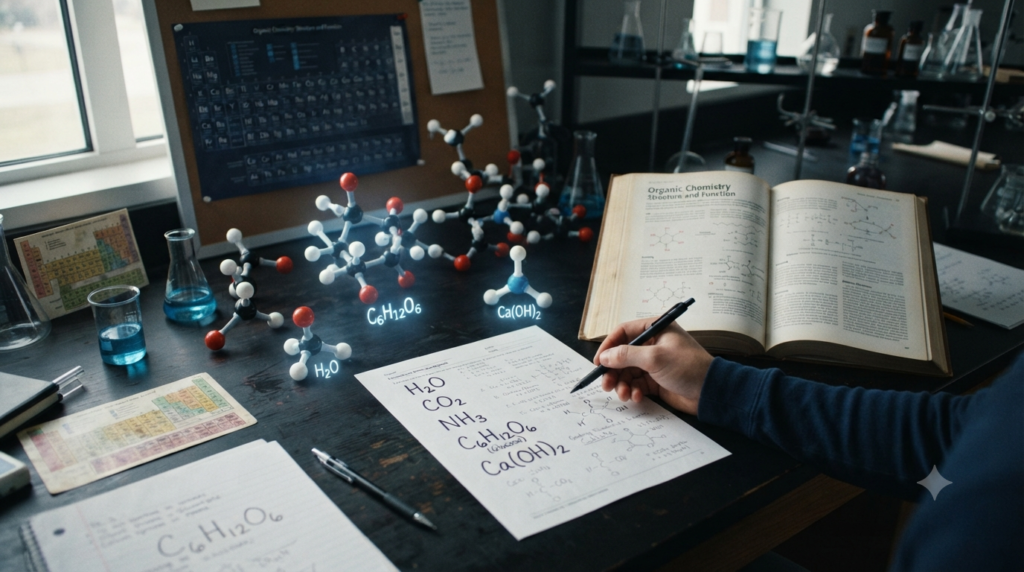
Chemistry study desk with chemical formulas, molecular models, periodic table, and notes for learning how to write simple chemical formulas

Chemical formulas are a simple way to represent substances using symbols and numbers. Instead of writing the full name of a substance every time, chemists use a short formula that shows which elements are present and, in many cases, how many atoms of each element are involved. For example, water is represented as H₂O, while carbon dioxide is written as CO₂. Learning how to write chemical formulas is an important foundation for understanding chemistry because formulas connect the names of substances with their composition. The process becomes much easier when you understand element symbols, valency, ionic charges, and the basic rules for combining atoms.

What Is a Chemical Formula?

A chemical formula is a symbolic representation of a chemical substance. It uses the symbols of elements and numerical subscripts to show the composition of the substance.

For example:

  • H₂O represents water.

  • CO₂ represents carbon dioxide.

  • NaCl represents sodium chloride.

  • NH₃ represents ammonia.

  • CaCO₃ represents calcium carbonate.

The letters in a formula come from the chemical symbols of elements. A small number written below and to the right of a symbol tells us how many atoms of that element are present.

In H₂O, the subscript ₂ means there are two hydrogen atoms. Oxygen has no subscript, which means there is one oxygen atom.

Learn Element Symbols First

The first step in writing a chemical formula is knowing the symbols of common elements. Every element has a unique chemical symbol.

Some common examples are:

  • Hydrogen — H

  • Oxygen — O

  • Carbon — C

  • Nitrogen — N

  • Sodium — Na

  • Potassium — K

  • Calcium — Ca

  • Magnesium — Mg

  • Aluminium — Al

  • Chlorine — Cl

  • Sulfur — S

  • Iron — Fe

Chemical symbols are case-sensitive. The first letter is always capitalized, while a second letter, when present, is lowercase. For example, sodium is Na, not NA, and chlorine is Cl, not CL.

Knowing these symbols makes it easier to convert the name of a substance into its chemical formula.

Understand Valency and Charge

For many simple compounds, understanding valency is essential. Valency describes the combining capacity of an atom in a compound. In ionic compounds, this is closely related to the charge of the ion.

For example, sodium commonly forms Na⁺, while chlorine forms Cl⁻. Because their charges are +1 and −1, they combine in a one-to-one ratio:

NaCl

Calcium commonly forms Ca²⁺, while chlorine forms Cl⁻. One calcium ion needs two chloride ions to balance the total charge:

CaCl₂

Similarly, magnesium forms Mg²⁺ and oxygen forms O²⁻. Their charges balance in a one-to-one ratio:

MgO

The goal is to form a compound whose overall electrical charge is zero.

Write the Positive Part First

When writing a simple ionic compound, the positive ion is generally written first, followed by the negative ion.

For example:

  • Sodium + chlorine → NaCl

  • Magnesium + oxygen → MgO

  • Calcium + chlorine → CaCl₂

  • Aluminium + oxygen → Al₂O₃

This order helps you organize the formula correctly. Metals usually form positive ions, while nonmetals often form negative ions in simple ionic compounds.

Use the Charge Balance Method

One useful method for writing ionic formulas is to balance the charges of the ions.

Consider calcium chloride. Calcium forms Ca²⁺ and chlorine forms Cl⁻. One Ca²⁺ ion has a charge of +2, while one Cl⁻ ion has a charge of −1. Therefore, two chloride ions are required to balance one calcium ion.

Ca²⁺ + 2Cl⁻ → CaCl₂

Now consider aluminium oxide. Aluminium forms Al³⁺ and oxygen forms O²⁻. The smallest common total charge is 6. Therefore, two aluminium ions provide +6 and three oxide ions provide −6.

Al₂O₃

This charge-balancing idea is one of the most useful skills for writing simple chemical formulas.

The Criss Cross Method

The criss cross method can also help when the charges are different.

Suppose you need to write the formula for aluminium oxide:

Al³⁺ and O²⁻

The numerical parts of the charges are crossed over and used as subscripts:

Al₂O₃

The 2 from oxygen becomes the subscript for aluminium, and the 3 from aluminium becomes the subscript for oxygen.

Another example is calcium nitride. Calcium has a charge of +2, while nitrogen forms nitride with a charge of −3:

Ca²⁺ and N³⁻

Crossing the numbers gives:

Ca₃N₂

However, the final formula should always be checked to make sure the total positive and negative charges balance.

Simplify the Subscripts When Necessary

After using charges to determine subscripts, check whether the numbers can be reduced to a simpler ratio.

For example, magnesium oxide contains Mg²⁺ and O²⁻. The charges have equal magnitude, so the simplest ratio is 1:1.

MgO

Writing Mg₂O₂ would show the same charge balance, but it is not the correct simplest formula for magnesium oxide.

Therefore, chemical formulas are normally written using the simplest whole-number ratio of atoms or ions.

Use Parentheses With Polyatomic Ions

Some groups of atoms behave as a single charged unit. These are called polyatomic ions. Examples include hydroxide (OH⁻), sulfate (SO₄²⁻), nitrate (NO₃⁻), and carbonate (CO₃²⁻).

When more than one polyatomic ion is needed, parentheses are used.

For example, calcium hydroxide contains Ca²⁺ and OH⁻. Two hydroxide ions are required to balance one calcium ion:

Ca(OH)₂

The parentheses show that the subscript ₂ applies to the entire hydroxide ion.

Similarly, aluminium sulfate is written as:

Al₂(SO₄)₃

Here, three sulfate ions are needed to balance two aluminium ions.

Writing Formulas for Covalent Compounds

Not every compound is formed by balancing ionic charges. Covalent compounds form when nonmetal atoms share electrons.

Some common covalent compounds include:

  • Carbon dioxide — CO₂

  • Carbon monoxide — CO

  • Sulfur dioxide — SO₂

  • Sulfur trioxide — SO₃

  • Nitrogen dioxide — NO₂

Prefixes in the names of many covalent compounds can indicate the number of atoms present. For example, “di-” means two and “tri-” means three.

Carbon dioxide therefore contains one carbon atom and two oxygen atoms:

CO₂

Nitrogen trichloride contains one nitrogen atom and three chlorine atoms:

NCl₃

Check the Formula Before Finalizing It

A formula should always be checked after it is written. Ask a few simple questions.

Are the element symbols correct?
Make sure each symbol represents the intended element.

Is the order correct?
For a simple ionic compound, the positive ion is generally written first.

Are the subscripts correct?
Check whether they represent the required ratio of atoms or ions.

Does the total charge balance?
For an ionic compound, the overall charge should be zero.

Have unnecessary subscripts been removed?
Use the simplest whole-number ratio.

These checks can prevent many common mistakes.

Common Mistakes When Writing Chemical Formulas

One common mistake is changing the capitalization of element symbols. Na represents sodium, while NA does not represent a valid element symbol.

Another mistake is forgetting subscripts. Writing CaCl instead of CaCl₂ does not correctly represent calcium chloride.

Students may also confuse coefficients with subscripts. In the expression 2H₂O, the coefficient 2 means there are two water molecules. The subscript ₂ in H₂O means each water molecule contains two hydrogen atoms.

Another frequent mistake is changing the chemical formula when balancing a chemical equation. The formula of a compound should not be changed simply to balance an equation. Coefficients are used for balancing equations, while subscripts are part of the chemical formula itself.

A Simple Step-by-Step Method

When writing a simple chemical formula, follow this basic process:

  1. Identify the elements or ions in the substance.

  2. Write the correct chemical symbols.

  3. Determine the valency or ionic charge when necessary.

  4. Write the positive ion first for an ionic compound.

  5. Balance the charges using the smallest whole-number ratio.

  6. Use parentheses when multiple polyatomic ions are required.

  7. Simplify the subscripts if possible.

  8. Check the final formula.

With practice, these steps become almost automatic.

Conclusion

Writing simple chemical formulas becomes much easier when the basic rules are understood. Start by learning common element symbols, then understand how atoms combine through valency, ionic charges, or electron sharing. For ionic compounds, make sure the positive and negative charges balance, while covalent compounds often use the prefixes in their names to identify the number of atoms. Always pay attention to capitalization, subscripts, parentheses, and the order of elements. Most importantly, check whether the final formula represents the correct composition of the substance. With regular practice, writing chemical formulas becomes a straightforward skill that provides a strong foundation for learning chemical reactions, equations, and more advanced chemistry.

FAQs

1. What is a chemical formula?

A chemical formula is a short way of representing a chemical substance using element symbols and numbers. It tells us which elements are present and, in many cases, how many atoms of each element are included. For example, H₂O represents water and contains two hydrogen atoms and one oxygen atom. CO₂ represents carbon dioxide and contains one carbon atom and two oxygen atoms. Chemical formulas make it easier to identify substances and understand their composition without writing their full names. Learning chemical symbols, subscripts, valency, and charge balance helps you write chemical formulas correctly.

2. How do you start writing a chemical formula?

To write a chemical formula, first identify the elements present in the substance. Then write the correct chemical symbols for those elements. If the substance is an ionic compound, determine the charges or valencies of the ions. Use these charges to find the simplest ratio that balances the positive and negative charges. Write the positive ion first and the negative ion second. Finally, check the formula to make sure the symbols, subscripts, and charge balance are correct. For covalent compounds, the name and prefixes can help determine how many atoms of each element are needed.

3. What is valency in chemistry?

Valency describes the combining capacity of an atom or ion when it forms a compound. It helps determine how atoms combine in fixed ratios. For example, sodium commonly has a valency of 1, while oxygen commonly has a valency of 2. Sodium and oxygen therefore combine in a ratio that produces sodium oxide, Na₂O. Valency is especially useful when writing formulas for simple ionic compounds. By knowing the valencies of the elements involved, you can determine the appropriate subscripts needed in the formula. Understanding common valencies makes writing chemical formulas faster and more accurate.

4. Why are subscripts used in chemical formulas?

Subscripts are small numbers written at the lower right of an element symbol or group of atoms. They show how many atoms or ions of that element or group are present. For example, in H₂O, the subscript 2 shows that each water molecule contains two hydrogen atoms. Oxygen has no subscript, so one oxygen atom is present. In CaCl₂, the subscript 2 indicates that two chlorine ions combine with one calcium ion. Subscripts are part of the chemical formula and should not be changed randomly because they determine the composition and identity of the substance.

5. What is the criss cross method for writing formulas?

The criss cross method is a simple technique commonly used to write formulas for ionic compounds. First, write the symbols of the positive and negative ions along with their charges. Then cross the numerical values of the charges and use them as subscripts for the opposite ions. For example, aluminium forms Al³⁺ and oxygen forms O²⁻. Crossing the numbers gives Al₂O₃. The final formula should always be checked and simplified if necessary. The criss cross method is useful for practice, but understanding why charges must balance is more important than memorizing the method.

6. Why is NaCl written as the formula for sodium chloride?

Sodium chloride is made from sodium ions and chloride ions. Sodium forms a positive ion with a charge of +1, written as Na⁺. Chlorine forms a negative chloride ion with a charge of −1, written as Cl⁻. One sodium ion balances one chloride ion because their charges are equal in magnitude and opposite in sign. Therefore, the simplest ratio is one sodium ion to one chloride ion. The formula is written as NaCl. No subscripts are necessary because one Na⁺ and one Cl⁻ together produce a neutral compound.

7. When should parentheses be used in chemical formulas?

Parentheses are used when more than one polyatomic ion is required in a chemical formula. A polyatomic ion is a group of atoms that carries an overall charge and behaves as a unit. For example, calcium hydroxide contains Ca²⁺ and hydroxide, OH⁻. Two hydroxide ions are required to balance one calcium ion, so the formula is Ca(OH)₂. The parentheses show that the subscript 2 applies to the entire hydroxide group. Without parentheses, the formula would not clearly represent two complete hydroxide ions. Parentheses are therefore important when multiple identical polyatomic ions are present.

8. What is the difference between a coefficient and a subscript?

A coefficient and a subscript both involve numbers, but they have different meanings. A subscript is part of a chemical formula and tells how many atoms are present in one molecule or formula unit. For example, H₂O contains two hydrogen atoms. A coefficient is placed before a formula and tells how many molecules or formula units are present. In 3H₂O, the coefficient 3 means there are three water molecules. Therefore, the subscript describes the composition of one unit, while the coefficient describes the number of units. This difference is especially important when balancing chemical equations.

9. How do you check whether a chemical formula is correct?

After writing a chemical formula, check several details. First, make sure the element symbols are correct and properly capitalized. Next, check whether the positive and negative charges balance for an ionic compound. Confirm that the subscripts represent the simplest whole-number ratio. If polyatomic ions are repeated, make sure parentheses are used correctly. You should also check the order of the elements. For example, an ionic compound generally places the positive ion first. Finally, compare the formula with the known composition of the substance. These simple checks can help identify most common errors.

10. How can I get better at writing chemical formulas?

The best way to improve is through regular practice. Start by memorizing the symbols and common valencies of frequently used elements. Practice writing formulas for simple ionic compounds such as NaCl, MgO, CaCl₂, and Al₂O₃. Then move on to compounds containing polyatomic ions and covalent compounds. After writing each formula, check whether the charges balance and whether the subscripts are in the simplest ratio. It is also helpful to learn the difference between coefficients and subscripts. With repeated practice, you will become more comfortable identifying elements, balancing charges, and writing accurate chemical formulas.

Related Posts

Leave a Comment

Your email address will not be published. Required fields are marked *

Scroll to Top