
What Is Valency in Chemistry?

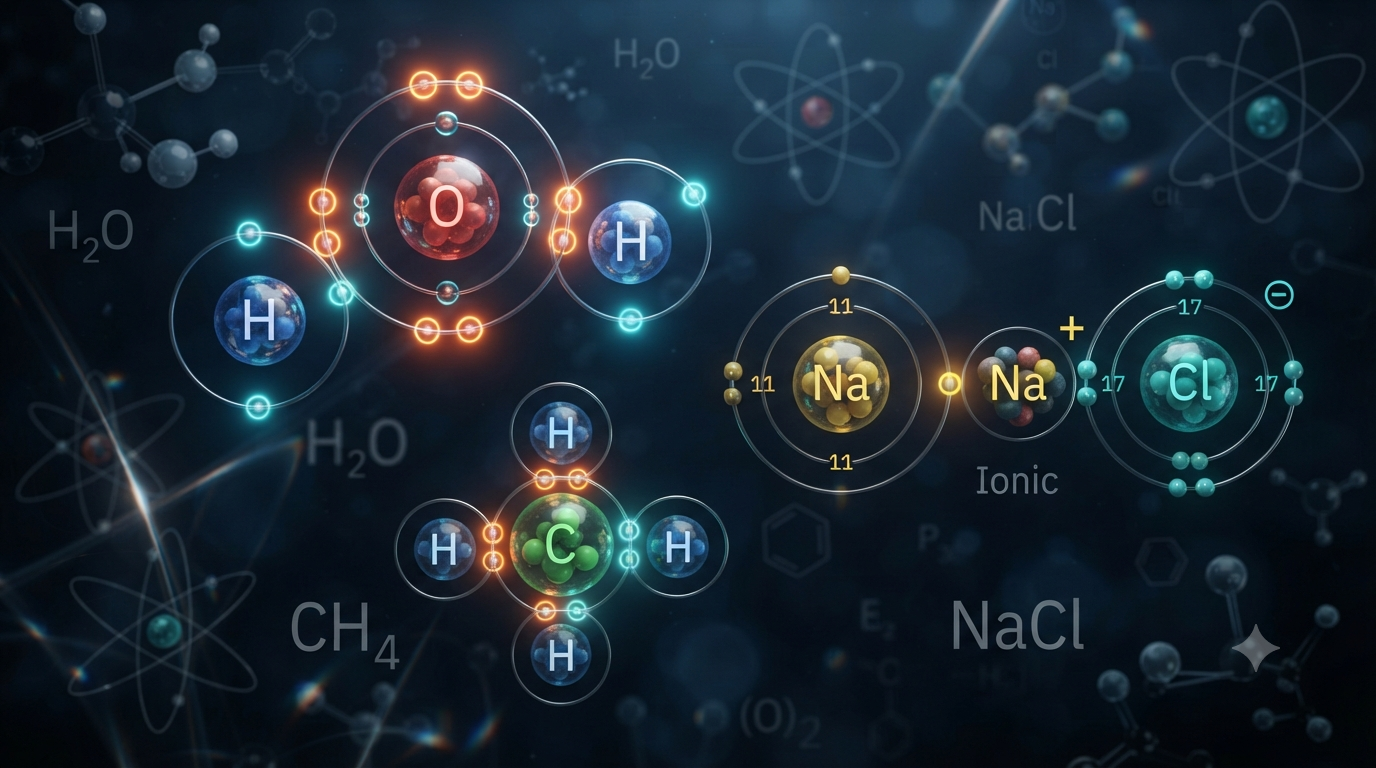
Diagram showing valency in chemistry with atoms, valence electrons, and chemical bonds forming simple molecules.

Valency is one of the basic concepts in chemistry that helps us understand how atoms combine with one another to form molecules and compounds. Every element has atoms with a particular electronic arrangement, and the outermost electrons play an important role in chemical bonding. Valency describes the combining capacity of an atom and helps explain why elements form compounds in specific ratios.

For example, hydrogen usually has a valency of 1, oxygen has a valency of 2, nitrogen commonly has a valency of 3, and carbon has a valency of 4. These values help us understand formulas such as H₂O, NH₃, and CH₄. Although valency is a simple idea, it provides an important foundation for understanding chemical formulas, bonding, and the formation of compounds.

What Does Valency Mean?

Valency is the combining capacity of an atom with other atoms. In simple terms, it tells us how many electrons an atom may lose, gain, or share to achieve a more stable electronic arrangement.

Atoms generally tend to reach a more stable outer electron configuration. For many main-group elements, this stability is associated with having a complete outer shell. To achieve this, atoms can lose electrons, gain electrons, or share electrons with other atoms.

For example, a sodium atom has one electron in its outermost shell. It can lose this electron and form a sodium ion. Therefore, sodium has a valency of 1.

Chlorine has seven electrons in its outermost shell. It needs one more electron to complete its outer shell, so it can gain one electron. Therefore, chlorine also has a valency of 1.

When sodium and chlorine combine, they form sodium chloride, NaCl. The valency of sodium and chlorine helps explain why one sodium atom combines with one chlorine atom.

Why Is Valency Important in Chemistry?

Valency helps us understand how atoms combine and how chemical formulas are formed. Without the concept of valency, it would be difficult to predict the ratio in which many elements combine.

Consider magnesium and chlorine. Magnesium commonly has a valency of 2, while chlorine has a valency of 1. One magnesium atom can combine with two chlorine atoms, producing magnesium chloride with the formula MgCl₂.

Similarly, aluminium has a common valency of 3, while oxygen has a valency of 2. Their valencies help determine the formula Al₂O₃.

Valency is therefore useful for:

  • Understanding chemical bonding

  • Writing chemical formulas

  • Predicting how atoms combine

  • Understanding the composition of compounds

  • Studying ionic and covalent compounds

  • Learning chemical reactions

  • Understanding the formation of ions

How Is Valency Related to Electrons?

The valency of an atom is closely connected with its electronic configuration, especially the electrons in its outermost shell. These electrons are often called valence electrons.

For example, consider sodium. Its electronic configuration can be written as 2, 8, 1. It has one electron in its outermost shell. Losing this electron gives sodium a more stable configuration. Therefore, its valency is 1.

Magnesium has an electronic configuration of 2, 8, 2. It can lose two outer electrons to achieve a stable configuration. Its valency is therefore 2.

Chlorine has an electronic configuration of 2, 8, 7. It needs one electron to complete its outer shell. Therefore, its valency is 1.

The relationship can be summarized as:

Valency depends largely on the number of electrons an atom loses, gains, or shares during chemical bonding.

Valency of Elements With One or Two Valence Electrons

Elements that have one, two, or three electrons in their outermost shell often show valencies related to the number of electrons they can lose.

For example:

  • Sodium has 1 valence electron → valency 1

  • Magnesium has 2 valence electrons → valency 2

  • Aluminium has 3 valence electrons → valency 3

These elements can lose their outer electrons and form positively charged ions.

Sodium forms Na⁺, magnesium forms Mg²⁺, and aluminium forms Al³⁺.

The charge of the ion and the numerical value of its common valency are closely related in these simple cases.

Valency of Elements With Five, Six, or Seven Valence Electrons

Atoms with five, six, or seven valence electrons can often gain electrons to achieve a more stable outer shell.

Nitrogen has five valence electrons and commonly gains or shares three electrons. Its common valency is 3.

Oxygen has six valence electrons and commonly gains or shares two electrons. Its common valency is 2.

Chlorine has seven valence electrons and commonly gains or shares one electron. Its common valency is 1.

For example, oxygen combines with hydrogen to form water. Hydrogen has a valency of 1, while oxygen has a valency of 2. Therefore, two hydrogen atoms combine with one oxygen atom to form H₂O.

Valency and Chemical Formula

Valency is particularly useful when writing chemical formulas.

Suppose we want to write the formula of a compound formed between calcium and chlorine.

Calcium has a valency of 2, while chlorine has a valency of 1. Calcium needs two chlorine atoms to balance its combining capacity. Therefore, the formula is:

CaCl₂

Now consider aluminium oxide. Aluminium has a valency of 3, and oxygen has a valency of 2. The smallest combination that balances their valencies contains two aluminium atoms and three oxygen atoms.

Therefore:

Al₂O₃

This demonstrates how valency helps determine the number of atoms present in a compound.

The Criss Cross Method

A commonly used method for writing chemical formulas from valencies is the criss-cross method.

In this method, the numerical values of the valencies are crossed over and used as subscripts.

For example, consider aluminium oxide:

Aluminium → valency 3
Oxygen → valency 2

Crossing the values gives:

Al₂O₃

Another example is magnesium chloride:

Magnesium → valency 2
Chlorine → valency 1

The resulting formula is:

MgCl₂

However, the criss-cross method should be used carefully. The final formula should always be simplified when the subscripts have a common factor, and the chemical context should be considered.

Common Valencies of Some Elements

Some elements have commonly encountered valencies that are useful to remember.

ElementSymbolCommon Valency
HydrogenH1
SodiumNa1
PotassiumK1
MagnesiumMg2
CalciumCa2
AluminiumAl3
CarbonC4
NitrogenN3
OxygenO2
FluorineF1
ChlorineCl1
BromineBr1
SulfurS2

These are common values, but some elements can show more than one valency depending on the compound in which they occur.

What Is Variable Valency?

Some elements can show more than one valency. This property is called variable valency.

Variable valency is particularly common among many transition metals. For example, iron can show valencies of 2 and 3.

Iron can form compounds such as iron(II) chloride, FeCl₂, and iron(III) chloride, FeCl₃.

Copper can also show more than one common valency. It can form copper(I) compounds and copper(II) compounds.

This means that simply knowing the name of an element may not always be enough to determine its valency. The particular compound and oxidation state must sometimes be considered.

Valency and Oxidation State Are They the Same?

Valency and oxidation state are related concepts, but they are not exactly the same.

Valency generally describes the combining capacity of an atom and is often expressed as a simple number without a positive or negative sign.

Oxidation state, on the other hand, represents the apparent charge assigned to an atom in a compound according to specific chemical rules. It can be positive, negative, or zero.

For example, chlorine commonly has a valency of 1, but its oxidation state can have different values in different compounds.

Therefore, valency is a useful basic concept for understanding chemical combination, while oxidation state provides a more detailed description of electron distribution in compounds and chemical reactions.

Valency in Ionic Compounds

In ionic compounds, atoms typically form ions by losing or gaining electrons.

For example, sodium loses one electron:

Na → Na⁺ + e⁻

Chlorine gains one electron:

Cl + e⁻ → Cl⁻

The oppositely charged ions attract one another and form sodium chloride.

Here, sodium has a valency of 1 and chlorine has a valency of 1.

Another example is magnesium oxide. Magnesium loses two electrons to form Mg²⁺, while oxygen gains two electrons to form O²⁻.

The resulting compound has the formula:

MgO

The equal and opposite charges allow the compound to have an overall electrical neutrality.

Valency in Covalent Compounds

Valency is also useful for understanding covalent compounds. In covalent bonding, atoms share electrons rather than simply transferring them.

Hydrogen has one electron and commonly forms one covalent bond. Oxygen commonly forms two covalent bonds. Nitrogen commonly forms three, while carbon commonly forms four.

For example, methane has the formula CH₄. Carbon has a common valency of 4, so it forms four bonds with four hydrogen atoms.

Water has the formula H₂O. Oxygen forms two bonds, one with each hydrogen atom.

Thus, valency can help us understand not only ionic compounds but also the bonding patterns found in covalent molecules.

How to Find Valency From Electronic Configuration

The electronic configuration of an element can often help determine its common valency.

First, identify the number of electrons in the outermost shell.

If the atom has one, two, or three outer electrons, it may commonly lose those electrons. Its valency may therefore correspond to that number.

If the atom has five, six, or seven outer electrons, it may commonly gain or share enough electrons to complete its outer shell. In simple cases, its valency can be related to:

8 − number of valence electrons

For example, chlorine has seven valence electrons:

8 − 7 = 1

Therefore, its common valency is 1.

Oxygen has six valence electrons:

8 − 6 = 2

Therefore, its common valency is 2.

This simple rule works well for many main-group elements, but it is not universal. Elements with more complex electronic structures may exhibit variable valency.

Valency of Noble Gases

Noble gases such as helium, neon, and argon have very stable outer electron configurations.

Helium has a complete first shell with two electrons, while neon and argon have stable outer shells. Because they generally do not need to gain, lose, or share electrons under ordinary conditions, their common valency is usually considered zero.

This is one reason noble gases are much less reactive than many other elements.

Valency and the Formation of Molecules

Valency also helps explain why atoms combine in particular numbers to form molecules.

Consider ammonia, NH₃. Nitrogen has a common valency of 3, while hydrogen has a valency of 1. Therefore, one nitrogen atom combines with three hydrogen atoms.

Similarly, carbon dioxide has the formula CO₂. Carbon has a common valency of 4, while oxygen has a valency of 2. Two oxygen atoms provide a total combining capacity of 4, matching that of carbon.

Valency therefore provides a simple way to visualize the relationships between atoms in many familiar molecules.

Common Mistakes About Valency

One common mistake is assuming that every element always has only one valency. This is not true because several elements can show variable valency.

Another mistake is confusing valency with the number of valence electrons. They are related but are not always identical. For example, oxygen has six valence electrons but a common valency of 2.

It is also important not to treat valency and oxidation state as exactly interchangeable terms. They describe related but different ideas.

Finally, when writing formulas, the valencies should be balanced correctly. A chemical formula must represent an electrically neutral compound when it describes a neutral ionic compound.

Why Learning Valency Matters

Valency provides a foundation for many other chemistry concepts. Once you understand valency, it becomes easier to understand chemical formulas, ionic compounds, covalent molecules, chemical bonding, and many chemical reactions.

It also makes it easier to interpret formulas that might otherwise appear difficult. A formula such as Al₂O₃ is not simply a collection of symbols and numbers. The subscripts reflect the combining capacities of aluminium and oxygen.

Understanding this relationship helps connect the microscopic behavior of atoms with the chemical substances we observe in the real world.

Conclusion

Valency is the combining capacity of an atom and is closely related to the way its electrons participate in chemical bonding. Atoms may lose, gain, or share electrons to achieve more stable arrangements, and their valencies help determine how they combine with other atoms. Valency is useful for understanding formulas such as H₂O, MgCl₂, Al₂O₃, and CH₄ and provides an important foundation for studying chemical bonding and compounds.

Although many elements have common valencies, some can show variable valency depending on the compound. Valency is therefore a simple but powerful concept that connects electronic structure with the formation of molecules and compounds. Learning it clearly makes many other areas of chemistry easier to understand.

FAQs

1. What is valency in chemistry?

Valency is the combining capacity of an atom with other atoms. It describes how many electrons an atom can lose, gain, or share while forming chemical bonds. Valency is mainly related to the electrons present in the outermost shell of an atom. For example, hydrogen has a valency of 1 because it commonly forms one bond. Oxygen has a valency of 2 because it commonly forms two bonds. Carbon has a valency of 4 because it can form four bonds. Understanding valency helps explain why atoms combine in particular ratios and makes it easier to write chemical formulas for different compounds.

2. Why is valency important in chemistry?

Valency is important because it helps us understand how atoms combine to form molecules and compounds. It provides a simple way to determine the number of bonds an atom can commonly form. Valency is also useful when writing chemical formulas. For example, magnesium has a valency of 2 and chlorine has a valency of 1, so their compound is written as MgCl₂. Similarly, aluminium has a valency of 3 and oxygen has a valency of 2, giving Al₂O₃. By learning common valencies, we can better understand chemical bonding, compound composition, and the relationships between different elements.

3. How is valency related to valence electrons?

Valency is closely related to valence electrons, which are the electrons present in an atom’s outermost shell. These electrons participate in chemical bonding and largely determine how an atom interacts with other atoms. An atom may lose, gain, or share valence electrons to achieve a more stable electronic arrangement. For example, sodium has one valence electron and commonly loses it, giving sodium a valency of 1. Oxygen has six valence electrons and commonly gains or shares two electrons, giving it a valency of 2. However, valency and the number of valence electrons are not always identical concepts.

4. How can we find the valency of an element?

The valency of many main-group elements can be estimated from their electronic configuration. First, identify the number of electrons in the outermost shell. Elements with one, two, or three valence electrons commonly lose those electrons, giving valencies of 1, 2, or 3. Elements with five, six, or seven valence electrons commonly gain or share electrons. In simple cases, their valency can be calculated as 8 minus the number of valence electrons. For example, chlorine has seven valence electrons, so its common valency is 8 − 7 = 1. This method has limitations for elements with more complex electronic structures.

5. What is the valency of hydrogen?

Hydrogen commonly has a valency of 1. A hydrogen atom has one electron and one proton, and its first electron shell can become stable when it contains two electrons. Hydrogen can therefore share one electron with another atom or participate in bonding in ways that give it a combining capacity of one. For example, in water, H₂O, each hydrogen atom forms one bond with oxygen. Hydrogen also combines with elements such as chlorine to form HCl. Although hydrogen commonly has a valency of 1, its chemical behavior can vary depending on the type of compound and bonding environment.

6. What are the common valencies of oxygen, nitrogen, and carbon?

Oxygen commonly has a valency of 2, nitrogen commonly has a valency of 3, and carbon commonly has a valency of 4. These values are especially useful when understanding simple covalent compounds. Oxygen can commonly form two bonds, as seen in water, H₂O. Nitrogen commonly forms three bonds in compounds such as ammonia, NH₃. Carbon can form four bonds, which is clearly demonstrated by methane, CH₄. These common valencies are related to the number of electrons needed to reach a more stable outer electronic arrangement. However, elements can sometimes exhibit different bonding behavior in different chemical environments.

7. What is variable valency?

Variable valency means that an element can show more than one valency in different compounds. This behavior is particularly common among transition metals. For example, iron can have valencies of 2 and 3. It forms compounds such as FeCl₂ and FeCl₃, where the different ratios of iron and chlorine reflect different oxidation states. Copper can also commonly show valencies of 1 and 2. Variable valency occurs because some elements have electronic structures that allow different numbers of electrons to participate in chemical bonding. Therefore, the valency of an element cannot always be determined from its name alone.

8. Is valency the same as oxidation state?

Valency and oxidation state are related, but they are not exactly the same concept. Valency generally describes the combining capacity of an atom and is commonly expressed as a numerical value. Oxidation state represents the formal charge assigned to an atom in a compound according to specific rules and can be positive, negative, or zero. For example, chlorine commonly has a valency of 1, but it can have different oxidation states in different compounds. Valency is particularly useful when learning basic chemical bonding and formula writing, while oxidation states are important for understanding chemical reactions, electron transfer, and more advanced inorganic chemistry.

9. How does valency help in writing chemical formulas?

Valency helps determine the ratio in which atoms combine to form a compound. For example, calcium has a valency of 2, while chlorine has a valency of 1. Therefore, one calcium atom combines with two chlorine atoms, giving CaCl₂. Aluminium has a valency of 3 and oxygen has a valency of 2. Balancing their combining capacities gives Al₂O₃. A common technique called the criss-cross method can be used to determine the subscripts, although the resulting formula should be simplified when appropriate. Valency therefore provides a useful foundation for writing and understanding many chemical formulas.

10. Do noble gases have valency?

Noble gases are generally considered to have a valency of zero under ordinary conditions. Elements such as helium, neon, and argon have stable outer electron configurations. Because their outer shells are already complete, they generally do not need to lose, gain, or share electrons to achieve greater stability. As a result, they are much less reactive than many other elements. Helium has a complete first electron shell with two electrons, while neon and argon have stable outer shells containing eight electrons. Although some heavier noble gases can form compounds under particular conditions, their commonly assigned valency in basic chemistry is zero.

Related Posts

Leave a Comment

Your email address will not be published. Required fields are marked *

Scroll to Top