When solving a mathematical or scientific problem, substitution often looks like one of the easiest steps. A formula is given, the known values are identified, and those values are placed into the formula. The calculation then produces a number that may look perfectly reasonable.
But a serious mistake can happen even when the arithmetic is completely correct.
An incorrect substitution can produce a correct-looking but wrong answer because the substituted value may have the wrong unit, wrong sign, wrong variable, wrong power, wrong position, or may belong to a different physical quantity. Since the final calculation can still produce a neat number, the mistake may remain hidden unless the solution is checked carefully.
This is why substitution is not simply about putting numbers into a formula. It is about understanding what each number represents, which unit it uses, where it belongs in the formula, and whether it is appropriate for the calculation.
Understanding these errors is especially important in physics, chemistry, mathematics, and engineering, where formulas often contain several variables and quantities with different units.
What Does Substitution Mean in a Formula?
Substitution means replacing a variable in a formula with its known value.
For example, consider the formula for speed:
Text block
v = s / t
where:
v is speed
s is distance
t is time
Suppose an object travels 100 metres in 20 seconds. We substitute the known values:
Text block
v = 100 m / 20 s
Therefore:
Text block
v = 5 m/s
The substitution is correct because 100 m represents the distance and 20 s represents the time.
The important point is that the numbers are not interchangeable. The value 100 belongs to distance, while 20 belongs to time. If the values are placed in the wrong positions, the arithmetic may still work, but the answer will represent something different.
How Can an Incorrect Substitution Still Produce a Reasonable Answer?
An incorrect substitution does not always create an obviously absurd result.
For example, suppose a problem gives:
distance = 100 m
time = 20 s
The correct calculation is:
Text block
v = 100 / 20
Now imagine that someone accidentally uses the time value as the distance and the distance value as the time:
Text block
v = 20 / 100
The result, 0.2 m/s, is mathematically valid. It is also a perfectly normal-looking number. There is nothing about the number itself that tells us the substitution was wrong.
The problem becomes clear only when we remember what the variables mean.
This illustrates an important principle:
A calculation can be mathematically correct while the substitution used in that calculation is scientifically wrong.
The calculator does not know what the numbers represent. It simply performs the operation it is given.
The Most Common Types of Incorrect Substitution
Incorrect substitution can happen in several different ways. Some of the most common errors involve units, signs, powers, variable positions, and confusing related quantities.
Substituting the Wrong Variable
A formula may contain several variables that have different meanings.
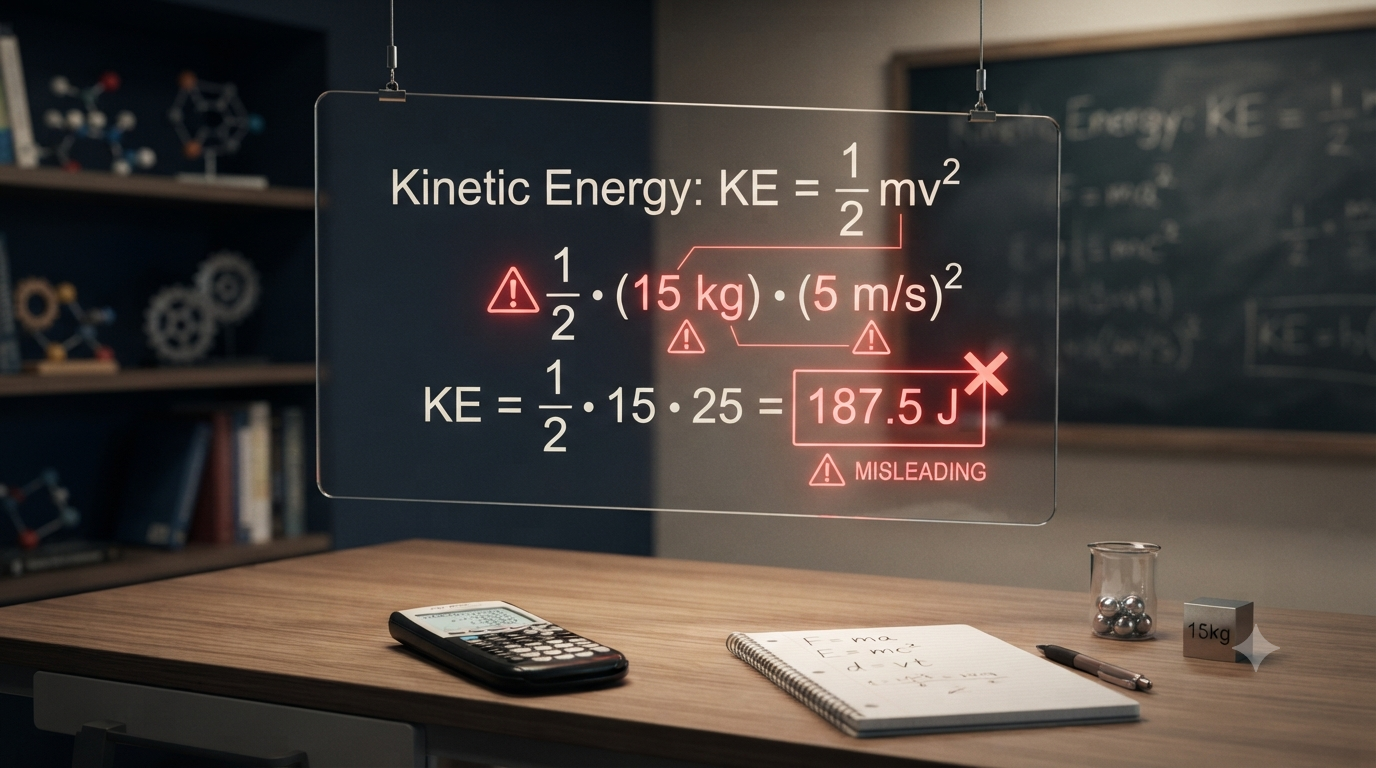
Consider the formula for kinetic energy:
Text block
K = 1/2 mv²
Here:
K is kinetic energy
m is mass
v is velocity
Suppose an object has a mass of 4 kg and a velocity of 3 m/s.
The correct substitution is:
Text block
K = 1/2 × 4 × 3²
The important detail is that the velocity must be squared.
A common mistake is to substitute the values without respecting the variables:
Text block
K = 1/2 × 3 × 4²
This may look like a small rearrangement, but it changes the calculation because the wrong quantity is being squared.
The correct result is:
Text block
K = 18 J
The incorrect substitution gives:
Text block
K = 24 J
Both answers look reasonable. The incorrect one is not obviously impossible. The mistake can be detected only by checking which value belongs to which variable.
Using the Wrong Unit
One of the most common substitution errors occurs when the numerical value is correct but the unit is not suitable for the formula.
Consider the speed formula:
Text block
v = s / t
Suppose a distance is given as 5 km and the time is 10 s.
A careless substitution might be:
Text block
v = 5 / 10
The arithmetic is correct, but depending on what the problem expects, the answer may need to be expressed in metres per second.
Since:
Text block
5 km = 5000 m
the correct calculation in SI units is:
Text block
v = 5000 m / 10 s
The first answer, 0.5 km/s, is actually equivalent to 500 m/s if the unit is retained correctly. However, if someone writes simply 0.5 m/s after treating 5 km as 5 m, the answer becomes wrong by a factor of 1000.
This shows why units should not be removed too early from a calculation.
Forgetting a Conversion Before Substitution
Sometimes a problem gives a value in one unit while the formula or other values use another unit.
For example, suppose a time is given as 2 minutes and a distance is 120 metres.
If speed is required in metres per second, the time must first be converted:
Text block
2 min = 120 s
Then:
Text block
v = 120 m / 120 s
If someone substitutes 2 directly into the formula:
Text block
v = 120 / 2
the arithmetic is correct, but the substitution is incorrect because 2 represents minutes, not seconds.
The answer of 60 m/s may look impressive and mathematically neat, but it is wrong because the units were ignored.
Using the Wrong Sign
Incorrect substitution can also occur when a value has a positive or negative sign that carries physical meaning.
Consider the equation:
Text block
v = u + at
Suppose:
u = 10 m/s
a = −2 m/s²
t = 3 s
The correct substitution is:
Text block
v = 10 + (−2)(3)
Therefore:
Text block
v = 10 − 6
If the negative sign is accidentally ignored:
Text block
v = 10 + (2)(3)
the result becomes:
Text block
v = 16 m/s
Both 4 m/s and 16 m/s look like reasonable velocities. The error is not visible from the final number alone.
The sign must be treated as part of the value.
Substituting the Wrong Power
Another common error occurs when a formula contains a square, cube, square root, or another mathematical operation.
Consider:
Text block
A = πr²
If the radius is 5 cm, the correct substitution is:
Text block
A = π(5)²
Therefore:
Text block
A = 25π cm²
A common mistake is to forget the square:
Text block
A = π(5)
which gives:
Text block
A = 5π cm²
The result is still a perfectly normal-looking number. There is no obvious sign that the answer is wrong unless the original formula is checked.
This is why it is useful to rewrite the formula with parentheses before inserting values.
Substituting a Related but Different Quantity
Some quantities are closely related and can easily be confused.
For example, speed and acceleration are both related to motion, but they are not the same quantity.
The acceleration formula is:
Text block
a = Δv / Δt
If a problem gives a velocity of 20 m/s and a time of 5 s, it does not automatically mean that 20 m/s should be substituted for Δv.
The formula requires a change in velocity, not simply the final velocity.
Suppose the initial velocity is 5 m/s and the final velocity is 20 m/s. Then:
Text block
Δv = v − u
So:
Text block
Δv = 20 − 5
The acceleration is:
Text block
a = 15 / 5
Using 20 m/s directly would give:
Text block
a = 20 / 5
Again, the result looks perfectly reasonable, but the wrong quantity was substituted.
Why the Calculator Cannot Detect the Mistake
A calculator can perform arithmetic extremely accurately, but it cannot determine whether the values entered into a formula are conceptually correct.
If you enter:
Text block
100 ÷ 20
the calculator will return 5.
It does not know whether 100 represents metres, kilograms, seconds, or something else. It also does not know whether 20 belongs in the denominator.
The calculator evaluates the operation, not the meaning behind it.
This is why using a calculator does not replace understanding the formula.
A calculator can help prevent arithmetic errors, but it cannot protect you from a substitution error.
A Correct-Looking Answer Is Not Proof of a Correct Solution
One of the most dangerous features of an incorrect substitution is that the final answer may look reasonable.
For example, if the expected answer is a speed, a value such as 5 m/s may seem completely believable. But whether 5 m/s is correct depends on how the value was obtained.
A correct-looking answer can therefore give false confidence.
Before accepting an answer, ask:
Did I identify the correct variable?
Did I use the correct value for that variable?
Did I preserve the sign?
Did I apply the correct power or root?
Did I convert the units where necessary?
Did I use the required change or difference rather than an absolute value?
Does the final unit match the quantity being calculated?
Does the answer make physical or mathematical sense?
These checks are often more valuable than simply repeating the calculation.
How to Avoid Incorrect Substitution
A reliable substitution method can make these mistakes much less likely.
Step 1: Write the Formula First
Do not immediately insert numbers.
For example:
Text block
K = 1/2 mv²
Writing the formula first makes the role of every variable visible.
Step 2: List the Known Values
Write each value next to its variable.
For example:
Text block
m = 4 kg
This prevents values from being accidentally swapped.
Step 3: Check the Units
Ask whether the units are compatible with the formula.
If necessary, convert them before substitution.
Step 4: Substitute Carefully
Use parentheses around values, especially negative numbers and quantities that will be squared or raised to another power.
For example:
Text block
v = 10 + (−2)(3)
is safer than simply writing a sequence of numbers.
Step 5: Calculate
Only after the substitution has been checked should the arithmetic be performed.
Step 6: Check the Unit
The final unit provides an important clue about whether the calculation was set up correctly.
For example, kinetic energy should have the unit joule:
Text block
1 J = 1 kg·m²/s²
If the result of a kinetic-energy calculation is expressed in metres per second, something has gone wrong.
Why Dimensional Analysis Can Catch Substitution Errors
Dimensional analysis is a powerful way to check a solution.
Suppose we calculate speed using:
Text block
v = s / t
The dimensions are:
Text block
[v] = [L] / [T]
So the result must have the dimensions of length divided by time.
If a calculation produces units of metres or seconds instead, the substitution or formula has probably been handled incorrectly.
Dimensional analysis cannot catch every possible substitution error, because two different mistakes can sometimes produce the same dimensions. However, it is an excellent first check.
Checking the Size of the Answer
Another useful method is to estimate whether the result is reasonable.
Suppose a distance of approximately 100 m is covered in approximately 20 s. Before calculating exactly, you can estimate:
Text block
100 / 20 ≈ 5
So an answer near 5 m/s makes sense.
If the calculation suddenly produces 5000 m/s, that should encourage you to investigate the substitution and unit conversions.
Estimation does not prove that an answer is correct, but it can quickly expose many large mistakes.
A Simple Example of a Hidden Substitution Error
Consider the formula:
Text block
s = ut + 1/2 at²
Suppose:
u = 5 m/s
a = 2 m/s²
t = 3 s
The correct substitution is:
Text block
s = (5)(3) + 1/2(2)(3)²
Then:
Text block
s = 15 + 9
Now imagine that the value of acceleration and velocity are accidentally swapped:
Text block
s = (2)(3) + 1/2(5)(3)²
This gives:
Text block
s = 6 + 22.5
The result of 28.5 m looks completely plausible. There is no obvious mathematical problem with it.
However, the substitution was wrong because 5 m/s belongs to u and 2 m/s² belongs to a.
This is exactly how an incorrect substitution can produce a correct-looking but wrong answer.
The Difference Between Arithmetic Errors and Substitution Errors
It is useful to distinguish between these two types of mistakes.
An arithmetic error occurs when the correct values are substituted but the calculation is performed incorrectly.
For example:
Text block
20 + 5 = 30
The setup may be correct, but the arithmetic is wrong.
A substitution error occurs earlier. The wrong value is placed into the formula, even if all subsequent arithmetic is perfect.
For example:
Text block
20 + 8
may be calculated correctly as 28, but if 8 was not the correct value for the variable, the final answer is still wrong.
This distinction matters because checking only the arithmetic will not catch a substitution error.
Substitution Is a Reasoning Step, Not Just a Calculation Step
It is tempting to think of substitution as a mechanical process: find a formula, insert numbers, and calculate.
In reality, substitution requires reasoning.
You need to understand what each variable represents and decide whether the information provided actually corresponds to that variable.
For example, a problem may give a final velocity, initial velocity, change in velocity, average velocity, and acceleration. These quantities may all have related units, but they cannot simply be exchanged.
The symbols in a formula carry meaning.
Replacing a symbol with a number without understanding that meaning can produce an answer that is mathematically neat but scientifically incorrect.
A Good Habit: Keep the Formula Visible
One of the simplest ways to reduce substitution errors is to keep the original formula visible while solving.
Instead of jumping directly from the question to a calculator, follow this pattern:
Text block
Formula:
This creates a clear chain from the original information to the final result.
If something goes wrong, you can easily return to the step where the mistake occurred.
Conclusion
An incorrect substitution can lead to a correct-looking but wrong answer because the arithmetic may be completely correct even when the values inserted into the formula are not.
The most common causes include using the wrong variable, ignoring units, forgetting conversions, dropping negative signs, applying the wrong power, confusing related quantities, or using a value that does not represent what the formula requires.
The key lesson is that a formula is more than a mathematical pattern of symbols and numbers. Each variable has a specific meaning, and every value must be matched with the correct variable before calculation begins.
A reliable solution should therefore follow a simple process: write the formula, identify each variable, check the units, substitute carefully, calculate, and then check the final unit and magnitude.
When you develop the habit of checking the meaning behind every substitution, you become much less likely to accept a neat-looking number that is actually wrong.
FAQs
1. What is an incorrect substitution in a formula?
Incorrect substitution happens when the wrong value is inserted into a variable in a mathematical or scientific formula. This can occur when two variables are confused, a value is placed in the wrong position, or a related but different quantity is used. For example, if a formula requires acceleration but velocity is substituted instead, the calculation may still produce a numerical result. The arithmetic can be completely correct, but the answer will be wrong because the input was incorrect. Careful identification of each variable before substitution helps prevent this type of error.
2. Why can an incorrect substitution produce a correct-looking answer?
An incorrect substitution can produce a correct-looking answer because calculators and mathematical operations only process the values they receive. They do not understand what those values represent. If the wrong number is substituted but the arithmetic is performed correctly, the final result can be a neat and realistic number. For example, a wrong velocity or time value may still produce a value that appears physically possible. Therefore, the appearance of the final number is not enough to confirm that a solution is correct. The variables, units, formula, and reasoning must also be checked.
3. How can using the wrong variable affect an answer?
Using the wrong variable changes the meaning of the calculation. Different variables represent different physical or mathematical quantities, even when their numerical values appear similar. For example, mass and velocity cannot be exchanged in a kinetic-energy formula simply because both are given as numbers. If the wrong variable is substituted, the resulting arithmetic may still be correct, but it will not represent the quantity described by the formula. This type of error can be difficult to notice because the final number may look reasonable. Always match every given value with its corresponding symbol before substituting it.
4. Can wrong units cause an incorrect substitution?
Yes. A numerical value without its unit can be misleading during substitution. For example, treating 2 minutes as 2 seconds changes the calculation significantly. The number 2 is correct, but its unit does not match what the formula requires. This can produce a result that looks mathematically valid but is physically incorrect. Unit conversion should therefore be completed before or during substitution whenever necessary. Keeping units attached to values makes these errors easier to detect. Checking the final unit is also useful because it can reveal whether incompatible quantities were accidentally used.
5. Why is it important to keep units during calculations?
Keeping units during calculations helps you understand what each number represents and provides an additional way to check your work. Suppose distance is measured in metres and time in seconds. Writing the units while substituting makes it clear that the resulting quantity should have units of metres per second. If the final unit does not match the quantity being calculated, an error may have occurred. Units can therefore expose mistakes that the numerical answer alone cannot reveal. They are especially important in physics, chemistry, engineering, and other subjects where different quantities may have similar-looking numerical values.
6. How can a wrong sign lead to a wrong answer?
A positive or negative sign can carry important mathematical or physical information. Ignoring a negative sign during substitution can completely change the result while still producing a perfectly normal-looking number. For example, if acceleration is −2 m/s², replacing it with +2 m/s² changes the direction of acceleration and therefore changes the final velocity. The calculator will perform either calculation correctly, but only one represents the given situation. Negative signs should always be treated as part of the value rather than as optional symbols. Writing negative values inside parentheses can help prevent sign errors.
7. How can powers cause substitution errors?
Powers such as squares and cubes are part of the formula and must be applied to the correct quantity. For example, in the formula A = πr², the radius must be squared. If a value of 5 is substituted and the square is accidentally ignored, the calculation becomes π × 5 instead of π × 5². The resulting number may still look reasonable, but it does not follow the original formula. Similar mistakes can occur with velocity squared, distance squared, or quantities raised to other powers. Carefully rewriting the formula before substitution helps ensure that the correct mathematical operation is applied.
8. Can a calculator detect an incorrect substitution?
No. A calculator can check arithmetic, but it cannot determine whether the values entered into a formula are conceptually correct. If you enter the wrong variable, incorrect unit conversion, or wrong sign, the calculator will still produce an accurate result for the numbers it receives. For this reason, calculators should be used after the formula and substitution have been checked. A good approach is to write the formula, identify each known value, substitute the values with their units, and then use the calculator for the arithmetic. This separates reasoning from calculation and reduces hidden errors.
9. How can dimensional analysis help detect substitution errors?
Dimensional analysis checks whether the units or dimensions of a calculation are consistent. For example, speed is calculated using distance divided by time, so its dimensions are length divided by time. If a supposed speed calculation produces units such as kilograms or seconds squared, something is likely wrong. Dimensional analysis cannot detect every substitution error, especially when the wrong quantities have compatible dimensions. However, it is a powerful checking method because it can identify many unit-related mistakes quickly. Using dimensional analysis together with careful substitution provides a stronger way to verify mathematical and scientific calculations.
10. What is the best way to avoid incorrect substitution?
The best approach is to make substitution a separate step rather than immediately entering numbers into a calculator. First, write the formula clearly. Then identify what each variable represents and write the known value next to the correct symbol. Check the units and convert them when necessary. Pay attention to negative signs, powers, fractions, and differences between related quantities. Next, substitute the values using parentheses where helpful and perform the calculation. Finally, check the unit and approximate size of the answer. This simple process makes it much easier to catch a correct-looking result that is actually wrong.