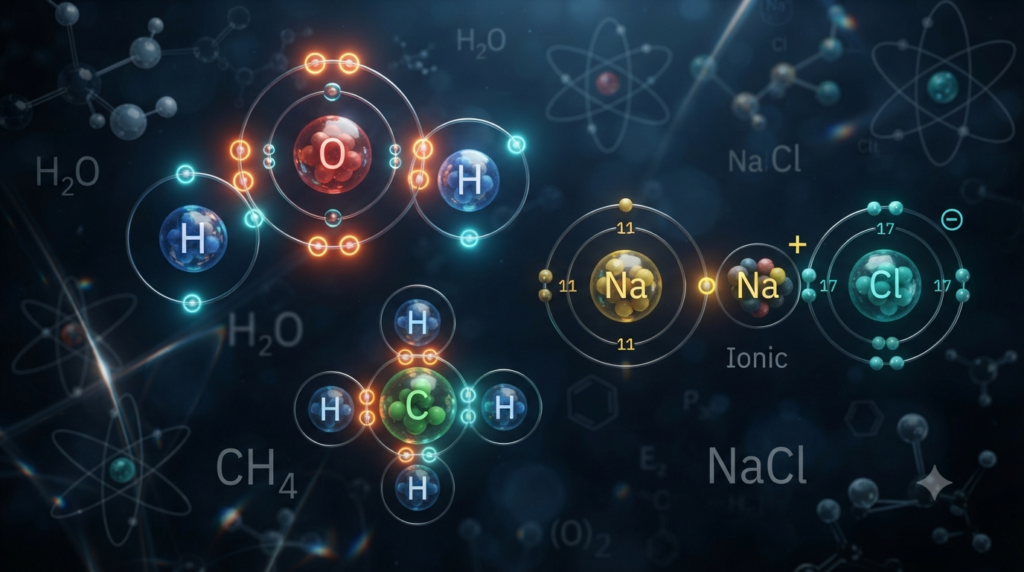
Salts are an important group of chemical compounds found in laboratories, industries, food, agriculture, medicines, and everyday materials. In chemistry, a salt is generally an ionic compound formed when the positive ion of a base or another source combines with the negative ion of an acid. Although sodium chloride is the most familiar example, there are many other salts with different chemical formulas and properties.
Learning the formulas of common salts helps in understanding chemical reactions, writing balanced equations, identifying ions, and studying acids, bases, and neutralization reactions. Some salts contain simple ions such as Na⁺ and Cl⁻, while others contain polyatomic ions such as SO₄²⁻, CO₃²⁻, NO₃⁻, and NH₄⁺. The correct formula of a salt depends on the charges of its ions.
What Is a Salt in Chemistry?
A salt is an ionic compound made up of positively charged ions called cations and negatively charged ions called anions. The total positive and negative charges in a salt must balance, making the compound electrically neutral.
For example, sodium chloride contains sodium ions and chloride ions. Sodium has a charge of +1, while chloride has a charge of −1. Therefore, one sodium ion combines with one chloride ion to form:
NaCl
Another example is calcium chloride. Calcium forms Ca²⁺ ions, while chloride forms Cl⁻ ions. Two chloride ions are required to balance the +2 charge of one calcium ion:
CaCl₂
This charge-balancing principle is one of the most important ideas for writing salt formulas.
How Are Salt Formulas Written?
To write the formula of a salt, first identify the cation and anion and then determine their charges. The numbers of ions are chosen so that the total positive charge equals the total negative charge.
For example, consider magnesium chloride.
Magnesium ion = Mg²⁺
Chloride ion = Cl⁻
One Mg²⁺ ion needs two Cl⁻ ions:
MgCl₂
Similarly, aluminium sulfate contains Al³⁺ and SO₄²⁻ ions. The smallest combination that balances the charges contains two aluminium ions and three sulfate ions:
Al₂(SO₄)₃
Parentheses are used around sulfate because the sulfate ion occurs three times in the formula.
Common Formulas of Sodium Salts
Sodium forms the Na⁺ ion and combines with many different anions to form common salts.
Sodium Chloride
Formula: NaCl
Sodium chloride is commonly known as table salt. It is widely used in food preparation and preservation. It is also an important raw material in the chemical industry.
Sodium Carbonate
Formula: Na₂CO₃
Sodium carbonate is commonly called washing soda when found in its hydrated form. It is used in cleaning products, water treatment, glass manufacturing, and several industrial processes.
Sodium Bicarbonate
Formula: NaHCO₃
Sodium bicarbonate is commonly known as baking soda. It is used in baking, cleaning, and some laboratory and industrial applications.
Sodium Sulfate
Formula: Na₂SO₄
Sodium sulfate is an important industrial salt used in applications such as detergents, paper production, and chemical manufacturing.
Sodium Nitrate
Formula: NaNO₃
Sodium nitrate is a nitrate salt used in fertilizers and various industrial processes.
Common Formulas of Potassium Salts
Potassium generally forms the K⁺ ion.
Potassium Chloride
Formula: KCl
Potassium chloride is used as a source of potassium in fertilizers and has applications in medicine and industry.
Potassium Nitrate
Formula: KNO₃
Potassium nitrate is commonly known as saltpetre. It is used in fertilizers and several industrial applications.
Potassium Sulfate
Formula: K₂SO₄
Potassium sulfate is an important potassium-containing fertilizer, particularly where crops require potassium without additional chloride.
Potassium Carbonate
Formula: K₂CO₃
Potassium carbonate is used in glass production, soap manufacturing, and other chemical processes.
Common Formulas of Calcium Salts
Calcium commonly forms the Ca²⁺ ion.
Calcium Chloride
Formula: CaCl₂
Calcium chloride is widely used for moisture control, de-icing, dust suppression, and several industrial processes.
Calcium Carbonate
Formula: CaCO₃
Calcium carbonate occurs naturally in materials such as limestone, marble, and chalk. It is also found in shells and other biological structures. It is widely used in construction, manufacturing, and other applications.
Calcium Sulfate
Formula: CaSO₄
Calcium sulfate is an important mineral compound. Its hydrated forms are associated with materials such as gypsum and plaster of Paris.
Calcium Nitrate
Formula: Ca(NO₃)₂
Calcium nitrate is a water-soluble salt used mainly as a fertilizer and in some industrial applications.
Common Formulas of Magnesium Salts
Magnesium usually forms Mg²⁺ ions.
Magnesium Chloride
Formula: MgCl₂
Magnesium chloride is found naturally in seawater and mineral deposits. It is used in various industrial and chemical applications.
Magnesium Sulfate
Formula: MgSO₄
Magnesium sulfate is commonly encountered as Epsom salt when it occurs as the heptahydrate, MgSO₄·7H₂O. It has applications in agriculture, laboratories, and other fields.
Magnesium Carbonate
Formula: MgCO₃
Magnesium carbonate occurs naturally as the mineral magnesite and is used in several industrial applications.
Common Formulas of Aluminium Salts
Aluminium commonly forms the Al³⁺ ion.
Aluminium Chloride
Formula: AlCl₃
Aluminium chloride is an important chemical used in industrial chemistry and as a catalyst in some chemical reactions.
Aluminium Sulfate
Formula: Al₂(SO₄)₃
Aluminium sulfate is widely used in water treatment and in the paper industry.
Aluminium Nitrate
Formula: Al(NO₃)₃
Aluminium nitrate is an ionic compound containing aluminium and nitrate ions and is used in laboratory and industrial chemistry.
Common Formulas of Ammonium Salts
Ammonium is a polyatomic cation with the formula NH₄⁺. Because its charge is +1, it can combine with many anions in a similar way to sodium and potassium.
Ammonium Chloride
Formula: NH₄Cl
Ammonium chloride is commonly known as sal ammoniac. It is used in laboratories, metal processing, fertilizers, and other applications.
Ammonium Sulfate
Formula: (NH₄)₂SO₄
Ammonium sulfate is an important nitrogen- and sulfur-containing fertilizer.
Ammonium Nitrate
Formula: NH₄NO₃
Ammonium nitrate is an important nitrogen fertilizer. Its handling and storage are subject to safety regulations because of its hazardous properties under certain conditions.
Ammonium Carbonate
Formula: (NH₄)₂CO₃
Ammonium carbonate is an ammonium salt used in some industrial and laboratory applications.
Common Formulas of Copper Salts
Copper can form more than one type of ion, with Cu²⁺ being especially common in many familiar salts.
Copper(II) Sulfate
Formula: CuSO₄
Copper(II) sulfate is a well-known laboratory chemical. Its pentahydrate form, CuSO₄·5H₂O, is commonly called blue vitriol because of its characteristic blue crystals.
Copper(II) Chloride
Formula: CuCl₂
Copper(II) chloride is an ionic copper compound used in laboratory and industrial chemistry.
Copper(II) Nitrate
Formula: Cu(NO₃)₂
Copper(II) nitrate contains copper(II) and nitrate ions and is used in chemical research and laboratory applications.
Common Formulas of Iron Salts
Iron commonly forms Fe²⁺ and Fe³⁺ ions, so the oxidation state must be specified when naming many iron salts.
Iron(II) Sulfate
Formula: FeSO₄
Iron(II) sulfate is also called ferrous sulfate. It is used in chemistry and has applications related to iron supplementation and water treatment.
Iron(III) Chloride
Formula: FeCl₃
Iron(III) chloride, also called ferric chloride, is widely used in water and wastewater treatment and in laboratory chemistry.
Iron(II) Chloride
Formula: FeCl₂
Iron(II) chloride contains Fe²⁺ ions and chloride ions.
Iron(III) Sulfate
Formula: Fe₂(SO₄)₃
Iron(III) sulfate contains Fe³⁺ and sulfate ions. Two Fe³⁺ ions provide a total charge of +6, while three sulfate ions provide −6.
Common Formulas of Zinc Salts
Zinc usually forms Zn²⁺ ions.
Zinc Chloride
Formula: ZnCl₂
Zinc chloride is used in chemical processing, metal treatment, and laboratory applications.
Zinc Sulfate
Formula: ZnSO₄
Zinc sulfate is an important zinc-containing compound used in agriculture, industry, and some nutritional applications.
Zinc Carbonate
Formula: ZnCO₃
Zinc carbonate occurs naturally as the mineral smithsonite and is used in some industrial applications.
Common Formulas of Silver Salts
Silver commonly forms Ag⁺ ions.
Silver Nitrate
Formula: AgNO₃
Silver nitrate is an important laboratory reagent. It is used in chemical analysis and in several specialized applications.
Silver Chloride
Formula: AgCl
Silver chloride is poorly soluble in water and is often used as an example when studying precipitation reactions.
For example:
AgNO₃ + NaCl → AgCl + NaNO₃
Here, silver chloride forms as a precipitate.
Common Formulas of Lead Salts
Lead commonly forms Pb²⁺ ions in many familiar compounds.
Lead(II) Nitrate
Formula: Pb(NO₃)₂
Lead(II) nitrate is a soluble lead salt used mainly in laboratory and chemical applications.
Lead(II) Chloride
Formula: PbCl₂
Lead(II) chloride is only sparingly soluble in water and can form as a precipitate in suitable reactions.
Common Formulas of Barium Salts
Barium generally forms Ba²⁺ ions.
Barium Chloride
Formula: BaCl₂
Barium chloride is a soluble barium salt used in laboratory chemistry.
Barium Sulfate
Formula: BaSO₄
Barium sulfate is highly insoluble in water. This property makes it useful in laboratory precipitation reactions and certain medical imaging applications.
A common precipitation reaction is:
BaCl₂ + Na₂SO₄ → BaSO₄ + 2NaCl
Common Formulas of Acetate Salts
The acetate ion is commonly written as CH₃COO⁻ or C₂H₃O₂⁻. It forms salts with many cations.
Sodium Acetate
Formula: CH₃COONa
Sodium acetate is used in chemical laboratories, food-related applications, and heat-pack technology.
Calcium Acetate
Formula: Ca(CH₃COO)₂
Calcium acetate is a calcium salt of acetic acid and has applications in food and industrial chemistry.
Common Formulas of Phosphate Salts
The phosphate ion is PO₄³⁻. Because it carries a −3 charge, it often requires two or three cations depending on the charge of the positive ion.
Sodium Phosphate
Formula: Na₃PO₄
Three Na⁺ ions are required to balance one PO₄³⁻ ion.
Calcium Phosphate
Formula: Ca₃(PO₄)₂
Three Ca²⁺ ions provide a total positive charge of +6, while two PO₄³⁻ ions provide a total negative charge of −6.
Calcium phosphate is an important component of minerals found in bones and teeth.
Common Formulas of Carbonate Salts
The carbonate ion is CO₃²⁻.
Some common carbonate salts include:
Sodium carbonate — Na₂CO₃
Calcium carbonate — CaCO₃
Magnesium carbonate — MgCO₃
Potassium carbonate — K₂CO₃
Zinc carbonate — ZnCO₃
Carbonate salts are important in geology, construction, manufacturing, and biological systems.
Common Formulas of Sulfate Salts
The sulfate ion is SO₄²⁻.
Some common sulfate salts are:
Sodium sulfate — Na₂SO₄
Potassium sulfate — K₂SO₄
Calcium sulfate — CaSO₄
Magnesium sulfate — MgSO₄
Copper(II) sulfate — CuSO₄
Zinc sulfate — ZnSO₄
Barium sulfate — BaSO₄
The sulfate ion is especially useful for understanding how polyatomic ions behave when forming ionic compounds.
Common Formulas of Nitrate Salts
The nitrate ion is NO₃⁻.
Common nitrate salts include:
Sodium nitrate — NaNO₃
Potassium nitrate — KNO₃
Calcium nitrate — Ca(NO₃)₂
Magnesium nitrate — Mg(NO₃)₂
Silver nitrate — AgNO₃
Copper(II) nitrate — Cu(NO₃)₂
Ammonium nitrate — NH₄NO₃
Because nitrate has a −1 charge, a metal ion with a +2 charge requires two nitrate ions.
For example:
Ca²⁺ + 2NO₃⁻ → Ca(NO₃)₂
Common Formulas of Chloride Salts
The chloride ion is Cl⁻, making it one of the simplest anions used in salt formulas.
Common chloride salts include:
Sodium chloride — NaCl
Potassium chloride — KCl
Calcium chloride — CaCl₂
Magnesium chloride — MgCl₂
Aluminium chloride — AlCl₃
Ammonium chloride — NH₄Cl
Zinc chloride — ZnCl₂
Copper(II) chloride — CuCl₂
Iron(III) chloride — FeCl₃
The number of chloride ions depends on the charge of the cation.
Hydrated Salts
Some salts contain water molecules as part of their crystal structure. These are called hydrated salts. The water associated with the salt is called water of crystallization.
The number of water molecules is shown after a dot in the formula.
For example:
CuSO₄·5H₂O
This is copper(II) sulfate pentahydrate.
Another example is:
MgSO₄·7H₂O
This is magnesium sulfate heptahydrate, commonly known as Epsom salt.
Hydrated and anhydrous forms of the same salt can have different physical appearances and properties.
Quick Table of Common Salt Formulas
| Salt | Chemical Formula |
|---|
| Sodium chloride | NaCl |
| Sodium carbonate | Na₂CO₃ |
| Sodium bicarbonate | NaHCO₃ |
| Sodium sulfate | Na₂SO₄ |
| Sodium nitrate | NaNO₃ |
| Potassium chloride | KCl |
| Potassium nitrate | KNO₃ |
| Potassium sulfate | K₂SO₄ |
| Calcium chloride | CaCl₂ |
| Calcium carbonate | CaCO₃ |
| Calcium sulfate | CaSO₄ |
| Calcium nitrate | Ca(NO₃)₂ |
| Magnesium chloride | MgCl₂ |
| Magnesium sulfate | MgSO₄ |
| Aluminium chloride | AlCl₃ |
| Aluminium sulfate | Al₂(SO₄)₃ |
| Ammonium chloride | NH₄Cl |
| Ammonium sulfate | (NH₄)₂SO₄ |
| Ammonium nitrate | NH₄NO₃ |
| Copper(II) sulfate | CuSO₄ |
| Copper(II) chloride | CuCl₂ |
| Zinc chloride | ZnCl₂ |
| Zinc sulfate | ZnSO₄ |
| Silver nitrate | AgNO₃ |
| Barium sulfate | BaSO₄ |
| Iron(II) sulfate | FeSO₄ |
| Iron(III) chloride | FeCl₃ |
| Lead(II) nitrate | Pb(NO₃)₂ |
| Calcium phosphate | Ca₃(PO₄)₂ |
Why Learning Salt Formulas Is Important
Knowing common salt formulas makes many areas of chemistry easier to understand. Salt formulas are used when writing chemical equations, predicting products, studying solubility, identifying precipitates, and calculating molar masses.
They also help connect chemical names with ions. For example, recognizing that sulfate is SO₄²⁻ makes it easier to understand why aluminium sulfate is Al₂(SO₄)₃ rather than AlSO₄. Similarly, knowing that nitrate is NO₃⁻ explains why calcium nitrate is Ca(NO₃)₂.
The key is not simply to memorize a long list. Understanding ion charges provides a reliable way to construct many formulas even when the salt is unfamiliar.
Conclusion
Common salts have a wide variety of chemical formulas, but their formulas follow a clear principle: the total positive charge must balance the total negative charge. Understanding the charges of common ions such as Na⁺, K⁺, Ca²⁺, Mg²⁺, Al³⁺, Cl⁻, NO₃⁻, SO₄²⁻, CO₃²⁻, and PO₄³⁻ makes salt formulas much easier to write and understand.
From familiar sodium chloride to compounds such as aluminium sulfate, calcium phosphate, copper(II) sulfate, and ammonium nitrate, these formulas appear throughout chemistry. Learning their patterns helps build a strong foundation for chemical equations, reactions, ionic compounds, and further study of chemistry.