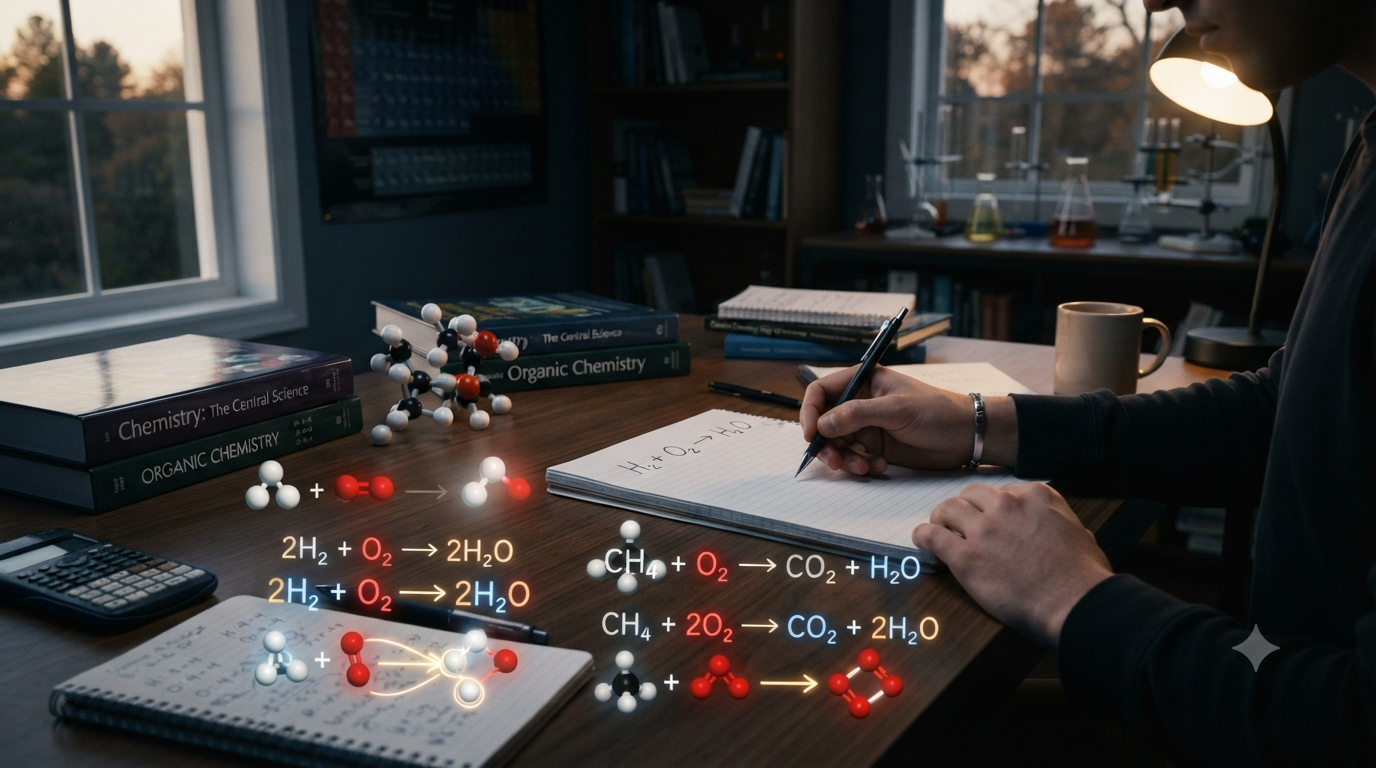
Chemical reactions describe how substances change into new substances. In chemistry, these changes are written using chemical equations. A chemical equation shows the reactants that take part in a reaction and the products that are formed. However, simply writing the correct chemical formulas is not enough. A chemical equation must also obey the law of conservation of mass, which states that matter is neither created nor destroyed during a chemical reaction.
This is why chemical equations need to be balanced. Balancing an equation means adjusting the number of molecules or formula units involved so that every element has the same number of atoms on both sides of the equation. Chemical formulas play an important role because they tell us which elements are present and how many atoms of each element are contained in a substance. By learning how to read formulas and change coefficients without changing formulas, you can balance chemical equations systematically and accurately.
What Is a Chemical Formula?
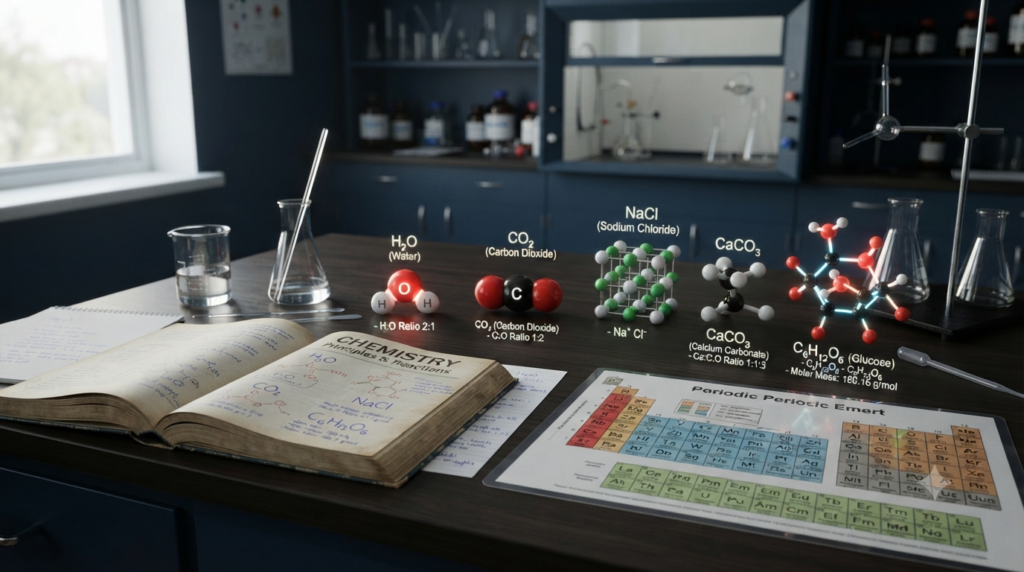
A chemical formula is a short way of representing the composition of a substance. It uses chemical symbols and subscripts to show which elements are present and how many atoms of each element are contained in a molecule or formula unit.
For example:
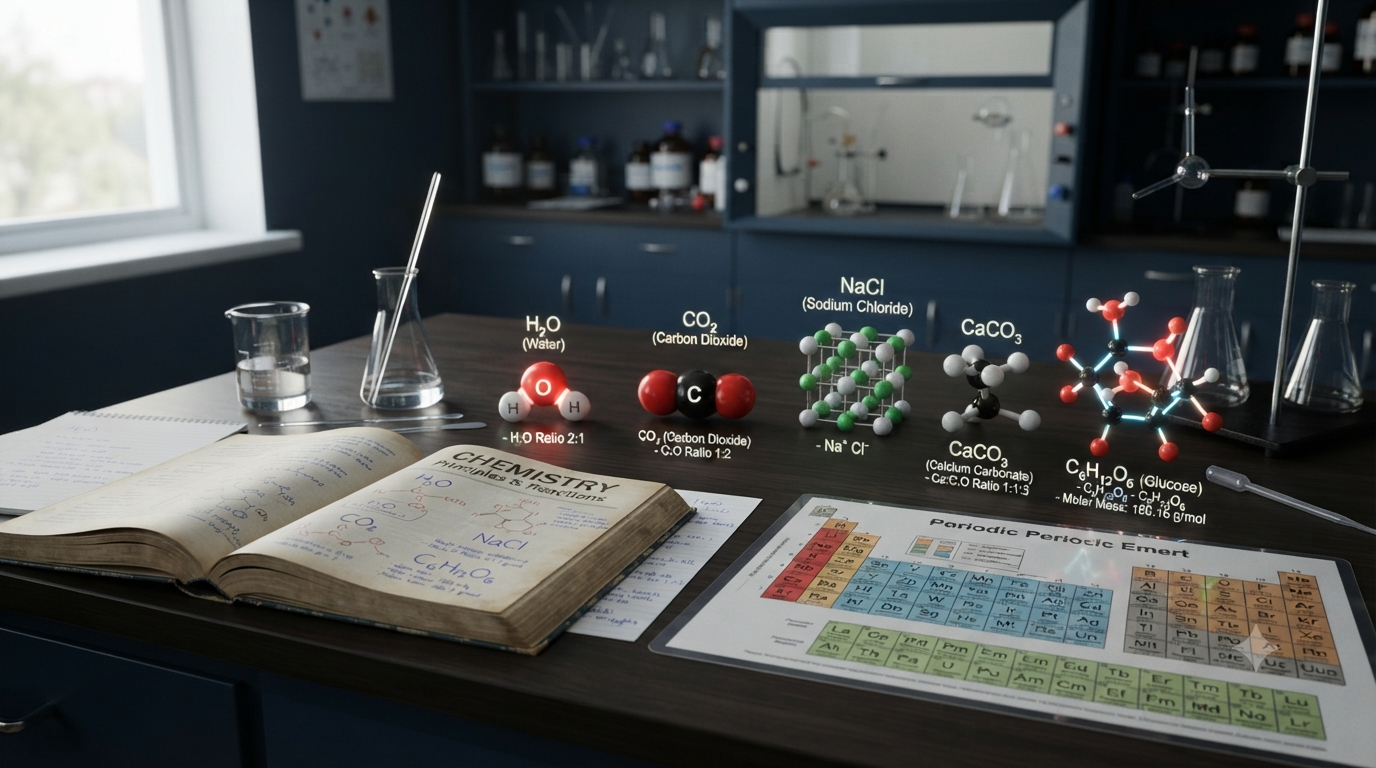
H₂O
The formula H₂O represents water. It contains two hydrogen atoms and one oxygen atom.
Similarly:
CO₂
The formula CO₂ represents carbon dioxide. It contains one carbon atom and two oxygen atoms.
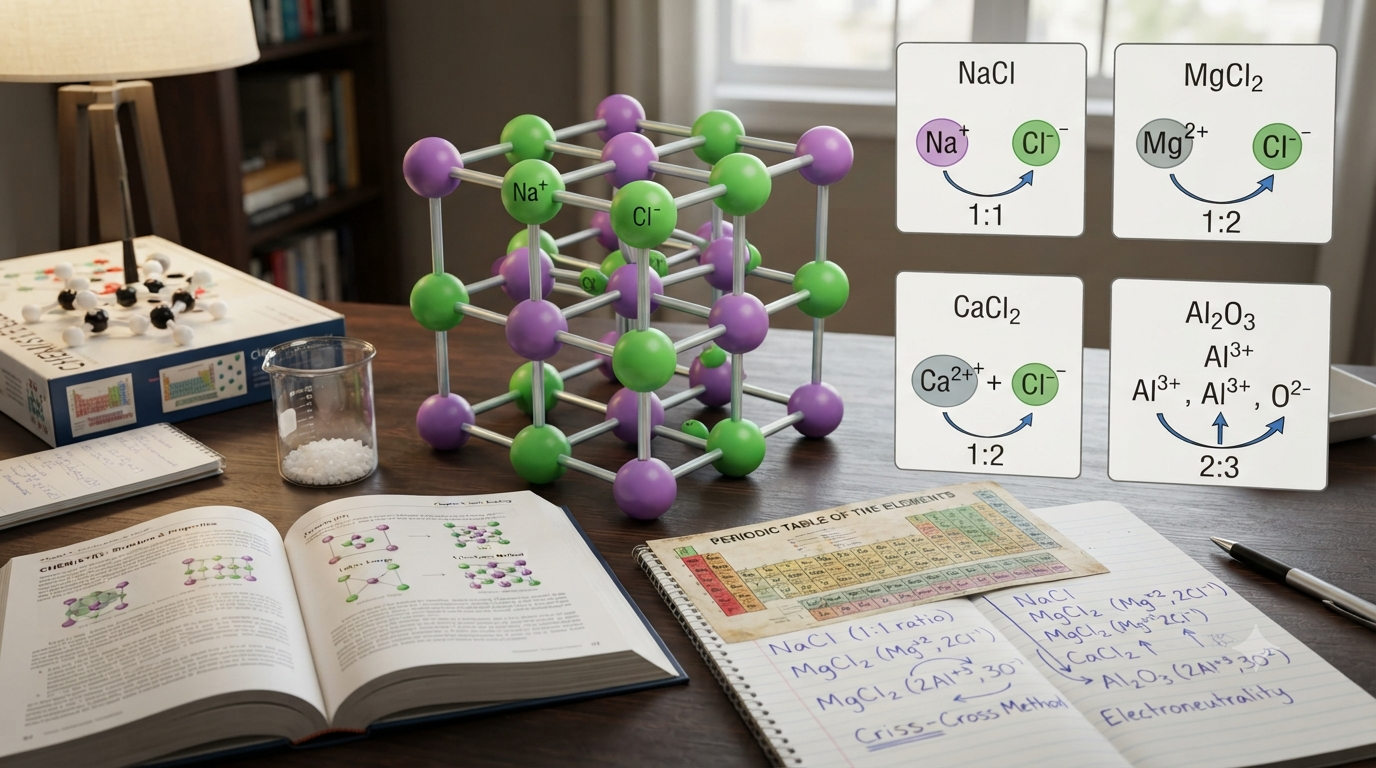
A formula such as CaCl₂ contains one calcium atom and two chlorine atoms.
The small numbers written below the element symbols are called subscripts. They are extremely important when balancing equations because they determine the number of atoms present in each substance.
How Chemical Formulas Help in Balancing Equations
Consider the formation of water from hydrogen and oxygen:
H₂ + O₂ → H₂O
The formulas tell us the number of atoms involved.
On the left side:
H₂ contains 2 hydrogen atoms.
O₂ contains 2 oxygen atoms.
On the right side:
H₂O contains 2 hydrogen atoms.
H₂O contains 1 oxygen atom.
Hydrogen is already balanced, but oxygen is not. There are two oxygen atoms on the reactant side and only one on the product side.
To correct this, we need to change the number of water molecules. We do this by placing a coefficient before the formula:
H₂ + O₂ → 2H₂O
Now there are four hydrogen atoms on the right, so hydrogen must also be adjusted:
2H₂ + O₂ → 2H₂O
The final equation has four hydrogen atoms and two oxygen atoms on each side.
This example demonstrates the most important principle of balancing: change coefficients, not subscripts.
Coefficients and Subscripts Are Different
Understanding the difference between coefficients and subscripts is essential.
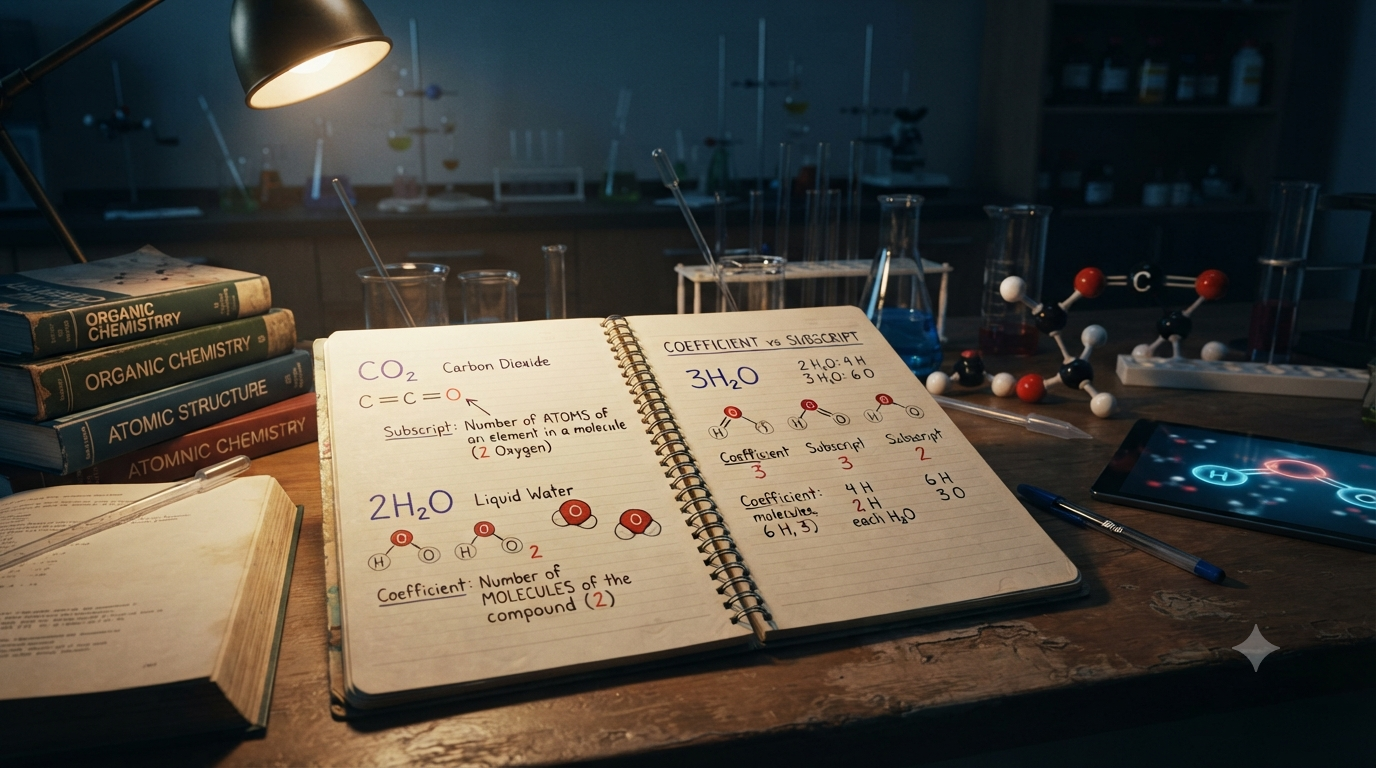
A subscript tells you how many atoms of an element are present in one molecule or formula unit.
For example:
2H₂O
The coefficient 2 means there are two water molecules. Each water molecule contains two hydrogen atoms and one oxygen atom.
Therefore:
Hydrogen atoms = 2 × 2 = 4
Oxygen atoms = 2 × 1 = 2
A coefficient changes the number of particles without changing the identity of the substance.
A subscript, however, changes the chemical formula itself.
For example:
H₂O
is water, while
H₂O₂
is hydrogen peroxide. They are different substances with different chemical properties.
Therefore, you should never balance an equation by changing a subscript. The correct method is to add suitable coefficients in front of chemical formulas.
Step 1 Identify the Reactants and Products
Before balancing an equation, identify what substances are reacting and what substances are being produced.
The substances on the left side of the arrow are called reactants. The substances on the right side are called products.
For example:
CH₄ + O₂ → CO₂ + H₂O
Here:
CH₄ and O₂ are reactants.
CO₂ and H₂O are products.
Knowing the formulas allows you to count the atoms of each element on both sides.
Step 2 Write the Correct Chemical Formulas
Balancing should begin only after the correct formulas have been written.
Suppose methane reacts with oxygen to produce carbon dioxide and water:
CH₄ + O₂ → CO₂ + H₂O
The formulas are already correct, so the next step is to count the atoms.
Reactant side:
Carbon = 1
Hydrogen = 4
Oxygen = 2
Product side:
Carbon = 1
Hydrogen = 2
Oxygen = 3 total
The equation is not balanced.
Step 3 Count Each Element
Create an atom count for every element appearing in the equation.
For:
CH₄ + O₂ → CO₂ + H₂O
we have:
| Element | Reactants | Products |
|---|---|---|
| Carbon | 1 | 1 |
| Hydrogen | 4 | 2 |
| Oxygen | 2 | 3 |
Carbon is balanced, but hydrogen and oxygen are not.
Counting atoms carefully helps prevent mistakes, especially in equations containing several different elements.
Step 4 Balance One Element at a Time
Start with an element that appears in relatively few compounds.
In methane combustion, carbon is already balanced. Hydrogen can be balanced next.
There are four hydrogen atoms in CH₄ but only two in H₂O. Place a coefficient 2 before H₂O:
CH₄ + O₂ → CO₂ + 2H₂O
Now the atom counts are:
Carbon = 1 on each side
Hydrogen = 4 on each side
Oxygen = 2 on the left and 4 on the right
Oxygen is now the only unbalanced element.
Place a coefficient 2 before O₂:
CH₄ + 2O₂ → CO₂ + 2H₂O
Now:
Carbon = 1 on both sides
Hydrogen = 4 on both sides
Oxygen = 4 on both sides
The equation is balanced.
Step 5 Use the Smallest Whole Number Coefficients
A properly balanced chemical equation is normally written using the smallest possible whole-number coefficients.
For example:
2H₂ + O₂ → 2H₂O
is balanced.
Although multiplying every coefficient by 2 would also conserve atoms:
4H₂ + 2O₂ → 4H₂O
this is not normally used because the coefficients can be simplified.
The simplest whole-number ratio is preferred because it clearly represents the relative amounts of substances involved in the reaction.
Step 6 Check the Equation Again
Never assume an equation is balanced simply because the coefficients look correct. Count every element again.
For:
2H₂ + O₂ → 2H₂O
we have:
Reactants:
Hydrogen = 4
Oxygen = 2
Products:
Hydrogen = 4
Oxygen = 2
Both sides contain the same number of atoms of every element, so the equation is balanced.
This final check is especially important for complicated equations.
Balancing Equations With More Than Two Elements
Some chemical equations contain several elements and compounds.
Consider the reaction:
N₂ + H₂ → NH₃
The reactant side contains:
Nitrogen = 2
Hydrogen = 2
The product side contains:
Nitrogen = 1
Hydrogen = 3
First balance nitrogen by placing 2 before NH₃:
N₂ + H₂ → 2NH₃
Now nitrogen is balanced, but hydrogen has become six atoms on the product side.
Place 3 before H₂:
N₂ + 3H₂ → 2NH₃
Now both elements are balanced:
Nitrogen = 2 on each side
Hydrogen = 6 on each side
How to Handle Polyatomic Ions
Some chemical formulas contain groups of atoms that behave as a unit in a reaction. These groups are called polyatomic ions.
Examples include:
SO₄²⁻
NO₃⁻
CO₃²⁻
OH⁻
When the same polyatomic ion appears unchanged on both sides of an equation, it can sometimes be balanced as a single unit rather than counting each atom separately.
For example:
Ca(OH)₂ + HCl → CaCl₂ + H₂O
The hydroxide group contains one oxygen and one hydrogen atom. The subscript 2 outside the parentheses means there are two OH groups.
A useful strategy is to recognize repeated groups and balance them carefully before checking individual atoms.
Parentheses in Chemical Formulas
Parentheses can make chemical formulas look more complicated, but their meaning is straightforward.
Consider:
Al₂(SO₄)₃
The subscript 3 outside the parentheses applies to the entire sulfate group.
Therefore:
Aluminium = 2 atoms
Sulfur = 3 atoms
Oxygen = 12 atoms
The sulfate group SO₄ contains one sulfur atom and four oxygen atoms. Because there are three sulfate groups, there are 3 sulfur atoms and 12 oxygen atoms.
Understanding parentheses and subscripts is essential when counting atoms in complex compounds.
Common Mistakes When Balancing Chemical Equations
One of the most common mistakes is changing subscripts instead of coefficients. Changing a subscript changes the substance itself and therefore changes the reaction.
Another mistake is forgetting that a coefficient multiplies the entire formula. For example:
3Ca(OH)₂
contains:
Calcium = 3
Oxygen = 6
Hydrogen = 6
The coefficient 3 applies to every atom represented by the formula.
A third mistake is balancing only one element and stopping. Every element must have equal atom counts on both sides.
It is also easy to lose track of atoms in equations containing parentheses. Writing a small atom-count table can make the process much easier.
A Useful Strategy for Difficult Equations
For more complicated equations, use a systematic approach.
First, write the correct formulas. Next, list every element that appears. Count the atoms on both sides. Then balance one element at a time by changing coefficients.
If an element appears in only one compound on each side, it is often convenient to balance it first. Elements appearing in several compounds may be left until later.
If oxygen and hydrogen appear in several compounds, they are often easier to balance toward the end.
After all elements appear balanced, reduce the coefficients to the smallest whole-number ratio and perform one final atom count.
Why Chemical Equations Must Be Balanced
Balancing is not simply a mathematical exercise. It represents a fundamental property of chemical reactions.
Atoms do not disappear during an ordinary chemical reaction, nor are new atoms created from nothing. Instead, the atoms present in the reactants are rearranged to form the products.
For example, when hydrogen and oxygen form water, the hydrogen and oxygen atoms are rearranged into water molecules. The total number of hydrogen and oxygen atoms remains unchanged.
A balanced equation therefore provides a quantitative description of a chemical reaction. It tells us the relative numbers of particles involved and forms the foundation for calculations involving masses, moles, and chemical quantities.
Chemical Formulas and Stoichiometry
Balanced equations are also essential for stoichiometry, the quantitative study of relationships between substances in chemical reactions.
Consider:
2H₂ + O₂ → 2H₂O
The coefficients show the ratio:
2 : 1 : 2
This means two units of hydrogen react with one unit of oxygen to produce two units of water, when expressed in terms of molecules or, at the mole scale, moles.
Without a balanced equation, these quantitative relationships cannot be determined correctly.
Therefore, learning to balance chemical equations is an important foundation for more advanced chemistry.
Final Checklist for Balancing Chemical Equations
Before considering an equation complete, check the following:
Are the chemical formulas correct?
Have all reactants and products been identified?
Have you counted every element?
Are you changing only coefficients?
Are the numbers of atoms equal on both sides?
Have you checked formulas containing parentheses?
Are the coefficients whole numbers?
Can the coefficients be reduced to a simpler ratio?
Have you performed a final atom count?
Following this checklist can make balancing equations much more reliable.
Conclusion
Chemical formulas provide the information needed to balance chemical equations because they show which elements are present and how many atoms each substance contains. By carefully reading subscripts, counting atoms, and adjusting coefficients, a chemical equation can be balanced without changing the identity of any substance. The key rule is simple: change coefficients, never subscripts. Start by identifying the reactants and products, count each element, balance one element at a time, and then verify the final equation. Once this method becomes familiar, even more complex chemical equations can be approached logically and confidently. Balanced equations are not only important for understanding reactions but also for performing accurate chemical calculations and studying stoichiometry.
FAQs
1. What does it mean to balance a chemical equation?
Balancing a chemical equation means making sure that the number of atoms of every element is the same on both the reactant and product sides. This follows the law of conservation of mass, which states that atoms are not created or destroyed during a chemical reaction. To balance an equation, coefficients are placed before chemical formulas to change the number of molecules or formula units involved. For example, H₂ + O₂ → H₂O becomes 2H₂ + O₂ → 2H₂O. The balanced equation contains four hydrogen atoms and two oxygen atoms on each side, accurately representing the reaction.
2. Why is it important to balance chemical equations?
Chemical equations must be balanced because chemical reactions conserve atoms. The same types and numbers of atoms present in the reactants must also be present in the products. A balanced equation provides the correct quantitative relationship between substances participating in a reaction. These relationships are essential for chemical calculations involving masses, moles, and amounts of reactants and products. For example, 2H₂ + O₂ → 2H₂O shows that two hydrogen molecules react with one oxygen molecule to form two water molecules. Without balancing, the equation would not correctly represent the proportions in which the substances react.
3. What is the difference between a coefficient and a subscript?
A coefficient is a number placed before a chemical formula, while a subscript is a small number written within a formula after an element symbol. A coefficient changes the number of molecules or formula units without changing the substance. For example, 2H₂O represents two water molecules. A subscript tells how many atoms of an element are present in one molecule or formula unit. In H₂O, the subscript 2 means two hydrogen atoms. When balancing equations, coefficients should be changed, but subscripts should not be changed because changing a subscript changes the identity and composition of the substance.
4. How do you balance a chemical equation step by step?
First, write the correct chemical formulas for all reactants and products. Next, count the atoms of each element on both sides of the equation. Identify which elements are unbalanced and place suitable coefficients before the formulas. Balance one element at a time, usually starting with elements that appear in fewer compounds. Leave hydrogen and oxygen until later when they occur in several substances. After adjusting the coefficients, count all atoms again. Finally, make sure the coefficients are the smallest possible whole numbers. For example, methane combustion can be balanced as CH₄ + 2O₂ → CO₂ + 2H₂O.
5. Can you change subscripts when balancing an equation?
No. Subscripts should not be changed when balancing a chemical equation. A subscript determines the composition and identity of a chemical substance. Changing it creates a different substance and therefore changes the reaction itself. For example, H₂O represents water, while H₂O₂ represents hydrogen peroxide. They are chemically different substances. Instead of changing subscripts, use coefficients placed before chemical formulas. For example, H₂ + O₂ → H₂O can be balanced as 2H₂ + O₂ → 2H₂O. The coefficients change the number of particles involved while keeping the chemical formulas unchanged.
6. How do subscripts help when counting atoms?
Subscripts tell you how many atoms of an element are present in one molecule or formula unit. For example, CO₂ contains one carbon atom and two oxygen atoms. If a coefficient is also present, multiply the coefficient by the number of atoms represented by each formula. For example, 3CO₂ contains three carbon atoms and six oxygen atoms. Parentheses require additional care. In Ca(OH)₂, the subscript 2 applies to the entire OH group, giving one calcium atom, two oxygen atoms, and two hydrogen atoms. Understanding subscripts correctly is essential for accurately counting atoms during equation balancing.
7. What should you balance first in a chemical equation?
There is no single rule that works for every equation, but a useful strategy is to begin with an element that appears in only one compound on each side. This makes its coefficient easier to determine. Elements that occur in several compounds can be left until later. Hydrogen and oxygen are often balanced toward the end when they appear in multiple substances. For example, in CH₄ + O₂ → CO₂ + H₂O, carbon can be checked first, hydrogen can then be balanced, and oxygen can be adjusted last. The goal is to balance systematically while avoiding unnecessary changes.
8. How do you balance equations containing parentheses?
When a chemical formula contains parentheses, the subscript outside the parentheses applies to every atom or group inside them. For example, Ca(OH)₂ contains one calcium atom, two oxygen atoms, and two hydrogen atoms. Similarly, Al₂(SO₄)₃ contains two aluminium atoms, three sulfur atoms, and twelve oxygen atoms. When balancing such equations, first expand the atom count correctly. Do not change the subscripts inside or outside the parentheses. Use coefficients before the complete formula instead. Careful atom counting helps prevent errors and makes equations containing polyatomic groups easier to balance.
9. What is the easiest way to check whether an equation is balanced?
The easiest method is to count the atoms of every element separately on both sides of the equation. Write the elements in a small table if necessary. For example, for 2H₂ + O₂ → 2H₂O, count hydrogen and oxygen independently. The reactant side contains four hydrogen atoms and two oxygen atoms. The product side also contains four hydrogen atoms and two oxygen atoms. Since the number of atoms of every element is equal on both sides, the equation is balanced. Always perform this final check because an equation may appear balanced while still containing an atom-counting error.
10. How are balanced chemical equations related to stoichiometry?
Balanced chemical equations provide the numerical ratios needed for stoichiometric calculations. The coefficients represent the relative amounts of substances participating in a reaction. For example, in 2H₂ + O₂ → 2H₂O, the coefficients give a ratio of 2:1:2 for hydrogen, oxygen, and water. These ratios can be used to calculate how much of one substance is required to react with a certain amount of another substance and how much product can be formed. Therefore, balancing equations is an important first step in stoichiometry and in quantitative chemistry calculations involving moles, masses, and reacting substances.
Related Posts
How to Write Formulas for Ionic Compounds
Writing formulas for ionic compounds is an important skill in chemistry because a chemical formula tells us which ions are […]
Read MoreHow to Use Chemical Formulas in Stoichiometry
Stoichiometry is one of the most useful parts of chemistry because it helps us understand the quantitative relationships between substances […]
Read MoreHow Atomic Ratios Differ From Mass Ratios in Compounds
When we study chemical compounds, we often use ratios to describe how their elements are combined. Two important types of […]
Read MoreWhat Is Work in Physics?
In everyday life, the word “work” usually means doing something that requires effort. We may say that carrying a heavy […]
Read MoreWhy Is Accuracy Different From Precision?
When we measure something, we usually want to know how close our result is to the actual value. But measurements […]
Read MoreHow to Calculate Molecular Mass Step by Step
Molecular mass is an important concept in chemistry because it helps us understand how heavy a molecule is compared with […]
Read MoreAccuracy, Precision and Errors in Physics Measurements
Measurement is one of the most important parts of physics. Almost every physical law, formula, and experiment depends on measurements. […]
Read MoreSI Unit of Mass Kilogram and Why It Is the Base Unit
Mass is one of the most important physical quantities in physics. It tells us how much matter an object contains […]
Read MoreHow Chemical Formulas Connect Atoms, Molecules, and Compounds
Chemistry becomes much easier to understand when we know how atoms are connected and how their combinations are represented. Everything […]
Read MoreHow to Interpret Chemical Formulas in Chemical Reactions
Chemical reactions describe how substances change into new substances. To understand these changes, chemists use chemical formulas as a compact […]
Read MoreWhy Is Displacement Different From Distance?
When we describe the motion of an object, we often want to know how far it has moved. Two important […]
Read MoreHow to Interpret the Ratio of Elements in a Compound
When a chemical compound is represented by a chemical formula, the symbols and numbers in that formula contain important information […]
Read MoreWhat Is Dimensional Consistency in Physics?
Physics uses mathematical equations to describe how different physical quantities are related. When scientists write an equation, every quantity in […]
Read MoreCommon Formulas of Bases in Chemistry
Bases are an important group of chemical substances that we encounter in laboratories, industries, medicines, agriculture, and everyday life. They […]
Read MoreHow can you count atoms from a chemical formula?
A chemical formula tells us much more than the name of a substance. It also gives information about the types […]
Read MoreMolecular Formula vs Empirical Formula
Chemical formulas give us a simple way to represent substances using the symbols of elements and numbers. However, not all […]
Read MoreCommon Valencies of Important Elements
Valency is one of the basic ideas in chemistry that helps us understand how atoms combine with one another. When […]
Read MoreHow can you identify the elements present in a formula?
A chemical formula is a short way of showing what a substance is made of. Instead of writing the complete […]
Read MoreWhat Is an Empirical Formula?
An empirical formula is a simple way of representing the composition of a chemical compound. It shows the simplest whole-number […]
Read MoreHow to Determine Atomic Ratios From Chemical Formulas
Chemical formulas provide much more information than simply telling us which elements are present in a substance. The symbols and […]
Read MoreHow to Read Chemical Formulas in Laboratory Chemistry
Chemical formulas are one of the most useful forms of scientific shorthand in chemistry. A formula can tell you what […]
Read MoreHow to Calculate Formula Mass From a Chemical Formula
Formula mass is an important concept in chemistry because it connects a chemical formula with the masses of the atoms […]
Read MoreHow Do Physicists Know Whether a Formula Is Correct?
A formula can look simple on paper, but how do physicists know that it actually describes nature? After all, anyone […]
Read MoreWhat Is Friction and Why Is It Important?
Friction is one of the most common forces we experience in everyday life. Whenever you walk, write with a pencil, […]
Read MoreWhy Is Physics Important in Everyday Life?
Physics is often introduced as the study of matter, energy, motion, forces, and the laws that govern the universe. It […]
Read MoreHow to Identify Elements in a Chemical Formula
Chemical formulas provide a simple way to describe the substances that make up the world around us. A formula may […]
Read MoreWhat Are Significant Figures in Physics?
Physics is a science based on measurement. Whether a physicist measures length, time, mass, temperature, or electrical current, every measurement […]
Read MoreHow to Read Subscripts in Chemical Formulas
Chemical formulas are a simple way to represent substances using symbols and numbers. When you look at a formula such […]
Read MoreHow to Organize Physics Formulas for Easy Revision
Physics becomes much easier when formulas are organized in a clear and meaningful way. Many learners struggle not because they […]
Read MoreHow Whole Number Ratios Are Used in Chemical Formulas
Chemical formulas are a simple way of showing what a substance is made of. A formula tells us which elements […]
Read More