Physics formulas are an important part of learning physics, but remembering them does not always mean simply memorizing long equations. Many learners can remember a formula for a short time and then forget it when they need to solve a problem. This usually happens when the formula is learned without understanding what it means, where it comes from, or when it should be used.
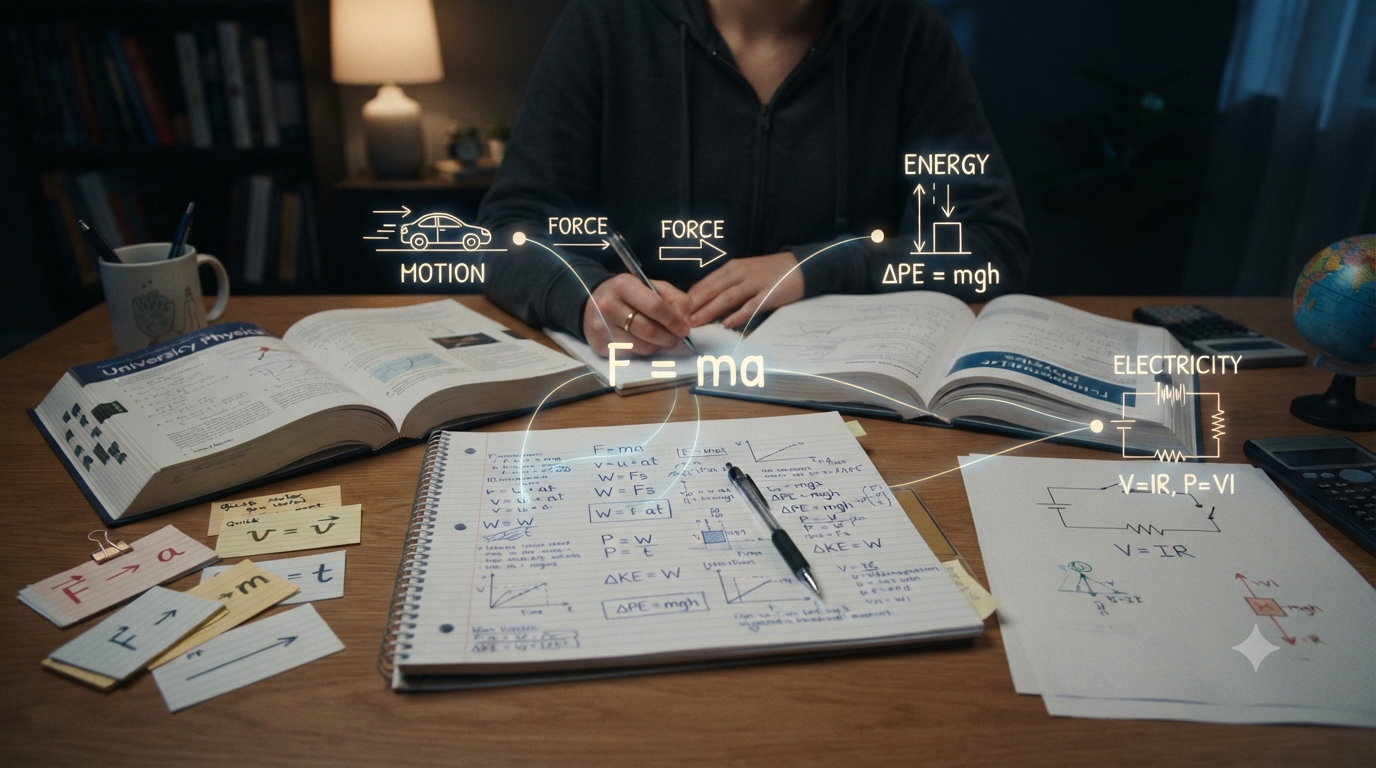
A better approach is to connect formulas with physical ideas, units, patterns, diagrams, and practical examples. When you understand the relationship between quantities, formulas become easier to recall naturally. Whether you are learning motion, force, work, energy, electricity, waves, or another area of physics, a few effective techniques can make formula learning much easier.
Understand the Meaning of the Formula
The first step in remembering a physics formula is to understand what it describes. Instead of trying to memorize symbols immediately, identify the physical quantities involved.
For example, the formula for speed is:
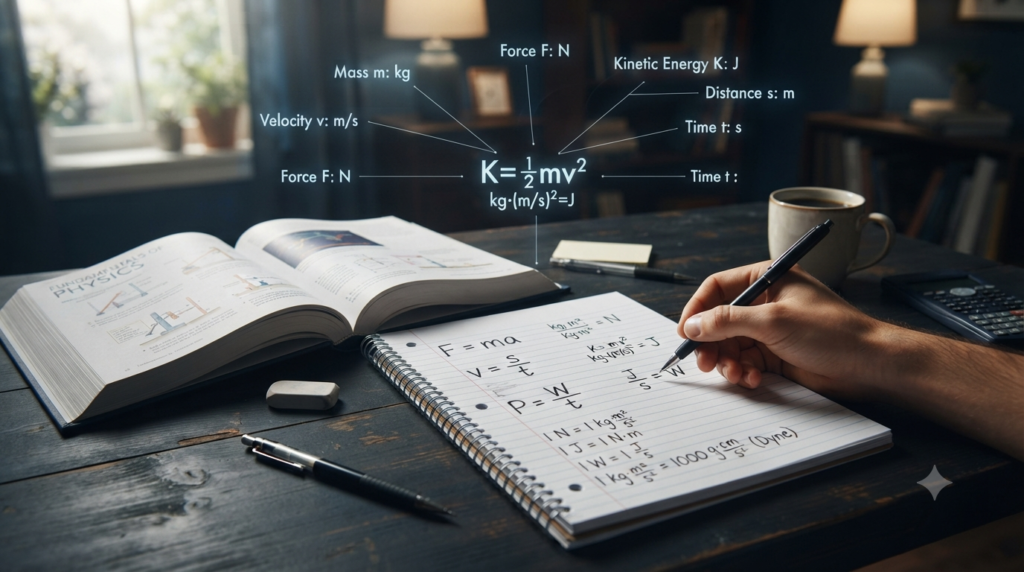
v = s/t
Here, v represents speed, s represents distance, and t represents time. The formula tells us that speed describes how much distance is covered in a given amount of time.
When you understand this relationship, the formula becomes more meaningful. If you forget the exact equation later, you may be able to reconstruct it from the concept.
The same method works with many other formulas. Before memorizing an equation, ask:
What physical quantity does this formula calculate?
What does each symbol represent?
How are the quantities related?
What situation does the formula describe?
Understanding these questions creates a stronger memory than repetition alone.
Learn Formulas in Groups
Physics contains many formulas, but they are not completely separate from one another. Several formulas belong to the same topic and are connected through common physical ideas.
For example, equations related to motion include:
v = u + at
s = ut + ½at²
v² = u² + 2as
Instead of memorizing these equations as three unrelated expressions, learn them as a group connected to uniformly accelerated motion.
Similarly, formulas involving work, energy, and power can be studied together:
W = Fs
P = W/t
K.E. = ½mv²
P.E. = mgh
Grouping formulas reduces the number of separate pieces you need to remember. It also helps you recognize which formula may be useful when you encounter a particular type of problem.
Understand Where Formulas Come From
A formula is often easier to remember when you know how it is obtained. Deriving an equation connects it to other concepts and gives your memory a logical path to follow.
For example, power is defined as work done per unit time:
P = W/t
If you already understand the meaning of power and work, there is less need to memorize the equation as an isolated fact.
Similarly, if you know that work is related to force and displacement, you can remember:
W = Fs
Learning simple derivations can therefore make formulas more logical. You do not necessarily need to derive every complicated equation from the beginning, but understanding the basic relationships behind important formulas can greatly improve recall.
Use Units to Check Your Memory
Units are one of the most useful tools for remembering and checking physics formulas.
Consider the formula:
v = s/t
Distance has the unit metre (m), while time has the unit second (s). Therefore:
v = m/s
This gives the familiar unit of speed.
Units can sometimes help you identify whether a remembered formula makes physical sense. For example, if you are trying to remember a relationship involving force, mass, and acceleration, the units can guide you toward:
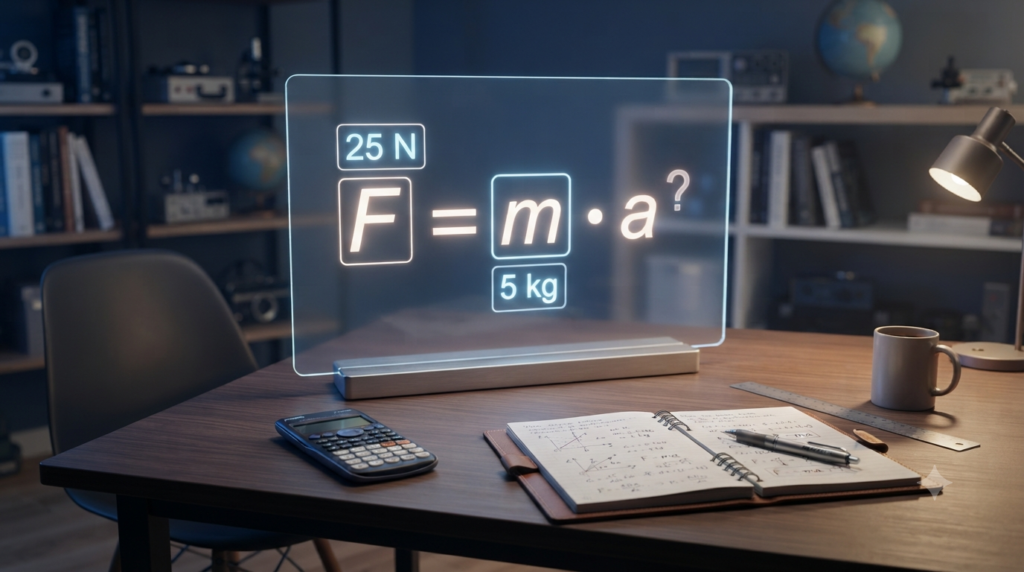
F = ma
because:
kg × m/s² = N
Dimensional analysis cannot always reconstruct a complete formula, especially when numerical constants or mathematical functions are involved. However, it is an excellent way to check whether an equation is dimensionally consistent.
Connect Formulas With Diagrams
Visual information can make formulas easier to recall. Whenever possible, connect an equation with a simple diagram.
For force problems, draw the object and show the forces acting on it. For motion, sketch the direction of movement and mark distance or displacement. For circuits, draw the components and their connections.
For example, Ohm’s law is:
V = IR
A simple circuit diagram can help you associate voltage, current, and resistance with their physical roles.
Diagrams are particularly useful because they connect mathematical symbols with something you can visualize. Instead of seeing F = ma as only letters, you can associate it with an object, its mass, and the acceleration produced by a net force.
Practice Formula Recall Without Looking
Reading formulas repeatedly can create a feeling of familiarity without guaranteeing that you can recall them independently. Active recall is more effective.
Close your textbook or notes and try to write the formulas from memory. Then compare your answers with the original formulas.
For example, write down the equations you remember from the motion chapter before checking your notes. Mark the formulas you forgot or wrote incorrectly. Review those formulas and test yourself again later.
This process forces your brain to retrieve information instead of simply recognizing it. The more often you practice retrieval, the easier it can become to recall formulas during problem solving.
Use Spaced Repetition
Trying to memorize twenty formulas in one sitting is usually less effective than reviewing them over several days.
A simple schedule can be:
Learn the formulas today.
Review them tomorrow.
Test yourself again after a few days.
Review them after one week.
Test yourself again later.
This method is called spaced repetition. The intervals between reviews allow you to repeatedly retrieve information before it becomes completely forgotten.
You can use a notebook, flashcards, or a digital study tool. On one side of a card, write the physical quantity or situation. On the other side, write the relevant formula.
For example:
Front: Formula for kinetic energy
Back: K.E. = ½mv²
This makes practice quick and focused.
Solve Problems Using the Formulas
One of the strongest ways to remember a formula is to use it in actual problems.
Suppose you learn:
W = Fs
Do not stop after reading the equation. Solve several problems involving different values of force and displacement. Then try problems where you first need to identify whether work is being calculated.
Problem solving teaches you not only what a formula looks like but also when it should be used.
After solving a problem, ask yourself:
Why did I choose this formula?
This question is important because knowing when to use a formula is often more useful than simply remembering its appearance.
Create a Formula Sheet
A personal formula sheet can provide a compact overview of an entire physics topic. Keep it organized rather than filling the page with every equation you encounter.
For each important formula, include:
The formula
Meaning of each symbol
SI units
The physical situation where it is used
A short note about related formulas
For example:
F = ma
F: force, m: mass, a: acceleration
SI unit: newton (N)
Use: relating net force, mass, and acceleration
Creating the sheet yourself also acts as a revision activity.
Avoid Memorizing Without Understanding
Pure memorization can be useful for some equations, but relying on it for every formula can create problems. If you forget even one symbol, you may struggle to reconstruct the entire equation.
Instead, combine memorization with understanding.
For example, remember that density describes mass per unit volume:
ρ = m/V
Once the meaning is clear, the arrangement of the quantities becomes easier to recall.
Understanding also helps you recognize equivalent forms. From:
V = IR
you can obtain:
I = V/R
and:
R = V/I
Knowing how the quantities are related reduces the number of separate equations you need to memorize.
Build Formula Connections
Many physics formulas are connected through broader concepts. Try to identify these relationships instead of treating every equation as an isolated fact.
For example:
P = W/t
and:
W = Fs
can be connected to form another relationship:
P = Fs/t
Since speed can be expressed as distance divided by time in appropriate situations, these relationships can reveal deeper connections between different parts of physics.
The more connections you build, the more pathways your memory has for retrieving a formula.
Use Formulas Regularly
Formula memory becomes stronger when formulas are used regularly. Include a few formula-based questions in your study sessions instead of waiting until an examination is approaching.
When reviewing a chapter, try this simple sequence:
Understand → Recall → Apply → Check → Review
First understand the concept, then recall the formula without looking, apply it to a problem, check your answer, and review the formula later.
This approach turns formulas from isolated information into working tools.
Conclusion
Remembering important physics formulas becomes much easier when you focus on understanding rather than memorizing equations mechanically. Learn what each formula means, group related equations, understand simple derivations, use units as checks, connect formulas with diagrams, and practice recalling them without looking at your notes. Spaced repetition and regular problem solving can strengthen your memory even further.
The goal is not to remember every formula as a separate piece of information. Instead, build connections between physical concepts, mathematical relationships, units, and real situations. When these connections become familiar, formulas become easier to recall and much easier to use correctly while solving physics problems.
FAQs
1. What is the best way to remember physics formulas?
The best way to remember physics formulas is to understand what each formula represents instead of memorizing it mechanically. Learn the meaning of every symbol and understand the relationship between the physical quantities. For example, v = s/t becomes easier to remember when you understand that speed represents distance covered per unit time. Group related formulas together, practice recalling them without looking at your notes, and use them in numerical problems. Regular revision through spaced repetition can strengthen long-term memory. Connecting formulas with diagrams, units, and real-world examples also makes them easier to recall when solving physics problems.

2. Why do I forget physics formulas after studying them?
You may forget physics formulas because they were memorized without understanding, reviewed only once, or not used in enough problems. Simply reading a formula repeatedly creates familiarity but does not always develop strong recall. Another reason may be trying to learn too many formulas at once. Instead, study formulas in smaller groups and understand how they relate to physical concepts. Test yourself by writing formulas without looking at your notes. Solve problems using them and review them at increasing intervals. Regular active recall and spaced repetition give your brain repeated opportunities to retrieve the information and strengthen your memory.
3. Should I memorize physics formulas or understand them?
Understanding physics formulas should come before memorization. When you understand what a formula means and how its quantities are related, remembering it becomes easier. For example, ρ = m/V describes density as mass per unit volume. Knowing this relationship helps you remember the equation instead of treating it as random symbols. Some formulas may still require memorization, especially equations that are difficult to derive during an examination. However, understanding their meaning, variables, units, and applications provides a stronger foundation. Combining conceptual understanding with regular recall and problem solving is generally more effective than relying only on memorization.
4. How can units help me remember physics formulas?
Units can help you understand and check physics formulas because physical quantities have specific dimensions. For example, speed is measured in metres per second, which matches v = s/t because distance is divided by time. Similarly, force can be expressed as F = ma, giving the unit kg·m/s², which is the newton. When you forget part of a formula, thinking about the required units can sometimes help you reconstruct the relationship. Units are also useful for identifying dimensional mistakes in calculations. However, dimensional analysis cannot determine every numerical constant or mathematical feature of an equation.
5. How does active recall help with physics formulas?
Active recall involves trying to remember information without looking at your notes. For physics formulas, you can close your textbook and write down the equations you remember from a particular topic. Then compare them with your notes and identify mistakes or missing formulas. This process requires your brain to retrieve the information rather than simply recognize it. Repeating this exercise over several study sessions can strengthen recall. You can also use flashcards by writing a physical quantity or problem situation on one side and the relevant formula on the other. Active recall is especially useful before solving numerical problems or preparing for examinations.
6. Is writing formulas repeatedly a good way to memorize them?
Writing formulas can help, but simply copying the same equation many times is not always the most effective method. It becomes more useful when you actively try to recall the formula before writing it. For example, close your notes, write the motion equations from memory, and then check your answers. You can also write what each symbol means, the units involved, and the situation in which the formula is used. Solving problems after writing the formula makes the learning more practical. Combining writing with understanding, active recall, spaced repetition, and problem solving can make formula practice more effective.
7. How can I remember many physics formulas for an exam?
Start by organizing formulas according to topics rather than trying to memorize the entire formula list at once. Create a concise formula sheet containing important equations, symbols, units, and applications. Study one topic at a time and test yourself without looking at the sheet. Then solve numerical problems that require those formulas. Use spaced repetition to review the formulas over several days instead of attempting one long memorization session. Pay special attention to formulas that you repeatedly forget. Understanding relationships between equations can also reduce the number of independent formulas you need to memorize. Regular practice is important for reliable recall during an exam.
8. Can solving physics problems help me remember formulas?
Yes, solving physics problems can strongly support formula recall because it teaches you when and how a formula should be used. Memorizing W = Fs, for example, is different from recognizing a problem where force and displacement are given and work needs to be calculated. When solving problems, first identify the known quantities and the quantity you need to find. Then select the appropriate equation and substitute the values carefully. After solving, ask yourself why that particular formula was appropriate. Repeatedly connecting formulas with different problem situations helps turn equations into practical tools rather than isolated information.
9. Should I make a separate physics formula notebook?
A separate formula notebook can be useful if you organize it clearly and use it for active revision. Instead of copying every equation from your textbook, include important formulas and brief information about their meaning, variables, units, and applications. Group formulas by topics such as motion, force, work and energy, electricity, waves, and thermal physics. Leave enough space to add related formulas or corrections later. You can also mark formulas that you frequently forget and review them more often. The notebook should be a revision tool rather than a collection of copied equations. Regularly test yourself using it instead of only reading it.
10. How often should I revise physics formulas?
The ideal revision frequency depends on how familiar you are with the formulas, but regular spaced review is more useful than one-time memorization. After learning a set of formulas, test yourself again the next day. Review them after a few days, then again after about a week. Continue revisiting formulas that you find difficult while reducing the frequency for those you can recall easily. Include formula recall in your normal physics practice and use the equations while solving numerical problems. The goal is to retrieve formulas repeatedly over time so that they become familiar and accessible when you need them.

Related Posts
What Do Coefficients Mean in Chemistry Formulas?
When you look at a chemical equation, you may notice numbers written before chemical formulas. These numbers are called coefficients. […]
Read MoreHow to Read Subscripts in Chemical Formulas
Chemical formulas are a simple way to represent substances using symbols and numbers. When you look at a formula such […]
Read MoreHow to Identify Elements in a Chemical Formula
Chemical formulas provide a simple way to describe the substances that make up the world around us. A formula may […]
Read MoreHow Elements Are Represented in Chemical Formulas
Chemistry deals with many different substances, from the oxygen we breathe to the water we drink and the minerals found […]
Read MoreChemical Symbols and Their Role in Chemistry Formulas
Chemistry is often described as the science of matter, but understanding chemistry also means learning how scientists communicate information about […]
Read MoreHow Chemical Formulas Represent Substances
Chemical formulas are one of the simplest ways scientists communicate information about matter. A substance may contain millions or billions […]
Read MoreWhat Is a Chemical Formula in Chemistry?
Chemistry is the study of substances, their properties, and the changes they undergo. To describe these substances clearly, chemists need […]
Read MoreBasic Types of Chemistry Formulas Explained
Chemistry formulas are one of the simplest ways scientists describe substances, reactions, and relationships between different particles. A formula can […]
Read MoreHow to Read and Understand Chemistry Formulas
Chemistry formulas may look like a collection of letters, numbers, and symbols, but they are actually a simple language used […]
Read MoreWhat Are Chemistry Formulas and Why Are They Important?
Chemistry is the science of substances, their properties, and the changes they undergo. To describe these substances clearly, chemists use […]
Read MoreHow to Verify an Answer Using Units
In physics, getting a numerical answer is only part of solving a problem. The next question is whether that answer […]
Read MoreHow to Check Whether a Physics Formula Is Correct
A physics formula is more than a collection of symbols and numbers. It represents a relationship between physical quantities and […]
Read MoreHow to Avoid Unit Conversion Mistakes in Physics
Unit conversion is one of the most common sources of mistakes in physics. A formula may be correct, the calculation […]
Read MoreHow to Avoid Sign Errors in Physics Calculations
Physics calculations are not only about choosing the correct formula and putting numbers into it. The signs of physical quantities […]
Read MoreCommon Mistakes When Using Physics Formulas
Physics formulas help us describe motion, forces, energy, electricity, heat, waves, and many other phenomena using mathematical relationships. A formula […]
Read MoreHow to Study Physics Formulas Step by Step
Physics formulas are an important part of learning physics, but simply memorizing them is not enough. A formula represents a […]
Read MoreHow to Organize Physics Formulas for Easy Revision
Physics becomes much easier when formulas are organized in a clear and meaningful way. Many learners struggle not because they […]
Read MoreHow to Build a Physics Formula Sheet
Physics involves many formulas, and remembering all of them can become difficult as you move from basic concepts to more […]
Read More