Perimeter is one of the basic measurements used in geometry. It tells us the total distance around the outside of a two-dimensional shape. Whether you are measuring the boundary of a garden, the edge of a table, the frame of a picture, or the outline of a geometric figure, the idea of perimeter is useful in many everyday situations.
Different geometric shapes have different formulas for finding their perimeter. Some shapes require simply adding all their side lengths, while others have special formulas based on their properties. Understanding these formulas makes it easier to solve geometry problems and work with real-world measurements.
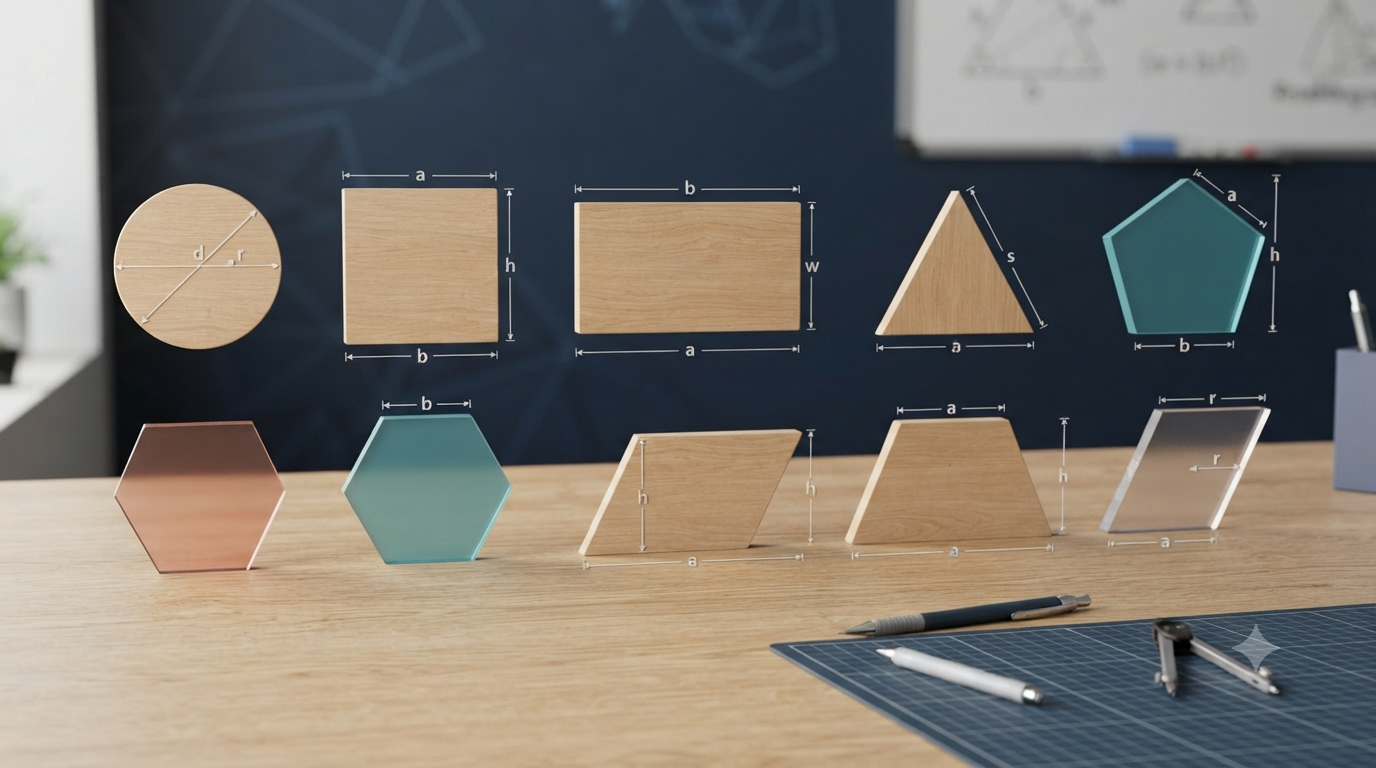
In this article, we will learn the perimeter formulas for common geometric shapes, including squares, rectangles, triangles, parallelograms, rhombuses, trapezoids, kites, regular polygons, and circles. We will also look at the meaning of perimeter, the units used to measure it, worked examples, and common mistakes to avoid.
What Is Perimeter?
The perimeter of a shape is the total length of its boundary. In simple terms, it is the distance you would travel if you started at one point on the edge of a shape and moved all the way around it until you returned to the starting point.
For a polygon, the perimeter is found by adding the lengths of all its sides.
For example, if a triangle has side lengths of 5 cm, 6 cm, and 7 cm, its perimeter is:
P = 5 + 6 + 7 = 18 cm
Therefore, the perimeter of the triangle is 18 cm.
Perimeter is measured in units of length, such as millimetres (mm), centimetres (cm), metres (m), kilometres (km), inches, feet, or yards.
General Perimeter Formula
For a polygon with several sides, the general formula is:
P = side 1 + side 2 + side 3 + … + last side
This means that you can find the perimeter by adding the lengths of every outside side of the shape.
When a shape has equal or repeated sides, a shorter formula can often be used.
For example, a square has four equal sides. Instead of adding the same side four times, we can write:
P = 4s
where s represents the side length.
Perimeter of a Square
A square is a four-sided geometric shape in which all four sides have equal lengths. Its opposite sides are parallel, and all four angles are right angles.
If the side length of a square is s, its perimeter is:
P = 4s
Example
Suppose a square has a side length of 8 cm.
P = 4 × 8
P = 32 cm
Therefore, the perimeter of the square is 32 cm.
The square formula is useful when the length of only one side is given because all four sides are equal.
Perimeter of a Rectangle
A rectangle has four sides, with opposite sides equal in length. Its two longer sides are called the length, and its two shorter sides are called the width.
The perimeter of a rectangle is:
P = 2(l + w)
where:
l = length
w = width
The formula comes from adding all four sides:
P = l + w + l + w
P = 2l + 2w
P = 2(l + w)
Example
A rectangle has a length of 12 cm and a width of 5 cm.
P = 2(12 + 5)
P = 2 × 17
P = 34 cm
Therefore, the perimeter is 34 cm.
Perimeter of a Triangle
A triangle has three sides. Therefore, its perimeter is the sum of the lengths of its three sides.
The general formula is:
P = a + b + c
where a, b, and c are the three side lengths.
Example
Consider a triangle with sides of 7 cm, 9 cm, and 11 cm.
P = 7 + 9 + 11
P = 27 cm
Therefore, the perimeter of the triangle is 27 cm.
Perimeter of an Equilateral Triangle
An equilateral triangle has three equal sides. If each side has length s, the perimeter is:
P = 3s
For example, if each side is 10 cm:
P = 3 × 10 = 30 cm
Perimeter of a Parallelogram
A parallelogram is a quadrilateral in which opposite sides are parallel and equal in length.
If the two different side lengths are a and b, its perimeter is:
P = 2(a + b)
Example
Suppose a parallelogram has side lengths of 14 cm and 9 cm.
P = 2(14 + 9)
P = 2 × 23
P = 46 cm
Therefore, the perimeter is 46 cm.
The formula is similar to that of a rectangle because both shapes have two pairs of equal opposite sides.
Perimeter of a Rhombus
A rhombus is a four-sided shape in which all four sides have equal lengths. It can look like a tilted square, although its angles do not necessarily have to be right angles.
If each side has length s, the perimeter is:
P = 4s
Example
If the side length of a rhombus is 6.5 cm:
P = 4 × 6.5
P = 26 cm
Therefore, the perimeter is 26 cm.
The diagonals of a rhombus are not needed to calculate its perimeter when the side length is already known.
Perimeter of a Trapezoid
A trapezoid is a quadrilateral with at least one pair of parallel sides. Depending on the type of trapezoid, its four sides may have different lengths.
If the four sides are a, b, c, and d, the perimeter is:
P = a + b + c + d
Example
Suppose a trapezoid has side lengths of 10 cm, 7 cm, 6 cm, and 8 cm.
P = 10 + 7 + 6 + 8
P = 31 cm
Therefore, the perimeter is 31 cm.
It is important not to use an area formula when calculating the perimeter of a trapezoid. The perimeter depends only on the lengths of its outer sides.
Perimeter of a Kite
A kite is a quadrilateral with two pairs of adjacent equal sides.
If the two different side lengths are a and b, the perimeter is:
P = 2(a + b)
Example
Suppose the two pairs of equal sides are 8 cm and 5 cm.
P = 2(8 + 5)
P = 26 cm
Therefore, the perimeter of the kite is 26 cm.
Perimeter of a Regular Polygon
A regular polygon has equal side lengths and equal interior angles. Examples include an equilateral triangle, square, regular pentagon, regular hexagon, and regular octagon.
If a regular polygon has n sides and each side has length s, its perimeter is:
P = ns
where:
n = number of sides
s = length of each side
Example
A regular hexagon has 6 equal sides, and each side is 4 cm long.
P = 6 × 4
P = 24 cm
Therefore, the perimeter is 24 cm.
This formula works for any regular polygon as long as the number of sides and the length of one side are known.
Perimeter of a Pentagon
A regular pentagon has five equal sides. If each side has length s, its perimeter is:
P = 5s
Example
If each side of a regular pentagon measures 7 cm:
P = 5 × 7
P = 35 cm
Therefore, its perimeter is 35 cm.
For an irregular pentagon, where the sides are not equal, simply add the five side lengths.
Perimeter of a Hexagon
A regular hexagon has six equal sides.
Its perimeter is:
P = 6s
Example
If each side of a regular hexagon is 9 cm:
P = 6 × 9
P = 54 cm
Therefore, the perimeter is 54 cm.
For an irregular hexagon, the six side lengths must be added individually.
Perimeter of a Circle
The perimeter of a circle is usually called its circumference. Unlike polygons, a circle does not have straight sides.
The circumference can be calculated using either of these formulas:
C = 2πr
or
C = πd
where:
C = circumference
r = radius
d = diameter
π (pi) is approximately 3.14159.
The diameter is twice the radius:
d = 2r
Example Using Radius
Suppose a circle has a radius of 5 cm.
C = 2πr
C = 2 × π × 5
C = 10π
Using π ≈ 3.14:
C ≈ 31.4 cm
Therefore, the circumference is approximately 31.4 cm.
Example Using Diameter
If the diameter of a circle is 12 cm:
C = πd
C = π × 12
C = 12π
Using π ≈ 3.14:
C ≈ 37.68 cm
Therefore, the circumference is approximately 37.68 cm.
Perimeter of a Semicircle
A semicircle is half of a circle. Its boundary contains both a curved part and a straight diameter.
If the radius is r, the perimeter of a semicircle is:
P = πr + 2r
This is because the curved part has length πr, while the straight diameter is 2r.
Example
If the radius of a semicircle is 7 cm:
P = π(7) + 2(7)
P = 7π + 14
Using π ≈ 3.14:
P ≈ 21.98 + 14
P ≈ 35.98 cm
Therefore, the perimeter is approximately 35.98 cm.
A common mistake is to calculate only the curved part and forget to include the diameter.
Perimeter of a Quarter Circle
A quarter circle consists of one-fourth of a complete circle and two straight radius segments.
The curved part has length:
(πr)/2
The two straight sides together have length:
2r
Therefore, the perimeter is:
P = (πr)/2 + 2r
Example
If the radius is 8 cm:
P = (π × 8)/2 + 2(8)
P = 4π + 16
Using π ≈ 3.14:
P ≈ 12.56 + 16
P ≈ 28.56 cm
Therefore, the perimeter is approximately 28.56 cm.
Perimeter of Composite Shapes
Some geometric figures are made by combining two or more basic shapes. These are called composite shapes.
To find the perimeter of a composite shape, identify the complete outside boundary and add the lengths of the parts that form that boundary.
The important point is that only the outer boundary is included. Internal lines that do not form part of the outside edge should not be counted.
For example, if two rectangles are joined together, a line inside the combined shape is not part of the perimeter.
Steps for Finding the Perimeter of a Composite Shape
Identify the complete outer boundary.
Mark or determine the length of every outside segment.
Do not include internal lines.
Add all outside lengths.
Write the final answer with the correct unit.
Sometimes an unknown side can be calculated using the known dimensions before finding the total perimeter.
Perimeter Formula Table
The following table summarizes the most common perimeter formulas.
| Shape | Perimeter Formula |
|---|---|
| Square | P = 4s |
| Rectangle | P = 2(l + w) |
| Triangle | P = a + b + c |
| Equilateral Triangle | P = 3s |
| Parallelogram | P = 2(a + b) |
| Rhombus | P = 4s |
| Trapezoid | P = a + b + c + d |
| Kite | P = 2(a + b) |
| Regular Polygon | P = ns |
| Circle | C = 2πr or πd |
| Semicircle | P = πr + 2r |
| Quarter Circle | P = πr/2 + 2r |
Perimeter vs Area
Perimeter and area are related to the size of a shape, but they measure different things.
Perimeter measures the distance around the outside of a two-dimensional shape.
Area measures the amount of surface contained inside the shape.
For example, a rectangle with a length of 10 cm and a width of 4 cm has:
Perimeter = 2(10 + 4) = 28 cm
Area = 10 × 4 = 40 cm²
Notice the different units. Perimeter uses square-free length units such as cm or m, while area uses square units such as cm² or m².
Perimeter and Units
The answer to a perimeter problem should always be expressed in a unit of length.
Common units include:
millimetres (mm)
centimetres (cm)
metres (m)
kilometres (km)
inches (in)
feet (ft)
yards (yd)
Before calculating the perimeter, make sure that all measurements use the same unit.
For example, if one side is given as 2 m and another as 50 cm, convert them to the same unit first.
Since:
2 m = 200 cm
the measurements can then be added correctly.
Common Mistakes When Finding Perimeter
Several simple mistakes can lead to an incorrect perimeter.
Confusing Perimeter With Area
Perimeter is the distance around a shape, while area is the space inside it. Using an area formula will not give the perimeter.
Forgetting a Side
For polygons, every outside side must be included. Carefully trace the boundary before adding the measurements.
Counting Internal Lines
In composite figures, internal lines are usually not part of the perimeter. Count only the outer boundary.
Mixing Units
Do not directly add centimetres and metres. Convert all measurements to one unit before calculating.
Using the Wrong Circle Formula
Remember that the circumference of a circle can be calculated using either:
C = 2πr
or:
C = πd
Do not confuse radius with diameter. The diameter is twice the radius.
Forgetting the Straight Side of a Semicircle
The perimeter of a semicircle includes the curved half of the circle and the straight diameter.
How to Solve Perimeter Problems
A simple method can be used for most perimeter questions.
First, identify the geometric shape. Then write down the dimensions provided in the question. Choose the appropriate perimeter formula. Substitute the values into the formula and perform the calculation. Finally, write the answer using the correct unit.
For an irregular or composite shape, trace the complete outside boundary and add each boundary segment.
This approach helps prevent missing sides and makes the calculation easier to check.
Real-Life Applications of Perimeter
Perimeter is not limited to textbook geometry. It is used in many practical situations.
A farmer may calculate the perimeter of a field to determine how much fencing is required. A homeowner may measure the perimeter of a room before installing decorative trim. Engineers and architects use boundary measurements when designing structures. Gardeners may calculate the perimeter of a garden to estimate the length of edging material needed.
In sports, the boundary of a field or court can also be described using perimeter. In manufacturing, perimeter measurements can help determine the dimensions of frames, panels, and other components.
Understanding perimeter therefore provides a useful connection between mathematical formulas and real-world measurements.
Conclusion
Perimeter is the total distance around the outside of a two-dimensional shape. The basic idea is simple: measure or determine every part of the outer boundary and add those lengths together. However, knowing the standard formulas makes the process much faster for common geometric shapes.
For squares, the formula is P = 4s, while rectangles use P = 2(l + w). Triangles use the sum of their three sides, and regular polygons can be calculated using P = ns. For circles, the perimeter is called circumference and can be found using C = 2πr or C = πd.
Once these formulas are understood, perimeter problems become easier to solve and apply to practical situations. The key is to identify the correct shape, use the appropriate dimensions, keep the units consistent, and include only the outside boundary in the calculation.
FAQs
1. What is the perimeter of a geometric shape?
The perimeter is the total distance around the outside boundary of a two-dimensional geometric shape. For polygons, it is found by adding the lengths of all the sides. For example, if a triangle has sides of 5 cm, 6 cm, and 7 cm, its perimeter is 18 cm. Different shapes have different formulas that make the calculation easier. A square uses P = 4s, while a rectangle uses P = 2(l + w). The perimeter is always expressed in units of length, such as centimetres, metres, inches, or feet. It is different from area, which measures the space inside a shape.
2. How do you calculate the perimeter of a square?
The perimeter of a square is calculated by multiplying the length of one side by four because all four sides of a square are equal. The formula is P = 4s, where P represents perimeter and s represents the side length. For example, if a square has a side length of 9 cm, its perimeter is P = 4 × 9 = 36 cm. You do not need to know the area or diagonal to calculate the perimeter when the side length is given. The final answer should always include a suitable unit of length, such as cm, m, or inches.
3. What is the perimeter formula for a rectangle?
The perimeter of a rectangle is calculated by adding its length and width and multiplying the result by two. The formula is P = 2(l + w), where l is the length and w is the width. This works because a rectangle has two equal lengths and two equal widths. For example, a rectangle with a length of 12 cm and a width of 5 cm has a perimeter of 2(12 + 5) = 34 cm. The perimeter measures the complete outside boundary of the rectangle. It should not be confused with the area, which is calculated by multiplying length by width.
4. How do you find the perimeter of a triangle?
To find the perimeter of a triangle, add the lengths of all three sides. The general formula is P = a + b + c, where a, b, and c represent the three side lengths. For example, if a triangle has sides measuring 6 cm, 8 cm, and 10 cm, its perimeter is 6 + 8 + 10 = 24 cm. For an equilateral triangle, all three sides are equal, so a shorter formula can be used: P = 3s. Always make sure that all three measurements use the same unit before adding them together to obtain the correct perimeter.
5. What is the perimeter formula for a regular polygon?
A regular polygon has equal side lengths and equal interior angles. Its perimeter can be calculated by multiplying the number of sides by the length of one side. The formula is P = ns, where n is the number of sides and s is the length of each side. For example, a regular hexagon has six equal sides. If each side is 7 cm, its perimeter is 6 × 7 = 42 cm. This formula works for regular triangles, squares, pentagons, hexagons, octagons, and other regular polygons. For irregular polygons, add the individual side lengths instead.
6. How is the perimeter of a circle calculated?
The perimeter of a circle is called its circumference. It can be calculated using either C = 2πr or C = πd. In these formulas, r represents the radius, d represents the diameter, and π is approximately 3.14. The diameter is twice the radius, so d = 2r. For example, if a circle has a radius of 5 cm, its circumference is approximately 2 × 3.14 × 5 = 31.4 cm. Unlike a polygon, a circle does not have straight sides. Its circumference represents the complete distance around the circular boundary.
7. What is the difference between perimeter and area?
Perimeter and area measure two different properties of a two-dimensional shape. Perimeter is the total distance around the outside boundary, while area measures the amount of surface contained inside the shape. Perimeter is measured in ordinary units of length, such as centimetres or metres. Area is measured in square units, such as cm² or m². For example, a rectangle measuring 10 cm by 4 cm has a perimeter of 28 cm and an area of 40 cm². Understanding this difference is important because perimeter formulas and area formulas are not interchangeable, even when they involve the same dimensions.
8. How do you find the perimeter of a composite shape?
To find the perimeter of a composite shape, identify and add the lengths of all segments that form its outside boundary. A composite shape is made by combining two or more simple geometric shapes. Internal lines that do not form part of the outer edge should not normally be included. If some boundary lengths are missing, use the dimensions given in the problem to determine them first. Then add all the outside lengths together. Carefully tracing around the entire boundary is a useful way to avoid missing a side or accidentally counting an internal line when calculating the perimeter.
9. What units are used to measure perimeter?
Perimeter is measured using units of length because it represents a distance around a shape. Common metric units include millimetres (mm), centimetres (cm), metres (m), and kilometres (km). Other systems use inches, feet, yards, and miles. All measurements should be converted to the same unit before calculating a perimeter. For example, if one side is 2 metres and another is 50 centimetres, convert 2 metres to 200 centimetres before adding the measurements. Unlike area, perimeter is not expressed in square units. Therefore, an answer such as 25 cm² would be incorrect for a perimeter calculation.
10. What are the most common mistakes when calculating perimeter?
Common perimeter mistakes include confusing perimeter with area, forgetting one of the outside sides, using the wrong formula, mixing different units, and counting internal lines in composite shapes. Another frequent mistake occurs with circles when the radius and diameter are confused. Before solving a problem, identify the shape and determine which measurements describe its outer boundary. Make sure all measurements use the same unit. For polygons, carefully add every outside side. For circles, use C = 2πr or C = πd. Finally, check that the answer is expressed in a unit of length rather than a square unit.