
Chemical reactions are processes in which substances change into new substances. We can observe some reactions through changes in color, temperature, gas formation, or the appearance of a solid. However, many details of a chemical reaction cannot be understood simply by looking at what happens. This is where chemical formulas become extremely useful.
Chemical formulas provide a compact way to represent the substances involved in a reaction. They tell us which elements are present and, through subscripts, how many atoms of each element are contained in a molecule or formula unit. When chemical formulas are combined with coefficients, they help us represent complete chemical equations and understand how atoms are rearranged during a reaction.
By reading and interpreting chemical formulas, we can identify reactants and products, count atoms, understand molecular composition, balance chemical equations, and calculate the amounts of substances involved. Chemical formulas therefore provide an important language for describing what happens during a chemical reaction.
What Is a Chemical Formula?
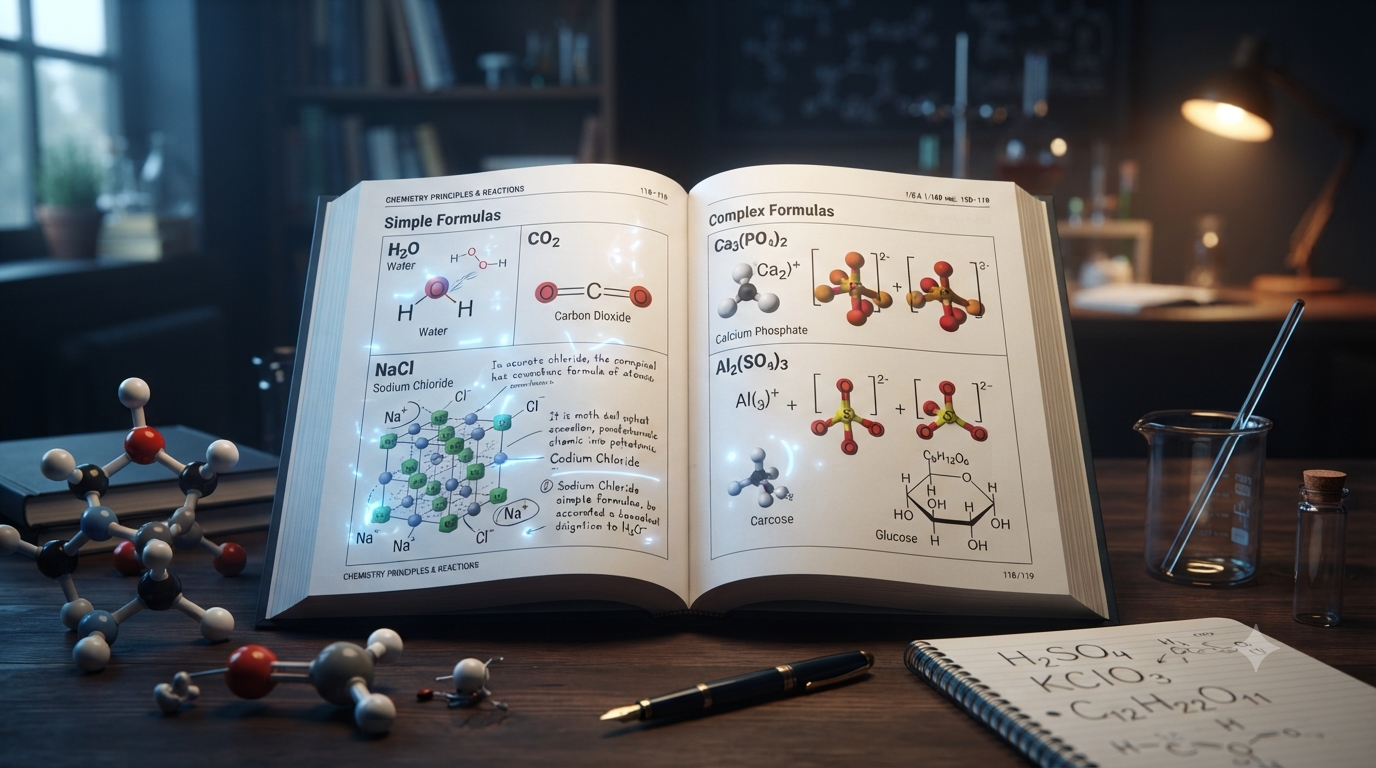
A chemical formula is a symbolic representation of a chemical substance. It uses the symbols of elements and, when necessary, numbers called subscripts to show the composition of the substance.
For example, water is represented by:
H₂O
This formula contains hydrogen and oxygen. The subscript ₂ means that each water molecule contains two hydrogen atoms. Because there is no subscript after O, one oxygen atom is present.
Similarly, carbon dioxide is represented as:
CO₂
This means that one carbon atom is combined with two oxygen atoms.
Chemical formulas allow scientists to describe substances without writing their complete names every time. More importantly, they provide information that can be used to understand how substances behave in chemical reactions.
How Chemical Formulas Represent Reactants and Products
A chemical reaction begins with one or more substances called reactants. These substances undergo chemical changes to form new substances called products.
For example, hydrogen reacts with oxygen to form water:
2H₂ + O₂ → 2H₂O
In this equation:
H₂ and O₂ are the reactants.
H₂O is the product.
The arrow shows the direction of the reaction.
The coefficients 2, 1, and 2 indicate the relative amounts of the substances involved.
The chemical formulas tell us exactly which substances participate in the reaction. Without the formulas, we might know that hydrogen and oxygen produce water, but we would not have a precise symbolic representation of the substances and their atomic composition.
Chemical Formulas Show Which Elements Are Present
One of the simplest ways chemical formulas help us understand reactions is by showing which elements are present in each substance.
Consider the reaction:
CH₄ + 2O₂ → CO₂ + 2H₂O
Methane, CH₄, contains carbon and hydrogen. Oxygen gas, O₂, contains oxygen. The products are carbon dioxide, CO₂, and water, H₂O.
By examining the formulas, we can see that carbon, hydrogen, and oxygen are involved throughout the reaction. The atoms are not simply disappearing or appearing. Instead, they are rearranged into new combinations.
This is a fundamental idea in chemistry: during an ordinary chemical reaction, atoms are rearranged to form different substances.
Subscripts and Coefficients Have Different Meanings
Understanding the difference between subscripts and coefficients is essential when using chemical formulas to study reactions.
Consider:
2H₂O
The coefficient 2 means there are two water molecules.
The subscript ₂ belongs to the formula H₂O and tells us that each water molecule contains two hydrogen atoms.
Therefore, two H₂O molecules contain:
4 hydrogen atoms
2 oxygen atoms
Changing a coefficient changes the number of particles involved. Changing a subscript changes the composition of the substance itself.
For example:
2H₂O
represents two water molecules.
But:
H₂O₂
represents hydrogen peroxide, a different substance.
This distinction is important when balancing chemical equations because coefficients can be changed, but subscripts should not be changed simply to balance an equation.
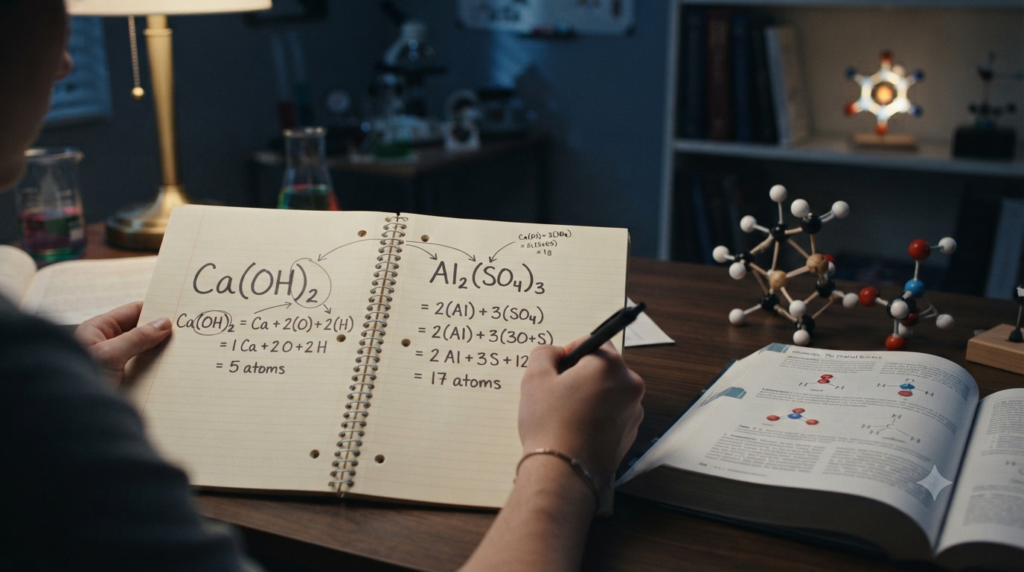
Chemical Formulas Help Us Count Atoms
Chemical formulas allow us to determine how many atoms of each element are involved in a reaction.
Consider:
2H₂ + O₂ → 2H₂O
On the left side:
2H₂ contains 4 hydrogen atoms.
O₂ contains 2 oxygen atoms.
On the right side:
2H₂O contains 4 hydrogen atoms and 2 oxygen atoms.
Therefore, the number of atoms of each element is the same on both sides.
This atom-counting process helps us understand whether a chemical equation correctly represents the reaction.
Chemical Formulas Help Us Understand Conservation of Mass
The law of conservation of mass states that matter is not created or destroyed during an ordinary chemical reaction. The atoms present in the reactants must therefore also be present in the products.
Chemical formulas make this principle visible.
Consider:
2Mg + O₂ → 2MgO
The reactants contain:
2 magnesium atoms
2 oxygen atoms
The products contain:
2 magnesium atoms
2 oxygen atoms
The atoms have been rearranged, but their total numbers remain unchanged.
This is one reason balanced chemical equations are so important. A balanced equation provides a symbolic representation in which the atoms of each element are conserved.
Chemical Formulas Help Us Balance Chemical Equations
A chemical equation must be balanced so that the same number of atoms of each element appears on both sides.
For example, consider the unbalanced equation:
H₂ + O₂ → H₂O
There are two hydrogen atoms on the left and two on the right, but there are two oxygen atoms on the left and only one on the right.
We can balance the equation by changing coefficients:
2H₂ + O₂ → 2H₂O
Now both sides contain four hydrogen atoms and two oxygen atoms.
The formulas remain unchanged. Only the coefficients are changed.
This shows how chemical formulas and coefficients work together to describe chemical reactions accurately.
Chemical Formulas Show How Compounds Change During Reactions
A chemical reaction often involves breaking old chemical arrangements and forming new ones.
For example:
CaCO₃ → CaO + CO₂
Calcium carbonate decomposes into calcium oxide and carbon dioxide.
The formula CaCO₃ tells us that calcium carbonate contains calcium, carbon, and oxygen. The products contain the same elements, but the atoms are arranged into different substances.
This gives us a symbolic view of the chemical change.
The formula does not merely tell us what a substance is called. It helps us follow the atoms as they move from reactants into products.
Chemical Formulas Can Indicate Ratios Between Substances
Balanced chemical equations also provide information about the relative quantities of substances involved.
Consider:
N₂ + 3H₂ → 2NH₃
The coefficients show a ratio of:
1 nitrogen molecule : 3 hydrogen molecules : 2 ammonia molecules
This does not necessarily mean that only one molecule of nitrogen reacts with exactly three molecules of hydrogen in a laboratory experiment. Instead, the equation expresses the proportional relationship between the substances.
The same ratio can be used on a much larger scale. For example, one mole of nitrogen reacts with three moles of hydrogen to produce two moles of ammonia, assuming the reaction proceeds according to the balanced equation.
Chemical Formulas Help Identify Molecular Composition
Chemical formulas can also reveal the composition of individual molecules.
For example:
C₂H₆O
contains:
2 carbon atoms
6 hydrogen atoms
1 oxygen atom
If this formula represents a particular molecular substance, we can use it to determine the relative number of atoms of each element in that molecule.
This information becomes useful when studying reactions because we can compare the composition of reactants and products.
Chemical Formulas Help Distinguish Different Substances
Small changes in a chemical formula can represent completely different substances.
For example:
CO is carbon monoxide.
CO₂ is carbon dioxide.
Both contain carbon and oxygen, but their formulas are different because their atoms occur in different ratios.
These substances also have different chemical properties.
This demonstrates why chemical formulas are important in reaction chemistry. A reaction cannot be accurately described by simply listing the elements involved. We need to know how the atoms are combined.
Chemical Formulas and States of Matter
Chemical equations may also include symbols that show the physical state of each substance.
Common symbols include:
(s) for solid
(l) for liquid
(g) for gas
(aq) for aqueous solution
For example:
2H₂(g) + O₂(g) → 2H₂O(l)
This equation tells us that hydrogen and oxygen are gases while water is present as a liquid under the conditions represented.
These state symbols can provide additional information about what happens during a reaction.
Chemical Formulas Help Describe Ionic Reactions
Chemical formulas are especially useful when studying reactions involving ions.
For example:
AgNO₃ + NaCl → AgCl + NaNO₃
The formulas show the substances involved and allow us to recognize that silver chloride, AgCl, is produced.
In an aqueous solution, compounds such as sodium chloride and silver nitrate can separate into ions. Understanding their formulas helps us identify which ions participate in forming the new compound.
Chemical formulas therefore provide the starting point for writing both molecular and ionic equations.
Chemical Formulas Help With Quantitative Calculations
Chemical formulas are not limited to describing reactions qualitatively. They also allow scientists to perform quantitative calculations.
A balanced chemical equation provides the ratios needed for stoichiometric calculations.
For example:
2H₂ + O₂ → 2H₂O
From this equation, we know that 2 moles of hydrogen react with 1 mole of oxygen to produce 2 moles of water.
If we know the amount of one substance, we can use the equation to calculate the theoretical amount of another substance.
Chemical formulas therefore connect the microscopic world of atoms and molecules with measurable quantities in the laboratory.
Chemical Formulas Help Calculate Molar Mass
The formula of a substance can also be used to calculate its molar mass.
For example, water is:
H₂O
Using approximate atomic masses:
H = 1 g/mol
O = 16 g/mol
Therefore:
H₂O = 2(1) + 16 = 18 g/mol
Knowing the molar mass allows us to convert between mass and moles. This becomes particularly important when chemical formulas are used in stoichiometric calculations.
Chemical Formulas Help Us Recognize Types of Reactions
Chemical formulas can also help us identify common reaction patterns.
For example:
A + B → AB
can represent a combination reaction.
AB → A + B
can represent a decomposition reaction.
A + BC → AC + B
can represent a single-displacement reaction.
AB + CD → AD + CB
can represent a double-displacement reaction.
These patterns are simplified representations, but chemical formulas allow us to see how substances change from reactants to products.
Reading a Chemical Equation Step by Step
When using a chemical equation to understand a reaction, it helps to examine it systematically.
Consider:
CH₄ + 2O₂ → CO₂ + 2H₂O
First, identify the reactants:
CH₄ and O₂
Next, identify the products:
CO₂ and H₂O
Then examine the formulas to determine which elements are present.
Carbon, hydrogen, and oxygen are involved.
Next, count the atoms on both sides.
The reactant side contains:
1 carbon atom
4 hydrogen atoms
4 oxygen atoms
The product side also contains:
1 carbon atom
4 hydrogen atoms
4 oxygen atoms
The equation is therefore balanced.
Finally, examine the coefficients to understand the relative quantities involved.
This simple process allows us to extract a considerable amount of information from a single chemical equation.
Why Chemical Formulas Are Important in Chemistry
Chemical formulas make chemistry easier to communicate, analyze, and calculate. A substance may have a long chemical name, but its formula can provide its composition in a compact form.
When formulas are used in chemical equations, they allow us to understand:
Which substances react
Which substances are produced
Which elements are present
How many atoms are involved
How atoms are rearranged
Whether an equation is balanced
The relative amounts of reactants and products
The physical states of substances
The quantities needed for calculations
This makes chemical formulas one of the most important tools for understanding chemical reactions.
Conclusion
Chemical formulas provide a symbolic language for understanding chemical reactions. They show the elements present in substances, the number of atoms in their molecules or formula units, and how those atoms are rearranged during a reaction. When combined with coefficients, formulas allow us to write balanced chemical equations and determine the relationships between reactants and products.
By learning how to read subscripts, coefficients, formulas, and chemical equations, we can move beyond simply memorizing reactions. We can understand what is happening at the atomic level and connect that understanding with measurable quantities such as moles and mass.
In this way, chemical formulas form a bridge between the invisible world of atoms and the observable changes that occur during chemical reactions.
FAQs
1. How do chemical formulas help us understand chemical reactions?
Chemical formulas show the elements present in a substance and the number of atoms of each element. When formulas are used in a chemical equation, they help identify the reactants and products involved in a reaction. For example, in 2H₂ + O₂ → 2H₂O, H₂ and O₂ are reactants, while H₂O is the product. The formulas also allow us to count atoms and see how they are rearranged during the reaction. By comparing the formulas on both sides of an equation, we can understand whether atoms are conserved and whether the chemical equation is correctly balanced.
2. What information does a chemical formula provide?
A chemical formula provides information about the composition of a chemical substance. It identifies the elements present and, through subscripts, shows the relative number of atoms of each element. For example, CO₂ contains one carbon atom and two oxygen atoms in each molecule. Chemical formulas can also help determine the ratio of elements, calculate molar mass, and understand how a substance participates in chemical reactions. When formulas are included in chemical equations, they show which substances react and which substances are formed. Therefore, chemical formulas provide a compact way to represent important information about chemical substances.
3. What is the difference between a subscript and a coefficient?
A subscript tells us how many atoms of an element are present in one molecule or formula unit, while a coefficient tells us how many molecules or formula units are involved. For example, in 3H₂O, the subscript ₂ means each water molecule contains two hydrogen atoms. The coefficient 3 means there are three water molecules. Therefore, 3H₂O contains six hydrogen atoms and three oxygen atoms. This difference is especially important when balancing chemical equations. Coefficients can be changed to balance an equation, but changing subscripts changes the chemical substance itself.
4. How do chemical formulas help in balancing chemical equations?
Chemical formulas allow us to count the atoms of each element on both sides of a chemical equation. A balanced equation must contain the same number of atoms of every element on the reactant and product sides. For example, H₂ + O₂ → H₂O is not balanced because there are two oxygen atoms on the left but only one on the right. Changing the coefficients gives 2H₂ + O₂ → 2H₂O. Now both sides contain four hydrogen atoms and two oxygen atoms. Chemical formulas therefore provide the information needed to balance equations without changing the identities of the substances.
5. How do chemical formulas show the conservation of atoms?
Chemical formulas help demonstrate that atoms are conserved during a chemical reaction. In an ordinary chemical reaction, atoms are rearranged to form new substances, but the total number of atoms of each element remains unchanged. For example, in 2Mg + O₂ → 2MgO, there are two magnesium atoms and two oxygen atoms before the reaction. The products also contain two magnesium atoms and two oxygen atoms. The formulas make this conservation easy to see. By counting the atoms represented by the formulas and coefficients, we can verify that a chemical equation follows the principle of conservation of mass.
6. How can chemical formulas identify reactants and products?
Chemical formulas are used to identify the substances present before and after a chemical reaction. In a chemical equation, the substances written on the left side of the arrow are called reactants, while those written on the right side are called products. For example, in CH₄ + 2O₂ → CO₂ + 2H₂O, CH₄ and O₂ are the reactants, while CO₂ and H₂O are the products. The formulas provide more information than names alone because they show the elemental composition of each substance. This allows us to follow how atoms are rearranged during the chemical reaction.
7. Can chemical formulas show the quantities of substances in a reaction?
Yes. When chemical formulas are combined with coefficients in a balanced chemical equation, they show the relative quantities of substances involved in a reaction. For example, N₂ + 3H₂ → 2NH₃ indicates that one mole of nitrogen reacts with three moles of hydrogen to produce two moles of ammonia. These ratios are important in stoichiometry, where the amount of one substance can be used to calculate the amount of another. Chemical formulas therefore connect the composition of substances with quantitative relationships. They help scientists determine how much reactant is required and how much product can theoretically form.
8. Why are chemical formulas important in stoichiometry?
Chemical formulas are essential in stoichiometry because they provide the information needed to relate different substances in a chemical reaction. A balanced chemical equation gives the mole ratio between reactants and products. For example, 2H₂ + O₂ → 2H₂O shows that two moles of hydrogen react with one mole of oxygen to produce two moles of water. Chemical formulas also allow us to calculate molar masses and convert between mass and moles. By combining these pieces of information, we can determine the amounts of substances consumed or produced in a chemical reaction.
9. How do chemical formulas help explain what happens at the atomic level?
Chemical formulas provide a simple way to visualize the rearrangement of atoms during a chemical reaction. Consider CH₄ + 2O₂ → CO₂ + 2H₂O. The formulas show that methane contains carbon and hydrogen, while oxygen gas contains oxygen. After the reaction, the atoms appear in carbon dioxide and water. The atoms have not disappeared; instead, they have been reorganized into new combinations. Chemical formulas therefore provide a connection between the microscopic world of atoms and the observable formation of new substances. They help us understand chemical reactions as processes involving the rearrangement of atoms.
10. Why is understanding chemical formulas important for learning chemistry?
Understanding chemical formulas is important because formulas are used throughout chemistry to represent substances and reactions. They help learners identify elements, count atoms, understand compound composition, write and balance chemical equations, calculate molar masses, and perform stoichiometric calculations. Chemical formulas also make it easier to recognize patterns in different types of reactions. Once learners understand subscripts, coefficients, element symbols, and chemical equations, many chemistry concepts become easier to follow. Rather than memorizing reactions without understanding them, learners can use formulas to see how atoms are organized and rearranged during chemical changes.
Related Posts
What information can be obtained from a chemical formula?
A chemical formula is a short and powerful way of representing a substance. It uses chemical symbols and numbers to […]
Read MoreMolar Mass vs Molecular Mass vs Formula Mass
Chemistry uses several terms to describe the mass of substances, and three of them often cause confusion: molar mass, molecular […]
Read MoreHow to Read and Interpret a Physics Formula
Physics formulas are more than mathematical expressions written in textbooks. They are compact ways of describing how physical quantities are […]
Read MoreCommon Formulas of Bases in Chemistry
Bases are an important group of chemical substances that we encounter in laboratories, industries, medicines, agriculture, and everyday life. They […]
Read MoreHow Whole Number Ratios Are Used in Chemical Formulas
Chemical formulas are a simple way of showing what a substance is made of. A formula tells us which elements […]
Read MoreSI Unit of Temperature Kelvin and Its Meaning
Temperature is one of the most important physical quantities in science. It helps us understand how hot or cold an […]
Read MoreHow should a student organize chemistry formulas for easy revision?
Chemistry involves many formulas, symbols, equations, ions, compounds, and numerical relationships. As the syllabus grows, simply memorizing formulas one after […]
Read MoreHow Does Direction Change the Meaning of a Physical Quantity?
In physics, numbers alone are often not enough to describe what is happening. A value such as 20 m/s, 10 […]
Read MoreHow to Remember Important Physics Formulas
Physics formulas are an important part of learning physics, but remembering them does not always mean simply memorizing long equations. […]
Read MoreWhat does a subscript mean in a chemical formula?
A chemical formula is a short way of showing what a substance is made of. Instead of writing the names […]
Read MoreWhat Is Density and How Is It Calculated?
Density is one of the most useful physical quantities in science. It helps us understand how much matter is packed […]
Read MoreMass and Weight: What Is the Difference?
Have you ever wondered why an object can have the same amount of matter but weigh differently in different places? […]
Read MoreHow to Calculate Molecular Mass Step by Step
Molecular mass is an important concept in chemistry because it helps us understand how heavy a molecule is compared with […]
Read MoreWhat is the difference between molecular and empirical formulas?
Chemical formulas give us a compact way to describe the composition of substances. Instead of writing the names and numbers […]
Read MoreWhy Do Some Physics Problems Need More Than One Formula?

Physics problems often look simple at first. You may be given a few values, asked to find an unknown quantity, […]
Read MoreWhat Is Work in Physics?
In everyday life, the word “work” usually means doing something that requires effort. We may say that carrying a heavy […]
Read MoreAccuracy, Precision and Errors in Physics Measurements
Measurement is one of the most important parts of physics. Almost every physical law, formula, and experiment depends on measurements. […]
Read MoreWhat Is a Chemical Formula in Chemistry?
Chemistry is the study of substances, their properties, and the changes they undergo. To describe these substances clearly, chemists need […]
Read MoreWhen Should You Simplify Chemical Formula Ratios?
Chemical formulas are more than collections of symbols and numbers. They show which elements are present in a substance and, […]
Read MoreHow to Avoid Sign Errors in Physics Calculations
Physics calculations are not only about choosing the correct formula and putting numbers into it. The signs of physical quantities […]
Read MoreWhat Are the Main Branches of Physics?
Physics is one of the fundamental sciences that helps us understand how the universe works. From the motion of planets […]
Read MoreHow to Avoid Unit Conversion Mistakes in Physics
Unit conversion is one of the most common sources of mistakes in physics. A formula may be correct, the calculation […]
Read MoreWhy can different compounds have the same empirical formula?
An empirical formula gives the simplest whole-number ratio of atoms present in a compound. It is useful because it tells […]
Read MoreHow to Interpret Chemical Formulas in Chemical Reactions
Chemical reactions describe how substances change into new substances. To understand these changes, chemists use chemical formulas as a compact […]
Read MoreHow to Calculate the Total Number of Atoms in a Formula
Chemical formulas provide a compact way to show which elements are present in a substance and how many atoms of […]
Read MoreDistance and Displacement: Definition and Differences
When an object moves from one place to another, we often describe its motion by saying how far it has […]
Read MoreHow to Identify the Simplest Ratio in a Chemical Formula
Chemical formulas do more than identify substances. They also show how atoms of different elements are combined. By looking carefully […]
Read MoreWhat Is Inertia and Why Does It Matter?
Have you ever noticed how your body moves forward when a bus suddenly stops? Or why you feel pushed backward […]
Read MoreCommon Formulas of Salts in Chemistry
Salts are an important group of chemical compounds found in laboratories, industries, food, agriculture, medicines, and everyday materials. In chemistry, […]
Read MoreHow Chemical Formulas Help Calculate Composition
Chemical formulas are much more than short combinations of element symbols. They provide a compact way to describe what a […]
Read More