
Chemical formulas are one of the most useful tools in chemistry. They provide a compact way to represent substances and tell us which elements are present and how their atoms are combined. But chemical formulas are not used only for naming or identifying compounds. They also form the foundation of many chemical calculations.
From finding molar mass to calculating the amount of a substance, determining the number of atoms, balancing reactions, and predicting how much product can form, chemical formulas provide the information needed to work with quantities in chemistry. A formula such as H₂O may look simple, but the small numbers in it carry important quantitative information.
Understanding how to read and use chemical formulas makes many chemistry calculations much easier. Instead of treating formulas as symbols to memorize, it is more useful to understand what information they contain and how that information can be converted into numerical values.
What Is a Chemical Formula?
A chemical formula represents the composition of a substance using chemical symbols and numbers. The symbols identify the elements present, while subscripts indicate the number of atoms of each element in one formula unit or molecule.
For example, water is represented as H₂O. The formula contains hydrogen (H) and oxygen (O). The subscript 2 after H means that each water molecule contains two hydrogen atoms. Because there is no subscript after O, it represents one oxygen atom.
Similarly, carbon dioxide is written as CO₂. It contains one carbon atom and two oxygen atoms per molecule.
A formula can therefore provide a direct ratio of atoms in a substance. This information becomes extremely important when performing chemical calculations.
Reading Subscripts in Chemical Formulas
Subscripts are among the most important parts of a chemical formula. They tell us the relative number of atoms of each element.
Consider calcium chloride, CaCl₂. It contains one calcium atom for every two chlorine atoms. The atomic ratio is therefore 1:2.
For sulfuric acid, H₂SO₄, the formula indicates:
2 hydrogen atoms
1 sulfur atom
4 oxygen atoms
The total number of atoms in one molecule is 7.
However, a subscript applies only to the element or group immediately before it. This distinction becomes especially important when parentheses are used.
For example, Ca(OH)₂ contains one calcium atom, two oxygen atoms, and two hydrogen atoms. The subscript 2 outside the parentheses applies to the entire OH group.
Understanding subscripts correctly prevents many calculation errors.
Chemical Formulas and Atomic Ratios
One of the simplest ways chemical formulas are used in calculations is by determining atomic ratios.
For example, in NH₃, the ratio of nitrogen atoms to hydrogen atoms is 1:3. This means that for every one nitrogen atom, there are three hydrogen atoms.
These ratios are not merely descriptive. They can be used to determine how many atoms of one element are associated with a known number of atoms of another element.
Suppose a sample contains a certain number of nitrogen atoms in ammonia. The formula NH₃ allows us to determine the corresponding number of hydrogen atoms using the 1:3 ratio.
Thus, chemical formulas connect microscopic particles with numerical relationships.
Calculating Molar Mass From a Chemical Formula
Chemical formulas are also used to calculate molar mass. Molar mass is the mass of one mole of a substance and is expressed in grams per mole (g/mol).
To calculate molar mass, we add the atomic masses of all the atoms represented in the formula.
For example, consider water, H₂O.
Using approximate atomic masses:
Therefore:
The chemical formula tells us how many atoms of each element must be included in the calculation.
For carbon dioxide, CO₂:
This method works for simple compounds as well as more complex substances.
Using Chemical Formulas to Calculate Moles
The mole is a fundamental unit used to count extremely large numbers of particles. Chemical formulas help connect the amount of a substance in grams to the number of moles.
The relationship is:
moles = mass ÷ molar mass
For example, suppose we have 36 g of water. The molar mass of water is approximately 18 g/mol.
moles of H₂O = 36 ÷ 18 = 2 mol
The formula H₂O is important because it allows us to calculate the molar mass required for this conversion.
Once the number of moles is known, additional calculations can be performed, such as finding the number of molecules or the number of individual atoms.
Finding the Number of Atoms in a Compound
A chemical formula can also help determine the number of atoms present in a given amount of a substance.
For example, one molecule of H₂O contains two hydrogen atoms and one oxygen atom.
If we have 1 mole of water molecules, there are Avogadro’s number of water molecules, approximately 6.022 × 10²³ molecules.
Because each molecule contains two hydrogen atoms, one mole of water contains approximately:
2 × 6.022 × 10²³ hydrogen atoms
Similarly, there is one oxygen atom per water molecule, so one mole of water contains approximately 6.022 × 10²³ oxygen atoms.
The formula provides the ratio needed to move from molecules to individual atoms.
Chemical Formulas in Percentage Composition
Chemical formulas can be used to calculate the percentage by mass of each element in a compound.
The general relationship is:
Percentage of element = (mass contributed by the element ÷ molar mass of compound) × 100
Consider water, H₂O.
The molar mass is approximately 18 g/mol. Hydrogen contributes about 2 g/mol, while oxygen contributes about 16 g/mol.
Therefore, the percentage of hydrogen is:
(2 ÷ 18) × 100 ≈ 11.1%
The percentage of oxygen is:
(16 ÷ 18) × 100 ≈ 88.9%
The percentages add up to approximately 100%.
This type of calculation is useful for understanding the mass composition of compounds.
Empirical and Molecular Formulas
Chemical formulas are also involved in determining empirical and molecular formulas.
An empirical formula represents the simplest whole-number ratio of elements in a compound. A molecular formula shows the actual number of atoms in a molecule.
For example, hydrogen peroxide has the molecular formula H₂O₂. Its simplest whole-number ratio is HO, so HO is its empirical formula.
If the molar mass and empirical formula are known, the molecular formula can sometimes be determined.
First, the molar mass of the empirical formula is calculated. The actual molecular molar mass is then divided by the empirical formula mass.
The resulting whole number indicates how many times the empirical formula must be multiplied to obtain the molecular formula.
This shows how chemical formulas and molar mass calculations work together.
Chemical Formulas in Balanced Chemical Equations
Chemical formulas become even more important when studying chemical reactions.
A chemical equation represents the substances involved in a reaction. The formulas identify the reactants and products, while coefficients indicate the relative amounts involved.
For example:
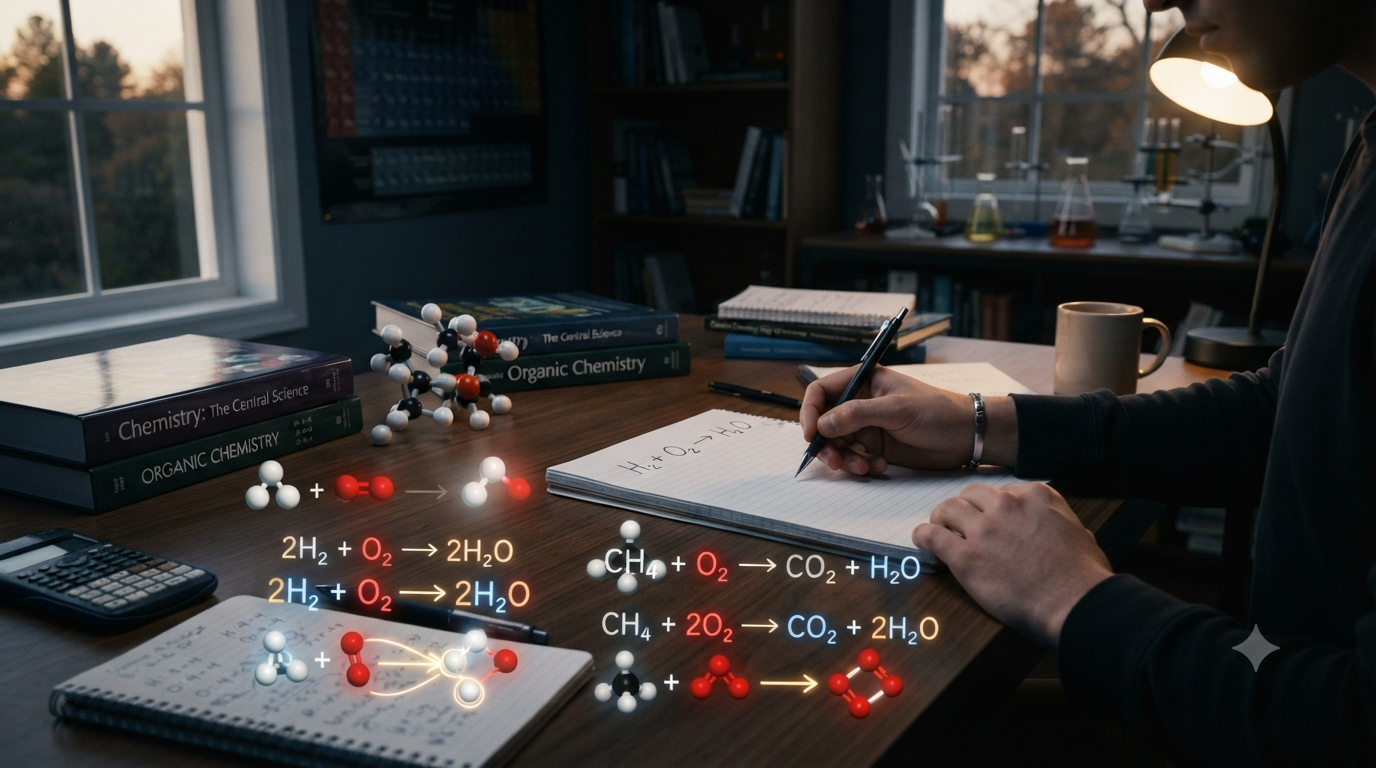
2H₂ + O₂ → 2H₂O
This balanced equation tells us that two molecules of hydrogen react with one molecule of oxygen to produce two molecules of water.
It also represents a mole ratio:
2 mol H₂ : 1 mol O₂ : 2 mol H₂O
These ratios are essential for chemical calculations.
If we know the amount of one reactant, we can use the balanced equation to determine the corresponding amount of another substance.
Stoichiometric Calculations
Stoichiometry is the quantitative study of relationships between reactants and products in chemical reactions. Chemical formulas provide the foundation for these calculations.
Consider:
2H₂ + O₂ → 2H₂O
Suppose we have 3 moles of O₂ and enough H₂ to react completely. According to the equation, 1 mole of O₂ produces 2 moles of H₂O.
Therefore:
3 mol O₂ × (2 mol H₂O ÷ 1 mol O₂) = 6 mol H₂O
The chemical formulas identify the substances, while the coefficients in the balanced equation provide the mole ratio.
Stoichiometric calculations can then be extended to masses, molecules, volumes, and other quantities.
Chemical Formulas and Limiting Reactants
Chemical formulas and balanced equations can also help identify the limiting reactant.
The limiting reactant is the reactant that is consumed first and therefore limits the amount of product that can form.
For example, consider:
2H₂ + O₂ → 2H₂O
The equation requires two moles of hydrogen for every one mole of oxygen. If the available amounts do not have this ratio, one reactant will run out before the other.
By comparing the available amounts with the ratio indicated by the balanced equation, we can determine which reactant limits the reaction.
This calculation is important because the maximum amount of product depends on the limiting reactant.
Chemical Formulas and Concentration Calculations
Chemical formulas are also used in solution chemistry. When preparing or studying solutions, the amount of a particular compound must often be related to the volume of solution.
Molarity is commonly expressed as:
Molarity = moles of solute ÷ volume of solution in litres
Suppose a solution contains 0.5 mol of NaCl in 1 litre of solution. Its concentration is:
Molarity = 0.5 ÷ 1 = 0.5 mol/L
The formula NaCl identifies the solute and is used to calculate its molar mass when converting between mass and moles.
Therefore, chemical formulas connect mass, moles, and concentration.
Chemical Formulas and Gas Calculations
Chemical formulas are also useful in calculations involving gases. In chemical reactions involving gases, the formulas identify the substances and balanced equations provide their quantitative relationships.
For example:
N₂ + 3H₂ → 2NH₃
The equation shows that one mole of nitrogen reacts with three moles of hydrogen to form two moles of ammonia.
When gases are measured under appropriate conditions, these mole relationships can be connected with gas volume relationships.
The formula of each substance therefore becomes part of a larger calculation involving moles, volume, pressure, and temperature.
Avoiding Common Mistakes
Several mistakes can occur when using chemical formulas in calculations.
One common mistake is ignoring subscripts. In H₂O, the subscript 2 must be included when calculating molar mass or counting atoms.
Another mistake is confusing subscripts with coefficients. In 2H₂O, the coefficient 2 means there are two water molecules, while the subscript 2 means each molecule contains two hydrogen atoms.
A useful way to distinguish them is to remember that a coefficient multiplies the entire formula, while a subscript applies to the element or group immediately before it.
It is also important to balance a chemical equation before using its coefficients for stoichiometric calculations. An unbalanced equation does not provide the correct mole ratios.
Why Chemical Formulas Matter in Calculations
Chemical formulas are much more than shorthand representations of substances. They provide the quantitative information needed to connect atoms, molecules, moles, and measurable quantities.
From a single formula, we can determine the elements present, their atomic ratios, the molar mass of the substance, its percentage composition, and the number of atoms or molecules associated with a given amount.
When chemical formulas are combined with balanced equations, they become even more powerful. They allow chemists to calculate reactant requirements, product quantities, concentrations, and many other important values.
Learning to read every symbol, subscript, and coefficient carefully is therefore an essential chemistry skill. Once these relationships become familiar, many chemical calculations become logical rather than difficult. The formula provides the composition, the equation provides the relationship, and mathematical calculations turn that information into useful quantitative results.
FAQs
1. What information does a chemical formula provide?
A chemical formula shows which elements are present in a substance and the relative number of atoms of each element. For example, H₂O contains two hydrogen atoms and one oxygen atom in each molecule. This information is useful in many chemical calculations because it provides the atomic ratio of the elements. By reading the subscripts correctly, we can calculate molar mass, determine the number of atoms, find percentage composition, and establish relationships between substances. Chemical formulas therefore connect the microscopic composition of a substance with measurable quantities such as mass, moles, and concentration.
2. How are chemical formulas used to calculate molar mass?
Chemical formulas provide the number of atoms of each element needed to calculate molar mass. First, the atomic mass of each element is obtained from the periodic table. Each atomic mass is then multiplied by the number of atoms shown by the corresponding subscript. Finally, all the contributions are added. For example, H₂O contains two hydrogen atoms and one oxygen atom. Its molar mass is approximately (2 × 1) + 16 = 18 g/mol. This calculation method works for simple compounds as well as more complex substances containing several elements or groups of atoms.
3. How do subscripts affect chemical calculations?
Subscripts indicate the number of atoms of an element or group present in a chemical formula. They directly affect calculations such as molar mass, atom counting, and percentage composition. For example, CO₂ contains one carbon atom and two oxygen atoms, so the oxygen contribution to its molar mass must be multiplied by two. In Ca(OH)₂, the subscript 2 applies to the entire OH group, giving two oxygen atoms and two hydrogen atoms. Changing a subscript changes the identity and composition of a substance, so subscripts should never be changed when balancing chemical equations.
4. What is the difference between a coefficient and a subscript?
A coefficient appears before a chemical formula and multiplies the entire formula, while a subscript appears within a formula and indicates the number of atoms of a particular element or group. For example, in 2H₂O, the coefficient 2 means there are two water molecules. Each water molecule still contains two hydrogen atoms and one oxygen atom. Therefore, the total is four hydrogen atoms and two oxygen atoms. Subscripts describe the composition of individual particles, whereas coefficients describe the relative quantity of particles involved in a reaction or calculation.
5. How are chemical formulas used to calculate the number of moles?
Chemical formulas are used to determine molar mass, which allows mass to be converted into moles. The basic relationship is moles = mass ÷ molar mass. For example, if 36 g of H₂O is available and the molar mass of water is approximately 18 g/mol, the amount is 36 ÷ 18 = 2 mol. Once the number of moles is known, it can be used to calculate the number of molecules, atoms, or ions. Chemical formulas provide the composition needed to make these conversions correctly and establish relationships between different particles.
6. How can a chemical formula be used to calculate percentage composition?
A chemical formula shows the relative amounts of each element in a compound, allowing its percentage composition to be calculated. First, the total molar mass of the compound is determined. Then, the mass contributed by the element being studied is divided by the total molar mass and multiplied by 100. For example, in H₂O, hydrogen contributes approximately 2 g/mol out of a total 18 g/mol. Therefore, its percentage is about (2 ÷ 18) × 100 = 11.1%. The same method can be applied to every element in the compound.
7. How are chemical formulas used in stoichiometric calculations?
Chemical formulas identify the substances involved in a reaction, while a balanced chemical equation provides the numerical relationships between them. For example, 2H₂ + O₂ → 2H₂O shows a mole ratio of 2:1:2. This ratio can be used to calculate how much reactant is required or how much product can form. A known quantity of one substance can be converted into moles and then related to another substance using the coefficients of the balanced equation. Chemical formulas are therefore essential for identifying substances and performing quantitative reaction calculations.
8. Can chemical formulas help determine the number of atoms in a sample?
Yes. A chemical formula provides the number of atoms of each element in one molecule or formula unit. If the number of particles is known, the formula can be used to determine the total number of atoms. For example, each H₂O molecule contains two hydrogen atoms and one oxygen atom. Therefore, a sample containing a known number of water molecules has twice as many hydrogen atoms as oxygen atoms. If the amount is given in moles, Avogadro’s number can be used to convert moles into particles before applying the atomic ratios from the formula.
9. How are chemical formulas used in concentration calculations?
Chemical formulas help identify the solute and determine its molar mass, which is important when calculating solution concentration. Molarity is calculated using the relationship: molarity = moles of solute ÷ volume of solution in litres. If the amount of solute is given in grams, its chemical formula is first used to calculate molar mass. The mass can then be converted into moles and divided by the solution volume. For example, NaCl’s formula provides the information needed to calculate its molar mass before determining the molarity of a sodium chloride solution.
10. Why are chemical formulas important for chemical calculations?
Chemical formulas are important because they provide the composition and atomic ratios needed for many quantitative calculations in chemistry. They are used to determine molar mass, convert between mass and moles, calculate the number of atoms or molecules, find percentage composition, and work with solution concentrations. When combined with balanced chemical equations, formulas also allow stoichiometric calculations involving reactants and products. Understanding subscripts, parentheses, and coefficients is therefore essential. Rather than simply being symbols for identifying substances, chemical formulas provide numerical information that connects the microscopic world of atoms and molecules with measurable quantities.
Related Posts
The Seven SI Base Units Explained with Examples
Every measurement in science needs a standard unit. Without standard units, it would be difficult to compare measurements made by […]
Read MoreSI Unit of Amount of Substance Mole Explained
The mole is one of the seven SI base units used in science. It is the SI unit of amount […]
Read MoreHow to Check Dimensions in a Physics Formula
Physics formulas connect different physical quantities through mathematical relationships. Before using a formula in a calculation, it is useful to […]
Read MoreWhat Is Measurement in Physics?
Measurement is one of the most important foundations of physics. Almost every idea in physics is connected to measurement in […]
Read MoreScientific Notation in Physics: A Beginner’s Guide
Physics deals with quantities that can be extremely large or incredibly small. The distance between stars, the mass of planets, […]
Read MoreHow to Convert Units Before Using a Physics Formula

Physics formulas help us describe motion, force, energy, pressure, electricity, heat, and many other physical phenomena. However, knowing the correct […]
Read MoreSI Unit of Temperature Kelvin and Its Meaning
Temperature is one of the most important physical quantities in science. It helps us understand how hot or cold an […]
Read MoreHow does physics connect mathematics with reality?
Physics is often described as the science of matter, energy, motion, space, and time. But behind almost every physical idea […]
Read MoreWhat Is a Reference Point in Physics?
In physics, we often describe where an object is, how it moves, or how far it has traveled. But to […]
Read MoreMolar Mass vs Molecular Mass vs Formula Mass
Chemistry uses several terms to describe the mass of substances, and three of them often cause confusion: molar mass, molecular […]
Read MoreCommon Valencies of Important Elements
Valency is one of the basic ideas in chemistry that helps us understand how atoms combine with one another. When […]
Read MoreWhy is a subscript different from a coefficient?
When learning chemical formulas, two small numbers can appear next to chemical symbols and look surprisingly similar. One is called […]
Read MoreWhy do some physical quantities have no units?
When we study physics, we usually encounter quantities such as length, mass, time, speed, force, and energy. Each of these […]
Read MoreHow to Name a Compound From Its Chemical Formula
A chemical formula tells us which elements are present in a compound and how many atoms of each element are […]
Read MoreWhy Is Accuracy Different From Precision?
When we measure something, we usually want to know how close our result is to the actual value. But measurements […]
Read MoreSI Unit of Length Metre and Its Modern Definition
Length is one of the most basic quantities measured in science. Whether we measure the distance between two cities, the […]
Read MoreWhat Are Chemistry Formulas and Why Are They Important?
Chemistry is the science of substances, their properties, and the changes they undergo. To describe these substances clearly, chemists use […]
Read MoreFundamental and Derived Physical Quantities Explained
Physics is the science of understanding how the natural world works. To describe motion, matter, energy, forces, electricity, and many […]
Read MoreWhat Are the Main Branches of Physics?
Physics is one of the fundamental sciences that helps us understand how the universe works. From the motion of planets […]
Read MoreHow to Convert Units in Physics
Unit conversion is one of the most important skills in physics. Measurements are expressed using units such as metres, kilometres, […]
Read MoreWhat Is Energy in Physics?
Energy is one of the most important ideas in physics. We use the word “energy” in everyday life when talking […]
Read MoreWhat Is a Molecular Formula?
A molecular formula is a way of representing a substance using chemical symbols and numbers. It tells us which elements […]
Read MoreHow can you identify the elements present in a formula?
A chemical formula is a short way of showing what a substance is made of. Instead of writing the complete […]
Read MoreChemical Symbols and Their Role in Chemistry Formulas
Chemistry is often described as the science of matter, but understanding chemistry also means learning how scientists communicate information about […]
Read MoreHow Charges Affect Chemical Formulas
Chemical formulas are a simple way to represent substances using symbols and numbers. A formula can tell us which elements […]
Read MoreHow to Write Formulas for Molecular Compounds
Writing the formula of a molecular compound is an important skill in chemistry. A chemical formula tells us which elements […]
Read MoreHow to Identify Constants in Physics Equations
Physics equations often contain several symbols, numbers, and quantities. To understand an equation correctly, it is important to know which […]
Read MoreWhen Should You Simplify Chemical Formula Ratios?
Chemical formulas are more than collections of symbols and numbers. They show which elements are present in a substance and, […]
Read MoreHow to Write Formulas Using Ionic Charges
Writing chemical formulas becomes much easier when you understand how ions combine and how their charges are balanced. An ionic […]
Read MoreWhat Are Derived Units in Physics?
Physics uses measurements to describe everything from the motion of a car to the energy produced by a power plant. […]
Read More