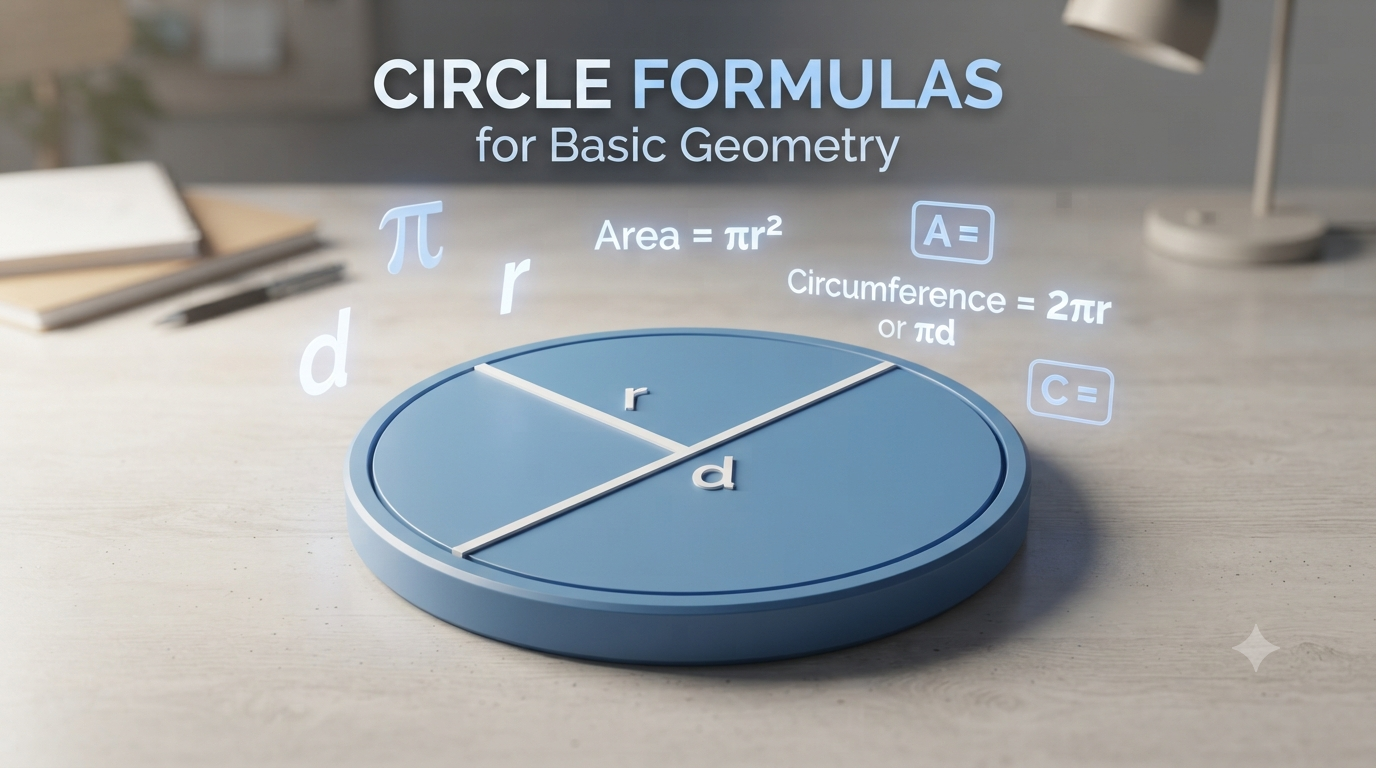
A circle is one of the most familiar shapes in geometry. We see circles in wheels, clocks, coins, plates, gears, lenses, and many other objects around us. In mathematics, a circle is a two-dimensional shape made up of all points that are at the same distance from a fixed point called the center. Learning the basic circle formulas helps us calculate important measurements such as circumference, area, diameter, radius, arc length, and sector area.
Circle formulas are useful not only for solving geometry problems but also for understanding measurements in science, engineering, construction, design, and everyday situations. The most important quantities in circle geometry are the radius (r), diameter (d), and pi (π). Once these are understood, most basic circle calculations become straightforward.
What Is a Circle?
A circle is a closed curved shape in which every point on the boundary is at an equal distance from its center. This fixed distance is called the radius.
The center is usually represented by the letter O, while the radius is represented by r. The straight line passing through the center and joining two points on the circle is called the diameter.
The diameter is twice the radius:
d = 2r
Therefore, the radius can also be calculated from the diameter:
r = d/2
The constant π (pi) is used in most circle formulas. Its approximate value is:
π ≈ 3.14159
For many calculations, π is also commonly written as 22/7 when an approximate answer is acceptable.
Important Parts of a Circle
Before using circle formulas, it is helpful to understand the main parts of a circle.
Radius
The radius is the distance from the center of a circle to any point on its boundary.
Formula:
r = d/2
All radii of the same circle have equal length.
Diameter
The diameter is a straight line passing through the center and connecting two points on the circle.
Formula:
d = 2r
The diameter is the longest chord of a circle.
Chord
A chord is a line segment joining any two points on the circumference of a circle. Unlike the diameter, a chord does not necessarily pass through the center.
Circumference
The circumference is the total distance around the circle. It is similar to the perimeter of other two-dimensional shapes.
Arc
An arc is a part of the circumference of a circle. A circle can have minor arcs and major arcs depending on their length.
Sector
A sector is the region enclosed by two radii and the arc between them. It looks like a slice of a circular object.
Formula for the Circumference of a Circle
The circumference is one of the most commonly used circle measurements.
The formula is:
C = 2πr
where:
C = circumference
r = radius
π = pi
Since the diameter is twice the radius, circumference can also be written as:
C = πd
Therefore, the two common circumference formulas are:
C = 2πr
C = πd
Example
Suppose a circle has a radius of 7 cm.
Using:
C = 2πr
Substitute the values:
C = 2 × 22/7 × 7
C = 44 cm
Therefore, the circumference of the circle is 44 cm.
Formula for the Area of a Circle
The area of a circle is the amount of space enclosed by its circumference.
The basic formula is:
A = πr²
where:
A = area
r = radius
π = pi
The symbol r² means the radius multiplied by itself:
r² = r × r
Example
Find the area of a circle with a radius of 5 cm.
Using:
A = πr²
A = π × 5²
A = 25π
Using π ≈ 3.14159:
A ≈ 78.54 cm²
Therefore, the area is approximately 78.54 cm².
Remember that area is expressed in square units, such as cm², m², or km².
Finding the Radius from the Circumference
Sometimes the circumference is known, but the radius is unknown.
Starting with:
C = 2πr
Rearrange the formula:
r = C/(2π)
Therefore:
r = C/2π
Example
If the circumference of a circle is 31.4 cm, the radius is approximately:
r = 31.4/(2 × 3.14)
r = 31.4/6.28
r = 5 cm
Therefore, the radius is 5 cm.
Finding the Diameter from the Circumference
The circumference formula is:
C = πd
To find the diameter:
d = C/π
Example
Suppose a circle has a circumference of approximately 62.8 m.
d = 62.8/3.14
d = 20 m
Therefore, the diameter is 20 m.
Finding the Radius from the Area
The area formula is:
A = πr²
To find the radius, divide both sides by π:
r² = A/π
Taking the square root:
r = √(A/π)
Therefore:
r = √(A/π)
Example
Suppose the area of a circle is approximately 78.54 cm².
r = √(78.54/3.14159)
r ≈ √25
r ≈ 5 cm
Therefore, the radius is approximately 5 cm.
Finding the Diameter from the Area
The diameter is twice the radius:
d = 2r
Since:
r = √(A/π)
we can write:
d = 2√(A/π)
This formula is useful when the area is known but neither the radius nor diameter is given.
Formula for the Arc Length
An arc is a portion of the circumference. The length of an arc depends on the radius and the central angle.
For an angle measured in degrees, the arc length formula is:
L = (θ/360°) × 2πr
where:
L = arc length
θ = central angle in degrees
r = radius
Example
A circle has a radius of 10 cm, and an arc corresponds to a central angle of 90°.
L = (90/360) × 2π × 10
L = 1/4 × 20π
L = 5π cm
Using π ≈ 3.14159:
L ≈ 15.71 cm
Therefore, the arc length is approximately 15.71 cm.
Formula for the Area of a Sector
A sector is a portion of the area of a circle. Its area depends on the central angle.
For an angle measured in degrees:
A = (θ/360°) × πr²
where:
A = area of the sector
θ = central angle
r = radius
Example
Find the area of a sector with a radius of 8 cm and a central angle of 90°.
A = (90/360) × π × 8²
A = 1/4 × π × 64
A = 16π cm²
Using π ≈ 3.14159:
A ≈ 50.27 cm²
Therefore, the sector area is approximately 50.27 cm².
Formula for the Area of a Semicircle
A semicircle is half of a circle.
The area of a complete circle is:
A = πr²
Therefore, the area of a semicircle is:
A = 1/2 πr²
Example
If the radius is 6 cm:
A = 1/2 × π × 6²
A = 18π
A ≈ 56.55 cm²
Therefore, the semicircle has an area of approximately 56.55 cm².
Formula for the Perimeter of a Semicircle
The perimeter of a semicircle includes both the curved half of the circle and its diameter.
The curved part has length:
πr
The diameter is:
2r
Therefore, the total perimeter is:
P = πr + 2r
or:
P = r(π + 2)
This is different from simply using half of the circumference because the diameter must also be included.
Formula for the Area of a Ring
A region between two concentric circles is called an annulus or circular ring.
If the outer radius is R and the inner radius is r, the area is:
A = πR² − πr²
This can be simplified to:
A = π(R² − r²)
Example
Suppose the outer radius is 10 cm and the inner radius is 6 cm.
A = π(10² − 6²)
A = π(100 − 36)
A = 64π cm²
A ≈ 201.06 cm²
Therefore, the area of the ring is approximately 201.06 cm².
Circle Formulas Using Diameter
Many circle problems provide the diameter instead of the radius. Since:
r = d/2
the area formula can be written in terms of diameter:
A = π(d/2)²
Therefore:
A = πd²/4
The circumference formula is:
C = πd
These formulas can be useful when the diameter is directly given in a problem.
Circle Formulas at a Glance
The most important basic circle formulas are:
| Quantity | Formula |
|---|---|
| Diameter | d = 2r |
| Radius | r = d/2 |
| Circumference | C = 2πr |
| Circumference using diameter | C = πd |
| Area | A = πr² |
| Area using diameter | A = πd²/4 |
| Radius from circumference | r = C/(2π) |
| Diameter from circumference | d = C/π |
| Radius from area | r = √(A/π) |
| Diameter from area | d = 2√(A/π) |
| Arc length | L = (θ/360°) × 2πr |
| Sector area | A = (θ/360°) × πr² |
| Semicircle area | A = 1/2 πr² |
| Semicircle perimeter | P = πr + 2r |
| Ring area | A = π(R² − r²) |
How to Choose the Correct Circle Formula
Choosing the correct formula becomes easier when you first identify what the question is asking.
If the problem asks for the distance around a circle, use the circumference formula:
C = 2πr
If it asks for the space inside a circle, use:
A = πr²
If the diameter is given and circumference is required, use:
C = πd
If an arc and its central angle are involved, use the arc length formula:
L = (θ/360°) × 2πr
If the question involves a slice of a circle, the sector area formula is usually required:
A = (θ/360°) × πr²
The key is to identify the known information and the quantity that needs to be calculated before selecting a formula.
Common Mistakes When Using Circle Formulas
One common mistake is confusing the radius with the diameter. Remember:
d = 2r
and:
r = d/2
Another common mistake is using the diameter directly in the area formula A = πr². If the diameter is given, it must first be divided by 2 to find the radius, unless you use the equivalent formula:
A = πd²/4
It is also important to use the correct units. Circumference is measured in ordinary units such as cm or m, while area is measured in square units such as cm² or m².
When using a calculator, avoid rounding π too early. Using more digits of π generally gives a more accurate result.
Why Circle Formulas Are Important
Circle formulas are used far beyond basic geometry exercises. They are useful for calculating the dimensions of wheels, pipes, circular tracks, gears, tanks, disks, and many other objects.
In physics, circular measurements appear in rotational motion, angular motion, waves, and orbital calculations. In engineering and architecture, circle geometry is used in mechanical components, structural designs, and technical drawings. In everyday life, these formulas can help determine the amount of material needed to cover a circular surface or the distance traveled by a rotating wheel.
Understanding the relationships between radius, diameter, circumference, and area also provides a strong foundation for more advanced mathematics.
Conclusion
Circle formulas provide a simple and systematic way to solve many basic geometry problems. The most important formulas are the circumference C = 2πr and the area A = πr². The relationship between radius and diameter, d = 2r, is equally important because many problems provide one measurement and require the other.
Once these basic formulas are understood, concepts such as arc length, sector area, semicircles, and circular rings become easier to calculate. The key is to identify the information given, choose the appropriate formula, substitute the values carefully, and use the correct units. With regular practice, circle formulas become an essential and easy-to-use part of basic geometry.
FAQs
1. What is the basic formula for the circumference of a circle?
The circumference of a circle is the total distance around its boundary. The basic formula is C = 2πr, where C represents circumference, π is approximately 3.14159, and r is the radius. If the diameter is known instead of the radius, you can use C = πd, where d is the diameter. Since the diameter is twice the radius, both formulas give the same result. For example, if a circle has a radius of 5 cm, its circumference is approximately 2 × 3.14159 × 5 = 31.42 cm. Circumference is always expressed in linear units such as centimeters or meters.
2. What is the formula for the area of a circle?
The formula for the area of a circle is A = πr², where A represents area and r represents the radius. The radius must be squared before multiplying by π. For example, if the radius is 4 cm, the area is π × 4² = 16π, which is approximately 50.27 cm². Area represents the amount of space enclosed by the circle, so the answer is expressed in square units such as cm², m², or km². It is important not to confuse area with circumference. Circumference measures the distance around a circle, while area measures the surface enclosed within its boundary.
3. What is the relationship between the radius and diameter of a circle?
The radius and diameter are directly related. The diameter is twice the radius, so the formula is d = 2r. Similarly, the radius is half the diameter, which can be written as r = d/2. For example, if a circle has a radius of 8 cm, its diameter is 2 × 8 = 16 cm. If the diameter is 20 cm, the radius is 20/2 = 10 cm. Understanding this relationship is important because some circle formulas require the radius while others can use the diameter directly. The diameter always passes through the center of the circle.
4. What is π (pi) in circle formulas?
π (pi) is a mathematical constant that represents the ratio of a circle’s circumference to its diameter. Its approximate value is 3.14159, although it has infinitely many decimal digits. In many basic calculations, π can be approximated as 22/7. Circle formulas commonly use π because circles have a fixed relationship between their circumference and diameter. For example, the circumference is calculated using C = πd, while the area is calculated using A = πr². Using the π button on a calculator generally provides a more accurate answer than using a rounded value such as 3.14.
5. How do you find the radius when the diameter is given?
To find the radius when the diameter is known, divide the diameter by 2. The formula is r = d/2. This works because the diameter extends across the entire circle through its center, while the radius extends from the center to the boundary. For example, if the diameter of a circle is 18 cm, the radius is 18/2 = 9 cm. Once the radius is known, it can be used in other formulas, such as A = πr² for area and C = 2πr for circumference. Always check whether a problem gives the radius or diameter before choosing a formula.
6. How do you calculate the circumference when the diameter is known?
When the diameter is known, the circumference can be calculated directly using C = πd. In this formula, C represents circumference, π represents approximately 3.14159, and d represents diameter. For example, if the diameter of a circle is 12 cm, the circumference is π × 12, which is approximately 37.70 cm. You do not need to calculate the radius first when using this formula. However, you can also divide the diameter by 2 to find the radius and then use C = 2πr. Both approaches produce the same result when the calculations are performed correctly.
7. What is the formula for the length of an arc?
The length of an arc represents the distance along a portion of a circle’s circumference. When the central angle is measured in degrees, the formula is L = (θ/360°) × 2πr, where L is the arc length, θ is the central angle, and r is the radius. The fraction θ/360° indicates what portion of the complete circle the arc represents. For example, a 90° arc represents one-quarter of a complete circle. Therefore, its length is one-quarter of the circumference. Arc length is useful when calculating distances along curved parts of circular objects, tracks, designs, or geometric figures.
8. What is the formula for the area of a sector?
A sector is a portion of a circle enclosed by two radii and an arc. Its area can be calculated using A = (θ/360°) × πr², where A is the sector area, θ is the central angle in degrees, and r is the radius. The fraction θ/360° tells us what portion of the full circle is included in the sector. For example, a sector with a central angle of 90° represents one-quarter of the circle, so its area is one-quarter of the full circular area. This formula is commonly used for circular slices, diagrams, and basic geometry problems involving sectors.
9. What is the difference between the circumference and area of a circle?
Circumference and area describe two different measurements of a circle. Circumference measures the total distance around the outside of the circle and is calculated using C = 2πr or C = πd. Its units are ordinary length units, such as centimeters or meters. Area measures the amount of space enclosed inside the circle and is calculated using A = πr². Its units are square units, such as cm² or m². For example, a circle may have a circumference measured in meters while its area is measured in square meters. Keeping these two concepts separate prevents many common calculation errors.
10. What are the most important circle formulas to remember?
The most important circle formulas are those used to calculate radius, diameter, circumference, and area. The relationship between radius and diameter is d = 2r and r = d/2. The circumference formulas are C = 2πr and C = πd. The area formula is A = πr². For more advanced basic geometry, the arc length formula is L = (θ/360°) × 2πr, while the sector area formula is A = (θ/360°) × πr². Learning these formulas and understanding what each variable represents makes most basic circle geometry problems much easier to solve.