
Electric current is one of the most important physical quantities in electricity and magnetism. Whenever electric charge moves through a conductor, an electric current is produced. From the tiny current flowing through an electronic circuit to the large currents used in power systems, measuring current accurately is essential for understanding and controlling electrical phenomena.
The SI unit of electric current is the ampere, represented by the symbol A. It is one of the seven SI base units and provides a standard way to express the amount of electric current flowing through a circuit. Understanding the ampere helps us connect electric charge, time, voltage, resistance, and electrical power in a meaningful way.
What Is Electric Current?
Electric current describes the rate at which electric charge flows through a given point in a circuit. In simple terms, it tells us how much charge passes through a conductor in a certain amount of time.
The relationship between electric current, charge, and time is:
I = Q/t
where:
I = electric current
Q = electric charge
t = time
Electric current is measured in amperes. If one coulomb of electric charge passes through a point in a circuit in one second, the current is one ampere.
Therefore:
1 A = 1 C/s
This relationship gives a simple physical meaning to the ampere.
What Is the Ampere?
The ampere is the SI base unit of electric current. Its symbol is A.
The ampere is different from many other SI units because electric current is treated as a base quantity rather than a derived quantity. This means that the ampere is defined directly within the SI system, while many other electrical units can be expressed using it.
For example, electric charge is measured in coulombs, and:
1 C = 1 A·s
This means that a coulomb can be understood as the amount of electric charge transferred by a current of one ampere in one second.
Why Is Ampere an SI Base Unit?
The International System of Units contains seven SI base units. These units form the foundation from which many other units are derived.
The seven SI base units are:
Second for time
Metre for length
Kilogram for mass
Ampere for electric current
Kelvin for thermodynamic temperature
Mole for amount of substance
Candela for luminous intensity
The ampere is included because electric current is fundamental to many areas of physics and electrical engineering. Units such as the volt, ohm, watt, and coulomb are connected to the ampere through relationships involving other SI units.
Modern Definition of the Ampere
The modern SI definition of the ampere is based on the elementary charge, represented by e.
The elementary charge has an exact fixed value:
e = 1.602 176 634 × 10⁻¹⁹ C
The coulomb is defined in relation to the ampere and the second, and the ampere can be understood through the flow of elementary charges.
One ampere corresponds to the flow of approximately:
6.24 × 10¹⁸ elementary charges per second
This gives an interesting microscopic interpretation of electric current. A current of one ampere represents an enormous number of individual charge carriers passing a point every second.
How Many Electrons Make One Ampere?
In a metal wire, electric current is mainly associated with the movement of electrons. Since the charge of one electron has a magnitude of approximately:
1.602 × 10⁻¹⁹ C
we can estimate the number of electrons required to transfer one coulomb of charge.
The number is approximately:
1 C ≈ 6.24 × 10¹⁸ electrons
Since one ampere means one coulomb per second:
1 A ≈ 6.24 × 10¹⁸ electrons per second
This does not mean that every electrical current consists of electrons moving in exactly the same way. In different materials and physical systems, different charge carriers can be responsible for current.
Ampere and Electric Charge
Electric charge and electric current are closely related, but they describe different physical quantities.
Charge tells us the quantity of electricity transferred, while current tells us how quickly that charge is flowing.
The relationship is:
I = Q/t
Rearranging the equation gives:
Q = It
For example, if a current of 2 A flows through a circuit for 5 seconds:
Q = 2 × 5 = 10 C
Therefore, 10 coulombs of charge pass through the circuit during those five seconds.
Ampere in Electrical Circuits
The ampere is commonly used to describe the current flowing through electrical circuits.
For example, a small electronic device may operate with a current of a few milliamperes, while household appliances can draw several amperes. Large electrical systems can involve currents measured in tens, hundreds, or even thousands of amperes.
Smaller units are often used when the current is very small:
1 milliampere (mA) = 10⁻³ A
1 microampere (µA) = 10⁻⁶ A
For example:
500 mA = 0.5 A
Using appropriate units makes electrical measurements easier to read and compare.
How Is Electric Current Measured?
Electric current is measured using an instrument called an ammeter.
An ammeter is connected in series with the part of a circuit through which the current is being measured. This allows the current flowing through the circuit path to pass through the measuring instrument.
Modern digital multimeters can also measure current, along with quantities such as voltage and resistance.
When measuring current, the correct measurement range and connection method are important. Incorrectly connecting an ammeter can cause excessive current to flow through the instrument and may damage the meter or circuit.
Ampere and Other Electrical Units
The ampere is closely connected with several important electrical units.
Using Ohm’s law:
V = IR
where V is voltage, I is current, and R is resistance.
From this relationship:
I = V/R
This shows that the current through a resistance depends on the applied voltage and the resistance of the circuit.
Electric power is also related to current:
P = VI
where P is electrical power measured in watts.
These relationships show why the ampere is important in understanding electrical circuits. Current is not an isolated quantity; it is connected to voltage, resistance, charge, energy, and power.
Why Is the Ampere Important?
The ampere is essential for both scientific measurements and practical electrical systems. Engineers use current measurements when designing electrical circuits, motors, generators, power supplies, batteries, communication systems, and electronic devices.
Knowing the current in a circuit also helps determine whether components are operating safely. Excessive current can produce unwanted heating and may damage electrical components.
In everyday life, electrical ratings often include current values. Chargers, power supplies, circuit breakers, cables, and electrical appliances are commonly designed with specific current limits.
Ampere and Electrical Safety
Current is also important when discussing electrical safety. The effect of an electric current on the human body depends on factors such as the current magnitude, duration, path through the body, and other conditions.
This is why electrical systems use protective devices such as fuses, circuit breakers, and residual-current protection devices. These systems are designed to detect or limit abnormal electrical conditions and reduce the risk of damage or injury.
The ampere therefore represents more than a measurement used in physics equations. It is also an important quantity in the safe design and operation of electrical systems.
Conclusion
The ampere (A) is the SI base unit of electric current. It describes the rate at which electric charge flows through a circuit and is related to charge and time by I = Q/t. One ampere corresponds to the transfer of one coulomb of charge per second, or approximately 6.24 × 10¹⁸ elementary charges per second. The ampere is fundamental to electrical science because it connects current with voltage, resistance, power, and charge. From simple circuits to advanced electrical technologies, accurate measurement of current is essential for understanding, designing, and safely operating electrical systems.
FAQs
The SI unit of electric current is the ampere, represented by the symbol A. It is one of the seven SI base units. Electric current describes the rate at which electric charge flows through a conductor or circuit. The relationship between current, charge, and time is I = Q/t, where I is current, Q is charge, and t is time. One ampere means that one coulomb of electric charge passes through a given point in one second. The ampere is widely used in physics, electronics, electrical engineering, and everyday electrical systems to measure and describe current.
One ampere means that electric charge is flowing at a rate of one coulomb per second. This can be expressed as 1 A = 1 C/s. If a current of one ampere flows through a wire for five seconds, the amount of charge transferred is 5 coulombs. At the microscopic level, one coulomb corresponds to approximately 6.24 × 10¹⁸ elementary charges. Therefore, a current of one ampere represents the movement of an enormous number of charge carriers every second. This definition provides a useful connection between the measurable current in a circuit and the movement of electric charge.
The ampere is an SI base unit because electric current is treated as a fundamental physical quantity in the International System of Units. The seven SI base units provide the foundation for expressing many other physical quantities. The ampere is particularly important because numerous electrical quantities are related to current. For example, the coulomb is related to ampere and second, while voltage, resistance, and power have relationships involving current. By defining electric current using the ampere as a base unit, scientists and engineers can maintain consistent electrical measurements throughout experiments, industries, laboratories, and technological applications.
The symbol for the ampere is A, written as a capital letter. Unlike a unit name, which may be written as “ampere” in normal text, the unit symbol remains A regardless of whether it appears in a sentence or equation. For example, an electrical device may draw 2 A of current. Smaller currents can be expressed using prefixes, such as milliamperes and microamperes. One milliampere is 10⁻³ A, while one microampere is 10⁻⁶ A. Correct use of the symbol makes electrical measurements clear and consistent across scientific and engineering applications.
Electric current describes how quickly electric charge passes through a particular point. Their relationship is given by I = Q/t, where I represents current, Q represents electric charge, and t represents time. Rearranging the equation gives Q = It. For example, if a current of 3 A flows for 4 seconds, the charge transferred is Q = 3 × 4 = 12 C. This relationship shows that a larger current transfers more charge in the same amount of time. It also explains why the ampere can be described as one coulomb of charge transferred per second.
A current of one ampere corresponds to the transfer of approximately 6.24 × 10¹⁸ elementary charges every second. In a metal conductor, these charge carriers are electrons. The magnitude of the charge of one electron is approximately 1.602 × 10⁻¹⁹ coulomb. Dividing one coulomb by the charge of an electron gives approximately 6.24 × 10¹⁸ electrons. Therefore, one ampere represents an extremely large number of electrons passing a point each second. This microscopic interpretation helps connect the everyday measurement of current with the movement of individual charged particles inside electrical conductors.
Electric current is measured using an instrument called an ammeter. An ammeter is normally connected in series with the part of a circuit where the current needs to be measured. This arrangement allows the current flowing through that circuit path to pass through the measuring instrument. Digital multimeters can also measure current when they are configured correctly. Current measurements may be expressed in amperes, milliamperes, or microamperes depending on the magnitude. Proper connection and selection of the measurement range are important because an incorrect connection can allow excessive current to flow through the instrument.
Ampere and volt are different electrical units, but they are connected through resistance. According to Ohm’s law, V = IR, where V is voltage, I is current, and R is resistance. Rearranging this equation gives I = V/R. This means that the current through a resistance depends on the applied voltage and the resistance value. For example, if a voltage of 12 V is applied across a resistance of 6 Ω, the current is I = 12/6 = 2 A. This relationship is fundamental for analysing electrical circuits and understanding how voltage produces current.
Milliamperes and microamperes are smaller units of electric current derived from the ampere. A milliampere (mA) equals one-thousandth of an ampere, so 1 mA = 10⁻³ A. A microampere (µA) equals one-millionth of an ampere, so 1 µA = 10⁻⁶ A. These smaller units are useful for describing currents in electronic circuits, sensors, measuring instruments, and other devices where the current is much smaller than one ampere. For example, 500 mA is equal to 0.5 A, while 250 µA is equal to 0.00025 A.
Measuring current in amperes is important because current affects how electrical circuits and devices operate. Engineers use current measurements to design circuits, select suitable wires and components, determine electrical power, and maintain safe operating conditions. Excessive current can cause overheating, damage components, or create dangerous electrical conditions. Protective devices such as fuses and circuit breakers are therefore designed with specific current ratings. Current measurement is also essential in batteries, motors, generators, power supplies, electronic devices, and electrical distribution systems. The ampere provides a standardized way to measure and compare electric current across different applications.
Related Post
How can the number of possible combinations be estimated before designing a digital system?
Before designing a digital system, engineers need to understand how many possible states, inputs, outputs, or arrangements the system may […]
Read MoreWhy does the number of possible states increase exponentially with the number of bits?

Computers represent information using bits, the smallest units of digital data. A bit can have one of two possible values: […]
Read MoreWhen is De Morgan’s law useful when working with logical expressions?
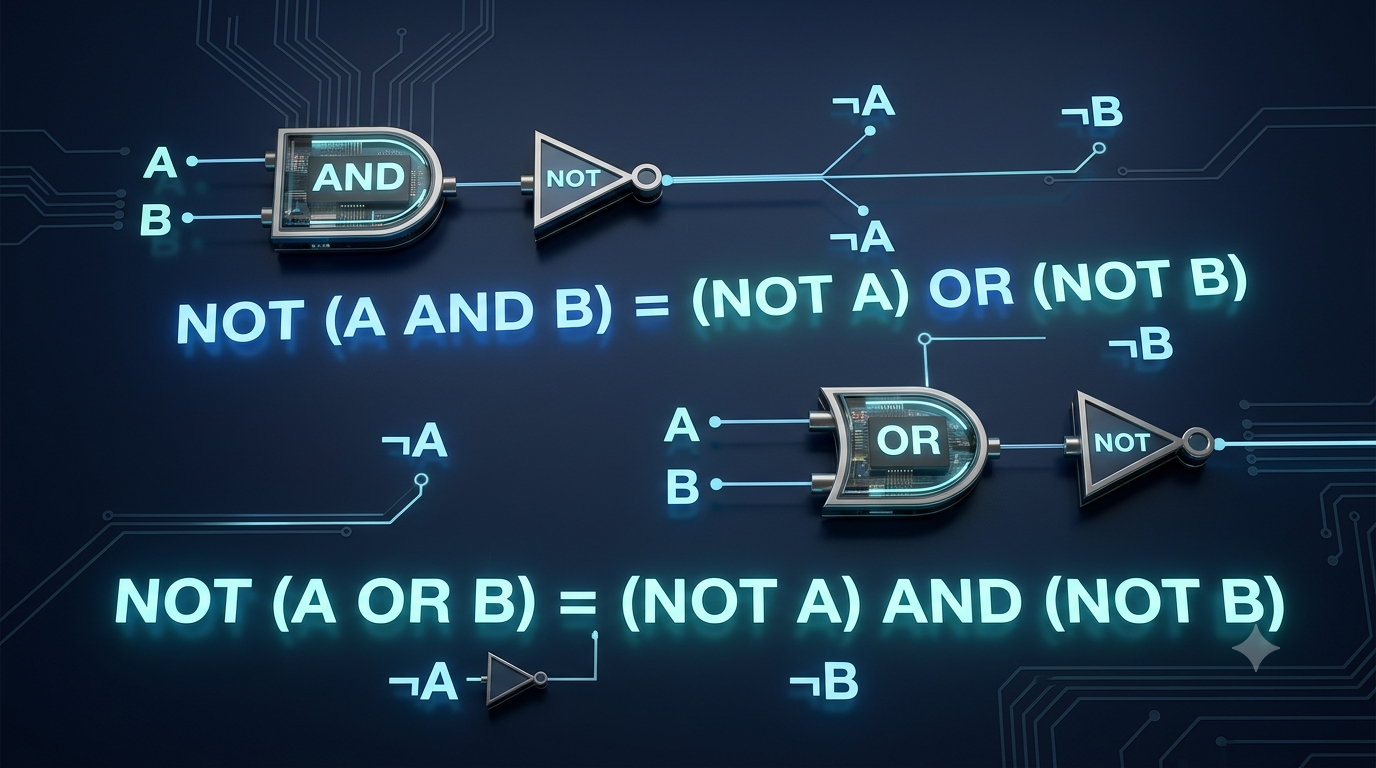
Logical expressions are used in mathematics, computer science, digital electronics, programming, and many other technical fields. They help us describe […]
Read MoreHow can a truth table reveal whether two Boolean expressions are equivalent?
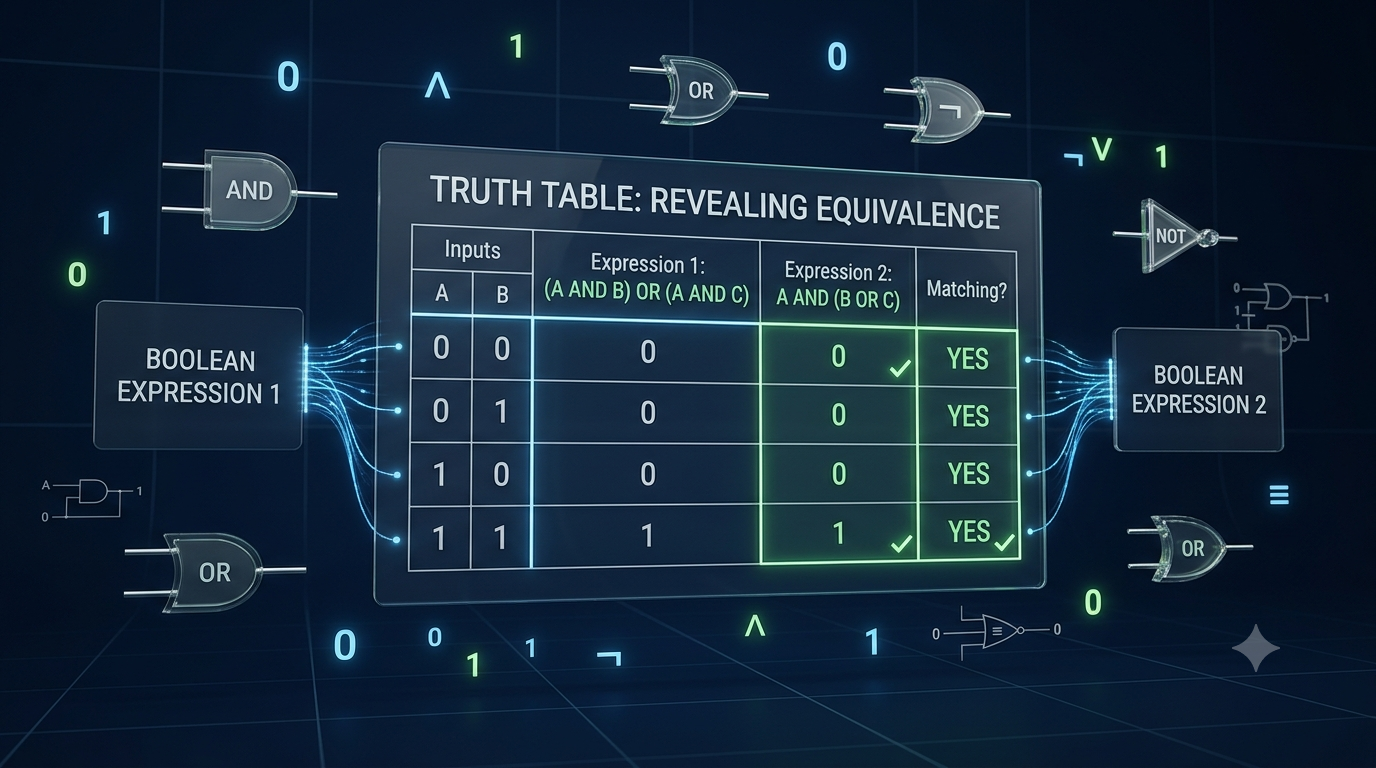
Boolean algebra is an important part of computer science, digital electronics, programming, and logic design. It deals with values that […]
Read MoreWhy does XOR behave differently from OR when both inputs are true?
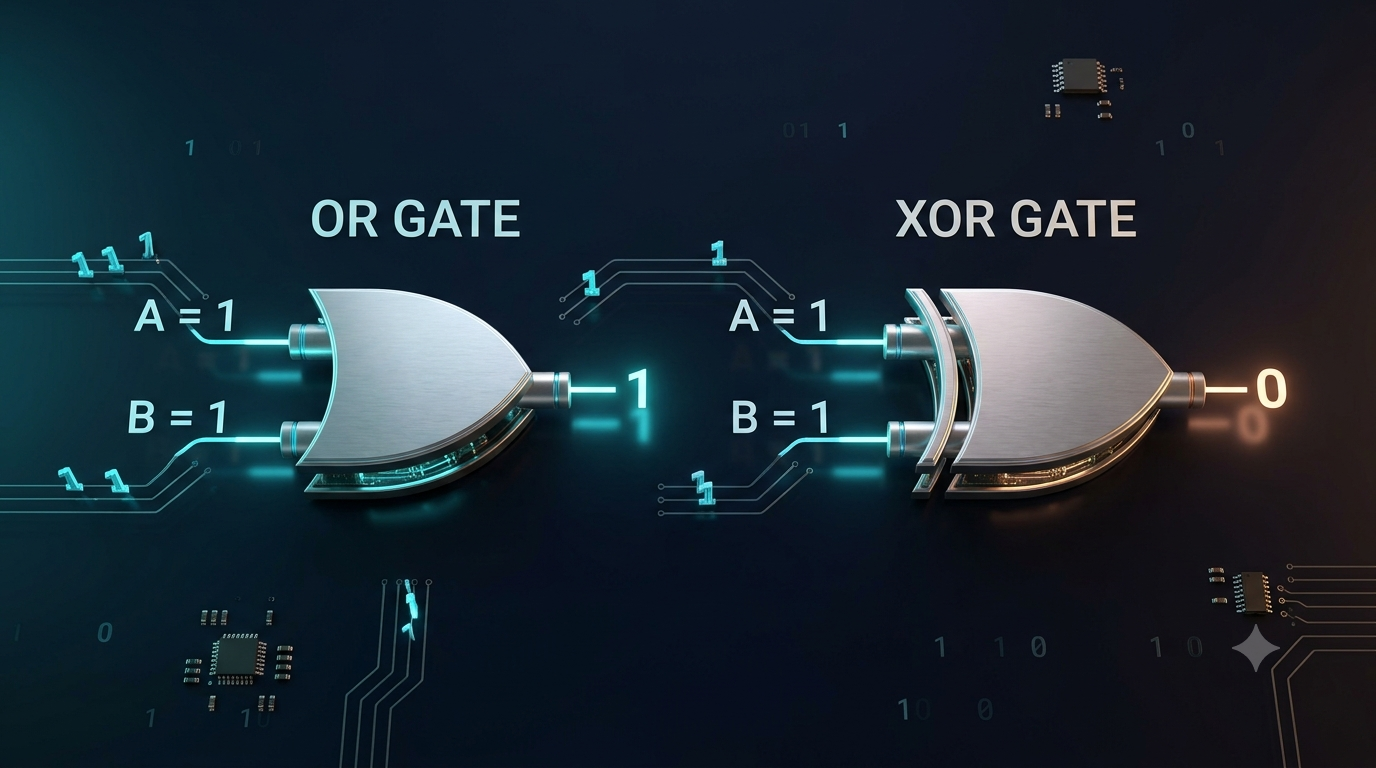
Logical operators are essential in computer science because they help computers make decisions, compare conditions, and process information. Among the […]
Read MoreHow are Boolean algebra and digital logic gates related?
Boolean algebra and digital logic gates are two fundamental concepts in computer science and digital electronics. They work together to […]
Read MoreWhy can Boolean expressions be simplified without changing their logical result?
Boolean expressions are an essential part of computer science, digital electronics, programming, and information technology. They are used to represent […]
Read MoreHow does Boolean algebra simplify decisions made by computer programs?

Every computer program makes decisions. A website decides whether to allow a user to log in, a mobile application checks […]
Read MoreWhy does character encoding affect the amount of storage required for text?

Text may look simple when we read it on a screen, but computers must represent every character using numerical data. […]
Read MoreHow can the size of a file be estimated from the number of stored bytes?

Every digital file occupies a certain amount of storage space on a computer, smartphone, or other digital device. Whether it […]
Read MoreWhy are storage measurements sometimes calculated differently using decimal and binary units?

Have you ever purchased a 500 GB hard drive and noticed that your computer reports a slightly different storage capacity? […]
Read MoreWhat happens when a numerical value exceeds the range available in its data representation?

Computers store numerical values using a limited number of bits. Every data type, such as an 8-bit integer, a 32-bit […]
Read MoreWhy does the maximum value of a fixed-width integer depend on its number of bits?

Computers store and process information using binary digits, commonly called bits. Each bit can hold one of two values: 0 […]
Read MoreHow does a signed number differ from an unsigned number at a fundamental level?

Computers use binary numbers to represent and process information. Every number stored in a computer occupies a certain number of […]
Read MoreWhy are powers of two so common in computer memory and digital systems?

Computers store, process, and transmit information using binary digits, commonly known as bits. Unlike the decimal number system, which uses […]
Read MoreHow can the same number of bits represent different types of information?

Computers process many different types of information, including numbers, letters, images, sounds, videos, and instructions. Although these forms of information […]
Read MoreWhy does one additional bit double the number of possible binary combinations?

Computers use binary numbers to store, process, and communicate information. Unlike the decimal system, which uses ten digits from 0 […]
Read MoreHow does increasing the number of binary digits affect the range of representable values?

Binary is the number system used by digital computers to represent and process information. It uses only two digits, 0 […]
Read More