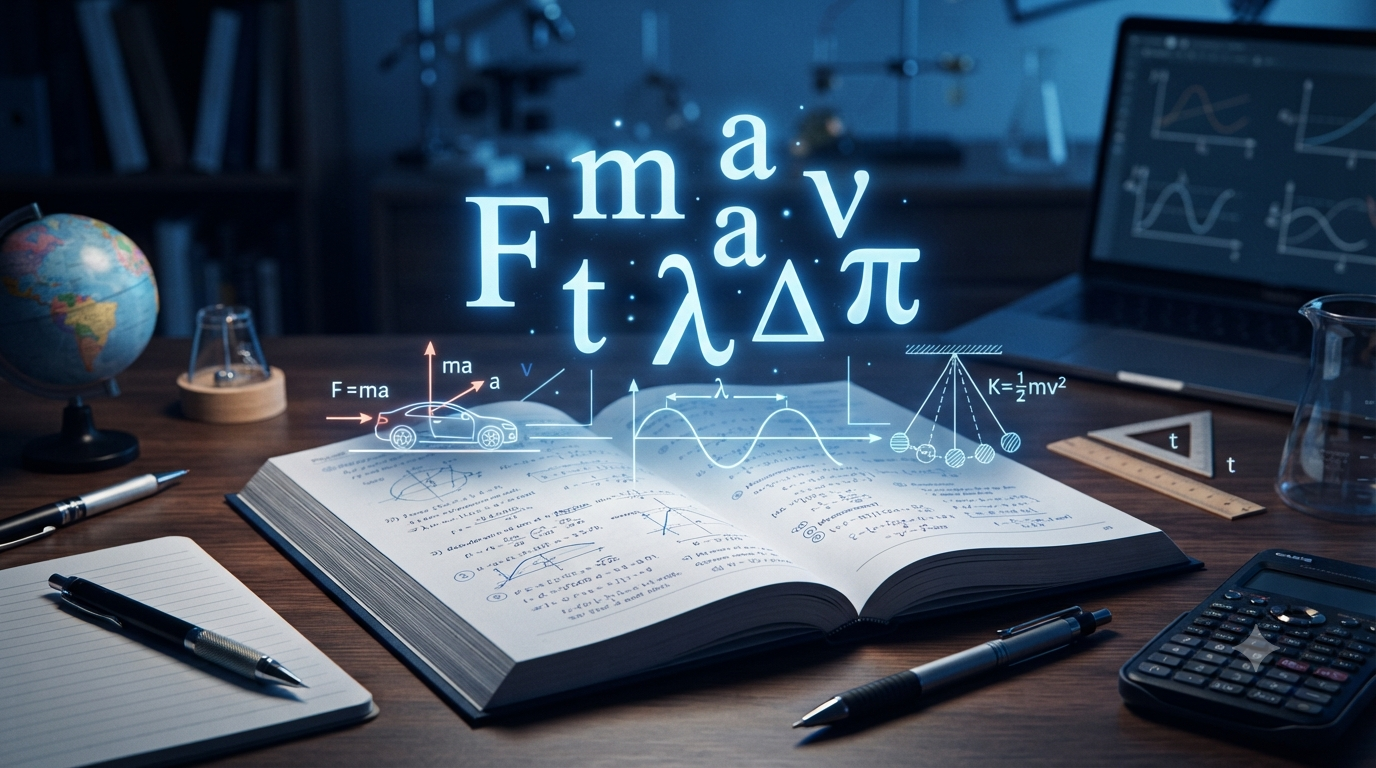
Physics formulas are written using mathematical symbols, letters, and numbers. These symbols help scientists describe motion, force, energy, time, temperature, and many other physical phenomena in a short and meaningful way. Instead of writing a complete sentence to explain a relationship, physicists use symbols to represent physical quantities and show how they are connected.
For example, the formula v = s/t describes the relationship between speed, distance, and time. Here, each letter has a specific meaning. Understanding these symbols is an important step toward learning physics because it allows you to read formulas, solve numerical problems, and understand physical relationships more easily.
In this article, we will learn what symbols mean in physics formulas, how to identify them, and how to use them correctly.
What Is a Symbol in a Physics Formula?
A symbol in a physics formula is a letter, Greek character, or mathematical sign used to represent a physical quantity, a constant, an operation, or a relationship. Symbols make formulas shorter and easier to understand.
For example, consider the formula for force:
F = ma
This formula tells us that force is related to mass and acceleration. The symbols have the following meanings:
Each symbol carries information. Once you understand what the symbols represent, the formula becomes easier to read and apply.
A symbol does not always have the same meaning in every formula. Its meaning depends on the topic, the context, and the definitions provided in the problem.
Why Are Symbols Important in Physics?
Symbols are important because physics deals with many quantities and relationships. Writing every quantity in full words would make formulas long and difficult to use. Symbols provide a common mathematical language for describing nature.
For example, the formula for kinetic energy is:
KE = ½mv²
Writing “kinetic energy equals one-half multiplied by mass multiplied by the square of velocity” every time would be inconvenient. Using symbols makes the expression compact and clear.
Symbols help physicists and learners in several ways:
They simplify formulas: A short expression can represent a complete physical relationship.
They make calculations easier: Symbols can be replaced with numerical values to solve problems.
They show relationships: A formula explains how one quantity depends on another.
They support communication: Scientists around the world can understand commonly used symbols.
They help rearrange equations: Symbols can be manipulated to find an unknown quantity.
Understanding symbols is therefore not just about memorizing letters. It is about understanding what each quantity means and how it behaves in a physical situation.
Common Symbols Used for Physical Quantities
Many physics formulas use familiar English letters to represent physical quantities. The same letter may have different meanings in different contexts, so it is important to read the formula carefully.
Symbols in Mechanics
Mechanics deals with motion, force, energy, and the behavior of objects. Some commonly used symbols are:
| Symbol | Physical quantity | SI unit |
|---|
s or x | Displacement or position, depending on context | metre (m) |
d | Distance, in many contexts | metre (m) |
t | Time | second (s) |
v | Velocity or speed, depending on context | metre per second (m/s) |
u | Initial velocity | metre per second (m/s) |
a | Acceleration | metre per second squared (m/s²) |
m | Mass | kilogram (kg) |
F | Force | newton (N) |
p | Momentum | kilogram metre per second (kg·m/s) |
W | Work | joule (J) |
P | Power | watt (W) |
For example, the equation of motion
s = ut + ½at²
uses s for displacement, u for initial velocity, a for acceleration, and t for time. The formula is meaningful only when each symbol is understood correctly.
Symbols in Electricity
Electricity and electromagnetism use their own set of symbols. Some common examples include:
| Symbol | Physical quantity | SI unit |
|---|
I | Electric current | ampere (A) |
V | Potential difference or voltage | volt (V) |
R | Electrical resistance | ohm (Ω) |
Q | Electric charge | coulomb (C) |
E | Energy or electric field, depending on context | joule (J) or newton per coulomb (N/C) |
C | Capacitance in many circuit formulas | farad (F) |
Ohm’s law is written as:
V = IR
Here, V represents potential difference, I represents electric current, and R represents resistance. This formula shows that the potential difference across a resistor equals the current through it multiplied by its resistance, under the conditions where Ohm’s law applies.
Greek Letters in Physics Formulas
Physics does not use only English letters. Greek letters are also common, especially in advanced topics such as waves, electromagnetism, thermodynamics, and modern physics.
Some frequently used Greek symbols include:
| Symbol | Common meaning in physics |
|---|
α (alpha) | Angular acceleration or another defined quantity |
β (beta) | A parameter, coefficient, or particle speed ratio in some contexts |
θ (theta) | Angle |
λ (lambda) | Wavelength |
μ (mu) | Coefficient of friction or another defined quantity |
ρ (rho) | Density or resistivity, depending on context |
σ (sigma) | Surface charge density, stress, or another quantity |
ω (omega) | Angular velocity or angular frequency |
π (pi) | Mathematical constant approximately equal to 3.14159 |
For example, the wavelength of a wave is often represented by λ, while angular velocity is commonly represented by ω.
The meaning of a Greek letter must always be checked in the formula or chapter where it appears.
Mathematical Symbols Used in Physics
In addition to letters, physics formulas contain mathematical symbols that indicate operations and relationships. These signs are essential for interpreting a formula correctly.
| Symbol | Meaning |
|---|
+ | Addition |
− | Subtraction |
× or implied multiplication | Multiplication |
/ or fraction bar | Division |
= | Equal to |
∝ | Proportional to |
√ | Square root |
² | Squared |
³ | Cubed |
Δ | Change in a quantity |
∑ | Sum of several terms |
≈ | Approximately equal to |
Consider the formula:
v = u + at
The symbol + means that the product at is added to the initial velocity u. The result is the final velocity v, provided the formula’s conditions are satisfied.
The symbol Δ is especially useful in physics. For example, Δt means a change in time or a time interval, while Δv means a change in velocity.
Symbols for Physical Constants
Some symbols represent constants. A physical constant is a quantity whose value is fixed under the conditions and definitions in which it is used.
For example, the speed of light in a vacuum is represented by c. Its value is approximately:
c = 3 × 10⁸ m/s
Another important constant is the gravitational constant, represented by G. It appears in Newton’s law of universal gravitation:
F = Gm₁m₂/r²
In this formula:
F is the gravitational force.
G is the gravitational constant.
m₁ and m₂ are the masses of two objects.
r is the distance between their centers, for the usual point-mass form of the equation.
Some symbols, such as g, represent quantities that are approximately constant in a particular situation. Near Earth’s surface, g commonly represents gravitational acceleration, approximately 9.8 m/s², although its value can vary slightly with location.
It is important to distinguish a universal or defined constant from a quantity that is only treated as constant under particular conditions.
The Same Symbol Can Have Different Meanings
One of the most important things to remember is that a symbol does not always represent the same quantity in every physics formula.
For example, the letter P can represent power in mechanics and electricity. In some contexts, it can represent pressure. The meaning depends on the topic and the formula.
Similarly, W can represent work, while in some contexts it may represent weight. The letter E can represent energy, electric field, or another defined quantity.
This is why memorizing a symbol without understanding its context can lead to mistakes. Always check the formula, the surrounding explanation, and the units.
How to Read Symbols in a Physics Formula
Reading a formula correctly involves more than identifying its letters. You must understand the mathematical operations and the physical meaning of each term.
Consider the formula for gravitational potential energy near Earth’s surface:
PE = mgh
You can read it as:
“Potential energy equals mass multiplied by gravitational acceleration multiplied by height.”
Here:
PE represents gravitational potential energy.
m represents mass.
g represents gravitational acceleration.
h represents height relative to a chosen reference level.
To understand the formula, follow these steps:
Identify the quantity being calculated.
Identify every symbol on the right-hand side.
Find the meaning and SI unit of each symbol.
Understand the mathematical operations between the quantities.
Check whether the formula applies to the given situation.
Substitute values only after understanding the symbols.
This method helps prevent confusion and improves accuracy when solving numerical problems.
Symbols, Units, and Dimensions
A symbol represents a physical quantity, while a unit tells us how that quantity is measured. These are related but different ideas.
For example, in the formula:
v = s/t
v represents velocity, and its SI unit is metre per second. The symbol m/s is the unit, not the symbol for velocity itself.
Similarly, m can represent mass, but kg is the SI unit of mass. Confusing a physical symbol with its unit can cause errors in calculations.
Symbols can also help us check whether a formula is dimensionally consistent. For example:
F = ma
Force has the dimensions of mass multiplied by acceleration. Therefore, the dimensions on both sides agree.
Understanding symbols, units, and dimensions together makes it easier to recognize whether a formula has been used correctly.
How to Avoid Mistakes When Using Symbols
Many errors in physics occur because a symbol is misunderstood or used in the wrong context. The following habits can help:
Read the definition of each symbol before using a formula.
Do not assume that the same letter always has the same meaning.
Check whether a symbol represents a scalar or a vector quantity.
Pay attention to uppercase and lowercase letters.
Check subscripts, superscripts, and Greek letters carefully.
Write the units of the quantities you substitute.
Confirm that the formula applies to the physical situation.
Use the correct sign and mathematical operation.
For example, v and V may represent different quantities. In some contexts, v is velocity, while V is voltage or volume. Similarly, m and M should not automatically be treated as the same symbol.
Careful reading is often more important than memorizing a long list of formulas.
Conclusion
Symbols are the language of physics formulas. They represent physical quantities, constants, mathematical operations, and relationships between different parts of a physical system. By understanding symbols such as F, m, a, v, t, λ, and ω, learners can read formulas more confidently and solve problems more accurately.
The key is to remember that every symbol has a meaning determined by its context. A letter may represent different quantities in different chapters, and its unit provides additional information about what it describes. When you identify each symbol, understand its mathematical role, and check its units, physics formulas become much easier to understand.
Learning symbols is therefore one of the first steps toward turning mathematical expressions into meaningful explanations of the physical world.