
A chemical formula is a short way of showing what a substance is made of. Instead of writing the names and quantities of atoms in a long sentence, chemistry uses symbols, numbers, and other conventions to represent the composition of a substance. One of the most important numbers found in a chemical formula is the subscript.
A subscript is a small number written at the lower right of a chemical symbol or group of symbols. It tells us how many atoms of an element are present in one molecule or formula unit of a substance. For example, the formula H₂O contains a subscript ₂ after H. This means that one water molecule contains two hydrogen atoms. Oxygen has no written subscript, which means there is one oxygen atom.
Understanding subscripts is essential for reading chemical formulas, counting atoms, calculating formula mass, writing chemical equations, and studying chemical reactions.
What Is a Subscript in Chemistry?
A subscript is a small number written below and to the right of a chemical symbol in a chemical formula.
For example:
H₂O
In this formula, the number ₂ is a subscript. It applies only to the hydrogen symbol H. Therefore, H₂O contains:
2 hydrogen atoms
1 oxygen atom
When a chemical symbol has no subscript, chemistry conventionally assumes that there is one atom of that element.
For example:
CO₂
The subscript ₂ belongs to oxygen, so the formula contains one carbon atom and two oxygen atoms.
Similarly:
NH₃
This formula contains one nitrogen atom and three hydrogen atoms.
The position of the subscript is important. A subscript tells us the number of atoms represented by the symbol immediately before it, unless the subscript follows a group inside parentheses.
Why Are Subscripts Used in Chemical Formulas?
Subscripts provide information about the exact composition of a substance. Different substances can contain the same elements but in different proportions.
For example:
H₂O contains hydrogen and oxygen in a 2:1 ratio.
H₂O₂ also contains hydrogen and oxygen, but its ratio is 2:2, which simplifies to 1:1.
These are different substances with different properties.
Without subscripts, it would be difficult to communicate the precise number of atoms in a chemical substance. The formula gives this information in a compact form.
Subscripts are therefore not decorative numbers. They are an essential part of a chemical formula.
How to Read a Subscript
Reading a subscript is straightforward once you know what it represents.
Consider:
O₂
The subscript ₂ tells us that there are two oxygen atoms.
Now consider:
N₂
The subscript ₂ tells us that there are two nitrogen atoms.
In:
CH₄
There is no subscript after C, so there is one carbon atom. The subscript ₄ after H means there are four hydrogen atoms.
Therefore:
CH₄ = 1 carbon atom + 4 hydrogen atoms
The same rule can be applied to larger formulas.
For example:
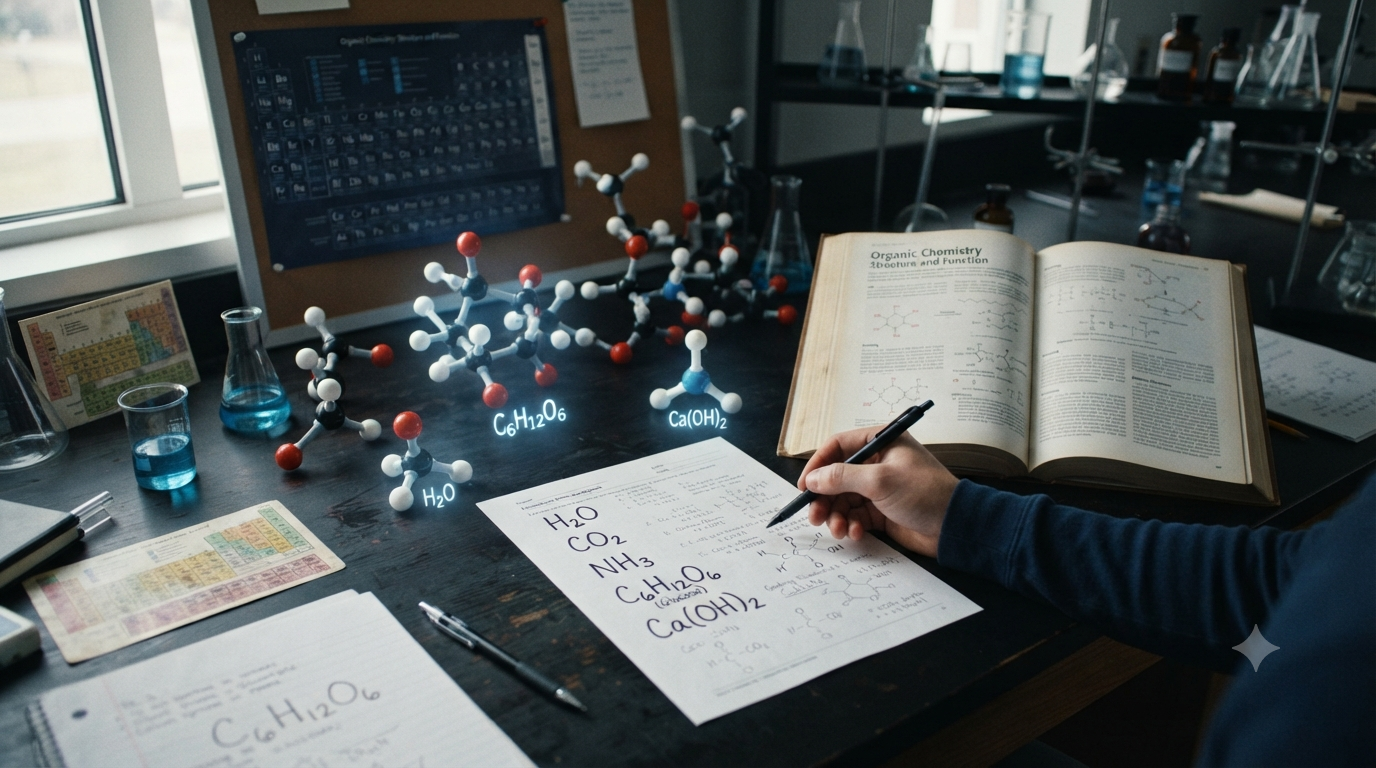
C₆H₁₂O₆
The formula contains:
6 carbon atoms
12 hydrogen atoms
6 oxygen atoms
The subscripts tell us the number of atoms of each element.
What Does a Missing Subscript Mean?
A missing subscript means the number is one.
For example:
NaCl
There is no subscript after Na and no subscript after Cl. Therefore, the formula represents:
1 sodium atom
1 chlorine atom
Similarly:
CO
means:
1 carbon atom
1 oxygen atom
A chemical formula does not normally write the number 1 as a subscript. Writing Na₁Cl₁ is unnecessary. NaCl already communicates the same information.
This is an important rule when counting atoms.
Subscripts Apply to the Symbol Immediately Before Them
A subscript generally applies to the chemical symbol immediately before it.
Consider:
CO₂
The ₂ applies to O, not C.
Therefore:
C = 1 atom
O = 2 atoms
Now consider:
SO₃
The ₃ applies to oxygen.
Therefore:
S = 1 sulfur atom
O = 3 oxygen atoms
The location of the subscript helps identify exactly which element it describes.
Subscripts With More Than One Digit
Subscripts are not always single digits. A formula can contain larger numbers.
For example:
C₁₂H₂₂O₁₁
This formula contains:
12 carbon atoms
22 hydrogen atoms
11 oxygen atoms
The entire number is treated as the subscript.
This is useful when studying larger molecules and compounds.
Subscripts and Chemical Groups
Subscripts can also describe groups of atoms when parentheses are used.
Consider:
Ca(OH)₂
The subscript ₂ appears after the closing parenthesis. It applies to the entire OH group.
Therefore, Ca(OH)₂ contains:
1 calcium atom
2 oxygen atoms
2 hydrogen atoms
The OH group occurs twice.
This is different from:
CaOH₂
where the placement of the subscript changes the interpretation of the formula.
Parentheses are used when a group of atoms behaves as a unit within a chemical formula.
How to Count Atoms Using Subscripts
One of the most useful skills in chemistry is counting the total number of atoms in a formula.
Consider:
Al₂(SO₄)₃
First, identify the subscript after Al:
Al₂ means 2 aluminum atoms.
Next, look at the sulfate group:
SO₄
Inside the parentheses, there is:
1 sulfur atom
4 oxygen atoms
The subscript ₃ outside the parentheses means the entire SO₄ group occurs three times.
Therefore:
Sulfur = 1 × 3 = 3 atoms
Oxygen = 4 × 3 = 12 atoms
So Al₂(SO₄)₃ contains:
2 aluminum atoms
3 sulfur atoms
12 oxygen atoms
The total number of atoms is:
2 + 3 + 12 = 17 atoms
This shows why understanding the position of a subscript is important.
Subscripts in Molecular Formulas
In molecular substances, subscripts indicate the number of atoms present in one molecule.
For example:
H₂O
One water molecule contains two hydrogen atoms and one oxygen atom.
Similarly:
CO₂
One carbon dioxide molecule contains one carbon atom and two oxygen atoms.
For:
C₂H₆
one molecule contains:
2 carbon atoms
6 hydrogen atoms
The subscripts therefore describe the composition of an individual molecule.
Subscripts in Ionic Compounds
Subscripts are also important in ionic compounds. They show the simplest whole-number ratio of ions in a formula unit.
For example:
MgCl₂
This formula represents:
1 magnesium ion
2 chloride ions
The ratio of magnesium to chloride is 1:2.
Another example is:
Al₂O₃
This formula contains:
2 aluminum ions
3 oxide ions
The ratio is 2:3.
In ionic compounds, the formula is generally written so that the overall compound is electrically neutral.
Subscript vs Coefficient
A subscript and a coefficient can both be numbers, but they have very different meanings.
Consider:
2H₂O
There are two parts to this expression.
The coefficient 2 is placed in front of H₂O. It means there are two water molecules.
The subscript ₂ belongs to H and means each water molecule contains two hydrogen atoms.
Therefore:
2H₂O contains:
4 hydrogen atoms
2 oxygen atoms
The coefficient multiplies the entire formula, while the subscript describes the number of atoms associated with a particular symbol or group.
This distinction becomes especially important when balancing chemical equations.
Subscript vs Coefficient Example
Compare:
H₂O
and:
2H₂O
In H₂O:
H = 2 atoms
O = 1 atom
In 2H₂O:
H = 2 × 2 = 4 atoms
O = 2 × 1 = 2 atoms
The subscript remains part of the formula. The coefficient tells us how many units of the formula are present.
This is why changing a subscript can change the identity of a substance, while changing a coefficient changes only the amount of the substance.
Why You Should Not Change Subscripts When Balancing Equations
Subscripts must be handled carefully during chemical equations.
For example:
H₂ + O₂ → H₂O
To balance the equation, we change the coefficients, not the subscripts.
The balanced equation is:
2H₂ + O₂ → 2H₂O
The formulas H₂, O₂, and H₂O remain unchanged.
Changing H₂O into H₂O₂ would create a different substance rather than simply balancing the equation.
Therefore, one important chemistry rule is:
Change coefficients when balancing equations; do not change subscripts.
Subscripts and Chemical Formulas
Subscripts help distinguish substances with different compositions.
For example:
CO
and:
CO₂
both contain carbon and oxygen, but their subscripts are different.
CO contains:
1 carbon atom
1 oxygen atom
CO₂ contains:
1 carbon atom
2 oxygen atoms
Because their atomic ratios differ, these formulas represent different substances.
Another example is:
H₂O
and:
H₂O₂
Both contain hydrogen and oxygen, but the number of oxygen atoms is different.
This demonstrates how a small subscript can carry important chemical information.
Common Mistakes When Reading Subscripts
Several mistakes can occur when interpreting chemical formulas.
Ignoring a Missing Subscript
Some learners may think that an element without a number has no atoms.
That is incorrect.
A missing subscript means one atom.
For example:
NaCl
contains one sodium atom and one chlorine atom.
Applying a Subscript to the Wrong Element
In:
CO₂
the ₂ applies to oxygen, not carbon.
The correct atom count is one carbon and two oxygen atoms.
Forgetting Parentheses
In:
Ca(OH)₂
the ₂ applies to the entire OH group.
Therefore, there are two oxygen atoms and two hydrogen atoms.
Confusing Subscripts With Coefficients
In:
3CO₂
the coefficient 3 applies to the entire CO₂ formula, while the subscript ₂ applies only to oxygen.
The total atoms are:
Carbon = 3 × 1 = 3
Oxygen = 3 × 2 = 6
Keeping these two concepts separate prevents many counting errors.
Subscripts and Formula Mass
Subscripts are also necessary when calculating the formula mass or molecular mass of a substance.
For example:
H₂O
contains two hydrogen atoms and one oxygen atom.
Using approximate atomic masses:
Hydrogen ≈ 1 u
Oxygen ≈ 16 u
Therefore:
H₂O = 2(1) + 16 = 18 u
Without the subscript ₂, the calculation would incorrectly treat water as containing only one hydrogen atom.
For larger formulas, the same principle applies. Each subscript tells you how many times the atomic mass of that element must be included.
Subscripts in Chemical Reactions
During a chemical reaction, atoms are rearranged to form new substances. Chemical formulas use subscripts to show the composition of those substances.
For example:
2H₂ + O₂ → 2H₂O
On the left side:
Hydrogen atoms = 2 × 2 = 4
Oxygen atoms = 2
On the right side:
Hydrogen atoms = 2 × 2 = 4
Oxygen atoms = 2 × 1 = 2
The number of each type of atom is conserved.
Subscripts tell us the composition of each chemical substance, while coefficients tell us how many units participate in the reaction.
A Simple Method for Understanding Subscripts
Whenever you see a chemical formula, follow these steps:
Identify each chemical symbol.
Look for the subscript immediately following each symbol.
If there is no subscript, count one atom.
If a subscript is present, use that number as the atom count.
Check for parentheses.
If a number follows parentheses, multiply every atom inside the parentheses by that number.
If there is a coefficient in front of the formula, multiply the entire formula by that coefficient.
For example:
2Al₂(SO₄)₃
First, Al₂ gives 2 aluminum atoms per formula unit.
The sulfate group SO₄ occurs 3 times:
S = 1 × 3 = 3
O = 4 × 3 = 12
Then the coefficient 2 doubles everything:
Al = 2 × 2 = 4
S = 3 × 2 = 6
O = 12 × 2 = 24
This step-by-step method makes even complex formulas easier to read.
Conclusion
A subscript in a chemical formula tells us how many atoms of an element are represented in one molecule or formula unit. A small number such as the ₂ in H₂O means that two hydrogen atoms are present, while an element without a subscript represents one atom. When a subscript appears after parentheses, it applies to the entire group inside them.
Understanding subscripts is a basic but essential chemistry skill. They help us read formulas, count atoms, distinguish substances, calculate formula mass, and understand chemical reactions. It is also important to remember the difference between a subscript and a coefficient: a subscript describes the composition of a substance, while a coefficient tells us how many units of that substance are present. Once this distinction becomes clear, chemical formulas become much easier to understand and interpret.
FAQs
1. What does a subscript mean in a chemical formula?
A subscript is a small number written at the lower right of a chemical symbol in a chemical formula. It tells us how many atoms of that element are present in one molecule or formula unit. For example, in H₂O, the subscript ₂ after H means that one water molecule contains two hydrogen atoms. Oxygen has no subscript, so it represents one oxygen atom. Similarly, CO₂ contains one carbon atom and two oxygen atoms. Subscripts are important because they show the exact composition of a substance and help us count atoms, calculate formula mass, and understand chemical reactions.
2. What does a subscript of 2 mean in chemistry?
A subscript of 2 means that two atoms of the element or two units of the group immediately before it are present. For example, in H₂O, the ₂ applies to hydrogen, so there are two hydrogen atoms in one water molecule. In O₂, the ₂ means that the molecule contains two oxygen atoms. When the subscript follows parentheses, it applies to the entire group. For example, Ca(OH)₂ contains two OH groups, giving two oxygen atoms and two hydrogen atoms. Therefore, always check what the subscript directly follows before determining what it represents.
3. What does a missing subscript mean?
A missing subscript means that there is one atom of that element. Chemistry normally does not write the number 1 as a subscript. For example, in H₂O, hydrogen has a subscript ₂, so there are two hydrogen atoms. Oxygen has no subscript, which means there is one oxygen atom. In NaCl, neither sodium nor chlorine has a written subscript, so the formula represents one sodium and one chlorine. Remembering that an absent subscript means one makes it much easier to read chemical formulas and count the atoms present in molecules and ionic compounds.
4. Does a subscript apply to the whole chemical formula?
No. A subscript normally applies only to the chemical symbol or group immediately before it. For example, in CO₂, the subscript ₂ applies only to oxygen, giving one carbon atom and two oxygen atoms. However, when a subscript follows parentheses, it applies to the entire group inside the parentheses. For example, Ca(OH)₂ contains two OH groups. It therefore has one calcium atom, two oxygen atoms, and two hydrogen atoms. Understanding where the subscript is placed is essential for correctly interpreting chemical formulas and avoiding mistakes when counting atoms.
5. How do you count atoms using subscripts?
To count atoms, identify each chemical symbol and look for its subscript. If a symbol has no subscript, count one atom. If it has a subscript, use that number as the atom count. For example, C₆H₁₂O₆ contains six carbon atoms, twelve hydrogen atoms, and six oxygen atoms. If parentheses are present, multiply the atoms inside the parentheses by the subscript outside them. For example, Ca(OH)₂ contains two oxygen atoms and two hydrogen atoms. This method allows you to determine the total number of each type of atom in a chemical formula.
6. What is the difference between a subscript and a coefficient?
A subscript shows the number of atoms of an element within one molecule or formula unit, while a coefficient shows how many molecules or formula units are present. For example, in 2H₂O, the subscript ₂ means each water molecule contains two hydrogen atoms. The coefficient 2 means there are two water molecules. Therefore, the expression contains four hydrogen atoms and two oxygen atoms altogether. Subscripts are part of the chemical formula and describe its composition. Coefficients are placed in front of formulas and are commonly changed when balancing chemical equations.
7. Why should subscripts not be changed when balancing equations?
Subscripts should not normally be changed when balancing a chemical equation because changing a subscript changes the composition and can create a different substance. For example, H₂O represents water, while H₂O₂ represents hydrogen peroxide. They are different substances. When balancing an equation, coefficients are changed instead. For example, the equation H₂ + O₂ → H₂O becomes 2H₂ + O₂ → 2H₂O when balanced. The subscripts remain unchanged. This ensures that the same substances are present on both sides while the number of atoms of each element is conserved.
8. What happens when a subscript follows parentheses?
When a subscript follows parentheses, it applies to every atom in the group inside the parentheses. For example, Ca(OH)₂ contains the OH group twice. The formula therefore contains one calcium atom, two oxygen atoms, and two hydrogen atoms. Another example is Al₂(SO₄)₃. The subscript ₃ applies to the entire SO₄ group. This gives three sulfur atoms and twelve oxygen atoms. Parentheses are used to show that a group of atoms is repeated. Recognizing this rule is important when counting atoms in chemical formulas containing polyatomic ions or repeated groups.
9. Can subscripts be used to calculate molecular or formula mass?
Yes. Subscripts are essential when calculating molecular mass or formula mass because they tell us how many atoms of each element contribute to the total mass. For example, H₂O contains two hydrogen atoms and one oxygen atom. Using approximate atomic masses of 1 u for hydrogen and 16 u for oxygen, its molecular mass is 2(1) + 16 = 18 u. Similarly, the subscripts in larger formulas determine how many times each element’s atomic mass must be included. Therefore, correctly reading subscripts is an important step in chemical calculations.
10. Why are subscripts important in chemistry?
Subscripts are important because they communicate the exact composition of a chemical substance in a compact form. They show how many atoms of each element are present in a molecule or formula unit. Subscripts help chemists identify substances, count atoms, calculate molecular or formula mass, write chemical formulas, and interpret chemical reactions. For example, H₂O and H₂O₂ both contain hydrogen and oxygen, but their different subscripts show different compositions and therefore different substances. Learning how to read subscripts correctly provides a foundation for understanding chemical equations, stoichiometry, molecular structures, and many other areas of chemistry.
Related Posts
How to Read Subscripts in Chemical Formulas
Chemical formulas are a simple way to represent substances using symbols and numbers. When you look at a formula such […]
Read MoreHow to Identify Constants in Physics Equations
Physics equations often contain several symbols, numbers, and quantities. To understand an equation correctly, it is important to know which […]
Read MoreHow to Use SI Units in Physics Formulas

Physics formulas connect different physical quantities through mathematical relationships. But a formula can give a wrong answer if the quantities […]
Read MoreWhat Do Symbols Mean in Physics Formulas?
Physics formulas are written using mathematical symbols, letters, and numbers. These symbols help scientists describe motion, force, energy, time, temperature, […]
Read MoreSI Unit of Length Metre and Its Modern Definition
Length is one of the most basic quantities measured in science. Whether we measure the distance between two cities, the […]
Read MoreHow to Write Formulas Using Valency
Writing chemical formulas becomes much easier when you understand valency. A chemical formula tells us which elements are present in […]
Read MoreHow to Read and Interpret a Physics Formula
Physics formulas are more than mathematical expressions written in textbooks. They are compact ways of describing how physical quantities are […]
Read MoreWhat Is Measurement in Physics?
Measurement is one of the most important foundations of physics. Almost every idea in physics is connected to measurement in […]
Read MoreHow Is Energy Transferred From One Object to Another?
Energy is all around us. It makes objects move, produces heat, creates sound, powers machines, and allows living organisms to […]
Read MoreHow do parentheses affect the number of atoms in a formula?
Chemical formulas tell us which elements are present in a substance and how many atoms of each element are included. […]
Read MoreCommon Mistakes When Writing Chemical Formulas
Chemical formulas are one of the simplest ways to represent substances in chemistry. A short formula can tell us which […]
Read MoreWhat Is Acceleration in Physics?
Acceleration is one of the most important concepts in physics because it describes how the velocity of an object changes […]
Read MoreBasic Types of Chemistry Formulas Explained
Chemistry formulas are one of the simplest ways scientists describe substances, reactions, and relationships between different particles. A formula can […]
Read MoreHow to Understand Units in Physics Formulas
Physics formulas are more than mathematical expressions. They describe relationships between physical quantities, and units help us understand what those […]
Read MoreWhat Is a Chemical Formula in Chemistry?
Chemistry is the study of substances, their properties, and the changes they undergo. To describe these substances clearly, chemists need […]
Read MoreHow to Write Formulas for Molecular Compounds
Writing the formula of a molecular compound is an important skill in chemistry. A chemical formula tells us which elements […]
Read MoreWhat Is Dimensional Analysis in Physics?
Physics is full of equations, measurements, and mathematical relationships. But how can we know whether an equation makes physical sense? […]
Read MoreHow to Write Formulas Using Ionic Charges
Writing chemical formulas becomes much easier when you understand how ions combine and how their charges are balanced. An ionic […]
Read MoreWhat Is Force in Physics?
Force is one of the most important ideas in physics. We experience forces every day, even when we do not […]
Read MoreMass and Weight: What Is the Difference?
Have you ever wondered why an object can have the same amount of matter but weigh differently in different places? […]
Read MoreCommon Formulas of Salts in Chemistry
Salts are an important group of chemical compounds found in laboratories, industries, food, agriculture, medicines, and everyday materials. In chemistry, […]
Read MoreWhy can different compounds have the same empirical formula?
An empirical formula gives the simplest whole-number ratio of atoms present in a compound. It is useful because it tells […]
Read MoreHow Does Measurement Uncertainty Affect a Physics Experiment?
Every physics experiment involves measurement. We measure length, time, mass, temperature, voltage, current, speed, or other physical quantities to understand […]
Read MoreHow to Study Physics Formulas Step by Step
Physics formulas are an important part of learning physics, but simply memorizing them is not enough. A formula represents a […]
Read MoreWhat Is a Reference Point in Physics?
In physics, we often describe where an object is, how it moves, or how far it has traveled. But to […]
Read MoreHow to Write Formulas for Ionic Compounds
Writing formulas for ionic compounds is an important skill in chemistry because a chemical formula tells us which ions are […]
Read MoreWhat Is Dimensional Consistency in Physics?
Physics uses mathematical equations to describe how different physical quantities are related. When scientists write an equation, every quantity in […]
Read MoreWhy the SI System Has Exactly Seven Base Units
When scientists measure the world, they need a common language for describing quantities such as time, length, mass, temperature, and […]
Read MoreCommon Valencies of Important Elements
Valency is one of the basic ideas in chemistry that helps us understand how atoms combine with one another. When […]
Read MoreWhat Are Physical Quantities in Physics?
Physics is the study of nature and the rules that describe how objects, matter, energy, space, and time behave. To […]
Read More