When solving a science or mathematics problem, one of the first things you need to do is identify which quantities are already known and which quantity you need to find. This simple step is often overlooked, but it is essential for choosing the correct formula and solving a problem accurately.
A formula usually contains several quantities represented by numbers and symbols. Some of these quantities are given directly in the question, while another quantity may be missing and must be calculated. The given values are called known quantities, and the value that needs to be calculated is called the unknown quantity.
For example, if a physics problem gives a distance of 100 metres and a time of 20 seconds and asks for speed, distance and time are known quantities, while speed is the unknown quantity. Using the formula speed = distance ÷ time, the unknown can be calculated.
Learning how to distinguish known and unknown quantities makes formula-based problems much easier. It also helps you avoid using the wrong formula or substituting values incorrectly.
What Are Known Quantities?
A known quantity is a value that is already provided in a problem or can be determined from the information given.
Known quantities are usually stated directly in a question. They may appear as numerical values with units, words, symbols, or descriptions.
For example:
A car travels 150 kilometres in 3 hours. Find its average speed.
In this problem, the distance is 150 kilometres and the time is 3 hours. Therefore:
Distance = 150 km
Time = 3 h
Both distance and time are known quantities.
The problem does not provide the speed because speed is what you are asked to calculate. Therefore, speed is the unknown quantity.
Known quantities do not always have to be numbers written explicitly in the question. Sometimes they can be obtained from other information.
For example, if a square has a side length of 8 cm, its side length is a known quantity. If the question asks for its area, the area is unknown.
What Is an Unknown Quantity?
An unknown quantity is the value that is not given and needs to be found.
The unknown is usually indicated by the wording of the question.
Common phrases that identify an unknown quantity include:
Find the speed.
Calculate the distance.
Determine the time.
What is the mass?
Find the force.
Calculate the area.
Determine the volume.
How much energy is required?
What is the acceleration?
For example:
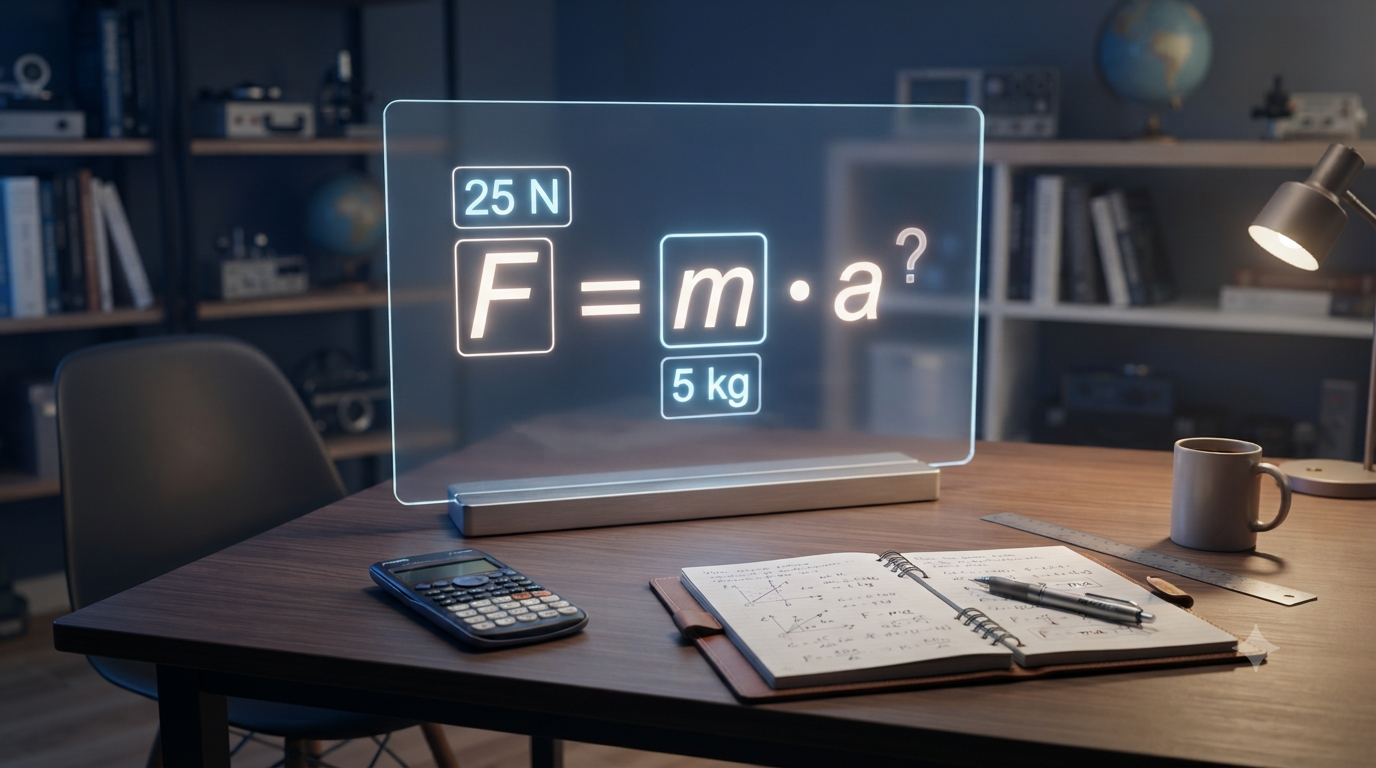
A force of 20 N acts on an object of mass 5 kg. Find its acceleration.
The question gives:
Force = 20 N
Mass = 5 kg
It asks for acceleration.
Therefore:
Force → known
Mass → known
Acceleration → unknown
Using Newton’s second law:
F = ma
The acceleration can be calculated by rearranging the formula:
a = F ÷ m
So:
a = 20 ÷ 5 = 4 m/s²
The important point is that you identify the unknown before substituting values into the formula.
How to Identify Known and Unknown Quantities
A simple method can be used for almost any formula-based problem.
Step 1: Read the Question Carefully
Do not immediately look for a formula. First, read the entire problem and understand what information is being provided.
For example:
A cyclist travels a distance of 240 m in 30 s. Calculate the cyclist’s speed.
The question provides two values and asks for another.
The important information is:
Distance = 240 m
Time = 30 s
Speed = ?
The question mark shows that speed is the unknown quantity.
Step 2: Look for Given Values
Identify every numerical value provided in the question.
Write each value together with its physical quantity and unit.
For example:
An object has a mass of 10 kg and experiences a force of 50 N. Find its acceleration.
You can write:
m = 10 kg
F = 50 N
These are known quantities.
Step 3: Identify What the Question Asks You to Find
Look carefully at the final part of the question.
If it says “find the velocity,” velocity is the unknown.
If it says “calculate the distance,” distance is the unknown.
If it says “determine the mass,” mass is the unknown.
A useful habit is to write the unknown with a question mark.
For example:
v = ?
or
s = ?
or
m = ?
This makes the goal of the calculation clear.
Step 4: Match the Quantities With the Formula
Once you know the given and unknown quantities, select a formula containing them.
For example, suppose:
F = 60 N
m = 12 kg
and acceleration is required.
The formula connecting force, mass, and acceleration is:
F = ma
The formula contains both known quantities and the unknown quantity.
Step 5: Rearrange the Formula if Necessary
The unknown quantity may not always be alone on one side of the formula.
For example:
v = u + at
If acceleration is unknown, you cannot simply substitute values and stop. You must rearrange the equation.
Starting with:
v = u + at
Subtract u from both sides:
v - u = at
Divide by t:
a = (v - u) ÷ t
Now acceleration is isolated.
This makes substitution easier and reduces mistakes.
Symbols Can Help You Identify the Unknown
Science formulas often use symbols instead of writing full quantity names.
Some common symbols include:
| Quantity | Common Symbol |
|---|---|
| Distance | s or d |
| Speed | v |
| Velocity | v |
| Time | t |
| Mass | m |
| Force | F |
| Acceleration | a |
| Energy | E |
| Work | W |
| Power | P |
| Pressure | p |
| Density | ρ |
| Volume | V |
| Area | A |
| Temperature | T |
The exact symbol can vary between formulas and textbooks, so always check what each symbol represents.
For example:
P = W ÷ t
Here:
P= powerW= workt= time
If work and time are given but power is not, then P is the unknown.
If power and time are given and work is required, then W becomes the unknown.
The same formula can therefore be used to find different quantities depending on what information is provided.
The Same Formula Can Have Different Unknowns
One of the most important things to understand is that a formula does not permanently have one unknown.
Consider:
v = s ÷ t
This formula relates speed, distance, and time.
If distance and time are known, speed is unknown:
v = s ÷ t
If speed and time are known, distance is unknown:
s = vt
If speed and distance are known, time is unknown:
t = s ÷ v
The quantities do not change. Only the role of the unknown changes according to the question.
This is why identifying the unknown is so important before choosing how to use a formula.
Known Does Not Always Mean “Already Calculated”
A quantity can be considered known even if it is not written as a simple number.
For example:
A rectangular field has a length of 20 m and a width that is 5 m less than its length. Find its area.
The length is directly given:
l = 20 m
The width is not directly written as a numerical value, but it can be determined:
w = 20 - 5
w = 15 m
Now the width is also known.
The area is the unknown:
A = ?
Using:
A = l × w
the area can be calculated.
This shows that some known quantities may need to be obtained from information given in the problem before the main formula is used.
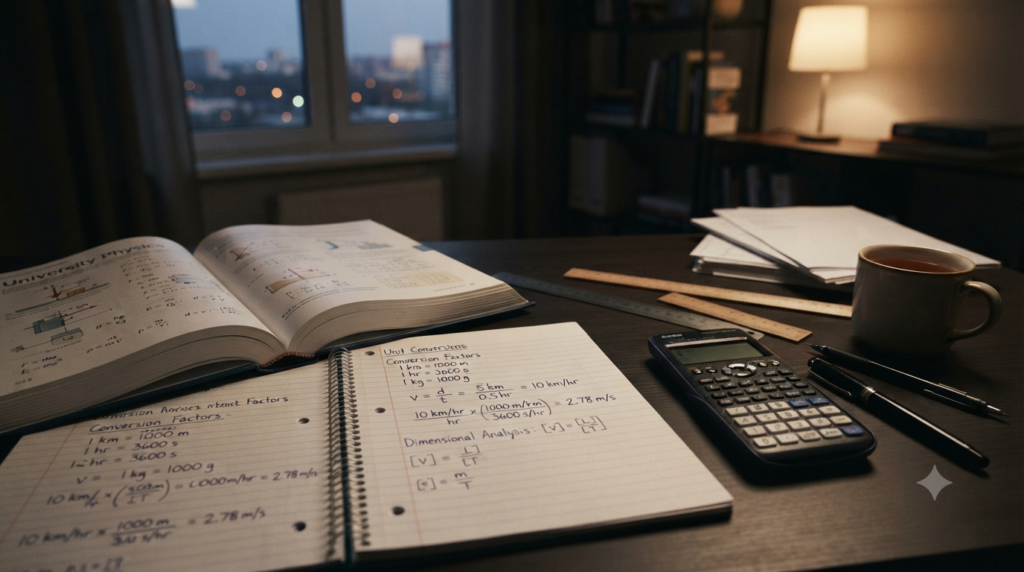
Watch the Units Carefully
Identifying known and unknown quantities is only part of solving a formula-based problem. You also need to check whether the units are compatible.
For example:
A vehicle travels 2 km in 10 seconds. Find its speed in metres per second.
The distance is given in kilometres, while time is given in seconds.
Before using the formula, convert kilometres to metres:
2 km = 2000 m
Now:
distance = 2000 m
time = 10 s
Speed is unknown:
v = ?
Using:
v = s ÷ t
we get:
v = 2000 ÷ 10
v = 200 m/s
If you use 2 directly without converting kilometres to metres, the result will have the wrong unit relationship.
Therefore, always identify both the numerical value and its unit.
A Useful Known-Unknown Table
For many problems, making a small table is an easy way to organize information.
Consider:
An object starts from rest and accelerates at 3 m/s² for 5 seconds. Find its final velocity.
You can organize the information as:
| Quantity | Symbol | Value |
|---|---|---|
| Initial velocity | u | 0 m/s |
| Acceleration | a | 3 m/s² |
| Time | t | 5 s |
| Final velocity | v | ? |
Now the structure of the problem is clear.
The formula is:
v = u + at
Substituting:
v = 0 + (3 × 5)
v = 15 m/s
This simple table prevents you from confusing the quantities.
What If More Than One Quantity Is Unknown?
Some problems contain more than one unknown quantity.
For example:
A rectangular box has an area of 60 m² and a length of 12 m. Find its width.
Here only width is unknown.
But consider a problem where both length and width are not given and only the area is provided. There may not be enough information to calculate both quantities uniquely.
For example:
A = l × w
If:
A = 60 m²
then:
60 = l × w
There are many possible combinations:
l = 10 m, w = 6 m
or
l = 12 m, w = 5 m
or
l = 15 m, w = 4 m
Without another condition, the individual dimensions cannot be determined uniquely.
This is an important lesson: a formula can only determine an unknown when enough information is available.
Do Not Assume an Unstated Value
When solving problems, use only the information provided or values that can be logically derived from it.
Do not assume that a missing quantity has a particular value just because it would make the calculation easier.
For example, if a problem gives mass and asks for acceleration but does not provide force, you cannot simply assume a force value.
Instead, check whether another part of the question provides enough information to determine force.
If the required information is missing, the problem may require another formula or additional information.
A Quick Example From Chemistry
The same idea applies outside physics.
Consider the formula:
density = mass ÷ volume
Suppose a substance has:
mass = 200 g
volume = 50 cm³
and density is required.
Known quantities:
Mass = 200 g
Volume = 50 cm³
Unknown quantity:
Density = ?
Using:
density = mass ÷ volume
density = 200 ÷ 50
density = 4 g/cm³
Now change the question:
A substance has a density of 4 g/cm³ and a volume of 50 cm³. Find its mass.
This time:
Density → known
Volume → known
Mass → unknown
The same relationship can be rearranged:
mass = density × volume
So:
mass = 4 × 50
mass = 200 g
The process is identical: identify what is known, identify what is unknown, select the relationship, rearrange if necessary, and calculate.
A Quick Example From Mathematics
Suppose the area of a triangle is given by:
A = ½bh
If:
b = 10 cm
h = 6 cm
and the area is required, then:
Base → known
Height → known
Area → unknown
Using:
A = ½ × 10 × 6
A = 30 cm²
But if the area and base are known and the height is required, then the height becomes the unknown.
Starting with:
A = ½bh
Multiply both sides by 2:
2A = bh
Divide by b:
h = 2A ÷ b
This example demonstrates why understanding the structure of a formula is more useful than simply memorizing formulas.
Common Mistakes When Identifying Known and Unknown Quantities
Several common mistakes can make a formula problem more difficult than it needs to be.
Confusing a Given Quantity With the Required Quantity
Sometimes students see a familiar number and immediately substitute it into a formula without checking what the question asks.
Always identify the target quantity first.
Ignoring Units
A number without its unit can be misleading. Always write the quantity with its unit.
For example:
m = 5 kg
is much clearer than simply writing:
m = 5
Using the Wrong Symbol
Different quantities can have similar-looking symbols. Make sure you know what each symbol means in the particular formula.
Using a Formula Without Rearranging It
If the unknown is not isolated, rearrange the formula before substitution when appropriate.
Assuming Missing Information
Do not invent values that are not provided. Check whether the missing quantity can be calculated from another relationship.
A Simple Five-Step Method
For most formula-based problems, you can use this five-step method:
1. Write the given quantities.
Record every known value with its symbol and unit.
2. Write the unknown quantity.
Put a question mark next to the quantity you need to find.
3. Choose the appropriate formula.
Select a formula that connects the known quantities with the unknown.
4. Rearrange the formula if required.
Make the unknown the subject of the formula.
5. Substitute and calculate.
Insert the values, perform the calculation, and include the correct unit.
For example:
A force of 40 N acts on a mass of 8 kg. Find the acceleration.
Given:
F = 40 N
m = 8 kg
Unknown:
a = ?
Formula:
F = ma
Rearrange:
a = F ÷ m
Substitute:
a = 40 ÷ 8
Answer:
a = 5 m/s²
This approach works across physics, chemistry, mathematics, and many other scientific calculations.
Conclusion
Knowing which quantities are known and which are unknown is one of the most important skills in solving formula-based problems. Known quantities are values that are given or can be determined from the information in the question. The unknown quantity is the value you are asked to calculate.
A reliable approach is to read the question carefully, list the given quantities with their symbols and units, identify the quantity being requested, select the formula that connects them, rearrange the formula when necessary, and then substitute the values.
Once you develop the habit of separating known and unknown quantities before calculating, formulas become much easier to understand and use. Instead of simply searching for a formula to memorize, you begin to see formulas as relationships between quantities. This makes problem-solving more organized, logical, and reliable.
FAQs
1. What is a known quantity in a formula?
A known quantity is a value that is already provided in a problem or can be calculated from the information given. It usually includes a numerical value and a unit. For example, if a problem states that an object has a mass of 10 kg and a force of 50 N, both mass and force are known quantities. Known quantities are used as inputs in a formula to calculate another value. Before solving a problem, it is helpful to list all known quantities using their symbols and units. This makes the problem easier to understand and helps you select the appropriate formula.
2. What is an unknown quantity in a formula?
An unknown quantity is the value that needs to be found or calculated in a problem. It is usually identified by the wording of the question, such as “find the speed,” “calculate the distance,” or “determine the mass.” For example, if a problem gives a distance of 100 m and a time of 20 s and asks for speed, speed is the unknown quantity. You can represent an unknown using a question mark, such as v = ?. Once the unknown is identified, you can choose a suitable formula, rearrange it if necessary, substitute the known values, and calculate the required result.
3. How can I identify the unknown quantity in a problem?
The easiest way to identify the unknown quantity is to look at what the question asks you to find. Words such as “find,” “calculate,” “determine,” “what is,” and “how much” usually indicate the required quantity. For example, in “A car travels 200 m in 10 seconds. Calculate its speed,” the distance and time are known, while speed is the unknown. You can write the information as s = 200 m, t = 10 s, and v = ?. Writing the unknown separately before selecting a formula makes it easier to organize the problem and avoid substituting values incorrectly.
4. Can the same formula have different unknown quantities?
Yes. A formula can be used to find different quantities depending on which values are given in a problem. For example, the relationship v = s ÷ t connects speed, distance, and time. If distance and time are known, speed is unknown. If speed and time are known, distance becomes the unknown and the formula can be rearranged to s = vt. If speed and distance are known, time is unknown and the formula becomes t = s ÷ v. Therefore, a formula does not always have one fixed unknown. The given information determines which quantity needs to be calculated.
5. Why should I write known quantities with their units?
Writing known quantities with their units helps you understand what each value represents and prevents calculation errors. For example, writing m = 5 kg clearly shows that the value 5 represents mass measured in kilograms. Units are also important because formulas often require compatible units. If a distance is given in kilometres but the desired speed is in metres per second, the distance may need to be converted into metres before calculation. Keeping units throughout the solution also helps you check whether the final answer has the correct unit. Therefore, always record both the numerical value and its unit when identifying known quantities.
6. What should I do if the unknown quantity is not alone in the formula?
If the unknown quantity is not already isolated, rearrange the formula before substituting the known values. For example, suppose you know force and mass but need to find acceleration. Newton’s second-law formula is F = ma. Since acceleration is multiplied by mass, divide both sides by mass to obtain a = F ÷ m. Now acceleration is alone on one side and the known values can be substituted easily. Rearranging a formula is an important algebra skill because it allows you to use the same relationship to calculate different quantities. Always perform the rearrangement carefully and maintain the correct mathematical relationship.
7. What if a quantity is not directly given but can be calculated?
A quantity can still become a known quantity if it can be determined from the information provided in the problem. For example, suppose a rectangle has a length of 20 m and a width that is 5 m less than its length. The width is not directly given as a number, but it can be calculated as 20 - 5 = 15 m. The width can then be treated as a known quantity when calculating the area. Therefore, known quantities include both values stated directly in the question and values that can be logically calculated from the given information.
8. What happens if there is not enough information to find the unknown?
If there is not enough information, the unknown quantity may not be determined uniquely. A formula requires sufficient information to calculate the desired value. For example, the area of a rectangle is A = l × w. If only the area is known, but neither the length nor width is known, there are many possible combinations of length and width. Therefore, the individual dimensions cannot be determined from the area alone. When a problem seems impossible to solve, check whether another value, relationship, or condition is provided. Do not assume a missing value unless the problem gives a valid reason for doing so.
9. Should I identify the known and unknown quantities before choosing a formula?
Yes. Identifying the known and unknown quantities before choosing a formula is a useful problem-solving habit. It tells you exactly what information you have and what you need to calculate. For example, if force and mass are given and acceleration is required, you can immediately look for a relationship connecting these three quantities, such as F = ma. Without identifying the unknown first, it is easy to choose a formula that does not contain the required quantity. A simple list such as F = 20 N, m = 5 kg, and a = ? can make the entire solution much more organized.
10. What is the easiest method for identifying known and unknown quantities?
A simple five-step method works for most formula-based problems. First, read the complete question carefully. Second, list all the quantities that are given, including their symbols and units. Third, identify exactly what the question asks you to find and mark it with a question mark. Fourth, select a formula that connects the known quantities with the unknown. Fifth, rearrange the formula if necessary, substitute the known values, and calculate the answer. For example, write F = 40 N, m = 8 kg, and a = ? before using a = F ÷ m. This method keeps the calculation clear and systematic.