
An empirical formula gives the simplest whole-number ratio of atoms present in a compound. It is useful because it tells us how the elements are combined at the most basic level. However, an empirical formula does not always identify one unique compound. In some cases, two or more completely different compounds can have exactly the same empirical formula even though their molecular formulas, structures, properties, and uses are different.
This happens because the empirical formula shows only the simplest ratio between the atoms. It does not tell us the actual number of atoms in one molecule or how those atoms are arranged. For example, two compounds may have molecular formulas that are different multiples of the same simplest ratio. When their formulas are reduced to the simplest whole-number ratio, they can produce the same empirical formula.
Understanding this idea is important in chemistry because it shows the difference between an empirical formula, a molecular formula, and a structural formula. It also explains why chemists need more information than an empirical formula when identifying an unknown compound.
What Is an Empirical Formula?
An empirical formula represents the simplest whole-number ratio of the elements in a compound. It does not necessarily represent the actual number of atoms present in a molecule.
For example, hydrogen peroxide has the molecular formula H₂O₂. This means that one molecule contains two hydrogen atoms and two oxygen atoms. The ratio of hydrogen to oxygen is 2:2, which can be simplified to 1:1. Therefore, the empirical formula of hydrogen peroxide is:
HO
The empirical formula tells us that hydrogen and oxygen are present in a 1:1 ratio, but it does not tell us that the actual molecular formula is H₂O₂.
This distinction becomes especially important when different compounds have molecular formulas that reduce to the same simplest ratio.
Molecular Formula and Empirical Formula Are Not Always the Same
A molecular formula shows the actual number of atoms of each element in one molecule of a molecular compound. An empirical formula shows only the simplest ratio.
For example:
Molecular formula: C₆H₁₂O₆
Empirical formula: CH₂O
The subscripts in C₆H₁₂O₆ can all be divided by 6:
C₆H₁₂O₆ → CH₂O
Therefore, the empirical formula is CH₂O.
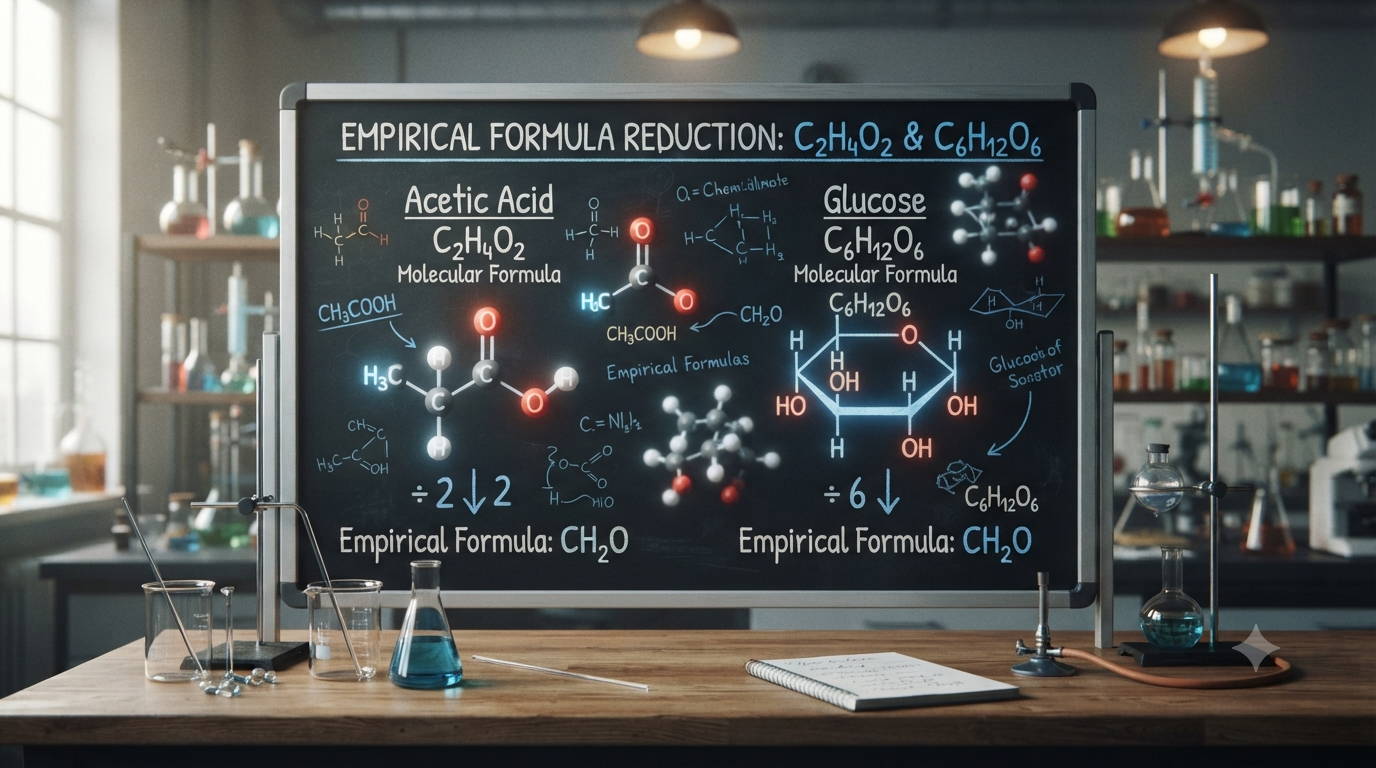
But C₆H₁₂O₆ is not the only molecular formula that can produce CH₂O. A compound with the molecular formula C₂H₄O₂ would also reduce to CH₂O:
C₂H₄O₂ → CH₂O
Similarly, C₃H₆O₃ would also have the empirical formula CH₂O.
Therefore, the same empirical formula can correspond to different molecular formulas.
Why Does This Happen?
The main reason is that an empirical formula removes common factors from the subscripts.
Consider two hypothetical compounds:
Compound A: C₂H₄O₂
Compound B: C₆H₁₂O₆
For Compound A:
C₂H₄O₂ → CH₂O
For Compound B:
C₆H₁₂O₆ → CH₂O
Although their molecular formulas contain different numbers of atoms, the ratios of carbon, hydrogen, and oxygen are identical.
Compound A has:
Carbon: 2
Hydrogen: 4
Oxygen: 2
Compound B has:
Carbon: 6
Hydrogen: 12
Oxygen: 6
In both cases, the ratio is:
C:H = 1:2:1
Therefore, both have the empirical formula CH₂O.
The empirical formula preserves the ratio but removes information about the size of the molecular formula.
Different Compounds Can Have the Same Empirical Formula
A useful real-world example involves compounds with the empirical formula CH₂O.
Glucose has the molecular formula:
C₆H₁₂O₆
Its empirical formula is:
CH₂O
Acetic acid has the molecular formula:
C₂H₄O₂
Its empirical formula is also:
CH₂O
However, glucose and acetic acid are different compounds. They have different molecular structures and different chemical and physical properties.
This example clearly demonstrates that an empirical formula alone cannot always identify a compound.
The two compounds contain the same elements in the same simplest ratio, but the actual numbers and arrangements of atoms are different.
The Molecular Formula Provides More Information
The molecular formula can distinguish between compounds that have the same empirical formula.
For example:
CH₂O
could represent the simplest ratio for several different molecular formulas, such as:
C₂H₄O₂
C₃H₆O₃
C₄H₈O₄
C₆H₁₂O₆
These formulas all reduce to CH₂O.
The relationship can be written as:
Molecular formula = n × Empirical formula
Here, n is a positive whole number.
For example:
CH₂O × 6 = C₆H₁₂O₆
and:
CH₂O × 2 = C₂H₄O₂
The value of n depends on the particular compound.
Structure Makes the Difference
Even when two compounds have related or identical elemental ratios, their atoms can be connected in different ways.
A molecular formula tells us how many atoms of each element are present, but it does not completely describe how those atoms are arranged. A structural formula gives more information by showing the connections between atoms.
For example, compounds can have the same molecular formula but different structures. Such compounds are called isomers.
This means there are several levels of information:
Empirical formula → simplest ratio of elements
Molecular formula → actual number of atoms
Structural formula → arrangement and bonding of atoms
Each level provides more information than the previous one.
Therefore, when two compounds have the same empirical formula, their differences may become visible only when we examine their molecular formulas or structures.
Same Empirical Formula Does Not Mean Same Compound
It is important not to assume that compounds with the same empirical formula are identical.
An empirical formula describes composition in terms of the simplest ratio of atoms. It does not provide enough information to determine all the characteristics of a substance.
Two compounds with the same empirical formula can differ in:
Molecular formula
Molecular mass
Structural arrangement
Functional groups
Bonding patterns
Physical properties
Chemical properties
Reactivity
Melting point
Boiling point
Solubility
Biological activity
Therefore, the empirical formula should be considered a basic description of composition rather than a complete chemical identity.
An Example Using Carbon and Hydrogen
Consider two hydrocarbons:
Compound A: C₂H₄
Compound B: C₃H₆
For Compound A:
C₂H₄ → CH₂
For Compound B:
C₃H₆ → CH₂
Both compounds have the same empirical formula:
CH₂
However, they are not the same molecular substance.
This happens because the atom ratio is the same:
C = 1:2
But the total number of atoms in their molecules is different.
This simple example shows why the empirical formula loses some information when the molecular formula is simplified.
How Molecular Mass Helps Identify the Molecular Formula
If the empirical formula is known, the molecular formula can sometimes be determined using the molar mass of the compound.
First, calculate the empirical formula mass.
For CH₂O:
Carbon = 12
Hydrogen = 2 × 1 = 2
Oxygen = 16
Therefore:
Empirical formula mass = 12 + 2 + 16 = 30
Suppose the experimentally determined molar mass of the compound is 180 g/mol.
Then:
n = Molecular molar mass ÷ Empirical formula mass
n = 180 ÷ 30
n = 6
Therefore, the molecular formula is:
CH₂O × 6 = C₆H₁₂O₆
This additional information allows chemists to move from the simplest ratio to the actual molecular formula.
Why Empirical Formulas Are Still Useful
The fact that empirical formulas do not uniquely identify every compound does not make them unimportant. They are extremely useful in chemistry.
Empirical formulas are commonly used to:
Represent the simplest elemental ratio.
Analyze the composition of compounds.
Calculate percentage composition.
Determine formulas from experimental data.
Compare elemental ratios between substances.
Help determine molecular formulas when molar mass is known.
Represent ionic compounds, where the formula often expresses the simplest ratio of ions.
For ionic compounds, the simplest ratio is particularly important because the formula unit represents the proportion of ions needed to produce electrical neutrality.
For example, sodium chloride is represented as NaCl because sodium ions and chloride ions occur in a 1:1 ratio.
How to Determine Whether Two Compounds Have the Same Empirical Formula
You can compare their empirical formulas by reducing each molecular formula to its simplest whole-number ratio.
Suppose we have:
Compound A: C₄H₈O₄
Compound B: C₆H₁₂O₆
For Compound A:
C₄H₈O₄ ÷ 4 = CH₂O
For Compound B:
C₆H₁₂O₆ ÷ 6 = CH₂O
Therefore, both compounds have the same empirical formula.
The procedure is simple:
Write the molecular formula.
Find the greatest common factor of the subscripts.
Divide every subscript by that factor.
Write the resulting simplest whole-number ratio.
Compare the empirical formulas.
If the simplified formulas are identical, the compounds have the same empirical formula.
Why the Empirical Formula Cannot Show Molecular Size
One important limitation of an empirical formula is that it does not reveal how many groups of the simplest ratio are present.
For example:
CH₂
could represent:
C₂H₄
or:
C₃H₆
or:
C₄H₈
or another molecular formula that is an integer multiple of CH₂.
The empirical formula is therefore like a reduced mathematical ratio.
If two quantities are 2:4 and 3:6, both simplify to 1:2. The simplified ratio is useful, but it does not tell us the original quantities.
Chemistry works similarly when molecular formulas are reduced to empirical formulas.
Empirical Formula Versus Structural Formula
The difference becomes even clearer when we compare an empirical formula with a structural formula.
An empirical formula tells us:
Which elements are present and their simplest ratio.
A molecular formula tells us:
How many atoms of each element are present in one molecule.
A structural formula tells us:
How those atoms are connected.
For complete identification of a compound, chemists may need additional information such as molecular mass, spectroscopy, chromatography, chemical reactions, and structural analysis.
This is why an empirical formula is often the starting point rather than the final answer.
The Key Idea
Different compounds can have the same empirical formula because the empirical formula reduces a molecular formula to its simplest whole-number ratio.
For example:
C₂H₄O₂ → CH₂O
C₆H₁₂O₆ → CH₂O
The two compounds have different molecular formulas, even though their empirical formulas are identical.
The empirical formula therefore tells us about relative composition, but not necessarily about the complete molecular identity of a compound.
This distinction is fundamental when interpreting chemical formulas. A formula that looks simple can hide important information about molecular size and structure.
Conclusion
Different compounds can have the same empirical formula because an empirical formula represents only the simplest whole-number ratio of the elements present. When different molecular formulas are reduced by their common numerical factors, they can produce the same empirical formula. For example, C₂H₄O₂ and C₆H₁₂O₆ both reduce to CH₂O, even though they represent different compounds.
The empirical formula is therefore useful for understanding elemental composition, but it cannot always identify a substance by itself. Molecular formulas, molecular masses, structural formulas, and experimental evidence provide additional information needed to distinguish compounds. Understanding this difference helps us interpret chemical formulas more accurately and appreciate how much information is contained in the way chemists represent matter.
FAQs
1. What is an empirical formula?
An empirical formula shows the simplest whole-number ratio of the elements present in a compound. It does not necessarily show the actual number of atoms in one molecule. For example, glucose has the molecular formula C₆H₁₂O₆. Dividing all the subscripts by 6 gives CH₂O, so CH₂O is its empirical formula. The empirical formula is useful for describing the relative proportions of elements in a compound. However, it does not always provide enough information to identify a compound uniquely because different molecular formulas can reduce to the same simplest ratio.
2. Can different compounds have the same empirical formula?
Yes, different compounds can have the same empirical formula. This happens when their molecular formulas contain elements in the same simplest whole-number ratio. For example, C₂H₄O₂ and C₆H₁₂O₆ both reduce to CH₂O. Although their empirical formulas are identical, their molecular formulas and chemical identities are different. An empirical formula only represents the simplest ratio of atoms, so it loses information about the actual number of atoms present in each molecule. Additional information such as molecular mass, molecular formula, and structure may be required to distinguish between different compounds.
3. Why can molecular formulas reduce to the same empirical formula?
Molecular formulas can reduce to the same empirical formula because empirical formulas are obtained by dividing all the subscripts by their greatest common factor. For example, C₂H₄O₂ can be divided by 2 to give CH₂O, while C₆H₁₂O₆ can be divided by 6 to give CH₂O. Both molecular formulas therefore produce the same simplest ratio. The reduction process removes information about the total number of atoms in the molecule. As a result, different molecular formulas can have identical empirical formulas while still representing different chemical substances.
4. What is the difference between an empirical formula and a molecular formula?
An empirical formula gives the simplest whole-number ratio of elements in a compound, while a molecular formula gives the actual number of atoms of each element in one molecule. For example, hydrogen peroxide has the molecular formula H₂O₂, but its empirical formula is HO. Similarly, glucose has the molecular formula C₆H₁₂O₆ and the empirical formula CH₂O. The molecular formula contains more information because it identifies the actual number of atoms. The empirical formula only describes their simplest relative proportions and may therefore apply to several different molecular formulas.
5. Does the same empirical formula mean the compounds are identical?
No, having the same empirical formula does not mean that two compounds are identical. An empirical formula only describes the simplest ratio of elements. Two compounds can have different molecular formulas or different arrangements of atoms while having the same empirical formula. For example, C₂H₄O₂ and C₆H₁₂O₆ both have the empirical formula CH₂O. Their molecular sizes, structures, properties, and chemical behavior can be different. Therefore, an empirical formula should not be used alone to determine the complete identity of an unknown compound.
6. How can the molecular formula be determined from an empirical formula?
The molecular formula can be determined when the empirical formula and molar mass are known. First, calculate the mass of the empirical formula. Then divide the compound’s molar mass by the empirical formula mass. The resulting whole number is multiplied by every subscript in the empirical formula. For example, if the empirical formula is CH₂O, its formula mass is 30 g/mol. If the compound has a molar mass of 180 g/mol, 180 ÷ 30 = 6. Therefore, the molecular formula is C₆H₁₂O₆.
7. Can compounds with the same empirical formula have different properties?
Yes, compounds with the same empirical formula can have different physical and chemical properties. The empirical formula only shows the simplest ratio of elements and does not describe the complete molecular structure. Differences in molecular size, bonding, atom arrangement, and functional groups can produce different properties. For example, compounds that share an empirical formula may have different melting points, boiling points, solubilities, reactivities, or biological effects. Therefore, the same empirical formula does not guarantee that two substances behave in the same way or have the same chemical characteristics.
8. What information does an empirical formula not provide?
An empirical formula does not provide several important details about a compound. It does not necessarily show the actual number of atoms in one molecule, the molecular mass, or the arrangement of atoms. It also does not directly reveal how atoms are bonded or where functional groups are located. For example, CH₂O tells us that carbon, hydrogen, and oxygen occur in a 1:2:1 ratio, but it does not tell us which molecular formula corresponds to a particular compound. Molecular formulas and structural information are needed to understand these additional details.
9. How do you check whether two compounds have the same empirical formula?
To check whether two compounds have the same empirical formula, simplify the subscripts in each molecular formula to their lowest whole-number ratio. First, find the greatest common factor of the subscripts. Divide every subscript by that factor and write the resulting formula. For example, C₄H₈O₄ becomes CH₂O after dividing all subscripts by 4. C₆H₁₂O₆ also becomes CH₂O after dividing by 6. Since both produce the same simplest formula, they have the same empirical formula, even though their molecular formulas are different.
10. Why is the empirical formula important in chemistry?
The empirical formula is important because it provides a simple way to represent the relative proportions of elements in a compound. It is useful when analyzing chemical composition, calculating percentage composition, interpreting experimental data, and determining molecular formulas when molar mass is available. It is also particularly useful for ionic compounds, where formulas commonly represent the simplest ratio of ions needed for electrical neutrality. Although an empirical formula may not uniquely identify a molecular compound, it provides an essential starting point for understanding its elemental composition and carrying out further chemical analysis.
Related Posts
How Chemical Formulas Connect Atoms, Molecules, and Compounds
Chemistry becomes much easier to understand when we know how atoms are connected and how their combinations are represented. Everything […]
Read MoreWhat Are Significant Figures in Physics?
Physics is a science based on measurement. Whether a physicist measures length, time, mass, temperature, or electrical current, every measurement […]
Read MoreHow can you identify the elements present in a formula?
A chemical formula is a short way of showing what a substance is made of. Instead of writing the complete […]
Read MoreCommon Formulas of Oxides in Chemistry
Oxides are among the most common compounds found in chemistry. They are formed when oxygen combines with another element, such […]
Read MoreHow can chemical formulas be used to understand chemical reactions?
Chemical reactions are processes in which substances change into new substances. We can observe some reactions through changes in color, […]
Read MoreSI Base Units and Their Official Symbols
The International System of Units, known as the SI system, provides a common language for measuring physical quantities. Whether scientists […]
Read MoreHow Does Direction Change the Meaning of a Physical Quantity?
In physics, numbers alone are often not enough to describe what is happening. A value such as 20 m/s, 10 […]
Read MoreWhat Is Momentum in Physics?
Momentum is one of the fundamental concepts in physics used to describe the motion of an object. It helps us […]
Read MoreEssential Chemistry Formulas for Beginners
Chemistry becomes much easier when you understand how chemical formulas represent substances. A chemical formula is a short way of […]
Read MoreCommon Formulas of Bases in Chemistry
Bases are an important group of chemical substances that we encounter in laboratories, industries, medicines, agriculture, and everyday life. They […]
Read MoreSI Unit of Amount of Substance Mole Explained
The mole is one of the seven SI base units used in science. It is the SI unit of amount […]
Read MoreHow to Learn Physics Formulas Without Rote Memorization
Physics formulas can seem difficult when there are dozens of equations to remember. Students often try to memorize formulas repeatedly, […]
Read MoreWhat Is Pressure in Physics?

Pressure is one of the most common physical quantities we experience in everyday life, even though we may not always […]
Read MoreHow Chemical Formula Ratios Describe Compound Composition
A chemical formula is much more than a short way of naming a compound. It provides important information about what […]
Read MoreWhy Does Momentum Matter in Collisions?
When two objects collide, many things can happen. A moving ball can hit another ball and send it in a […]
Read MoreHow Valency Helps in Writing Chemical Formulas
Writing a chemical formula is not simply a matter of putting element symbols together. A correct formula must show how […]
Read MoreAccuracy, Precision and Errors in Physics Measurements
Measurement is one of the most important parts of physics. Almost every physical law, formula, and experiment depends on measurements. […]
Read MoreWhat is the difference between molecular and empirical formulas?
Chemical formulas give us a compact way to describe the composition of substances. Instead of writing the names and numbers […]
Read MoreHow to Study Physics Formulas Step by Step
Physics formulas are an important part of learning physics, but simply memorizing them is not enough. A formula represents a […]
Read MoreHow to Handle Different Units in Physics Problems
Physics problems often look difficult because they contain formulas, numbers, symbols, and different units at the same time. A formula […]
Read MoreHow to Convert Units Before Using a Physics Formula
Physics formulas help us describe motion, force, energy, pressure, electricity, heat, and many other physical phenomena. However, knowing the correct […]
Read MoreWhat Is Work in Physics?
In everyday life, the word “work” usually means doing something that requires effort. We may say that carrying a heavy […]
Read MoreHow to Build a Basic Chemistry Formula Reference Sheet
Chemistry involves many formulas, symbols, equations, names, and relationships that are useful for solving problems and understanding chemical reactions. As […]
Read MoreHow should a student organize chemistry formulas for easy revision?
Chemistry involves many formulas, symbols, equations, ions, compounds, and numerical relationships. As the syllabus grows, simply memorizing formulas one after […]
Read MoreHow Chemical Formulas Represent Substances
Chemical formulas are one of the simplest ways scientists communicate information about matter. A substance may contain millions or billions […]
Read MoreWhy are graphs so useful for understanding motion?
Motion is one of the most important ideas in physics. We see motion everywhere around us. A car travels along […]
Read MoreWhat Is a Structural Formula?
A structural formula is a way of representing a chemical compound by showing how its atoms are arranged and connected […]
Read MoreHow Chemical Formulas Represent Fixed Composition
A chemical formula is much more than a short name for a substance. It gives important information about what a […]
Read MoreChemical Symbols and Their Role in Chemistry Formulas
Chemistry is often described as the science of matter, but understanding chemistry also means learning how scientists communicate information about […]
Read MoreWhat does a subscript mean in a chemical formula?
A chemical formula is a short way of showing what a substance is made of. Instead of writing the names […]
Read More