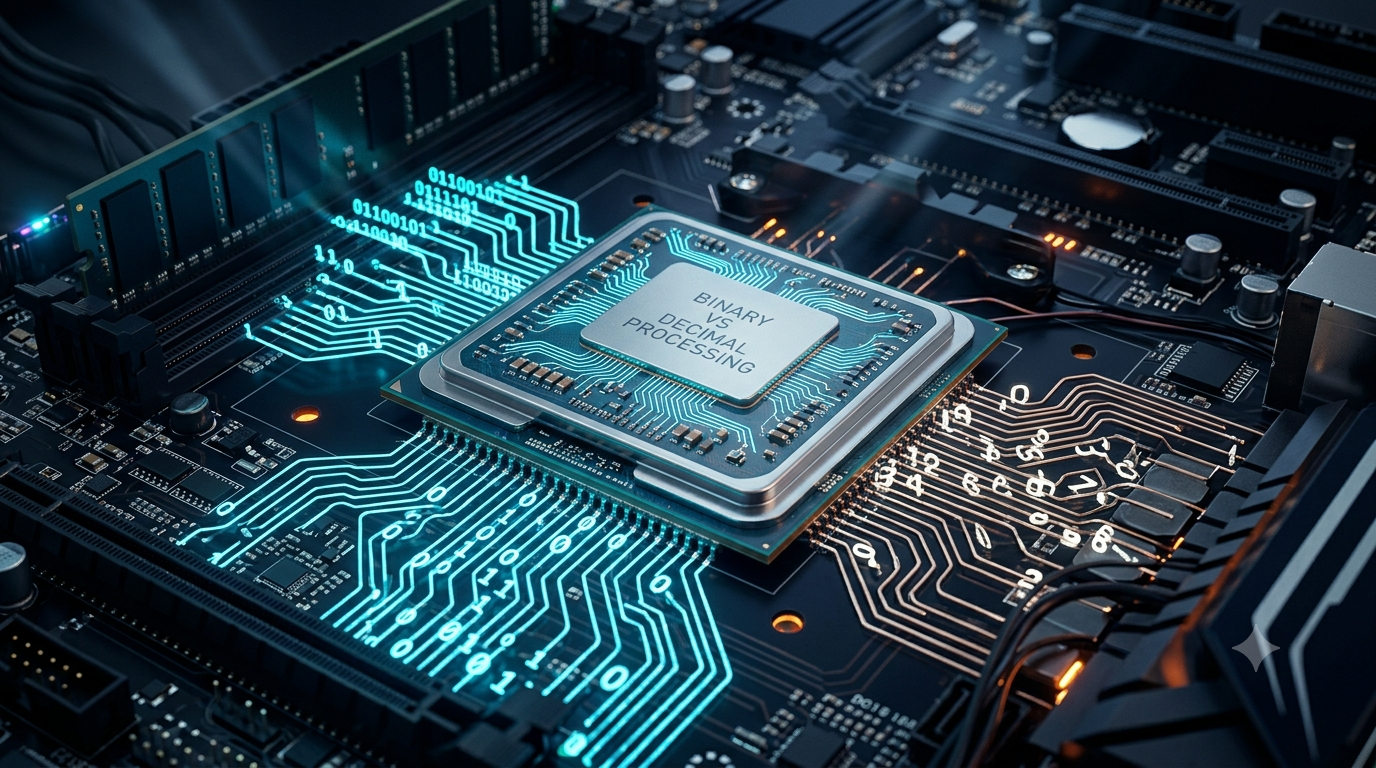
Digital devices are part of almost every aspect of modern life. Computers, smartphones, calculators, televisions, digital cameras, and communication systems all depend on digital hardware to process and store information. Although humans normally use the decimal system, which contains ten digits from 0 to 9, digital hardware primarily uses the binary system, which contains only two digits: 0 and 1.
At first, it may seem strange that powerful computers rely on such a simple number system. After all, the decimal system is familiar, convenient, and widely used in everyday calculations. However, digital hardware operates using electronic circuits that can represent two distinct states very reliably. These states can be interpreted as binary 0 and binary 1.
Binary is not used simply because computers prefer smaller numbers. It is closely connected to how electronic components work, how information can be represented, and how digital systems can be designed to operate accurately and efficiently. Understanding why digital hardware uses binary helps explain the fundamental principles behind modern computing.
1. Understanding the Binary and Decimal Number Systems
Before exploring the reasons behind binary computing, it is important to understand the difference between binary and decimal.
What Is the Decimal Number System?
The decimal number system is a base-10 number system. It uses ten different digits, from 0 to 9, to represent numbers.
For example, the decimal number 572 contains three digits. Each digit represents a value based on its position.
The number can be expanded as follows:
572 = (5 × 100) + (7 × 10) + (2 × 1)
In decimal notation, each position represents a power of 10. This system is convenient for humans because we commonly use it for counting, measuring, shopping, and performing calculations.
What Is the Binary Number System?
The binary number system is a base-2 number system. It uses only two digits: 0 and 1.
Each position represents a power of 2 rather than a power of 10.
For example, the binary number 1011 can be converted into decimal as follows:
1011₂ = (1 × 8) + (0 × 4) + (1 × 2) + (1 × 1)
1011₂ = 8 + 0 + 2 + 1 = 11₁₀
Therefore, the binary number 1011 represents the decimal number 11.
Computers use binary because electronic circuits can conveniently represent two distinguishable states. These states can encode binary digits, commonly called bits.
2. Digital Hardware Works with Two Distinguishable States
The most important reason digital hardware uses binary is that electronic circuits can reliably distinguish between two states.
A digital circuit can be designed to interpret an electrical signal within one voltage range as a logical 0 and a signal within another voltage range as a logical 1.
For example, a particular circuit might interpret a low voltage as 0 and a high voltage as 1. The actual voltage ranges depend on the technology and circuit design.
These two logical states do not necessarily correspond to exactly zero volts and a specific high voltage. Instead, digital circuits use defined voltage ranges to determine whether a signal represents a 0 or a 1.
How Electronic Signals Represent Binary Digits
Consider a simple digital circuit that uses two voltage ranges:
Low voltage range: represents binary 0.
High voltage range: represents binary 1.
The circuit can detect which range an incoming signal belongs to and process the information accordingly.
This approach makes it possible to construct digital systems using electronic components such as transistors, logic gates, and memory cells.
The circuit does not need to distinguish between ten separate voltage levels to represent a single decimal digit. It only needs to distinguish between two logical states.
This simplicity is one of the main reasons binary is practical for digital hardware.
3. Binary Is More Resistant to Electrical Noise
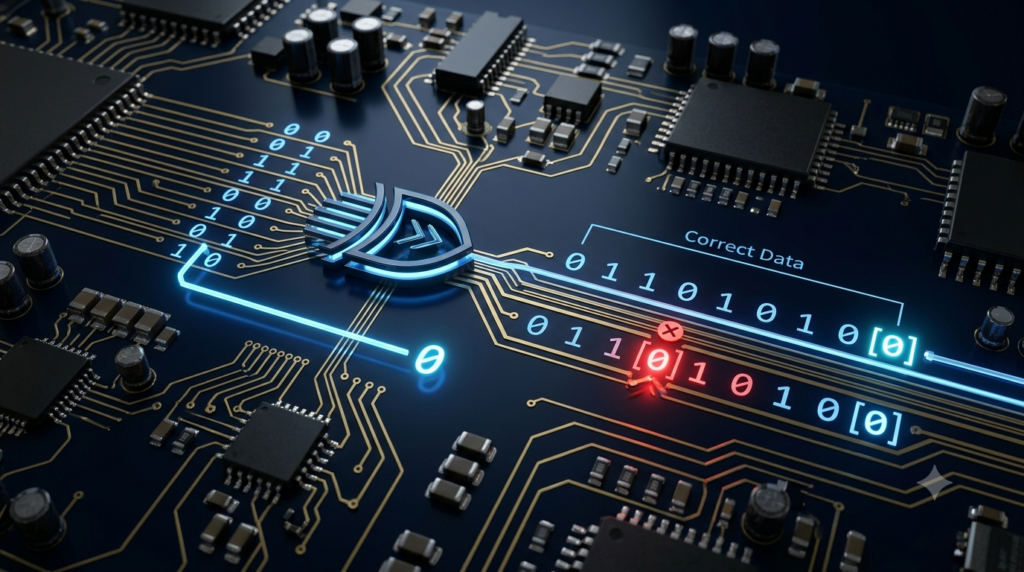
Electronic circuits do not operate in perfectly controlled conditions. Electrical noise, interference, changes in temperature, and variations in component characteristics can affect signals.
A reliable digital system must be able to interpret signals correctly even when these disturbances occur.
Why Two States Improve Reliability
Suppose a digital circuit is designed with a low-voltage range for logical 0 and a high-voltage range for logical 1. The circuit can still interpret a signal correctly if its voltage changes slightly but remains within the acceptable range.
For example, if a signal representing 0 experiences a small voltage disturbance, it may still be recognized as 0.
This tolerance is an important advantage of digital signaling.
Now imagine designing a system that uses ten distinct voltage levels to represent decimal digits from 0 to 9. The circuit would need to distinguish among more signal levels. Depending on the voltage range and circuit design, the separation between neighboring levels could become smaller, making accurate detection more difficult.
A multilevel system is not inherently unreliable, but it generally requires more careful signal design and detection than a comparable two-level system.
Binary therefore offers a practical balance between simplicity, reliability, and implementation cost.
4. Transistors Can Implement Binary Logic Efficiently
Transistors are fundamental components of modern digital electronics. They can control the flow of electrical current and are used to build logic gates, processors, memory circuits, and many other electronic systems.
Although transistors do not function as perfect mechanical switches in every application, they can be arranged to produce electronic behavior that supports two-state digital logic.
The Role of Transistors in Digital Circuits
A transistor-based circuit can be designed to produce one of two logical output states depending on its input signals.
These states allow circuits to perform logical operations such as:
AND
OR
NOT
NAND
NOR
XOR
For example, an AND gate produces a logical 1 only when both of its inputs are logical 1. Otherwise, it produces a logical 0.
A NOT gate reverses a binary input. If the input is 0, the output is 1. If the input is 1, the output is 0.
By connecting many logic gates together, engineers can build circuits that perform arithmetic, compare values, make decisions, and execute instructions.
Binary provides a consistent foundation for these operations.
Why Not Use Ten States Directly?
A decimal-based electronic circuit could theoretically represent each decimal digit using ten distinguishable electrical states. However, the circuit would need more complex signal-generation and detection arrangements.
Binary circuits can use relatively straightforward switching behavior to create large systems from repeated building blocks.
This makes binary particularly suitable for integrating billions of transistors into modern processors and memory chips.
5. Binary Simplifies Logic Design
Digital hardware must perform more than storing numbers. It must also process information according to logical rules.
Binary makes this possible through Boolean algebra, a mathematical system that works with logical values such as true and false, or 1 and 0.
What Is Boolean Algebra?
Boolean algebra describes operations on binary values. These operations form the foundation of digital logic design.
For example, the AND operation can be represented by the following truth table:
| A | B | A AND B |
|---|---|---|
| 0 | 0 | 0 |
| 0 | 1 | 0 |
| 1 | 0 | 0 |
| 1 | 1 | 1 |
The table shows every possible combination of the two inputs and the corresponding output.
Engineers use such logical relationships to design circuits that perform specific tasks.
Building Complex Circuits from Simple Operations
Individual logic gates can be connected to create more complicated systems, including:
Adders that perform binary arithmetic.
Comparators that determine whether values are equal or different.
Control circuits that manage processor operations.
Multiplexers that select between multiple input signals.
Registers that temporarily store binary information.
Because these components follow well-defined binary rules, they can be combined into increasingly complex designs.
The same fundamental principles apply across many different types of digital hardware.
6. Binary Makes Data Storage Practical
Digital hardware must store information, including instructions, numbers, images, audio, videos, and documents.
Binary provides a convenient way to represent all these types of data.
What Is a Bit?
A bit, short for binary digit, is the smallest standard unit of digital information. It can represent either 0 or 1.
A group of eight bits is called a byte.
For example:
1 bit can represent 2 possible combinations.
2 bits can represent 4 possible combinations.
3 bits can represent 8 possible combinations.
4 bits can represent 16 possible combinations.
8 bits can represent 256 possible combinations.
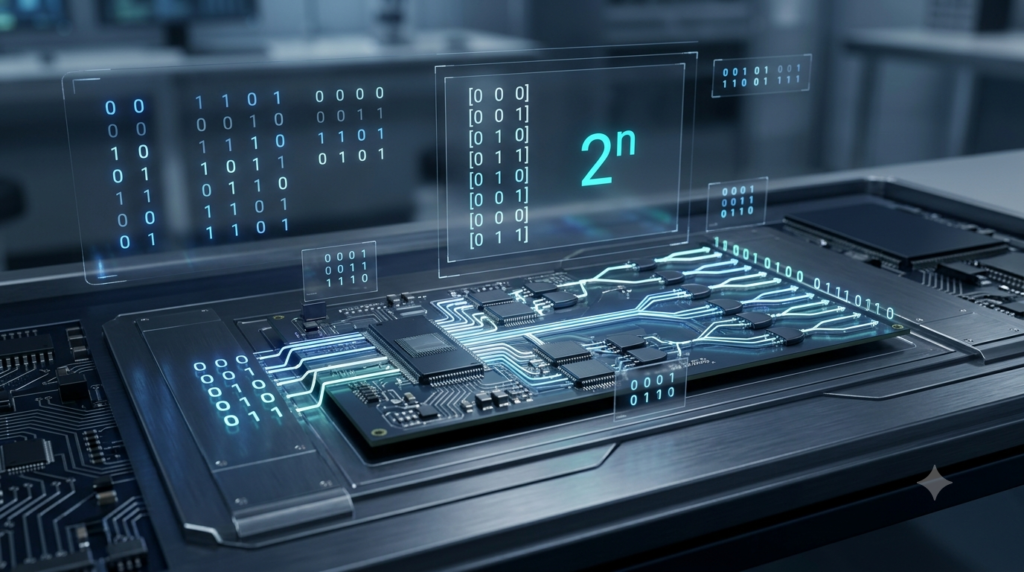
In general, a group of n bits can represent (2^n) distinct combinations.
This relationship is important because adding more bits increases the amount of information that can be represented.
How Binary Information Is Stored
Different types of digital memory use different physical mechanisms to store information. Depending on the technology, binary states may be represented using electrical charge, transistor states, magnetic orientations, or other physical properties.
For example, semiconductor memory circuits can store information using electronic states associated with their circuit designs. Solid-state storage devices retain data using physical properties of memory cells.
Regardless of the underlying technology, binary provides a common logical representation for the stored information.
This allows processors, memory devices, and other digital components to exchange data using a consistent format.
7. Binary Makes Arithmetic Operations Easier to Implement
Computers must perform mathematical operations quickly and accurately. These operations include addition, subtraction, multiplication, and division.
Although people often perform calculations in decimal, digital hardware can perform arithmetic using binary values.
Binary Addition
Binary addition follows simple rules.
| Binary Calculation | Result |
|---|---|
| 0 + 0 | 0 |
| 0 + 1 | 1 |
| 1 + 0 | 1 |
| 1 + 1 | 10 |
The final example is especially important. In binary, 1 + 1 equals 10 because the result represents decimal 2.
The rightmost digit becomes 0, and a carry of 1 moves to the next position.
For example:
101
The binary number 101 represents decimal 5, and 011 represents decimal 3. Their sum, 1000, represents decimal 8.
Digital circuits called adders perform these operations using logic gates. More complex arithmetic units combine these basic operations to support calculations inside processors.
Binary arithmetic fits naturally into the logical structure of digital hardware.
8. Binary Can Represent More Than Numbers
One common misunderstanding is that computers use binary only to perform mathematical calculations. In reality, binary can represent many different forms of information.
The meaning of a binary sequence depends on the encoding or format used by a computer system.
Text
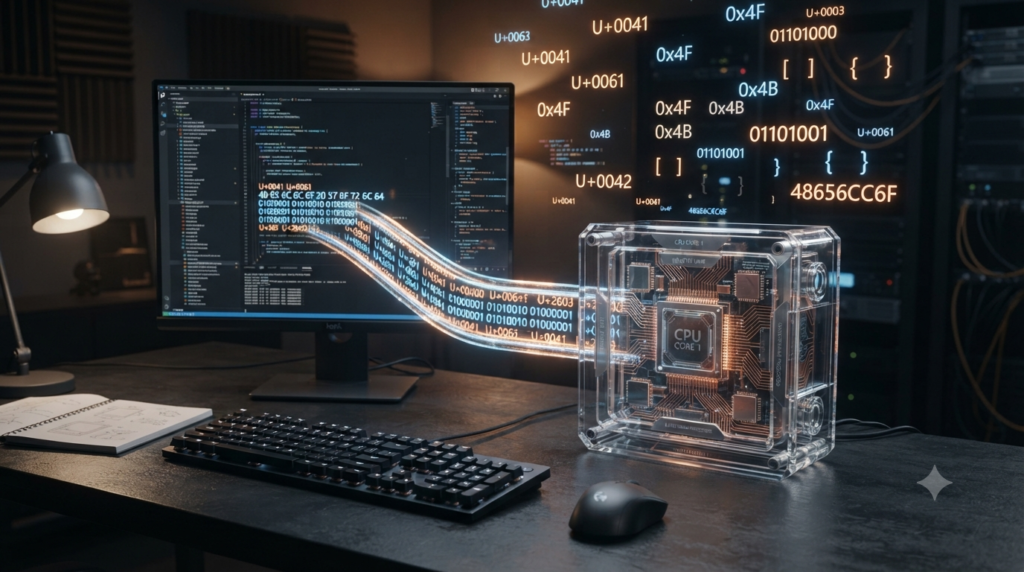
Text can be represented using character-encoding systems. For example, ASCII assigns numerical codes to letters, digits, and certain control characters.
The letter A has the decimal code 65 in ASCII. Its eight-bit binary representation is:
01000001
This shows how a familiar character can be represented using a sequence of binary digits.
Modern text systems often use Unicode, with UTF-8 being a widely used encoding. These systems allow computers to represent characters from many languages and writing systems.
Images
Digital images are commonly represented using pixels. Each pixel contains information about its color or brightness.
For example, an image format might use separate binary values to represent the red, green, and blue components of a pixel.
By storing many such values, a computer can represent detailed images and photographs.
Audio and Video
Digital audio systems represent sound using numerical samples of an audio signal. These sample values are encoded in binary for storage or transmission.
Digital video represents moving images using sequences of frames, often combined with audio and compression techniques.
In each case, binary serves as the underlying representation of the encoded information.
9. Binary Supports Efficient Digital Communication
Computers and digital devices frequently exchange information through cables, wireless connections, and communication networks.
Digital communication systems transmit encoded information as physical signals. Depending on the technology, these signals may use electrical voltage changes, light pulses, radio waves, or more complex modulation schemes.
Binary data can be encoded into these signals so that a receiving device can recover the intended information.
Detecting and Correcting Errors
Communication channels can introduce errors because of interference, noise, signal attenuation, or other disturbances.
Digital communication systems can use techniques such as parity checks, checksums, and error-correcting codes to help detect or correct certain errors.
These techniques operate on structured representations of digital data, often using binary arithmetic and logical operations.
For example, a parity bit can be added to a group of bits so that the total number of 1s follows an agreed rule. The receiver can check the rule to detect some types of transmission errors.
Binary does not eliminate communication errors, but it provides a practical foundation for encoding, checking, and processing digital information.
10. Could Computers Use the Decimal System Instead?
Yes. It is technically possible to build electronic systems that represent decimal digits directly or use other number systems. Binary is not the only possible choice for computation.
Decimal arithmetic hardware exists, and some processors include instructions for decimal-related operations. Specialized systems may use decimal representations when exact decimal arithmetic is especially important.
However, building an entire general-purpose digital computer around ten-state logic would introduce different engineering challenges.
Challenges of Decimal-Based Digital Hardware
A decimal-oriented electronic circuit would need to distinguish among ten possible states when representing one decimal digit directly.
This may require more complex components, more careful signal detection, or additional circuitry compared with a binary implementation. The exact trade-offs depend on the design.
Binary, by contrast, offers a well-established foundation for transistor switching, logic gates, memory, and processor design.
It also benefits from decades of engineering development, manufacturing improvements, standardized architectures, and software support.
Consequently, binary is the dominant foundation of conventional digital hardware.
It is important to distinguish between using decimal numbers in software and physically implementing hardware with decimal states. A computer can process decimal calculations while still representing its internal data using binary bits.
11. Is Binary Always the Best Choice?
Binary is highly effective for conventional digital electronics, but it is not the only useful way to represent information or perform computation.
Other approaches exist, including ternary systems, multilevel signaling, analog computing, and quantum computing.
Ternary systems use three logical values or states rather than two. Multilevel signaling can encode multiple bits in a single transmitted symbol by using more than two distinguishable signal levels.
Analog computing represents information through continuously varying physical quantities, while quantum computing uses quantum states and operations that differ fundamentally from ordinary binary logic.
These approaches can offer advantages in particular applications, but they also introduce their own technical challenges.
For example, multilevel signals can increase data transmission efficiency, although distinguishing among more levels can require greater signal precision. Quantum computing operates according to different physical principles and does not simply replace every conventional binary circuit.
Binary remains dominant because it offers a practical combination of reliability, scalability, cost-effectiveness, and compatibility with established digital technology.
Conclusion
Digital hardware uses binary instead of the decimal system primarily because electronic circuits can represent two distinguishable states reliably and efficiently. These states form the basis of bits, logic gates, memory systems, arithmetic circuits, and digital communication.
Binary also simplifies circuit design, supports Boolean algebra, and provides a consistent way to represent numbers, text, images, audio, and video. Although decimal-based and other computing approaches are technically possible, they involve different engineering trade-offs.
The key idea is that computers do not need to think in the same way humans do. Humans commonly use decimal because it is familiar for everyday counting and calculation. Digital hardware uses binary because two-state electronic logic is well suited to building complex, reliable, and scalable computing systems.
Understanding this difference provides a foundation for learning about computer architecture, digital electronics, data representation, and the internal operation of modern computing devices.
FAQs
1. Why does digital hardware use binary instead of decimal?
Digital hardware uses binary because electronic circuits can reliably represent two distinct states, commonly interpreted as 0 and 1. These states can be implemented using different voltage ranges or other physical properties. Binary simplifies the design of logic gates, memory circuits, and processors. It also helps digital systems tolerate small signal variations without confusing one state with another. Although humans find decimal convenient for everyday calculations, binary is well suited to electronic switching. This makes it practical to build reliable, fast, and complex computing systems using millions or billions of interconnected electronic components.
2. What is the main advantage of the binary number system in computers?
The main advantage of binary is its compatibility with electronic circuits that distinguish between two logical states. This makes hardware design simpler and more reliable than directly representing ten decimal digits with ten different states. Binary also supports Boolean algebra, which provides the mathematical foundation for digital logic. Using binary, computers can perform arithmetic, store information, process instructions, and communicate data. Each bit represents a 0 or a 1, and groups of bits can represent many different values. These characteristics make binary an efficient foundation for conventional digital computing systems.
3. How do electronic circuits represent binary 0 and 1?
Electronic circuits represent binary 0 and 1 using two distinguishable physical states. In many digital circuits, these states correspond to low and high voltage ranges. A circuit interprets an input voltage within the specified low range as logical 0 and an input within the high range as logical 1. The exact voltage levels depend on the technology being used. These states are processed by transistors and logic gates to perform different operations. Because circuits can recognize acceptable voltage ranges rather than requiring perfectly exact values, digital systems can tolerate certain electrical variations while maintaining reliable operation.
4. Why is binary more reliable than using ten electrical states?
Binary can be easier to implement reliably because a circuit needs to distinguish between only two logical states. When a system represents information using ten electrical levels, it must differentiate among more possible signal values within its available operating range. This can require more precise signal generation and detection. Electrical noise and component variations may make closely spaced levels harder to distinguish. Binary systems also use defined voltage ranges that allow some signal variation without changing the interpreted value. However, multilevel systems can still be reliable when carefully designed, so the advantage depends on the technology and application.
5. What is a bit, and why is it important in digital hardware?
A bit, or binary digit, is the smallest standard unit of digital information. It can have one of two values: 0 or 1. Bits are essential because digital hardware uses binary representations to store and process information. A single bit has two possible states, while a group of eight bits forms a byte and can represent 256 different combinations. By combining bits, computers can represent numbers, text, images, sound, and program instructions. Memory circuits store bits using physical states, while processors manipulate them through logical and arithmetic operations. Therefore, bits form the basic building blocks of digital information.
6. Can a computer use the decimal number system instead of binary?
Yes, computers can perform decimal arithmetic, and specialized hardware can represent decimal digits directly. However, conventional digital hardware primarily uses binary because two-state electronic logic is practical to implement using transistors. A system representing each decimal digit directly would need to distinguish among ten states, introducing different design challenges. Importantly, a computer can accept decimal numbers from users and perform decimal calculations while internally representing much of its information in binary. Software and hardware can convert between decimal and binary representations when necessary. Therefore, decimal computation is possible, but binary remains the dominant foundation of modern general-purpose digital hardware.
7. How does binary help computers perform arithmetic calculations?
Binary allows computers to perform arithmetic using simple rules that electronic circuits can implement. For example, binary addition follows rules involving 0, 1, and carry values. The calculation 1 + 1 produces 10 in binary, which represents decimal 2. Digital circuits called adders perform these operations using logic gates. More complex arithmetic circuits combine basic operations to support subtraction, multiplication, division, and other calculations. Processors use these circuits to execute program instructions and process data. Although people commonly calculate in decimal, binary arithmetic is well suited to the two-state logic used by conventional digital hardware.
8. How does binary represent text, images, and videos?
Computers represent different kinds of information by assigning binary patterns to data according to specific encoding formats. Text characters receive numerical codes that can be stored as sequences of bits. Images are represented using pixel information, including color or brightness values. Digital audio uses numerical samples of sound, while video typically consists of sequences of image frames and associated audio. Compression and encoding techniques can reduce storage requirements or prepare information for transmission. The binary digits themselves do not inherently mean a particular letter, color, or sound. Their meaning depends on the format and instructions used to interpret them.
9. Does binary completely eliminate electrical noise and data errors?
No, binary does not completely eliminate electrical noise or data errors. Digital circuits are designed to tolerate certain signal variations, but sufficiently strong interference can cause a 0 to be interpreted as a 1 or vice versa. Errors can also occur during data storage, transmission, or processing. Digital systems use techniques such as parity checks, checksums, error-detecting codes, and error-correcting codes to identify or correct certain errors. Reliable circuit design, signal conditioning, and appropriate communication protocols also help reduce problems. Binary makes reliable digital processing practical, but additional engineering measures are necessary to maintain data integrity.
10. Are binary and decimal the only number systems used in computing?
No, binary and decimal are not the only number systems used in computing. Octal uses eight digits, from 0 to 7, while hexadecimal uses sixteen symbols, from 0 to 9 and A to F. Programmers frequently use hexadecimal because one hexadecimal digit corresponds exactly to four binary bits, making long binary sequences easier to read. Ternary systems use three states, and specialized hardware may employ other representations. However, conventional digital processors generally rely on binary internally. Decimal remains important for human-readable calculations, while hexadecimal and octal provide convenient ways to express binary data in programming and digital electronics.