
Chemistry uses symbols, numbers, and formulas to describe substances and chemical changes. Two important ways of representing chemical information are chemical formulas and chemical equations. Although they may look similar because both use chemical symbols and numbers, they have different purposes. A chemical formula tells us about a particular substance, while a chemical equation represents a chemical reaction in which substances are converted into new substances.
Understanding the difference between these two concepts is essential for reading chemical reactions correctly. A chemical formula can describe the composition of water, oxygen, carbon dioxide, or sodium chloride. A chemical equation, on the other hand, can show what happens when hydrogen reacts with oxygen to form water. Let us understand how chemical formulas and chemical equations work and how they are different.
What Is a Chemical Formula?
A chemical formula is a symbolic representation of a chemical substance. It shows which elements are present in the substance and the number or ratio of their atoms.
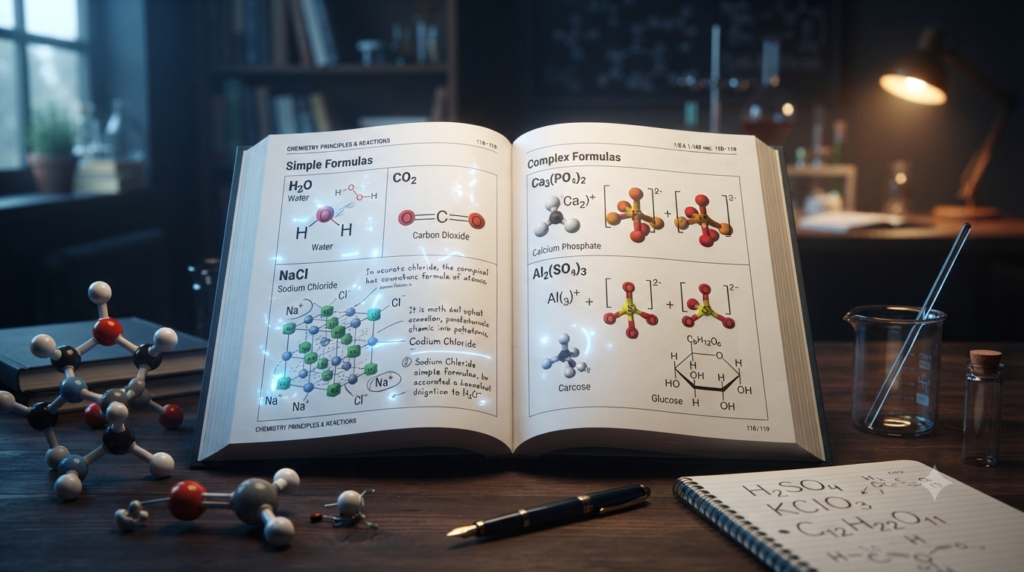
For example, water has the chemical formula H₂O. This tells us that a water molecule contains two hydrogen atoms and one oxygen atom. Similarly, carbon dioxide is represented as CO₂, meaning each molecule contains one carbon atom and two oxygen atoms.
Chemical formulas are used for elements, compounds, and ions. An element such as oxygen can be represented by O₂, while a compound such as sodium chloride is represented by NaCl.
The small numbers written below the symbols are called subscripts. They indicate the number of atoms of that element in the substance.
For example:
H₂O → 2 hydrogen atoms and 1 oxygen atom
CO₂ → 1 carbon atom and 2 oxygen atoms
NH₃ → 1 nitrogen atom and 3 hydrogen atoms
CH₄ → 1 carbon atom and 4 hydrogen atoms
If no subscript is written, the number of atoms is understood to be one.
What Is a Chemical Equation?
A chemical equation is a symbolic representation of a chemical reaction. It shows the substances that take part in the reaction and the new substances produced.
For example, hydrogen reacts with oxygen to form water. The reaction can be represented as:
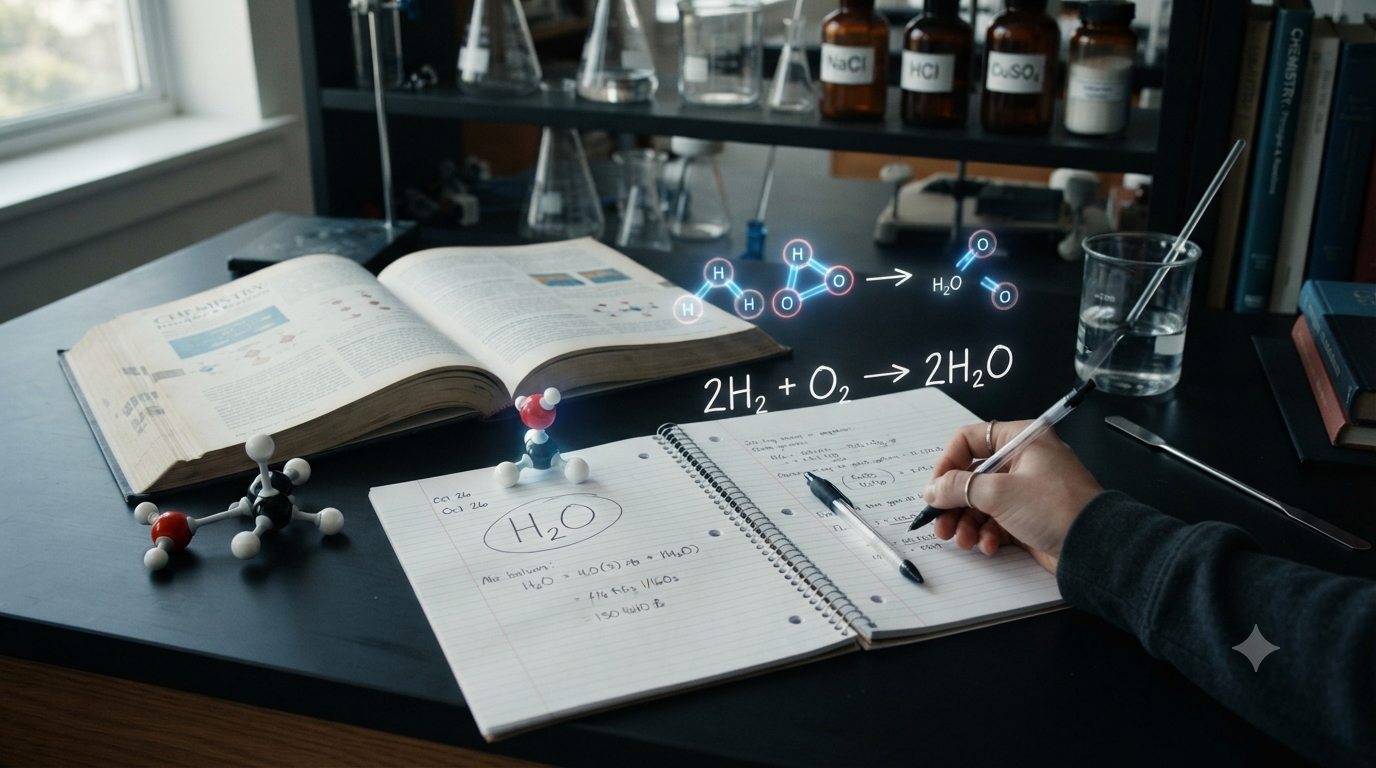
2H₂ + O₂ → 2H₂O
Here, hydrogen and oxygen are the reactants, while water is the product.
The arrow indicates the direction of the chemical reaction. The numbers placed before chemical formulas are called coefficients. They show the relative number of molecules or units involved in the reaction.
A chemical equation therefore provides information about a chemical change rather than simply describing one substance.
Main Difference Between a Chemical Formula and a Chemical Equation
The most important difference is their purpose.
A chemical formula describes the composition of a substance, whereas a chemical equation describes a chemical reaction.
For example, H₂O is a chemical formula. It tells us what water is made of. It does not tell us how water is produced or what substances react to produce it.
In contrast, 2H₂ + O₂ → 2H₂O is a chemical equation. It shows hydrogen and oxygen reacting to produce water.
Therefore, a formula focuses on a substance, while an equation focuses on a reaction.
Chemical Formula Uses Subscripts
Chemical formulas commonly use subscripts to show the number of atoms present in a molecule or the ratio of ions in a compound.
Consider the formula CO₂. The subscript 2 belongs only to oxygen, so there are two oxygen atoms for every one carbon atom.
Changing a subscript changes the identity or composition of the substance.
For example, H₂O represents water, while H₂O₂ represents hydrogen peroxide. These are different substances with different properties.
This is why subscripts in chemical formulas must not be changed casually.
Chemical Equations Use Coefficients
Chemical equations use coefficients to balance the number of atoms on both sides of a reaction.
Consider the equation:
H₂ + O₂ → H₂O
This equation is not balanced because there are two oxygen atoms on the left but only one oxygen atom on the right.
We can balance it by adding coefficients:
2H₂ + O₂ → 2H₂O
Now there are four hydrogen atoms and two oxygen atoms on each side.
The important point is that coefficients can be changed when balancing an equation, but the subscripts in chemical formulas should remain unchanged.
Changing the subscript would change the substance itself.
Examples of Chemical Formulas
Chemical formulas are found throughout chemistry. Some common examples include:
H₂O — water
CO₂ — carbon dioxide
O₂ — oxygen
N₂ — nitrogen
NaCl — sodium chloride
CaCO₃ — calcium carbonate
HCl — hydrochloric acid
NH₃ — ammonia
CH₄ — methane
Each formula gives information about the composition of a particular substance.
Examples of Chemical Equations
Chemical equations describe chemical reactions. For example, the formation of water can be written as:
2H₂ + O₂ → 2H₂O
The reaction between calcium carbonate and hydrochloric acid can be represented as:
CaCO₃ + 2HCl → CaCl₂ + H₂O + CO₂
Another example is the combustion of methane:
CH₄ + 2O₂ → CO₂ + 2H₂O
In each equation, the formulas identify the substances, while the complete arrangement of formulas and coefficients represents the chemical reaction.
How Chemical Formulas and Equations Work Together
Chemical formulas and chemical equations are closely connected. A chemical equation is actually constructed using chemical formulas.
For example, the formula CH₄ represents methane. The formula O₂ represents oxygen, and CO₂ represents carbon dioxide. When these formulas are combined with coefficients and an arrow, they can describe the combustion of methane:
CH₄ + 2O₂ → CO₂ + 2H₂O
The individual formulas identify the substances involved, while the equation shows how those substances participate in the reaction.
This makes chemical formulas the building blocks of chemical equations.
Formula vs Equation in Simple Terms
The difference can be remembered with a simple idea.
For example:
H₂O → describes water.
2H₂ + O₂ → 2H₂O → describes the formation of water from hydrogen and oxygen.
This simple distinction can make many chemistry problems easier to understand.
Why the Difference Is Important
Knowing the difference between chemical formulas and chemical equations is important because they provide different types of information.
When reading a chemical formula, you need to understand elements, subscripts, atomic ratios, and sometimes charges. When reading a chemical equation, you also need to understand reactants, products, coefficients, reaction conditions, and balancing.
Confusing a subscript with a coefficient can lead to incorrect interpretations. For example, 2H₂O means two water molecules or two units of water, while H₂O₂ represents a completely different substance.
Understanding this distinction becomes especially important when balancing equations and performing chemical calculations.
Chemical Formula vs Chemical Equation
| Chemical Formula | Chemical Equation |
|---|---|
| Represents a substance | Represents a chemical reaction |
| Shows composition | Shows reactants and products |
| Uses chemical symbols and subscripts | Uses formulas, coefficients, and an arrow |
| Usually describes one substance | Usually involves two or more substances |
| Example: H₂O | Example: 2H₂ + O₂ → 2H₂O |
| Subscripts show atomic ratios | Coefficients show relative amounts |
Conclusion
Chemical formulas and chemical equations are fundamental tools for communicating chemical information. A chemical formula represents the composition of a substance by showing the elements present and their ratios. A chemical equation uses chemical formulas to represent a chemical reaction, showing the reactants, products, and their relative amounts.
The key difference is simple: a formula describes a substance, while an equation describes a chemical change. Subscripts are an important part of chemical formulas, whereas coefficients are used in chemical equations to balance reactions. Once this distinction is clear, reading and writing chemical reactions becomes much easier. These two forms of chemical notation provide a concise language that allows chemists to describe substances and chemical changes accurately.
FAQs
1. What is a chemical formula?
A chemical formula is a symbolic way of representing a substance. It shows which elements are present and how many atoms of each element are included in the substance. For example, H₂O is the chemical formula for water. It contains two hydrogen atoms and one oxygen atom. Similarly, CO₂ represents carbon dioxide, which contains one carbon atom and two oxygen atoms. Small numbers written below element symbols are called subscripts and indicate the number of atoms. Chemical formulas help scientists identify substances and understand their composition. They are also used as building blocks when writing chemical equations for chemical reactions.
2. What is a chemical equation?
A chemical equation is a symbolic representation of a chemical reaction. It shows the substances that react and the new substances formed during the reaction. The substances present before the reaction are called reactants, while the substances formed are called products. For example, 2H₂ + O₂ → 2H₂O represents the formation of water from hydrogen and oxygen. The arrow indicates the direction of the reaction, while the numbers before the formulas are coefficients. Chemical equations provide a short and organized way to communicate chemical reactions and show the relative amounts of substances involved.
3. What is the main difference between a chemical formula and a chemical equation?
The main difference is what each one represents. A chemical formula describes the composition of a particular substance, while a chemical equation describes a chemical reaction. For example, H₂O is a chemical formula that tells us water contains hydrogen and oxygen in a specific ratio. In contrast, 2H₂ + O₂ → 2H₂O is a chemical equation showing hydrogen and oxygen reacting to form water. A formula generally focuses on one substance, whereas an equation connects multiple substances through a reaction. Understanding this difference makes it easier to read chemical reactions and interpret chemical information correctly.
4. What do subscripts mean in chemical formulas?
Subscripts are the small numbers written after or below chemical symbols in a formula. They show how many atoms of an element are present in one molecule or the ratio of elements in a compound. For example, H₂O contains two hydrogen atoms and one oxygen atom. In CO₂, the subscript 2 means there are two oxygen atoms for every carbon atom. If there is no subscript, the number is understood to be one. Subscripts are important because changing them can change the substance itself. For example, H₂O and H₂O₂ represent two different substances with different compositions.
5. What are coefficients in a chemical equation?
Coefficients are numbers placed before chemical formulas in a chemical equation. They indicate the relative number of molecules, formula units, or moles involved in a reaction. For example, in 2H₂ + O₂ → 2H₂O, the coefficient 2 before H₂ means two units of hydrogen participate in the reaction. The coefficient 2 before H₂O indicates two units of water are produced. Coefficients are especially important when balancing chemical equations because they allow the same number of atoms of each element to appear on both sides. Unlike subscripts, coefficients can be changed without changing the substances involved.
6. Can a chemical formula become a chemical equation?
A chemical formula by itself does not become a chemical equation simply by adding symbols. A chemical equation requires information about a chemical reaction, including reactants, products, and an appropriate reaction arrow. However, chemical formulas are used to construct chemical equations. For example, H₂ represents hydrogen and O₂ represents oxygen. When these formulas are combined with a product formula and coefficients, they can form the equation 2H₂ + O₂ → 2H₂O. Therefore, chemical formulas act as the basic components of chemical equations. Several formulas can be arranged together to represent a complete chemical reaction.
7. Why are chemical equations balanced?
Chemical equations are balanced to follow the law of conservation of mass. During a chemical reaction, atoms are rearranged, but they are not created or destroyed. Therefore, the number of atoms of each element must be the same on both sides of a balanced equation. For example, H₂ + O₂ → H₂O is not balanced because the number of oxygen atoms differs on each side. By adding coefficients, we obtain 2H₂ + O₂ → 2H₂O. Now both sides contain four hydrogen atoms and two oxygen atoms. Balancing ensures that the equation accurately represents the quantities involved in the reaction.
8. Can subscripts be changed when balancing a chemical equation?
No. Subscripts should not be changed when balancing a chemical equation because they are part of the chemical formula and determine the identity or composition of a substance. For example, changing H₂O to H₂O₂ would not balance the equation; it would replace water with hydrogen peroxide. Instead, coefficients should be placed before formulas. For example, 2H₂ + O₂ → 2H₂O is balanced by changing the coefficients, not the subscripts. This distinction is essential when writing chemical equations because changing subscripts can produce completely different substances and therefore change the meaning of the reaction.
9. What information can a chemical equation provide?
A chemical equation can provide several types of information about a chemical reaction. It identifies the reactants and products, shows the direction of the reaction, and can indicate the relative quantities of substances involved. Coefficients also allow scientists to determine mole ratios for chemical calculations. Additional information, such as reaction conditions, temperature, pressure, catalysts, or physical states, may also be included when needed. For example, 2H₂ + O₂ → 2H₂O shows that hydrogen and oxygen react to produce water. A balanced equation therefore provides a concise representation of what happens during a chemical reaction.
10. Why is it important to understand chemical formulas and equations?
Understanding chemical formulas and equations is important because they form a basic language of chemistry. Chemical formulas help identify substances and describe their composition, while chemical equations explain how substances interact during chemical reactions. This knowledge is useful for understanding topics such as chemical reactions, stoichiometry, acids and bases, combustion, and laboratory processes. It also helps students and science learners interpret chemical information accurately. Knowing the difference between subscripts and coefficients is particularly important because they have different meanings. Once these concepts are understood, reading, writing, and balancing chemical equations becomes much easier and more meaningful.
Related Posts
What Is Valency in Chemistry?
Valency is one of the basic concepts in chemistry that helps us understand how atoms combine with one another to […]
Read MoreHow Valency Helps in Writing Chemical Formulas
Writing a chemical formula is not simply a matter of putting element symbols together. A correct formula must show how […]
Read MoreHow to Write Formulas Using Valency
Writing chemical formulas becomes much easier when you understand valency. A chemical formula tells us which elements are present in […]
Read MoreHow to Write Formulas for Molecular Compounds
Writing the formula of a molecular compound is an important skill in chemistry. A chemical formula tells us which elements […]
Read MoreHow to Write Formulas for Ionic Compounds
Writing formulas for ionic compounds is an important skill in chemistry because a chemical formula tells us which ions are […]
Read MoreHow to Write Simple Chemical Formulas
Chemical formulas are a simple way to represent substances using symbols and numbers. Instead of writing the full name of […]
Read MoreChemical Formula vs Chemical Equation
Chemistry uses symbols, numbers, and formulas to describe substances and chemical changes. Two important ways of representing chemical information are […]
Read MoreWhat Is a Condensed Chemical Formula?
A condensed chemical formula is a convenient way of writing the structure of an organic compound without drawing every bond […]
Read MoreWhat Is a Structural Formula?
A structural formula is a way of representing a chemical compound by showing how its atoms are arranged and connected […]
Read MoreMolecular Formula vs Empirical Formula
Chemical formulas give us a simple way to represent substances using the symbols of elements and numbers. However, not all […]
Read MoreWhat Is an Empirical Formula?
An empirical formula is a simple way of representing the composition of a chemical compound. It shows the simplest whole-number […]
Read MoreWhat Is a Molecular Formula?
A molecular formula is a way of representing a substance using chemical symbols and numbers. It tells us which elements […]
Read MoreHow to Calculate the Total Number of Atoms in a Formula
Chemical formulas provide a compact way to show which elements are present in a substance and how many atoms of […]
Read MoreHow to Count Atoms From a Chemical Formula
Chemical formulas provide a compact way to describe what a substance is made of. A formula tells us which elements […]
Read MoreSubscripts vs Coefficients in Chemical Formulas
Chemical formulas may look like simple combinations of letters and numbers, but every symbol and number has a specific meaning. […]
Read MoreWhat Do Coefficients Mean in Chemistry Formulas?
When you look at a chemical equation, you may notice numbers written before chemical formulas. These numbers are called coefficients. […]
Read MoreHow to Read Subscripts in Chemical Formulas
Chemical formulas are a simple way to represent substances using symbols and numbers. When you look at a formula such […]
Read MoreHow to Identify Elements in a Chemical Formula
Chemical formulas provide a simple way to describe the substances that make up the world around us. A formula may […]
Read MoreHow Elements Are Represented in Chemical Formulas
Chemistry deals with many different substances, from the oxygen we breathe to the water we drink and the minerals found […]
Read MoreChemical Symbols and Their Role in Chemistry Formulas
Chemistry is often described as the science of matter, but understanding chemistry also means learning how scientists communicate information about […]
Read MoreHow Chemical Formulas Represent Substances
Chemical formulas are one of the simplest ways scientists communicate information about matter. A substance may contain millions or billions […]
Read MoreWhat Is a Chemical Formula in Chemistry?
Chemistry is the study of substances, their properties, and the changes they undergo. To describe these substances clearly, chemists need […]
Read MoreBasic Types of Chemistry Formulas Explained
Chemistry formulas are one of the simplest ways scientists describe substances, reactions, and relationships between different particles. A formula can […]
Read MoreHow to Read and Understand Chemistry Formulas
Chemistry formulas may look like a collection of letters, numbers, and symbols, but they are actually a simple language used […]
Read MoreWhat Are Chemistry Formulas and Why Are They Important?
Chemistry is the science of substances, their properties, and the changes they undergo. To describe these substances clearly, chemists use […]
Read MoreHow to Verify an Answer Using Units
In physics, getting a numerical answer is only part of solving a problem. The next question is whether that answer […]
Read MoreHow to Check Whether a Physics Formula Is Correct
A physics formula is more than a collection of symbols and numbers. It represents a relationship between physical quantities and […]
Read MoreHow to Avoid Unit Conversion Mistakes in Physics
Unit conversion is one of the most common sources of mistakes in physics. A formula may be correct, the calculation […]
Read MoreHow to Avoid Sign Errors in Physics Calculations
Physics calculations are not only about choosing the correct formula and putting numbers into it. The signs of physical quantities […]
Read MoreCommon Mistakes When Using Physics Formulas
Physics formulas help us describe motion, forces, energy, electricity, heat, waves, and many other phenomena using mathematical relationships. A formula […]
Read More