Boolean algebra and digital logic gates are two fundamental concepts in computer science and digital electronics. They work together to make modern computers, smartphones, calculators, communication systems, and many other electronic devices function correctly. Although they are closely related, they serve different purposes. Boolean algebra provides the mathematical rules for working with binary values, while digital logic gates use electronic circuits to perform operations based on those rules.
Both concepts rely on binary values: 0 and 1. In digital systems, these values represent two logical states, such as false and true, or low and high voltage levels. Boolean algebra helps engineers describe and simplify logical operations, while logic gates physically implement those operations in hardware. Understanding their relationship makes it easier to learn how processors calculate numbers, how memory circuits store information, and how digital devices make decisions.
What Is Boolean Algebra?
Boolean algebra is a branch of mathematics that deals with logical values and operations. Unlike ordinary algebra, which commonly works with numbers such as 2, 5, or 10, Boolean algebra primarily uses two values: 0 and 1.
In Boolean algebra, 0 represents FALSE, and 1 represents TRUE. These values can be combined using logical operations to produce a result.
For example, consider the expression:
Y = A AND B
Here, A and B are Boolean variables, and Y is the output. The AND operation produces 1 only when both A and B are 1. In every other case, the output is 0.
Boolean algebra commonly uses three fundamental operations:
AND: Produces 1 when all inputs are 1.
OR: Produces 1 when at least one input is 1.
NOT: Reverses the input value, changing 1 to 0 or 0 to 1.
These operations form the foundation of more complex logical expressions. Boolean algebra also includes mathematical laws that help simplify expressions without changing their logical results.
For example, the expression A AND 1 is always equal to A. Similarly, A OR 0 is always equal to A. Such rules are useful when designing efficient digital circuits.
What Are Digital Logic Gates?
Digital logic gates are electronic circuits that perform logical operations on binary inputs and generate binary outputs. They are the hardware components used to implement Boolean algebra in digital systems.
A logic gate receives one or more input signals and produces an output according to a specific logical rule. These signals are represented by voltage levels inside electronic circuits. Depending on the circuit technology, a voltage range represents logical 0, while another range represents logical 1.
For example, an AND gate has two inputs and one output. The output becomes 1 only when both inputs are 1. This behavior follows the Boolean AND operation.
The most common types of logic gates are:
AND gate: Outputs 1 only when all inputs are 1.
OR gate: Outputs 1 when at least one input is 1.
NOT gate: Produces the opposite of its input.
NAND gate: Produces the opposite of an AND gate’s output.
NOR gate: Produces the opposite of an OR gate’s output.
XOR gate: Outputs 1 when its two inputs are different.
XNOR gate: Outputs 1 when its two inputs are the same.
These gates are combined to create larger circuits capable of performing arithmetic calculations, comparisons, data processing, and control operations.
How Are Boolean Algebra and Digital Logic Gates Related?
Boolean algebra and digital logic gates are closely connected because every basic logic gate performs an operation that can be described using Boolean algebra.
Boolean algebra provides the mathematical representation of a logical operation, while the corresponding logic gate implements that operation electronically.
For example, the Boolean expression Y = A AND B describes a relationship between two inputs and an output. An AND gate is the electronic circuit that produces the output specified by this expression.
The same relationship applies to OR, NOT, NAND, NOR, XOR, and XNOR operations.
This connection allows engineers to move between mathematical expressions and circuit diagrams. They can first describe a problem using Boolean expressions, simplify those expressions using mathematical laws, and then build a circuit using the required logic gates.
In simple terms, Boolean algebra describes what a digital circuit should do, while logic gates perform the required operations in hardware.
Understanding the Relationship Through Truth Tables
A truth table shows every possible combination of input values and the corresponding output of a logical operation. Truth tables help connect Boolean expressions with the behavior of physical logic gates.
Consider a two-input AND operation.
| Input A | Input B | Output Y = A AND B |
|---|---|---|
| 0 | 0 | 0 |
| 0 | 1 | 0 |
| 1 | 0 | 0 |
| 1 | 1 | 1 |
The table shows that the output is 1 only when both inputs are 1.
The Boolean expression describes this rule mathematically. The truth table lists its results, and the AND gate implements the same behavior electronically.
Now consider an OR operation.
| Input A | Input B | Output Y = A OR B |
|---|---|---|
| 0 | 0 | 0 |
| 0 | 1 | 1 |
| 1 | 0 | 1 |
| 1 | 1 | 1 |
The OR gate follows the Boolean OR operation by producing 1 whenever at least one input is 1.
Truth tables are especially helpful when checking whether a logic circuit correctly implements a Boolean expression. If the truth table derived from the expression matches the circuit’s expected behavior for every input combination, the design is logically correct.
Boolean Expressions and Their Corresponding Logic Gates
Boolean expressions can be translated directly into logic gate arrangements. Each logical operation in an expression corresponds to a gate or a combination of gates.
Consider the expression:
Y = A AND B
This requires one AND gate with inputs A and B.
Now consider:
Y = A OR B
This requires one OR gate.
For the expression:
Y = NOT A
A NOT gate, also called an inverter, reverses the value of A.
More complex expressions require multiple gates.
For example:
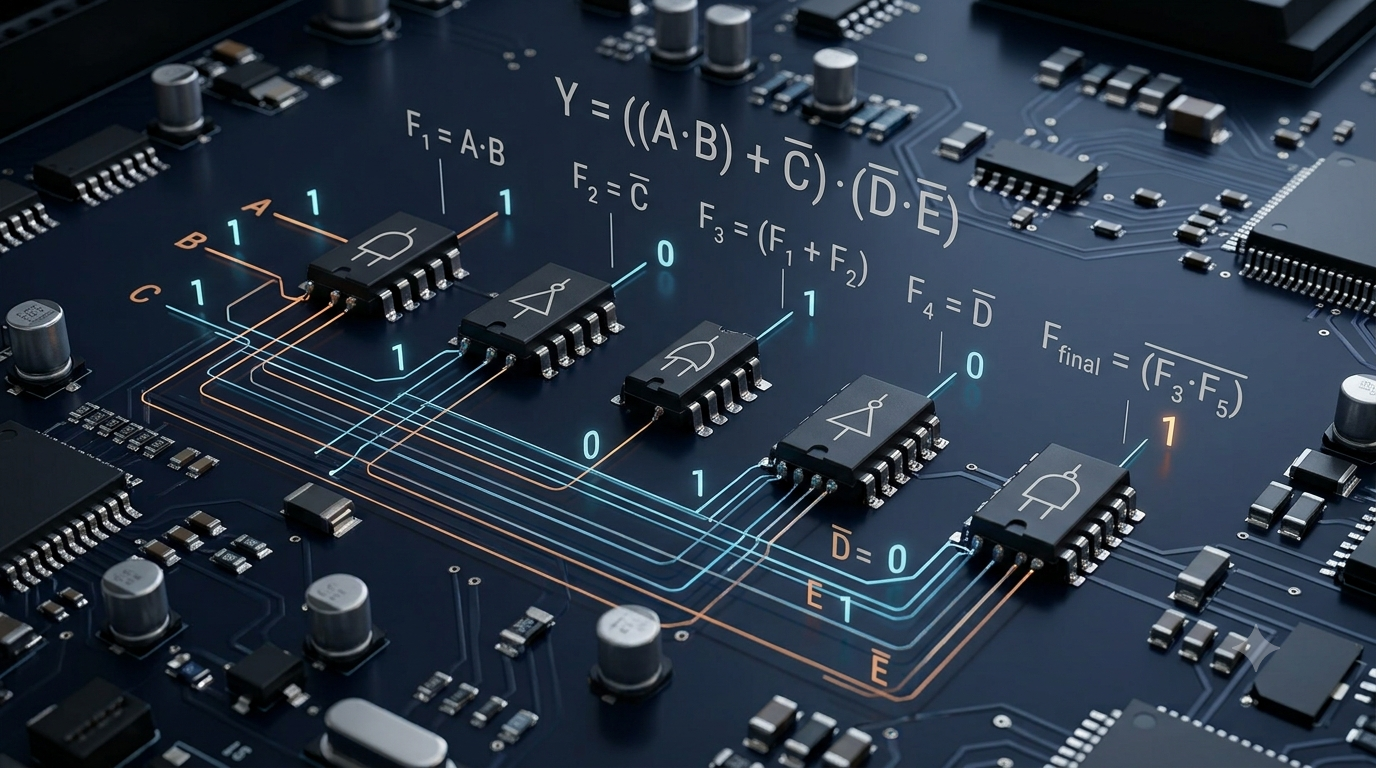
Y = (A AND B) OR C
This expression contains two operations. First, A and B are combined using an AND operation. The result is then combined with C using an OR operation.
The circuit therefore requires an AND gate followed by an OR gate. The output of the AND gate becomes one input of the OR gate, while C becomes its other input.
This process demonstrates how a mathematical expression can be converted into a physical digital circuit.
How Boolean Algebra Simplifies Digital Logic Circuits
One of the most important uses of Boolean algebra is simplifying logic expressions. A simplified expression often requires fewer gates, fewer connections, and less hardware.
Consider the Boolean expression:
Y = A AND 1
According to the identity law of Boolean algebra, this expression simplifies to:
Y = A
Instead of using an AND gate with a constant input of 1, the circuit can simply use the signal A as its output.
Another example is:
Y = A OR A
Using the idempotent law, this expression simplifies to:
Y = A
There is no need to perform an OR operation on two identical signals.
Boolean algebra also provides De Morgan’s laws, which are particularly useful when designing circuits using NAND and NOR gates.
The laws are:
NOT (A AND B) = (NOT A) OR (NOT B)
NOT (A OR B) = (NOT A) AND (NOT B)
These relationships allow designers to replace certain gate combinations with equivalent alternatives.
For example, a circuit that performs the NOT of an AND operation can be implemented directly using a NAND gate. Depending on the design requirements, equivalent expressions can help reduce the number of components or make a circuit easier to implement.
Simplification is important because a digital system may contain millions or billions of transistors. Even small improvements in individual circuit designs can contribute to better performance, lower power consumption, and reduced manufacturing costs.
The Role of NAND and NOR Gates
NAND and NOR gates have a special place in digital electronics because they are known as universal gates.
A universal gate can be used to construct any Boolean function when enough gates of that type are available. This means that complete digital logic circuits can be designed using only NAND gates or only NOR gates.
For example, a NOT operation can be implemented using a NAND gate by connecting both of its inputs to the same signal.
The resulting expression is:
Y = NOT (A AND A)
Since A AND A equals A, the expression simplifies to:
Y = NOT A
Similarly, an OR operation can be constructed using NAND gates and suitable input inversions.
The same principle applies to NOR gates. By combining them appropriately, designers can build NOT, AND, OR, and more complex logical functions.
Boolean algebra makes these transformations possible by providing rules for proving that different gate arrangements produce identical outputs.
Universal gates are useful in circuit design because a designer may choose to build a circuit using a limited set of gate types rather than requiring a separate physical implementation for every logical operation.
Applications in Computers and Digital Electronics
Boolean algebra and logic gates work together in almost every digital electronic system. Their relationship becomes particularly important in computer architecture and electronic circuit design.
1. Arithmetic Logic Units
An arithmetic logic unit (ALU) is a component of a processor that performs arithmetic and logical operations. It uses digital circuits built from logic gates to carry out tasks such as addition, subtraction, comparison, and bitwise operations.
Boolean expressions help describe the logical conditions and operations required by these circuits.
2. Memory Circuits
Digital memory uses electronic circuits to store and manage binary information. Certain memory structures, such as registers and latches, rely on combinations of logic gates and feedback connections.
Boolean logic helps describe how these circuits respond to input signals and control conditions.
3. Control Units
A processor’s control unit coordinates activities such as instruction execution and data movement. It uses logical conditions to determine which operations should occur at a particular time.
Boolean expressions help represent these conditions, while logic circuits implement the required decisions.
4. Digital Communication Systems
Communication devices process binary data as it moves between systems. Logic gates are used in circuits that perform encoding, decoding, comparison, and error-detection operations.
Boolean algebra provides a mathematical foundation for designing and simplifying many of these circuits.
5. Embedded Systems and Automation
Digital logic is also used in calculators, industrial controllers, household appliances, and embedded devices. For example, a system might activate an alarm only when two required conditions are satisfied.
A Boolean expression can describe the conditions, and an AND gate or a more complex logic circuit can implement the decision.
Advantages of Using Boolean Algebra with Logic Gates
Combining Boolean algebra with digital logic gates provides several important benefits.
Simpler circuit design: Boolean algebra helps transform complicated expressions into simpler forms that can be implemented with fewer gates.
Improved efficiency: Reducing unnecessary logic can lower hardware complexity and may reduce power consumption and signal delays.
Easier troubleshooting: Truth tables and Boolean expressions help engineers identify logical errors and verify expected circuit behavior.
Reliable logical operations: Mathematical rules make it possible to analyze a circuit systematically before implementing it in hardware.
Scalable designs: Basic gates can be combined into larger circuits, allowing designers to build complex digital systems from simple logical operations.
However, simplifying a Boolean expression does not automatically guarantee the fastest or lowest-power physical circuit. Actual performance also depends on gate characteristics, circuit layout, loading, signal timing, and the technology used to manufacture the device.
Conclusion
Boolean algebra and digital logic gates are two closely connected foundations of digital electronics. Boolean algebra provides the mathematical language for representing, analyzing, and simplifying logical operations, while digital logic gates implement those operations through electronic circuits.
The relationship between them can be understood through Boolean expressions, truth tables, and circuit diagrams. An expression such as Y = A AND B describes a logical rule, a truth table shows its possible outcomes, and an AND gate produces the required output in hardware.
By using Boolean algebra to simplify expressions and choosing suitable logic gates, engineers can design efficient and reliable digital circuits. These principles support the operation of processors, memory systems, communication devices, and countless other technologies. Learning both concepts together provides a strong foundation for understanding how computers process information and make logical decisions.
FAQs
1. What is the main relationship between Boolean algebra and digital logic gates?
Boolean algebra and digital logic gates are closely related because logic gates physically perform the logical operations described by Boolean algebra. Boolean algebra uses binary values, 0 and 1, to represent logical states and defines operations such as AND, OR, and NOT. Digital logic gates implement these operations through electronic circuits. For example, the Boolean expression Y = A AND B describes an operation in which the output becomes 1 only when both inputs are 1. An AND gate produces this exact result in a digital circuit. Together, these concepts form the mathematical and physical foundations of digital electronics.
2. How does Boolean algebra help in designing digital circuits?
Boolean algebra helps engineers design digital circuits by providing mathematical rules for representing and simplifying logical operations. Engineers can write Boolean expressions to describe the required behavior of a circuit and then convert those expressions into logic gate arrangements. Simplification can reduce the number of gates and connections required. For example, the expression A AND 1 simplifies to A, so an AND gate is unnecessary for that operation. This can make a circuit less complex and potentially improve its performance. Boolean algebra also helps engineers verify circuit behavior, compare alternative designs, and identify logical errors before implementing the hardware.
3. What are the three basic operations of Boolean algebra?
The three basic operations of Boolean algebra are AND, OR, and NOT. The AND operation produces 1 only when all its inputs are 1. The OR operation produces 1 when at least one input is 1. The NOT operation reverses a Boolean value, changing 1 to 0 or 0 to 1. These operations correspond to the AND, OR, and NOT logic gates used in digital electronics. More complex logical functions can be constructed by combining these basic operations. Understanding them is essential for learning how digital circuits process binary information and how Boolean expressions are translated into electronic hardware.
4. What is the difference between Boolean expressions and logic gates?
A Boolean expression is a mathematical representation of a logical relationship, whereas a logic gate is an electronic circuit that performs a logical operation. For example, Y = A OR B is a Boolean expression describing an output that becomes 1 when either input or both inputs are 1. An OR gate implements this behavior in hardware. Boolean expressions help engineers analyze and simplify circuit designs, while logic gates carry out the operations electronically. Both represent the same underlying logic at different levels. Understanding this difference helps learners connect mathematical reasoning with the practical operation of computers and digital electronic devices.
5. Why are truth tables important in Boolean algebra and digital logic?
Truth tables are important because they show the output of a logical operation for every possible combination of input values. For a two-input AND gate, a truth table contains four input combinations: 00, 01, 10, and 11. Only the combination 11 produces an output of 1. The same table can represent the Boolean AND operation and the behavior of its corresponding logic gate. Engineers use truth tables to understand circuit behavior, verify Boolean expressions, and test whether a circuit produces the expected results. They are especially useful when analyzing complex expressions involving multiple inputs and several logical operations.
6. How does Boolean algebra reduce the number of logic gates?
Boolean algebra reduces the number of logic gates by simplifying logical expressions without changing their outputs. It provides laws such as the identity, idempotent, distributive, and complement laws to remove unnecessary operations. For example, A OR A simplifies to A because combining a Boolean variable with itself using OR does not change its value. Similarly, A AND 1 simplifies to A. When these simplifications are applied to larger expressions, some gates may become unnecessary. Using fewer gates can reduce circuit complexity, component requirements, and potentially power consumption and signal delay. However, actual improvements depend on the circuit design and hardware technology.
7. What are universal gates, and how are they related to Boolean algebra?
NAND and NOR are called universal gates because either type can be used to construct circuits that perform any Boolean function. This is possible because Boolean algebra allows logical operations to be rewritten into equivalent expressions using NAND-only or NOR-only arrangements. For example, connecting both inputs of a NAND gate to the same signal produces the NOT of that signal. By combining such arrangements, designers can construct other logical operations, including AND and OR. Universal gates are useful in digital circuit design because they allow many different logical functions to be implemented using a single gate type, depending on the design requirements.
8. Can Boolean algebra be used to design complex digital circuits?
Yes, Boolean algebra is widely used to design complex digital circuits. Engineers begin by describing the required behavior using Boolean expressions, truth tables, or logical conditions. They then simplify the expressions and convert them into networks of logic gates. These networks can perform tasks such as binary addition, data comparison, instruction control, and error detection. Larger circuits are often organized into functional blocks that work together as part of a digital system. For example, an arithmetic logic unit in a processor combines many logical and arithmetic circuits. Boolean algebra provides the mathematical foundation for designing, analyzing, and verifying these interconnected components.
9. How are Boolean algebra and logic gates used in computer processors?
Boolean algebra and logic gates help computer processors perform calculations, process instructions, and make logical decisions. Inside a processor, logic gates form circuits that support arithmetic operations, comparisons, data selection, and control functions. Boolean expressions describe the logical conditions required for these tasks, while electronic circuits implement them. For example, an arithmetic logic unit uses digital circuits to perform operations such as addition and bitwise AND. Control circuits also use logical conditions to determine which actions should occur during instruction execution. By combining many gates into complex arrangements, processors can execute millions or billions of individual logical operations as part of their overall functioning.
10. Why should beginners learn Boolean algebra before studying digital logic gates?
Learning Boolean algebra first helps beginners understand the mathematical principles behind digital logic gates. It introduces binary values, logical operations, Boolean expressions, and truth tables. Once learners understand these concepts, they can more easily determine how individual gates behave and how multiple gates work together. Boolean algebra also explains why different gate arrangements can produce the same output and how unnecessary operations can be removed. This knowledge is valuable when studying digital electronics, computer architecture, programming logic, and circuit design. By learning the mathematical rules alongside practical gate examples, beginners can develop a clearer understanding of how digital systems process information.