Computers perform millions of calculations every second, from calculating the total cost of an online purchase to processing scientific data and running complex software. However, a computer must do more than simply recognize numbers and mathematical operators. It must also determine the correct order in which those operations should be performed. This is known as the order of operations.
For example, consider the expression 2 + 3 × 4. If addition is performed first, the result is 20. If multiplication is performed first, the result is 14. Both calculations follow basic arithmetic rules, but only one follows the standard order of operations. Computers use defined rules to interpret expressions consistently and produce predictable results.
Understanding why the order of operations matters helps explain how programming languages evaluate mathematical expressions, how software avoids calculation errors, and why programmers must write expressions carefully. These principles are essential in computer science, mathematics, data processing, and software development.
What Is the Order of Operations?
The order of operations is a set of rules that determines which mathematical operations must be performed first when an expression contains multiple operators.
In mathematics, the commonly used order is often remembered through PEMDAS or BODMAS. Although the abbreviations differ, they represent essentially the same hierarchy of operations.
The standard order is:
Parentheses: Evaluate expressions inside parentheses first.
Exponents: Calculate powers and roots according to the relevant rules.
Multiplication and Division: Perform these operations from left to right when they have equal precedence.
Addition and Subtraction: Perform these operations from left to right when they have equal precedence.
For example:
5 + 2 × 6
Multiplication has a higher precedence than addition, so the expression is evaluated as follows:
5 + 12 = 17
The answer is 17, not 42.
The order of operations prevents different people, calculators, and computer programs from interpreting the same expression in conflicting ways. In computer science, these rules are usually implemented through the syntax and evaluation rules of a programming language.
How Does a Computer Evaluate an Expression?
A computer does not automatically understand a mathematical expression in the same way a human reader does. A programming language defines how the expression should be interpreted, and the computer follows the language’s rules when evaluating it.
Consider this Python expression:
result = 5 + 2 * 6
The output is:
17Python evaluates multiplication before addition because multiplication has higher operator precedence than addition.
The process can be understood in three steps:
Step 1: Read the expression. The interpreter identifies the numbers, operators, and structure of the expression.
Step 2: Apply precedence and associativity rules. The interpreter determines which operation should be evaluated first. Multiplication takes priority over addition in this example.
Step 3: Calculate the result. The multiplication produces 12, and the addition produces 17.
Programming languages commonly use a parser to analyze an expression and represent its structure. This structure may be stored as an abstract syntax tree, which identifies the relationships between operators and their operands.
For the expression 5 + 2 * 6, the multiplication operation is grouped together before the addition. The computer therefore evaluates the expression consistently with Python’s rules.
Why Does the Order of Operations Matter?
1. It Ensures Correct Mathematical Results
The most important reason for following the order of operations is mathematical correctness.
Consider the expression:
8 + 4 × 3
Following the standard rules:
8 + 12 = 20
If addition is performed first instead, the calculation becomes:
12 × 3 = 36
The two answers are different because the operations were grouped differently.
Computers must follow the intended mathematical structure to produce correct results. This is especially important in applications such as engineering calculations, scientific simulations, financial software, and statistical analysis.
A small mistake in evaluating an expression can produce incorrect output and potentially affect many later calculations.
2. It Makes Programs Predictable
A programming language needs clear rules so that developers can predict what an expression will return.
Imagine a program that evaluates the expression:
10 - 2 × 3
Under standard precedence rules, multiplication is performed first:
10 - 6 = 4
If a computer could freely choose the order of operations, the same expression might produce different answers on different occasions. Such behavior would make software unreliable.
Programming languages establish precedence and associativity rules to reduce ambiguity. When developers understand these rules, they can write expressions that behave as expected.
Predictability is essential when programs are tested, maintained, shared, or executed on different systems.
3. It Prevents Logical Errors in Code
Incorrect assumptions about operator precedence can introduce bugs into otherwise valid programs.
For example, suppose a programmer wants to calculate a final price after applying a discount.
The intended calculation is:
(original_price - discount) × quantity
If the programmer writes the expression without the necessary grouping, the result may differ from the intended calculation.
Consider this Python example:
original_price = 100
Output:
240The discounted price is 80, and buying three items costs 240.
Now consider the following expression:
wrong_total = original_price - discount * quantity
Output:
40The computer multiplies the discount by the quantity first, then subtracts the result from the original price. It follows Python’s rules correctly, but the expression does not represent the intended calculation.
This example demonstrates an important principle: a computer can evaluate an expression correctly according to the language’s rules while still producing the wrong result for the programmer’s intended task.
Parentheses help make the intended calculation explicit.
4. It Helps Computers Interpret Complex Expressions
Simple expressions usually contain only a few numbers and operators. However, real programs frequently use expressions containing several levels of operations.
For example:
(a + b) × c² - d ÷ e
A computer must determine which parts of the expression belong together and which operations take priority.
Parentheses determine explicit grouping. Exponentiation has its own precedence, while multiplication and division take priority over subtraction. When operators share the same precedence, associativity rules determine how they are grouped.
Without these rules, complex expressions would be difficult to interpret consistently.
Programming languages use formal syntax rules to handle such expressions. These rules help compilers and interpreters transform source code into a structured representation that can be evaluated or translated into machine instructions.
5. It Supports Reliable Scientific and Engineering Calculations
Computers are widely used to calculate physical quantities, analyze experimental results, model chemical reactions, and simulate engineering systems.
Many of these tasks depend on mathematical formulas that contain multiple operations.
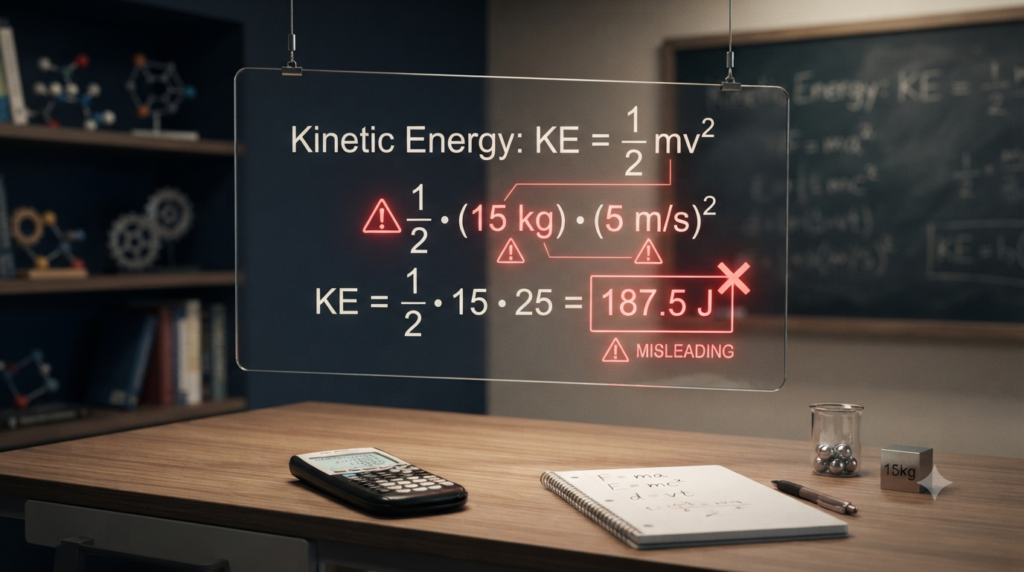
For example, the formula for kinetic energy is:
KE = 1/2 × m × v²
Here, m represents mass and v represents velocity.
Suppose an object has a mass of 4 kilograms and a velocity of 3 metres per second.
The calculation is:
KE = 1/2 × 4 × 3²
First, calculate the square of the velocity:
3² = 9
Then multiply:
KE = 1/2 × 4 × 9
Therefore:
KE = 18 joules
Correctly interpreting the exponent and multiplication is essential to obtaining the intended result.
In scientific software, a precedence error can affect simulations, measurements, or calculated predictions. Explicit parentheses and careful testing help reduce these risks.
6. It Improves Code Readability
Programmers do not write code only for computers. They also write it for other developers who may need to read, review, debug, or update it later.
Consider these two expressions:
result = a + b * cresult = a + (b * c)Both expressions produce the same result in Python because multiplication has higher precedence than addition.
However, the second expression makes the intended grouping more visible. This can be helpful when the expression is part of a longer formula or when the grouping is important to the reader.
Parentheses are particularly useful when expressions contain several operators or when a calculation represents a scientific or business rule.
Good code should communicate the programmer’s intention clearly rather than relying entirely on the reader’s knowledge of precedence rules.
Operator Precedence and Associativity
Operator precedence and associativity are related concepts, but they are not identical.
Operator precedence determines which type of operation is grouped first when different operators appear in an expression.
Operator associativity determines how operators of the same precedence are grouped when multiple operators occur together.
For example:
20 - 5 - 3
Subtraction is generally left-associative in common programming languages such as Python. Therefore, the expression is evaluated as:
(20 - 5) - 3
15 - 3 = 12
It is not evaluated as:
20 - (5 - 3)
That alternative grouping would produce 18.
Similarly, multiplication and division commonly have equal precedence and are evaluated from left to right.
For example:
24 ÷ 4 × 2
The calculation is:
(24 ÷ 4) × 2
6 × 2 = 12
The result is 12, not 3.
These rules matter because the order in which operations are grouped can change the final answer, even when the expression contains the same numbers and operators.
How Parentheses Help Control Evaluation
Parentheses allow programmers to specify which operations should be grouped together.
Consider the expression:
4 + 3 × 2
Multiplication is performed first, producing:
4 + 6 = 10
Now add parentheses:
(4 + 3) × 2
The expression inside the parentheses is evaluated first:
7 × 2 = 14
The numbers and operators are identical, but the grouping changes the result.
In Python, parentheses can be used in the same way:
first_result = 4 + 3 * 2
Output:
10
Parentheses are not merely decorative symbols. They define the intended structure of an expression and can override the default precedence of operators.
Programmers should use them whenever they help communicate the intended calculation or prevent ambiguity.
Does Every Programming Language Use the Same Rules?
No. Many programming languages share familiar precedence rules, but their complete operator rules are not identical.
For example, Python, Java, JavaScript, and C have their own language specifications defining operator precedence, associativity, and evaluation behavior.
The meaning of a particular expression may therefore depend on the language in which it is written.
Some operators may not exist in every language, and certain operations have language-specific behavior. Exponentiation, for instance, is represented by ** in Python, while JavaScript uses ** for exponentiation but does not support the ** operator in exactly the same grouping contexts as every other language. In Python, unary operators and exponentiation also have a specific precedence relationship that programmers should understand.
Consider this Python expression:
print(-2 ** 2)Output:
-4Python evaluates the exponentiation before applying the leading minus sign. The expression is interpreted as:
-(2 ** 2)
To square negative two instead, parentheses are required:
print((-2) ** 2)Output:
4This example illustrates why programmers should learn the rules of the language they are using instead of assuming that every language interprets every expression identically.
What Happens When an Expression Is Written Incorrectly?
An incorrectly written expression can lead to different problems depending on the situation.
Incorrect results: The program runs but returns a value that does not match the intended calculation.
Unexpected program behavior: A calculation may affect conditions, loops, or other decisions, causing the program to behave differently from what the developer expects.
Difficult debugging: If an expression contains many operators without clear grouping, identifying the source of a mistake can take longer.
Potential safety or financial consequences: In systems that calculate payments, control machinery, or process scientific measurements, an incorrect result may have serious consequences.
It is important to distinguish between a syntax error and a logical error. A syntax error occurs when code violates the programming language’s grammatical rules. A logical error occurs when valid code performs the wrong task or calculates an unintended result.
An expression with incorrect grouping may be perfectly valid code and therefore produce no syntax error. The programmer must check whether the result matches the intended logic.
Best Practices for Writing Expressions in Programming
Programmers can reduce mistakes by following a few practical habits.
Learn the language’s precedence rules. Understand how the language evaluates arithmetic, comparison, logical, and other operators.
Use parentheses for clarity. Even when parentheses are not strictly necessary, they can communicate the intended grouping.
Break complex calculations into smaller steps. Assign intermediate results to clearly named variables when an expression becomes difficult to understand.
Test expressions with known values. Check the output against a calculation performed independently.
Review boundary cases. Test values such as zero, negative numbers, very large numbers, and other inputs relevant to the problem.
Avoid relying on assumptions. Do not assume that an expression is interpreted according to the order that seems most natural when reading it.
Use automated tests when appropriate. Tests can verify that calculations continue to produce the expected results when code changes.
These practices improve the correctness, readability, and maintainability of software.
Conclusion
The order of operations matters when a computer evaluates an expression because it determines how numbers and operators are grouped and which calculations are performed first. Without clearly defined rules for precedence and associativity, the same expression could be interpreted in different ways and produce inconsistent results.
Programming languages establish these rules so that expressions can be evaluated predictably. Parentheses allow programmers to control grouping, while testing and clear coding practices help prevent logical errors.
Most importantly, correct evaluation does not automatically mean that a program performs the intended calculation. Programmers must understand both the language’s rules and the logic behind the expression they write. Whether developing a simple calculator, analyzing scientific data, or building complex software, understanding the order of operations is a fundamental skill in computer science.
FAQs
1. What is the order of operations in computer programming?
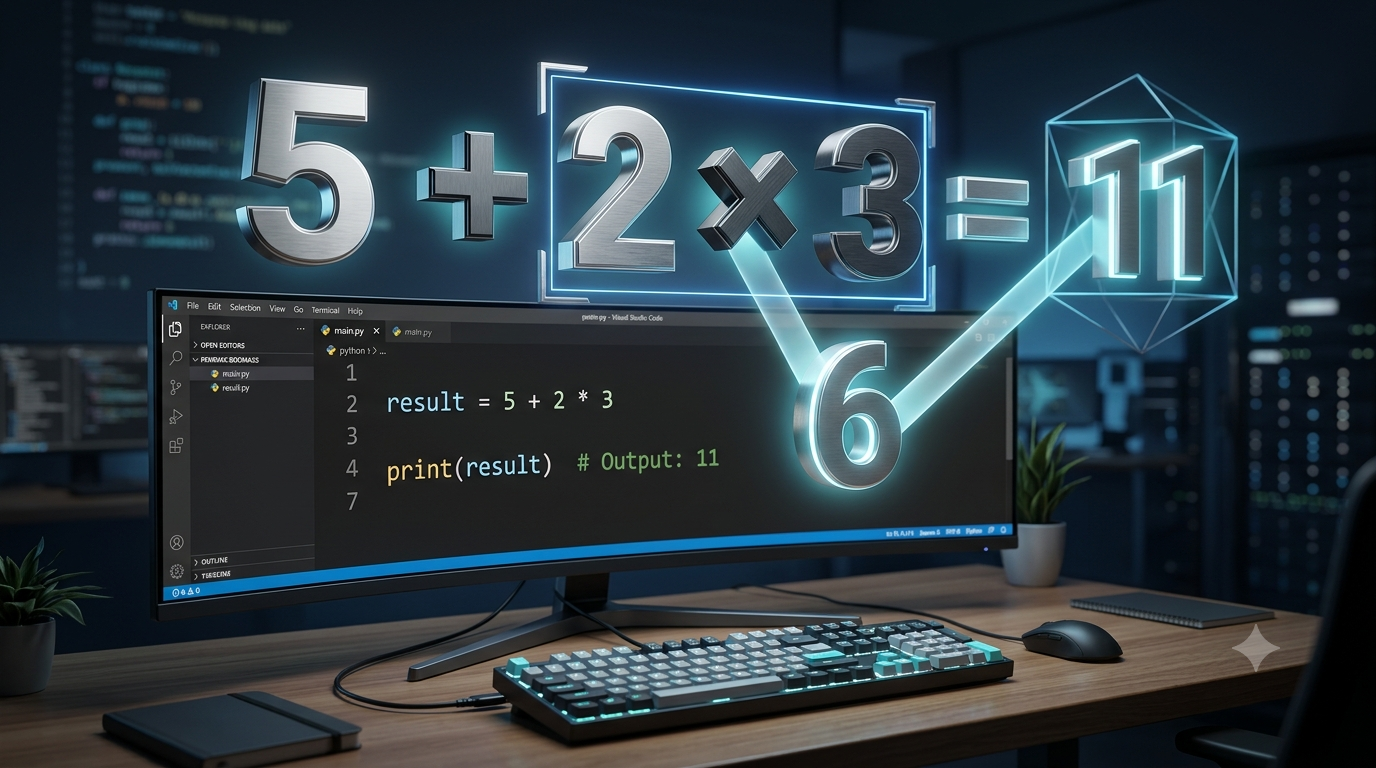
The order of operations is a set of rules that determines the sequence in which mathematical operations are evaluated in a programming expression. These rules specify how operators such as addition, subtraction, multiplication, division, and exponentiation are grouped and processed. For example, in the expression 5 + 2 * 3, multiplication is performed before addition, producing 11. Programming languages define operator precedence and associativity to ensure consistent interpretation. Understanding these rules helps programmers write accurate expressions, prevent logical errors, and produce predictable results in mathematical calculations and software applications.
2. Why is the order of operations important for computers?
The order of operations is important because it ensures that computers interpret expressions consistently and produce results according to the rules of the programming language. Without these rules, an expression containing multiple operators could be grouped in different ways, leading to different answers. For example, 10 + 4 * 2 produces 18 when multiplication is performed first, rather than 28 when addition is performed first. Correct evaluation is essential for financial calculations, scientific applications, data processing, and everyday software. Programmers must understand operator precedence to ensure that expressions represent their intended calculations accurately.
3. What is operator precedence in programming?
Operator precedence determines which operators are grouped first when an expression contains different types of operators. In many programming languages, multiplication and division have higher precedence than addition and subtraction. For example, 8 + 3 * 4 is evaluated as 8 + 12, producing 20. Parentheses can override the default precedence by explicitly grouping operations. For instance, (8 + 3) * 4 produces 44. The exact precedence rules depend on the programming language. Understanding operator precedence helps developers interpret expressions correctly, write readable code, and avoid mistakes when performing calculations.
4. What is the difference between operator precedence and associativity?
Operator precedence determines which types of operations take priority, while associativity determines how operators with the same precedence are grouped. For example, multiplication has higher precedence than addition in many programming languages. However, multiplication and division generally have equal precedence and are evaluated from left to right. In the expression 24 / 4 * 2, the division occurs first, followed by multiplication, producing 12. Associativity rules are important because changing the grouping can change the result. Programmers should understand both concepts to evaluate expressions correctly and avoid unexpected behavior in their code.
5. How do parentheses affect expression evaluation?
Parentheses specify which part of an expression should be evaluated as a group before surrounding operations. They can change the default order of operations and make calculations easier to understand. For example, 4 + 3 * 2 produces 10 because multiplication occurs first. However, (4 + 3) * 2 produces 14 because the addition inside the parentheses is performed first. In programming, parentheses are particularly useful for complex mathematical formulas and logical conditions. They help communicate the programmer’s intention clearly, reduce misunderstandings, and prevent errors caused by incorrect assumptions about operator precedence.
6. Do all programming languages follow the same order of operations?
No, not every programming language follows identical rules for all operators and expressions. Many languages, including Python, Java, JavaScript, and C, follow similar arithmetic precedence conventions, but their complete operator rules can differ. Certain operators may have different precedence, associativity, or evaluation behavior depending on the language. For example, Python and JavaScript both use ** for exponentiation, but other language-specific details may affect how expressions are interpreted. Programmers should consult the documentation for their chosen language rather than assuming that every expression behaves identically across programming environments. This knowledge helps prevent language-specific errors.
7. What happens if a programmer ignores the order of operations?
Ignoring the order of operations can cause a program to produce incorrect results even when its code contains no syntax errors. For example, a programmer calculating the total cost of discounted items might forget parentheses around the discounted price. The program could then calculate a different total than intended. Such mistakes are known as logical errors. They can affect financial calculations, scientific results, and application behavior. To avoid these problems, programmers should understand operator precedence, use parentheses where appropriate, and test expressions with known values. Careful review helps ensure that the program’s calculations match the intended logic.
8. How does the order of operations affect scientific calculations?
Scientific calculations often combine addition, subtraction, multiplication, division, powers, and parentheses. The order of operations ensures that a computer interprets these formulas correctly. For example, kinetic energy is calculated using the formula KE = 1/2 * m * v**2, where m represents mass and v represents velocity. The velocity must be squared as specified by the formula. Incorrect grouping could produce an unintended answer and affect a scientific analysis or simulation. Scientists and engineers therefore need to understand how programming languages evaluate expressions and should use clear formulas, appropriate parentheses, and reliable testing procedures.
9. What is an abstract syntax tree, and how does it relate to expression evaluation?
An abstract syntax tree, commonly called an AST, is a structured representation of an expression or program. A compiler or interpreter can use this structure to represent relationships between operators, operands, and other language elements. For example, the expression 5 + 2 * 3 can be represented so that multiplication is grouped beneath the addition operation, reflecting the higher precedence of multiplication. This structure helps the language implementation process the expression according to its grammatical rules. Abstract syntax trees are important in parsing, code analysis, optimization, and program execution, although the exact implementation varies between programming languages.
10. How can programmers avoid order-of-operations errors?
Programmers can avoid order-of-operations errors by learning the precedence and associativity rules of their programming language. Using parentheses to make intended grouping explicit is particularly helpful when expressions contain several operators. Breaking complicated calculations into smaller steps with meaningful variable names can also improve readability. Developers should test expressions with known inputs, check results independently, and use automated tests for important calculations. Reviewing boundary cases, such as zero and negative numbers, can reveal additional problems. These habits make code easier to understand, maintain, and debug while reducing the risk of incorrect results in software applications.