Set theory is an important foundation of mathematics because it provides a simple way to organize and compare collections of objects. A set may contain numbers, letters, objects, people, or any other clearly defined elements. Once we understand what a set is, we can perform different operations on sets to find relationships between them.
Three of the most important set operations are union, intersection, and difference. These operations help us combine sets, identify their common elements, or find the elements that belong to one set but not another.
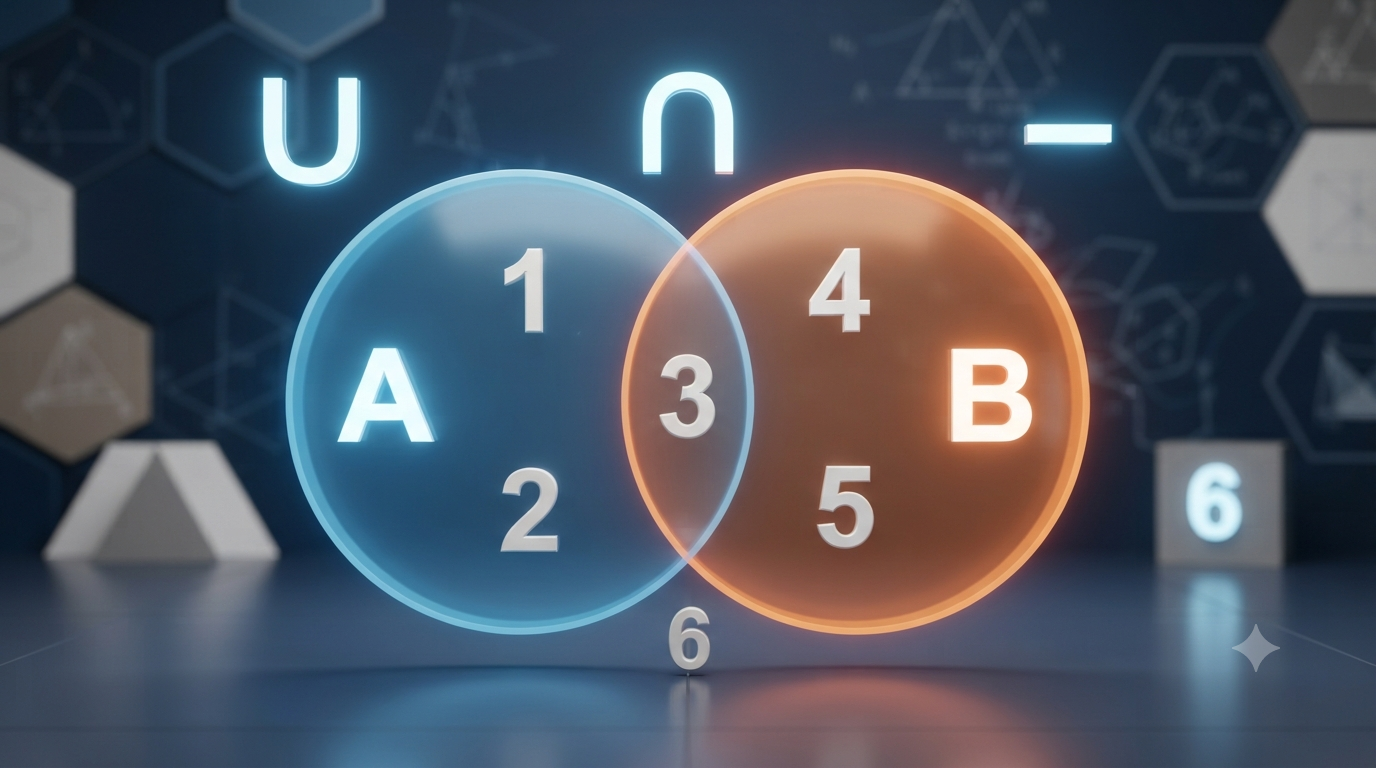
For example, consider two sets:
A = {1, 2, 3, 4}
B = {3, 4, 5, 6}
The union of A and B contains every element from both sets. The intersection contains only the elements common to both sets. The difference A − B contains the elements that are in A but not in B.
Understanding these rules makes it easier to solve problems involving sets, Venn diagrams, probability, logic, and many other areas of mathematics.
What Is a Set?
A set is a well-defined collection of distinct objects or elements.
For example:
A = {2, 4, 6, 8}
Here, A is a set containing four elements: 2, 4, 6, and 8.
Another example is:
B = {a, e, i, o, u}
This set contains the vowels of the English alphabet.
Sets are usually represented using capital letters such as A, B, C, and D. Their elements are written inside curly brackets { }.
An important feature of a set is that repeated elements are counted only once. For example:
C = {1, 2, 2, 3, 3, 3}
is simply written as:
C = {1, 2, 3}
The order of elements also does not normally matter. Therefore:
{1, 2, 3} = {3, 2, 1}
What Are Set Operations?
Set operations are mathematical operations used to create or compare sets.
The three basic operations discussed in this article are:
Union
Intersection
Difference
Each operation answers a different question.
Union: What elements are in either set?
Intersection: What elements are common to both sets?
Difference: What elements are in one set but not the other?
Let us examine each operation carefully.
Set Union
The union of two sets is the set containing all elements that belong to either set, including elements that belong to both sets.
The symbol for union is:
∪
The union of sets A and B is written as:
A ∪ B
It is read as “A union B.”
Union Rule
The basic rule is:
A ∪ B = {x | x ∈ A or x ∈ B}
In simple words, an element belongs to A ∪ B if it is present in A, B, or both.
Consider:
A = {1, 2, 3, 4}
B = {3, 4, 5, 6}
Combining all elements gives:
A ∪ B = {1, 2, 3, 4, 5, 6}
Notice that 3 and 4 appear in both sets, but they are written only once in the union.
Example of Union
Suppose:
P = {10, 20, 30}
Q = {30, 40, 50}
Then:
P ∪ Q = {10, 20, 30, 40, 50}
The common element 30 is not repeated.
Union of Disjoint Sets
Two sets are called disjoint sets when they have no common elements.
For example:
A = {1, 2, 3}
B = {4, 5, 6}
Since A and B have no common elements:
A ∪ B = {1, 2, 3, 4, 5, 6}
Set Intersection
The intersection of two sets is the set containing only the elements that are common to both sets.
The symbol for intersection is:
∩
The intersection of A and B is written as:
A ∩ B
It is read as “A intersection B.”
Intersection Rule
The basic rule is:
A ∩ B = {x | x ∈ A and x ∈ B}
In simple words, an element belongs to A ∩ B only when it is present in both A and B.
Consider:
A = {1, 2, 3, 4}
B = {3, 4, 5, 6}
The elements common to both sets are 3 and 4.
Therefore:
A ∩ B = {3, 4}
Example of Intersection
Suppose:
P = {2, 4, 6, 8}
Q = {4, 8, 12, 16}
The common elements are 4 and 8.
Therefore:
P ∩ Q = {4, 8}
Intersection of Disjoint Sets
If two sets have no elements in common, their intersection is the empty set.
For example:
A = {1, 2, 3}
B = {4, 5, 6}
Therefore:
A ∩ B = ∅
Here, ∅ represents the empty set.
Set Difference
The difference of two sets identifies the elements that belong to one set but do not belong to the other.
Unlike union and intersection, set difference depends on the order of the sets.
The difference between A and B is written as:
A − B
It is read as “A difference B” or “A minus B.”
Difference Rule
The basic rule is:
A − B = {x | x ∈ A and x ∉ B}
In simple words, A − B contains the elements that are in A but not in B.
Consider:
A = {1, 2, 3, 4}
B = {3, 4, 5, 6}
The elements 1 and 2 are in A but not in B.
Therefore:
A − B = {1, 2}
Now reverse the order:
B − A = {5, 6}
This shows why set difference is not generally commutative.
Important Difference Rule
In general:
A − B ≠ B − A
For the example above:
A − B = {1, 2}
while:
B − A = {5, 6}
Therefore, the order matters when finding the difference between sets.
Comparing Union, Intersection, and Difference
Suppose:
A = {1, 2, 3, 4, 5}
B = {4, 5, 6, 7, 8}
The three operations give:
A ∪ B = {1, 2, 3, 4, 5, 6, 7, 8}
A ∩ B = {4, 5}
A − B = {1, 2, 3}
B − A = {6, 7, 8}
This example clearly shows the purpose of each operation.
The union combines the sets, the intersection keeps only common elements, and the difference removes the elements that the two sets have in common.
Union Rules and Properties
Set union follows several important mathematical properties.
Commutative Property of Union
Changing the order of the sets does not change the result.
A ∪ B = B ∪ A
For example:
A = {1, 2, 3}
B = {3, 4, 5}
Then:
A ∪ B = {1, 2, 3, 4, 5}
and:
B ∪ A = {1, 2, 3, 4, 5}
Associative Property of Union
When three sets are involved, the grouping does not affect the result.
(A ∪ B) ∪ C = A ∪ (B ∪ C)
This means the sets can be grouped in either way.
Identity Rule for Union
The union of any set with the empty set is the original set.
A ∪ ∅ = A
For example:
A = {1, 2, 3}
Then:
A ∪ ∅ = {1, 2, 3}
Idempotent Rule for Union
A set united with itself remains unchanged.
A ∪ A = A
For example:
A = {2, 4, 6}
Then:
A ∪ A = {2, 4, 6}
Intersection Rules and Properties
Intersection also follows several useful properties.
Commutative Property of Intersection
The order of the sets does not affect the result.
A ∩ B = B ∩ A
For example:
A = {1, 2, 3}
B = {2, 3, 4}
Then:
A ∩ B = {2, 3}
and:
B ∩ A = {2, 3}
Associative Property of Intersection
For three sets:
(A ∩ B) ∩ C = A ∩ (B ∩ C)
The grouping does not affect the final result.
Identity Rule for Intersection
If U is the universal set, then:
A ∩ U = A
Every element of A is contained in the universal set.
Empty Set Rule
The intersection of any set with the empty set is the empty set.
A ∩ ∅ = ∅
For example:
A = {1, 2, 3}
Therefore:
A ∩ ∅ = ∅
Idempotent Rule for Intersection
A set intersected with itself remains unchanged.
A ∩ A = A
Important Difference Rules
Set difference has some important rules that help simplify expressions.
Difference with the Empty Set
Subtracting the empty set from a set gives the original set.
A − ∅ = A
For example:
A = {1, 2, 3}
Therefore:
A − ∅ = {1, 2, 3}
Difference of a Set from Itself
A set minus itself produces the empty set.
A − A = ∅
For example:
A = {2, 4, 6}
Then:
A − A = ∅
Empty Set Minus a Set
The empty set contains no elements, so:
∅ − A = ∅
Difference and Intersection
Set difference can also be understood using intersection with a complement:
A − B = A ∩ Bᶜ
This means that A − B contains the elements that are in A and outside B.
This relationship is especially useful when working with Venn diagrams and set algebra.
Venn Diagram Interpretation
Venn diagrams provide a visual way to understand set operations.
Suppose two circles represent sets A and B.
For A ∪ B, the entire area covered by either circle is included.
For A ∩ B, only the overlapping region between the two circles is included.
For A − B, only the portion of circle A that does not overlap with circle B is included.
For B − A, only the portion of circle B that does not overlap with circle A is included.
Venn diagrams are particularly useful because they make the difference between these operations easy to see.
Common Mistakes in Set Operations
Students often make a few common mistakes when working with union, intersection, and difference.
Repeating Common Elements in a Union
Suppose:
A = {1, 2, 3}
B = {3, 4, 5}
A common mistake is to write:
A ∪ B = {1, 2, 3, 3, 4, 5}
This is incorrect because sets do not contain duplicate elements.
The correct answer is:
A ∪ B = {1, 2, 3, 4, 5}
Confusing Union with Intersection
Union includes all elements from both sets, while intersection includes only common elements.
For:
A = {1, 2, 3}
B = {2, 3, 4}
The correct results are:
A ∪ B = {1, 2, 3, 4}
A ∩ B = {2, 3}
Reversing Set Difference
Another common mistake is assuming:
A − B = B − A
This is generally false.
For:
A = {1, 2, 3}
B = {3, 4, 5}
we have:
A − B = {1, 2}
but:
B − A = {4, 5}
Therefore, always pay attention to the order of the sets.
Solved Example
Consider the following sets:
A = {2, 4, 6, 8, 10}
B = {6, 8, 10, 12, 14}
Find A ∪ B, A ∩ B, A − B, and B − A.
Step 1: Find the Union
Include every distinct element from both sets:
A ∪ B = {2, 4, 6, 8, 10, 12, 14}
Step 2: Find the Intersection
Identify the elements present in both sets:
A ∩ B = {6, 8, 10}
Step 3: Find A − B
Find the elements in A that are not in B:
A − B = {2, 4}
Step 4: Find B − A
Find the elements in B that are not in A:
B − A = {12, 14}
Therefore, the final results are:
A ∪ B = {2, 4, 6, 8, 10, 12, 14}
A ∩ B = {6, 8, 10}
A − B = {2, 4}
B − A = {12, 14}
Why These Set Rules Matter
Union, intersection, and difference are not limited to basic set theory. They are used throughout mathematics and other fields.
In probability, sets can represent events, and union and intersection help describe combined or simultaneous events.
In logic, set operations have close relationships with logical operations such as OR and AND.
In computer science, sets are used in databases, programming, search systems, and data processing.
In statistics, set operations can help organize groups of observations and events.
In everyday situations, these ideas can also be useful. For example, one group might represent people who like mathematics, another might represent people who like physics, and their intersection represents people who like both subjects.
Quick Summary of Set Operations
The three basic operations can be remembered using simple questions:
Union (∪): What is in A or B?
Intersection (∩): What is common to A and B?
Difference (−): What is in A but not in B?
For example, if:
A = {1, 2, 3, 4}
B = {3, 4, 5, 6}
then:
A ∪ B = {1, 2, 3, 4, 5, 6}
A ∩ B = {3, 4}
A − B = {1, 2}
B − A = {5, 6}
Remember that union and intersection are commutative, meaning the order does not change the result. Set difference, however, is generally not commutative, so the order of the sets is important.
Conclusion
Set union, intersection, and difference are three fundamental operations in set theory. The union combines all distinct elements from two or more sets, the intersection identifies elements common to the sets, and the difference finds elements that belong to one set but not another.
Learning these rules carefully provides a strong foundation for more advanced topics such as Venn diagrams, set algebra, probability, logic, functions, and mathematical reasoning. The easiest way to remember them is to focus on what each operation is asking: union combines, intersection finds common elements, and difference separates what belongs to one set from what belongs to another.
FAQs
1. What is the union of two sets?
The union of two sets is the set containing all distinct elements that belong to either of the two sets. The symbol for union is ∪. For example, if A = {1, 2, 3} and B = {3, 4, 5}, then A ∪ B = {1, 2, 3, 4, 5}. The common element 3 is included only once because sets do not contain duplicate elements. In simple terms, union means combining the elements of two sets without repeating any element. It is useful when we want to consider everything that belongs to at least one of the given sets.
2. What is the intersection of two sets?
The intersection of two sets is the set containing only the elements that are common to both sets. The symbol for intersection is ∩. For example, if A = {1, 2, 3, 4} and B = {3, 4, 5, 6}, then A ∩ B = {3, 4}. The elements 3 and 4 appear in both sets, so they form the intersection. If two sets have no common elements, their intersection is the empty set, represented by ∅. Intersection is useful for identifying shared elements or conditions that are satisfied by both sets at the same time.
3. What is the difference between two sets?
The difference between two sets contains the elements that belong to the first set but do not belong to the second set. It is represented by a minus sign. For example, if A = {1, 2, 3, 4} and B = {3, 4, 5}, then A − B = {1, 2}. The elements 3 and 4 are removed because they are also present in B. Set difference depends on the order of the sets. Therefore, A − B is generally different from B − A. This operation is useful for finding elements that are unique to one particular set.
4. Is set union commutative?
Yes, set union is commutative. This means that changing the order of the sets does not change the result. The rule is A ∪ B = B ∪ A. For example, if A = {1, 2, 3} and B = {3, 4, 5}, then A ∪ B = {1, 2, 3, 4, 5}. Reversing the order gives B ∪ A = {1, 2, 3, 4, 5}, which is the same set. The commutative property makes union easier to work with because the order in which sets are combined does not affect the final result.
5. Is set intersection commutative?
Yes, set intersection is commutative. This means that the order of the sets does not affect the intersection. The rule is A ∩ B = B ∩ A. For example, if A = {2, 4, 6} and B = {4, 6, 8}, then A ∩ B = {4, 6}. If the order is reversed, B ∩ A is also {4, 6}. This happens because intersection simply identifies the elements that both sets have in common. Therefore, you can change the order of the sets when finding their intersection without changing the answer.
6. Is set difference commutative?
No, set difference is generally not commutative. This means that changing the order of the sets can produce a different result. For example, let A = {1, 2, 3} and B = {3, 4, 5}. Then A − B = {1, 2}, because 1 and 2 are in A but not in B. However, B − A = {4, 5}, because 4 and 5 are in B but not in A. Therefore, A − B ≠ B − A in general. When calculating a set difference, always pay attention to which set comes first.
7. What happens when two sets are disjoint?
Two sets are called disjoint when they have no elements in common. Therefore, their intersection is the empty set. For example, if A = {1, 2, 3} and B = {4, 5, 6}, there are no common elements between them. Thus, A ∩ B = ∅. Their union, however, contains all elements from both sets: A ∪ B = {1, 2, 3, 4, 5, 6}. Disjoint sets are useful when groups do not overlap. In probability and other mathematical applications, recognizing disjoint sets can make calculations and reasoning much simpler.
8. What is the difference between union and intersection?
The main difference is that union includes all distinct elements from the sets, while intersection includes only the elements common to both sets. For example, if A = {1, 2, 3} and B = {3, 4, 5}, then A ∪ B = {1, 2, 3, 4, 5}. On the other hand, A ∩ B = {3}. A simple way to remember this is that union combines, while intersection compares for common elements. In a Venn diagram, union covers both circles, whereas intersection covers only the overlapping region between the circles.
9. What is the difference between A − B and B − A?
A − B and B − A identify different groups of elements because set difference depends on the order of the sets. A − B contains elements that are in A but not in B. B − A contains elements that are in B but not in A. For example, if A = {1, 2, 3, 4} and B = {3, 4, 5, 6}, then A − B = {1, 2}, while B − A = {5, 6}. Therefore, they are usually different. When solving set difference problems, always identify the first set before removing elements belonging to the second set.
10. How are union, intersection, and difference used in mathematics?
Union, intersection, and difference are used to compare and organize sets in many areas of mathematics. Union helps combine elements from different groups, intersection identifies elements shared by groups, and difference finds elements that belong to one group but not another. These operations are important in probability, logic, statistics, Venn diagrams, and other mathematical topics. They are also useful in computer science for working with databases, search results, and collections of data. Learning these three operations provides an important foundation for understanding more advanced concepts in set theory and mathematical reasoning.