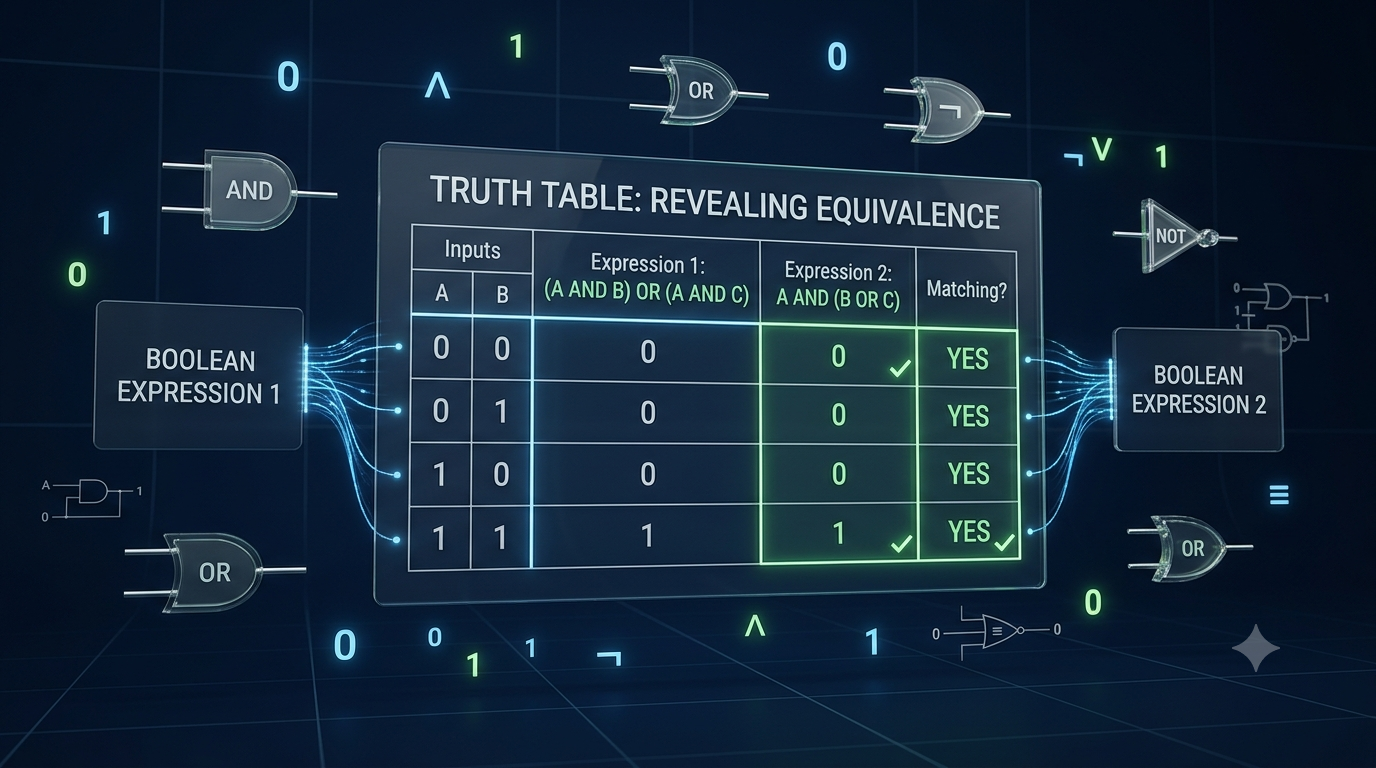
Boolean algebra is an important part of computer science, digital electronics, programming, and logic design. It deals with values that are either true or false, commonly represented by 1 and 0. Boolean expressions combine these values using logical operations such as AND, OR, and NOT. Although two Boolean expressions may look different, they can sometimes produce exactly the same result for every possible combination of inputs. In such cases, the expressions are called logically equivalent or Boolean equivalent.
A truth table provides a simple and systematic way to check this equivalence. It lists every possible input combination and shows the output produced by each expression. By comparing the outputs row by row, we can determine whether the expressions always behave identically. This method is useful for verifying logical identities, simplifying computer programs, designing digital circuits, and understanding how Boolean logic works.
What Is a Boolean Expression?
A Boolean expression is a logical statement formed using Boolean variables, constants, and logical operators. Its final result is always either true or false, represented by 1 or 0.
For example, consider the expression:
A AND B
Here, A and B are Boolean variables. The AND operation produces 1 only when both variables are 1. If either variable is 0, the result is 0.
Boolean expressions commonly use three fundamental logical operators.
1. AND Operation
The AND operation is true only when all its inputs are true. It is represented by the symbol ∧ or sometimes by multiplication.
For two variables, the expression is:
A ∧ B
For example, if A = 1 and B = 1, the output is 1. If either input is 0, the output is 0.
2. OR Operation
The OR operation is true when at least one input is true. It is represented by the symbol ∨ or sometimes by addition.
For two variables, the expression is:
A ∨ B
If A = 0 and B = 0, the output is 0. In all other input combinations, the output is 1.
3. NOT Operation
The NOT operation reverses the value of a Boolean variable. It is represented by the symbol ¬ or a bar over the variable.
For example:
¬A
If A = 1, then ¬A = 0. If A = 0, then ¬A = 1.
These operators can be combined to form more complex Boolean expressions. A truth table helps us understand their behavior and compare the results of different expressions.
What Is a Truth Table?
A truth table is a structured table that displays all possible combinations of Boolean input values and the corresponding output of a logical expression.
For example, if an expression contains two Boolean variables, A and B, there are four possible input combinations:
| A | B |
|---|---|
| 0 | 0 |
| 0 | 1 |
| 1 | 0 |
| 1 | 1 |
The number of possible combinations depends on the number of independent Boolean variables. If there are n variables, the total number of input combinations is:
Number of combinations = 2ⁿ
Therefore:
One variable produces 2 combinations.
Two variables produce 4 combinations.
Three variables produce 8 combinations.
Four variables produce 16 combinations.
A complete truth table includes every possible input combination. This is important because two expressions might produce the same output for some inputs but different outputs for others.
A truth table reveals equivalence only when the output columns match for every possible input combination.
What Does It Mean for Two Boolean Expressions to Be Equivalent?
Two Boolean expressions are equivalent when they produce the same output for every possible combination of their input variables.
Suppose the expressions are P and Q. They are logically equivalent if:
P ≡ Q
This notation means that P and Q always have identical truth values.
For example, consider these two expressions:
Expression 1: A ∧ B
Expression 2: B ∧ A
Both expressions use the AND operation. The first places A before B, while the second places B before A. Although their written forms differ, their outputs are identical for every possible input combination.
This property is known as the commutative law of AND.
However, expressions that look similar are not necessarily equivalent. For example, A ∧ B and A ∨ B produce different outputs for some input combinations. A truth table helps identify these differences without relying on appearance or assumptions.
How Can a Truth Table Reveal Equivalence?
The process involves creating a truth table, evaluating both expressions for each input combination, and comparing their outputs.
Step 1: Identify the Boolean Variables
First, identify all the variables used in both expressions.
For example, consider:
Expression 1: A ∧ B
Expression 2: B ∧ A
The variables are A and B.
Both expressions use the same two variables, so we need four input combinations.
Step 2: List Every Possible Input Combination
Create columns for A and B and list all possible combinations of 0 and 1.
| A | B |
|---|---|
| 0 | 0 |
| 0 | 1 |
| 1 | 0 |
| 1 | 1 |
Each row represents one possible situation that the expressions must handle.
Step 3: Calculate the Output of the First Expression
Evaluate Expression 1, which is A ∧ B.
Remember that AND produces 1 only when both inputs are 1.
| A | B | A ∧ B |
|---|---|---|
| 0 | 0 | 0 |
| 0 | 1 | 0 |
| 1 | 0 | 0 |
| 1 | 1 | 1 |
The output is 1 only in the final row.
Step 4: Calculate the Output of the Second Expression
Now evaluate Expression 2, which is B ∧ A.
| A | B | B ∧ A |
|---|---|---|
| 0 | 0 | 0 |
| 0 | 1 | 0 |
| 1 | 0 | 0 |
| 1 | 1 | 1 |
The output column is exactly the same as the output column for A ∧ B.
Step 5: Compare the Output Columns
Place both expressions in the same table to make the comparison easier.
| A | B | A ∧ B | B ∧ A |
|---|---|---|---|
| 0 | 0 | 0 | 0 |
| 0 | 1 | 0 | 0 |
| 1 | 0 | 0 | 0 |
| 1 | 1 | 1 | 1 |
Every row contains matching outputs.
Therefore:
A ∧ B ≡ B ∧ A
The truth table proves that the two expressions are equivalent because their outputs are identical for every possible input combination.
Example 2: Verifying De Morgan’s Law
Truth tables can also verify more complex Boolean identities.
Consider the following expressions:
Expression 1: ¬(A ∧ B)
Expression 2: ¬A ∨ ¬B
These expressions are related by De Morgan’s law, which states that the NOT of an AND expression is equivalent to the OR of the negated inputs.
Let’s verify this relationship using a truth table.
| A | B | A ∧ B | ¬(A ∧ B) | ¬A | ¬B | ¬A ∨ ¬B |
|---|---|---|---|---|---|---|
| 0 | 0 | 0 | 1 | 1 | 1 | 1 |
| 0 | 1 | 0 | 1 | 1 | 0 | 1 |
| 1 | 0 | 0 | 1 | 0 | 1 | 1 |
| 1 | 1 | 1 | 0 | 0 | 0 | 0 |
The two expressions being compared are ¬(A ∧ B) and ¬A ∨ ¬B.
Their output columns are:
¬(A ∧ B): 1, 1, 1, 0
¬A ∨ ¬B: 1, 1, 1, 0
Because these outputs match in all four rows, the expressions are equivalent.
Therefore:
¬(A ∧ B) ≡ ¬A ∨ ¬B
This example demonstrates how a truth table can verify a logical identity even when the expressions have different structures.
Example 3: Identifying Two Non-Equivalent Expressions
A truth table is equally useful for showing that two expressions are not equivalent.
Consider:
Expression 1: A ∧ B
Expression 2: A ∨ B
Construct the following truth table.
| A | B | A ∧ B | A ∨ B |
|---|---|---|---|
| 0 | 0 | 0 | 0 |
| 0 | 1 | 0 | 1 |
| 1 | 0 | 0 | 1 |
| 1 | 1 | 1 | 1 |
The output columns match in the first and last rows, but they differ in the second and third rows.
For example, when A = 0 and B = 1:
A ∧ B = 0
A ∨ B = 1
A single input combination that produces different outputs is enough to prove that two Boolean expressions are not equivalent.
Therefore:
A ∧ B ≢ A ∨ B
The symbol ≢ indicates that the expressions are not logically equivalent.
This example highlights an important principle: expressions must match in every row, not just most rows, to be considered equivalent.
Using Truth Tables with Three Boolean Variables
The same technique works when expressions contain three variables.
Consider the following expressions:
Expression 1: (A ∧ B) ∧ C
Expression 2: A ∧ (B ∧ C)
These expressions represent two different groupings of the AND operation.
Since there are three variables, the truth table must contain 2³ = 8 input combinations.
| A | B | C | (A ∧ B) ∧ C | A ∧ (B ∧ C) |
|---|---|---|---|---|
| 0 | 0 | 0 | 0 | 0 |
| 0 | 0 | 1 | 0 | 0 |
| 0 | 1 | 0 | 0 | 0 |
| 0 | 1 | 1 | 0 | 0 |
| 1 | 0 | 0 | 0 | 0 |
| 1 | 0 | 1 | 0 | 0 |
| 1 | 1 | 0 | 0 | 0 |
| 1 | 1 | 1 | 1 | 1 |
The output columns match in all eight rows.
Therefore:
(A ∧ B) ∧ C ≡ A ∧ (B ∧ C)
This verifies the associative law of AND.
When more variables are involved, the procedure remains the same. However, the number of rows increases rapidly, so careful organization becomes increasingly important.
Why Must Every Possible Input Combination Be Tested?
Testing every possible input combination is essential because Boolean expressions can behave differently under specific conditions.
Suppose two expressions produce the same output for seven out of eight input combinations. They might appear equivalent if we examine only a few selected examples. However, the one differing row proves that they are not equivalent.
A complete truth table prevents this mistake by systematically examining every possible input.
For n Boolean variables, there are 2ⁿ possible combinations. A complete comparison checks both expressions against all these combinations.
This method provides a definitive result for finite Boolean expressions: if the output columns match in every row, the expressions are equivalent. If at least one row differs, they are not equivalent.
Applications of Truth Tables in Computer Science
Truth tables are useful in several areas of computer science and digital technology.
1. Verifying Boolean Algebra Laws
Computer scientists use truth tables to check identities such as the commutative, associative, distributive, and De Morgan’s laws. These laws help simplify logical expressions and make their behavior easier to understand.
2. Designing Digital Circuits
Digital circuits use logic gates to process binary inputs. Engineers can compare two circuit designs by expressing their outputs as Boolean expressions and constructing truth tables.
If the output columns match, both circuits implement the same logical function for the tested inputs.
3. Simplifying Programming Conditions
Programming languages frequently use logical operators such as AND, OR, and NOT. A complex condition can sometimes be rewritten into a simpler equivalent condition.
Truth tables help developers verify that the rewritten condition preserves the original behavior.
4. Testing Logical Systems
Truth tables provide a systematic method for checking the correctness of small logical systems. They can help identify conditions where an expression produces an unexpected result.
5. Learning Digital Logic
Students and beginners can use truth tables to understand how logical operators work together. Rather than relying on memorized rules, they can examine the outputs and discover patterns directly.
Advantages and Limitations of Truth Tables
Truth tables have several advantages when comparing Boolean expressions.
Advantages
They provide a clear, systematic comparison of outputs.
They can verify logical identities without relying on visual similarity.
They identify specific inputs where expressions differ.
They are suitable for learning, circuit verification, and testing logical conditions.
They provide a definitive equivalence check when all possible inputs are included.
However, truth tables also have limitations.
Limitations
The number of rows doubles whenever another independent variable is added.
Large tables require considerable time and space to construct manually.
Complex expressions can be difficult to evaluate without intermediate columns.
For large Boolean systems, algebraic simplification, automated tools, or formal verification methods may be more efficient.
Despite these limitations, truth tables remain one of the clearest methods for understanding and verifying Boolean equivalence.
Conclusion
A truth table reveals whether two Boolean expressions are equivalent by comparing their outputs for every possible combination of input values. The process begins by identifying the variables, listing all input combinations, calculating each expression’s output, and comparing the resulting columns. If the outputs match in every row, the expressions are logically equivalent. If even one row contains different outputs, they are not equivalent.
This method can verify basic Boolean laws, check logical conditions in computer programs, and compare digital circuit designs. Although truth tables become larger as the number of variables increases, they provide a reliable foundation for understanding Boolean logic. By learning to construct and interpret truth tables, readers can develop a clearer understanding of logical reasoning and the principles behind digital computing.
FAQs
1. What is Boolean expression equivalence?
Boolean expression equivalence means that two Boolean expressions produce the same output for every possible combination of their input variables. The expressions may look different or use different logical operations, but their final results must always match. For example, A ∧ B and B ∧ A are equivalent because the AND operation gives the same result regardless of the order of its inputs. Truth tables are commonly used to verify this property. By comparing the output columns of both expressions, we can determine whether they represent the same logical function.
2. How does a truth table prove that two Boolean expressions are equivalent?
A truth table proves equivalence by listing every possible input combination and calculating the output of each expression. Both expressions must be evaluated using the same input values. Their output columns are then compared row by row. If the outputs match in every row, the expressions are logically equivalent. If even one row contains different outputs, the expressions are not equivalent. This method provides a systematic way to verify Boolean identities without relying on the expressions’ appearance. It is useful in computer science, digital electronics, programming, and logical reasoning.
3. How many rows are required in a truth table for Boolean equivalence?
The number of rows depends on the number of independent Boolean variables in the expressions. If there are n variables, the truth table requires 2ⁿ rows to include every possible input combination. For example, one variable requires two rows, two variables require four rows, and three variables require eight rows. Four variables require sixteen rows. Both expressions must be evaluated for all these combinations to establish equivalence. Omitting an input combination may cause an important difference to go unnoticed. Therefore, a complete truth table is essential for a reliable comparison.
4. What happens if two Boolean expressions differ in only one truth table row?
If two Boolean expressions produce different outputs in even one row, they are not logically equivalent. That row provides a counterexample demonstrating that the expressions behave differently for a particular input combination. For example, A ∧ B and A ∨ B differ when A = 0 and B = 1. The AND expression produces 0, while the OR expression produces 1. Even though their outputs match for some other combinations, this single difference is enough to disprove equivalence. Identifying such rows also helps explain precisely why two expressions cannot be used interchangeably.
5. Can two Boolean expressions look different but still be equivalent?
Yes, two Boolean expressions can have different structures and still produce identical outputs for every possible input combination. For example, ¬(A ∧ B) and ¬A ∨ ¬B are equivalent according to De Morgan’s law. One expression negates an entire AND operation, while the other negates both variables and combines them using OR. Their structures differ, but their truth table outputs match in every row. This demonstrates why appearance alone cannot determine equivalence. A truth table provides a reliable method for checking whether differently written expressions represent the same logical function.
6. What is the difference between equivalent and non-equivalent Boolean expressions?
Equivalent Boolean expressions produce identical outputs for every possible combination of their input variables. Non-equivalent expressions produce different outputs for at least one combination. For example, A ∧ B and B ∧ A are equivalent because their output columns always match. In contrast, A ∧ B and A ∨ B are not equivalent because their outputs differ for certain inputs. A truth table makes this distinction clear by displaying the results side by side. This comparison helps determine whether an expression can be replaced with another without changing the logical behavior of a program or digital circuit.
7. Which Boolean algebra laws can truth tables verify?
Truth tables can verify many important Boolean algebra laws, including the commutative, associative, distributive, identity, idempotent, and De Morgan’s laws. For example, the commutative law states that A ∧ B is equivalent to B ∧ A. De Morgan’s law states that ¬(A ∧ B) is equivalent to ¬A ∨ ¬B. To verify either identity, construct a truth table and compare the output columns of the two expressions. If the columns match for every possible input combination, the identity is confirmed. This technique helps learners understand why Boolean algebra rules work.
8. How are truth tables used to compare digital logic circuits?
Digital logic circuits are built using gates such as AND, OR, and NOT. Each circuit can be represented by a Boolean expression describing its output. To compare two circuits, their Boolean expressions are evaluated using the same input combinations. A truth table displays both outputs side by side. If the output columns match in every row, the circuits implement the same logical function for those inputs. If a row differs, the circuits behave differently under that condition. This approach helps engineers verify circuit designs, identify logical errors, and simplify digital systems while preserving their intended behavior.
9. Can truth tables help simplify Boolean expressions in programming?
Yes, truth tables can help developers verify whether a simplified Boolean expression preserves the behavior of the original expression. Programming languages use logical operators such as AND, OR, and NOT in conditional statements and decision-making structures. When a developer rewrites a complicated condition, a truth table can compare the original and revised conditions for every possible combination of Boolean inputs. Matching outputs confirm that the conditions are equivalent. However, truth tables become large when many variables are involved. For complex programs, automated testing, Boolean algebra, and formal verification tools may provide more efficient ways to check correctness.
10. What are the limitations of using truth tables to check Boolean equivalence?
The main limitation of truth tables is that their size increases exponentially with the number of independent variables. Two variables require four rows, but ten variables require 1,024 rows. Constructing and checking large tables manually can therefore become time-consuming and introduce calculation errors. Complex Boolean expressions may also require additional intermediate columns to evaluate correctly. Despite these limitations, truth tables are excellent for learning Boolean logic and verifying expressions with relatively few variables. For larger systems, computer-based Boolean solvers, symbolic simplification, and formal verification tools can make equivalence checking more practical and efficient.