
Physics formulas connect different physical quantities through mathematical relationships. Before using a formula in a calculation, it is useful to check whether the equation is dimensionally correct. This process is known as dimensional checking or dimensional analysis. It helps identify mistakes in formulas, calculations, and unit conversions.
The basic idea is simple: every physical quantity has dimensions based on fundamental quantities such as length, mass, and time. For example, velocity has dimensions [LT⁻¹], while acceleration has dimensions [LT⁻²]. By comparing the dimensions on both sides of an equation, we can determine whether the formula is consistent. In this article, we will learn how to check dimensions in a physics formula step by step.
What Does Dimension Mean in Physics?
The dimension of a physical quantity describes how that quantity depends on fundamental physical quantities. The most commonly used fundamental dimensions in basic mechanics are:
Mass = [M]
Length = [L]
Time = [T]
Other quantities can be expressed using combinations of these fundamental dimensions.
For example, velocity is distance divided by time.
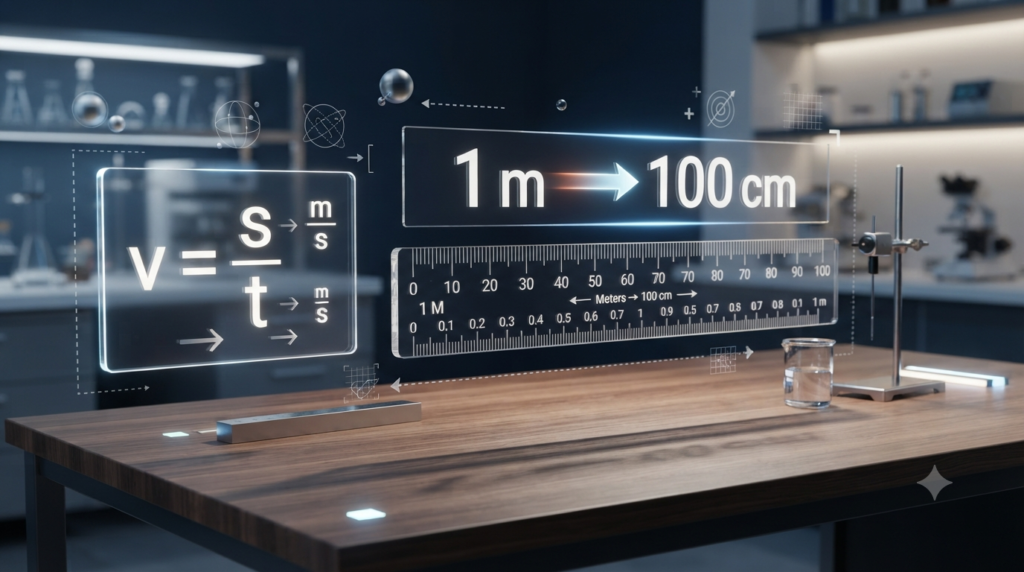
v = distance / time
Therefore,
[v] = [L] / [T] = [LT⁻¹]
Similarly, acceleration is change in velocity divided by time.
[a] = [LT⁻¹] / [T] = [LT⁻²]
Dimensions are different from units. Metre, kilometre, and centimetre are units of length, while [L] represents the dimension of length.
Why Should You Check the Dimensions of a Formula?
Dimensional checking is useful because it provides a quick way to test whether a physical equation is possible.
Suppose a formula is written as:
s = ut + ½at²
We can check whether both sides have the same dimensions.
The dimensions are:
[s] = [L]
[u] = [LT⁻¹]
[t] = [T]
[a] = [LT⁻²]
For the first term:
[ut] = [LT⁻¹][T] = [L]
For the second term:
[at²] = [LT⁻²][T²] = [L]
Both terms have the dimension [L], so the right-hand side has the dimension [L]. This agrees with the left-hand side.
Therefore, the equation is dimensionally consistent.
The Basic Rule of Dimensional Checking
The most important rule is:
Both sides of a physical equation must have the same dimensions.
If an equation is:
A = B
then:
[A] = [B]
For example:
F = ma
The dimension of force is:
[F] = [MLT⁻²]
On the right side:
[ma] = [M][LT⁻²] = [MLT⁻²]
Therefore,
[F] = [ma]
The equation is dimensionally consistent.
If the dimensions on the two sides are different, the formula cannot be physically correct as written.
Step 1 Identify the Physical Quantity on Each Side
Start by looking at the complete formula and identify the quantities involved.
Consider:
v = u + at
Here:
v = final velocity
u = initial velocity
a = acceleration
t = time
The left side contains velocity, while the right side contains two terms.
Before calculating anything, write the dimensions of each quantity.
[v] = [LT⁻¹]
[u] = [LT⁻¹]
[a] = [LT⁻²]
[t] = [T]
Step 2 Write the Dimensions of Each Quantity
Use known dimensional formulas for the quantities.
Some important dimensions are:
Distance = [L]
Displacement = [L]
Time = [T]
Speed = [LT⁻¹]
Velocity = [LT⁻¹]
Acceleration = [LT⁻²]
Momentum = [MLT⁻¹]
Force = [MLT⁻²]
Work = [ML²T⁻²]
Energy = [ML²T⁻²]
Power = [ML²T⁻³]
Pressure = [ML⁻¹T⁻²]
Density = [ML⁻³]
These relationships can then be substituted into the formula.
Step 3 Apply the Mathematical Operations
After writing the dimensions, perform the same mathematical operations that appear in the formula.
For multiplication, multiply the dimensions.
For example:
[Mass × acceleration] = [M][LT⁻²]
= [MLT⁻²]
For division, subtract the powers of the dimensions.
For example:
[Distance / time] = [L][T⁻¹]
= [LT⁻¹]
For powers, multiply the dimensional powers.
For example:
[Acceleration × time²] = [LT⁻²][T²]
= [LT⁰]
= [L]
Step 4 Compare Both Sides
After simplifying the dimensions, compare the left-hand side and right-hand side.
Take the formula:
v = u + at
The left side is:
[v] = [LT⁻¹]
The first term on the right is:
[u] = [LT⁻¹]
The second term is:
[at] = [LT⁻²][T]
= [LT⁻¹]
Therefore, both terms on the right have the same dimensions as velocity.
So:
[LT⁻¹] = [LT⁻¹]
The equation is dimensionally consistent.
Why Terms Being Added Must Have the Same Dimensions
An important part of dimensional checking is addition and subtraction.
Physical quantities can only be added or subtracted when they have the same dimensions.
For example:
x + y
is meaningful if:
[x] = [y]
Consider:
s = ut + ½at²
Both ut and at² have the dimension [L]. Therefore, they can be added.
However, an expression such as:
distance + time
would not be dimensionally meaningful because:
[distance] = [L]
while:
[time] = [T]
Since [L] and [T] are different, they cannot be directly added.
Checking a Formula With Powers
Dimensions become especially useful when formulas contain squares, cubes, or other powers.
Consider kinetic energy:
K = ½mv²
The dimensions of mass are:
[m] = [M]
The dimensions of velocity are:
[v] = [LT⁻¹]
Therefore:
[v²] = [L²T⁻²]
Now multiply:
[mv²] = [M][L²T⁻²]
= [ML²T⁻²]
So:
[K] = [ML²T⁻²]
This is the dimension of energy.
The numerical constant ½ has no dimensions, so it does not affect the dimensional check.
Checking Formulas With Constants
Many physics equations contain constants such as 2, ½, π, or other pure numerical values.
For example:
s = ut + ½at²
The factor ½ is dimensionless.
Similarly, in:
C = 2πr
both 2 and π are dimensionless, while r has dimension [L]. Therefore:
[C] = [L]
The presence of a pure number does not change the dimensions of an expression.
However, some physical constants do have dimensions. For example, the gravitational constant G has dimensions. Such constants must be included when checking the equation.
Example of Finding an Incorrect Formula
Suppose someone proposes:
s = ut + at
Let us check it.
The left side has:
[s] = [L]
The first term is:
[ut] = [LT⁻¹][T] = [L]
But the second term is:
[at] = [LT⁻²][T] = [LT⁻¹]
Therefore, the right side contains:
[L] + [LT⁻¹]
These quantities have different dimensions and cannot be added.
So the proposed equation is dimensionally incorrect.
This does not require any numerical calculation. Dimensional analysis identifies the problem immediately.
Can Dimensional Analysis Prove a Formula Is Correct?
Dimensional consistency is a powerful check, but it does not prove that a formula is completely correct.
A formula may have matching dimensions and still be physically wrong.
For example, numerical constants or certain mathematical structures may not be determined by dimensional analysis alone. A formula could have the correct dimensions but an incorrect coefficient.
Therefore, dimensional analysis is best understood as a necessary check, not a complete proof.
If the dimensions do not match, the formula is definitely incorrect. If they match, the formula is dimensionally possible, but it still needs physical or experimental justification.
A Simple Method to Remember
Whenever you want to check the dimensions of a physics formula, follow this sequence:
Write the formula clearly.
Identify every physical quantity.
Write the dimensions of each quantity.
Substitute the dimensions into the formula.
Simplify the dimensions using multiplication, division, and powers.
Check that terms being added or subtracted have the same dimensions.
Compare the final dimensions on both sides.
Decide whether the equation is dimensionally consistent.
This method works for many equations in mechanics, electricity, heat, waves, and other areas of physics.
Common Mistakes While Checking Dimensions
Several mistakes can make dimensional analysis confusing.
One common mistake is confusing units with dimensions. Metre is a unit, while [L] is a dimension.
Another mistake is forgetting powers. If velocity is [LT⁻¹], then velocity squared is [L²T⁻²], not [LT⁻²].
It is also important not to ignore addition and subtraction. Every term being added or subtracted must have the same dimensions.
Finally, remember that pure numerical constants such as 2, 3, ½, and π are dimensionless.
Conclusion
Checking dimensions is one of the quickest ways to examine a physics formula. The process involves identifying the dimensions of each physical quantity, substituting them into the equation, simplifying the resulting expression, and comparing both sides. If both sides have identical dimensions, the equation is dimensionally consistent. If they differ, there is an error in the formula or its arrangement. Dimensional analysis cannot prove every detail of a formula, but it is an extremely useful tool for detecting mistakes, understanding relationships between physical quantities, and developing confidence when working with physics equations.
FAQs
Checking dimensions means comparing the dimensions of physical quantities on both sides of a physics equation. Every physical quantity can be expressed using fundamental dimensions such as mass [M], length [L], and time [T]. For an equation to be dimensionally consistent, both sides must have identical dimensions. For example, in F = ma, force has dimensions [MLT⁻²], while mass multiplied by acceleration also gives [M][LT⁻²] = [MLT⁻²]. Since both sides match, the equation is dimensionally consistent. Dimensional checking is a simple mathematical method used to identify many errors in physics formulas.
Dimensional analysis is important because it provides a quick way to check whether a physics equation is possible. It can help detect incorrect formulas, missing powers, and mistakes in calculations or unit conversions. For example, if one side of an equation has dimensions [L] and the other has [LT⁻¹], the equation cannot be correct. Dimensional analysis is also useful for deriving relationships between physical quantities and understanding how different quantities are connected. Although it cannot prove every detail of a formula, it is an excellent first check before using an equation in numerical calculations or experiments.
The basic dimensions commonly used in mechanics are mass [M], length [L], and time [T]. Many other physical quantities can be expressed using combinations of these dimensions. For example, distance has dimension [L], velocity has dimension [LT⁻¹], and acceleration has dimension [LT⁻²]. Force has dimension [MLT⁻²], while energy has dimension [ML²T⁻²]. These dimensions describe the fundamental nature of physical quantities rather than the particular units used to measure them. Other areas of physics may require additional fundamental dimensions, but [M], [L], and [T] are especially important for checking formulas in basic mechanics.
First, identify every physical quantity in the equation. Next, write the dimensions of each quantity and substitute them into the formula. Simplify the resulting dimensional expression using multiplication, division, and powers. Finally, compare the simplified dimensions on the left and right sides. For example, in v = u + at, velocity has dimensions [LT⁻¹]. Initial velocity also has [LT⁻¹], while acceleration multiplied by time gives [LT⁻²][T] = [LT⁻¹]. Therefore, every term has the same dimensions, making the equation dimensionally consistent. This process can be applied to most physics equations.
Yes, dimensional analysis can identify a formula that is dimensionally incorrect. If the dimensions on the two sides of an equation are different, the equation cannot be physically correct as written. For example, consider s = ut + at. The left side has dimension [L], and ut also has [L]. However, at has dimension [LT⁻¹]. Since [L] and [LT⁻¹] cannot be added, the equation is dimensionally inconsistent. However, dimensional analysis cannot identify every possible mistake. A formula may have matching dimensions but still contain an incorrect numerical constant or physical relationship. Therefore, it is a useful check, not complete proof.
Physical quantities with different dimensions cannot be directly added or subtracted. Every term in an addition or subtraction must have the same dimensions. For example, in s = ut + ½at², both ut and at² have dimension [L], so they can be added. In contrast, adding a length [L] directly to a time [T] is not physically meaningful. This rule is especially useful when checking long physics equations. If two terms being added have different dimensions, there is almost certainly an error in the formula, calculation, or interpretation of the physical quantities involved.
Pure numerical constants such as 2, 3, ½, and π are dimensionless, so they do not affect the dimensions of a formula. For example, in s = ut + ½at², the factor ½ has no dimensions. Therefore, the dimensions of the second term depend only on a and t². Similarly, in C = 2πr, the constants 2 and π do not change the dimension of circumference, which is [L]. However, physical constants such as the gravitational constant G can have dimensions. When checking an equation containing a dimensional physical constant, its dimensions must be included in the calculation.
Units and dimensions describe physical quantities in different ways. A unit is a standard measurement used to express a quantity, while a dimension describes the fundamental nature of that quantity. For example, metre, kilometre, and centimetre are different units of length, but all have the dimension [L]. Similarly, metres per second and kilometres per hour are different units of velocity, while velocity has the dimension [LT⁻¹]. Understanding this difference is important when performing dimensional analysis. Dimensional checking focuses on fundamental dimensions such as [M], [L], and [T], rather than the specific measurement units.
No, dimensional analysis cannot completely prove that a physics formula is correct. It can show that an equation is dimensionally consistent, but several different formulas can have the same dimensions. For example, dimensional analysis may not determine an exact numerical coefficient such as 2, ½, or π. It also cannot establish whether a particular physical relationship is supported by experiment or theory. Therefore, matching dimensions means that a formula is dimensionally possible, not necessarily physically correct. Dimensional analysis should be combined with physical principles, mathematical derivations, experimental evidence, and appropriate scientific reasoning.
A simple way to remember dimensional checking is to follow four main steps: identify, substitute, simplify, and compare. First, identify the physical quantities in the formula. Second, substitute their dimensions, such as [M], [L], and [T]. Third, simplify the dimensions using the mathematical operations in the equation. Finally, compare the dimensions on both sides. Also check that every term being added or subtracted has the same dimensions. If both sides match, the equation is dimensionally consistent. This simple process can make dimensional analysis faster and easier when solving physics problems.
Related Posts
How can the number of possible combinations be estimated before designing a digital system?
Before designing a digital system, engineers need to understand how many possible states, inputs, outputs, or arrangements the system may […]
Read MoreWhy does the number of possible states increase exponentially with the number of bits?

Computers represent information using bits, the smallest units of digital data. A bit can have one of two possible values: […]
Read MoreWhen is De Morgan’s law useful when working with logical expressions?
Logical expressions are used in mathematics, computer science, digital electronics, programming, and many other technical fields. They help us describe […]
Read MoreHow can a truth table reveal whether two Boolean expressions are equivalent?
Boolean algebra is an important part of computer science, digital electronics, programming, and logic design. It deals with values that […]
Read MoreWhy does XOR behave differently from OR when both inputs are true?

Logical operators are essential in computer science because they help computers make decisions, compare conditions, and process information. Among the […]
Read MoreHow are Boolean algebra and digital logic gates related?
Boolean algebra and digital logic gates are two fundamental concepts in computer science and digital electronics. They work together to […]
Read MoreWhy can Boolean expressions be simplified without changing their logical result?

Boolean expressions are an essential part of computer science, digital electronics, programming, and information technology. They are used to represent […]
Read MoreHow does Boolean algebra simplify decisions made by computer programs?

Every computer program makes decisions. A website decides whether to allow a user to log in, a mobile application checks […]
Read MoreWhy does character encoding affect the amount of storage required for text?

Text may look simple when we read it on a screen, but computers must represent every character using numerical data. […]
Read MoreHow can the size of a file be estimated from the number of stored bytes?

Every digital file occupies a certain amount of storage space on a computer, smartphone, or other digital device. Whether it […]
Read MoreWhy are storage measurements sometimes calculated differently using decimal and binary units?

Have you ever purchased a 500 GB hard drive and noticed that your computer reports a slightly different storage capacity? […]
Read MoreWhat happens when a numerical value exceeds the range available in its data representation?

Computers store numerical values using a limited number of bits. Every data type, such as an 8-bit integer, a 32-bit […]
Read MoreWhy does the maximum value of a fixed-width integer depend on its number of bits?

Computers store and process information using binary digits, commonly called bits. Each bit can hold one of two values: 0 […]
Read MoreHow does a signed number differ from an unsigned number at a fundamental level?

Computers use binary numbers to represent and process information. Every number stored in a computer occupies a certain number of […]
Read MoreWhy are powers of two so common in computer memory and digital systems?

Computers store, process, and transmit information using binary digits, commonly known as bits. Unlike the decimal number system, which uses […]
Read MoreHow can the same number of bits represent different types of information?

Computers process many different types of information, including numbers, letters, images, sounds, videos, and instructions. Although these forms of information […]
Read MoreWhy does one additional bit double the number of possible binary combinations?

Computers use binary numbers to store, process, and communicate information. Unlike the decimal system, which uses ten digits from 0 […]
Read MoreHow does increasing the number of binary digits affect the range of representable values?

Binary is the number system used by digital computers to represent and process information. It uses only two digits, 0 […]
Read More