A mathematical expression usually produces a predictable result when we solve it using ordinary arithmetic. However, in computer science and programming, the same expression can sometimes produce different results depending on the data types involved. For example, adding two integers may produce a different result from adding two floating-point numbers, even when the values appear identical. Similarly, dividing two integers can produce a whole-number result in some programming languages, while dividing floating-point numbers can produce a decimal result.
These differences occur because computers do not always process numbers in the same way that people perform calculations on paper. Each data type has its own rules for storing values, representing numbers, and performing operations. Understanding these rules is important for writing accurate programs, preventing calculation errors, and interpreting results correctly. In this article, we will learn why the same mathematical expression can produce different results in different data types and how these differences affect real-world programming.
1. What Are Data Types in Programming?
A data type defines the kind of value a variable can store and the operations that can be performed on that value. Programming languages use data types to determine how information is represented and processed.
Common data types include integers, floating-point numbers, strings, and Boolean values.
Integer Data Type
An integer represents a whole number without a fractional part.
Examples include:
5
12
0
-8
250
Integers are commonly used for counting objects, storing quantities, and representing values that do not require decimal places.
Floating-Point Data Type
A floating-point data type represents numbers that may contain fractional parts.
Examples include:
3.14
7.5
0.25
-12.75
Floating-point numbers are useful for measurements, scientific calculations, financial approximations, and mathematical operations involving decimal values.
String Data Type
A string represents text rather than a numeric value.
For example, "25" is a string, while 25 is an integer in many programming languages.
Although these values look similar, they can behave differently during operations. Adding two numeric strings might join their characters instead of performing arithmetic, depending on the language and operation.
Boolean Data Type
A Boolean represents one of two logical values: true or false.
Boolean values are primarily used in conditions, comparisons, and logical operations. Some languages also allow Boolean values to participate in arithmetic under specific rules.
Therefore, data types influence not only how values are stored but also how expressions are evaluated.
2. How Integer and Floating-Point Calculations Differ
One of the most common reasons for different results is the difference between integer arithmetic and floating-point arithmetic.
Consider the following mathematical expression:
10 / 3
In ordinary mathematics, the result is approximately 3.3333.
However, a programming language may evaluate this expression differently depending on the types of the operands and the division rules.
Integer Division
In languages such as Python, dividing two integers with the / operator produces a floating-point result. In contrast, languages such as C and Java perform integer division when both operands are integers.
For example, in C:
int result = 10 / 3;The result is 3 because integer division discards the fractional part.
In Python:
result = 10 / 3
The result is approximately 3.3333333333333335.
Python also provides the // operator for floor division:
print(10 // 3)This produces 3, while -10 // 3 produces -4 because floor division rounds down toward negative infinity.
The important point is that the result depends on the programming language, the operator, and the data types involved.
Floating-Point Division
When the operands are floating-point numbers, a calculation can preserve a fractional result.
For example, in C:
double result = 10.0 / 3.0;The result is approximately 3.3333333333333335.
This happens because the operands are floating-point values, so the division follows floating-point arithmetic rules.
Floating-point calculations still have limitations because computers cannot represent every possible real number exactly.
3. Why Floating-Point Numbers Sometimes Produce Unexpected Results
Floating-point numbers are stored using a finite binary representation. Some decimal fractions cannot be represented exactly in binary, just as certain fractions have repeating decimal expansions.
For example, the decimal value 0.1 has a repeating representation in binary. A computer must store an approximation when using a typical binary floating-point format.
Consider this Python expression:
print(0.1 + 0.2)The result is commonly displayed as:
0.30000000000000004A person might expect exactly 0.3, but the computer works with nearby representable binary values.
Precision and Rounding
Precision describes how many significant digits a number can represent reliably. Floating-point formats have limited precision, so some calculations introduce small rounding differences.
For example, repeated calculations involving decimals may accumulate small errors. These differences are usually insignificant in everyday applications, but they can matter in scientific simulations, financial calculations, and numerical algorithms.
Why the Data Type Matters
Different numeric types may provide different precision and ranges. For example, a 32-bit floating-point number generally provides less precision than a 64-bit floating-point number.
As a result, an expression evaluated using one floating-point type may produce a slightly different result when evaluated using another.
This does not necessarily mean the computer has calculated incorrectly. It means the result reflects the representation and precision limits of the selected data type.
4. How Data Type Conversion Changes Results
Data type conversion occurs when a value is changed from one type to another. It can happen automatically or through an explicit instruction written by the programmer.
Conversion can affect the result because some information may be lost during the process.
Converting a Floating-Point Number to an Integer
Consider the following Python code:
number = 7.9
The output is:
7In Python, converting a positive floating-point number to an integer using int() truncates the fractional part rather than rounding to the nearest integer.
Therefore, int(7.9) produces 7, not 8.
Similarly:
print(int(4.6))The output is 4.
The conversion changes the value because the integer type cannot preserve the fractional part.
Converting an Integer to a Floating-Point Number
Converting an integer to a floating-point number generally preserves its numerical value when the integer is within the range that the floating-point format can represent exactly.
For example:
number = 8
The output is:
8.0The displayed form changes, but the numerical value remains equivalent.
However, sufficiently large integers may not be represented exactly by a floating-point type. Therefore, converting between numeric types should be done with an understanding of their precision and range.
5. Why the Same Values Behave Differently in Different Languages
Programming languages define their own rules for arithmetic, type conversion, and operator behavior. Consequently, an expression can produce different results across languages even when the written expression looks identical.
Consider the expression:
10 / 3Its behavior depends on the language.
In Python,
/produces a floating-point result when dividing integers.In C, if both operands are integers,
/performs integer division.In Java, if both operands are integer types,
/performs integer division.In JavaScript, ordinary numeric values use the
Numbertype, so10 / 3produces approximately3.3333333333333335.
These differences arise from language design rather than from the mathematical expression itself.
Type Rules and Operator Definitions
A programming language specifies which operations are permitted for different types and what results those operations produce.
For example, the + operator can mean numeric addition or string concatenation, depending on the language and the types of the operands.
Python example:
print(5 + 3)
Output:
8
The first expression adds two integers. The second joins two strings.
Although both expressions use the same operator, they perform different operations because their operands have different data types.
This is why programmers must understand both the expression and the rules of the language in which it is evaluated.
6. How Integer Overflow Can Change Results
Integer overflow occurs when a calculation produces a value outside the range supported by a particular integer representation.
For example, an unsigned 8-bit integer can represent values from 0 to 255. It cannot directly represent 256 as an ordinary value of that same type.
In systems or languages that use fixed-width arithmetic with wrapping behavior, adding 1 to 255 in an unsigned 8-bit value can produce 0.
Conceptually:
255 + 1 = 0This result is not ordinary mathematical addition. It reflects arithmetic performed within a limited range.
However, overflow behavior varies by language and type. In C, signed integer overflow is undefined behavior, while unsigned integer arithmetic wraps modulo the representable range. Other languages may raise an exception, use arbitrary-precision integers, or define different rules.
Why Overflow Matters
Overflow can affect:
Large numerical calculations
Counters and indexes
Financial and scientific software
Image and signal processing
Network protocols and embedded systems
For example, a program that stores a very large population count in an integer type with an insufficient range may produce an incorrect result or trigger an error.
Choosing a suitable data type helps prevent these problems.
7. How Operator Precedence and Type Rules Work Together
Operator precedence determines the order in which parts of an expression are evaluated. Data types can then influence the result of each operation.
Consider this expression:
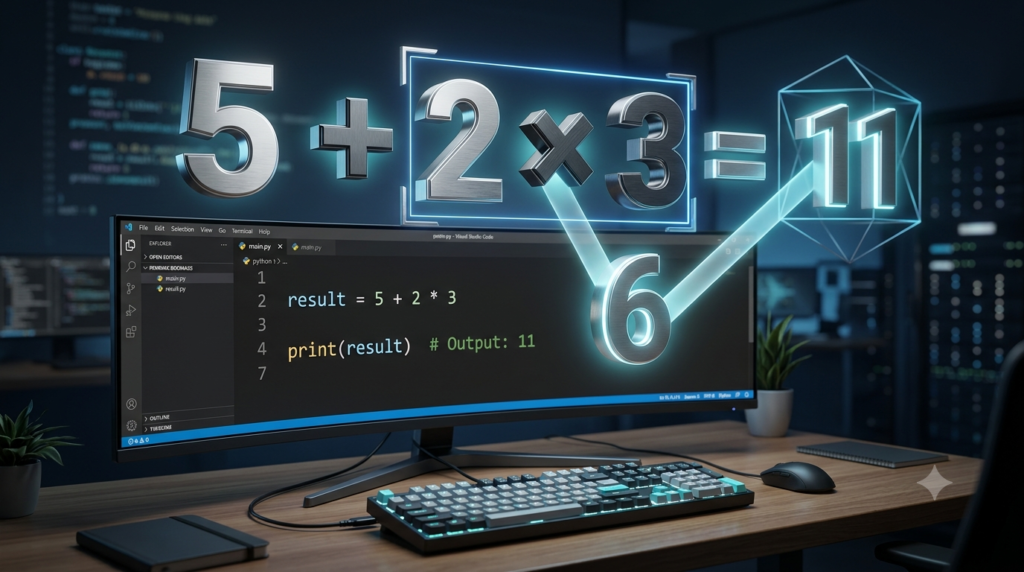
5 + 10 / 3Division generally takes precedence over addition, so the division is evaluated first.
In a language that performs integer division for 10 / 3, the calculation becomes:
5 + 3 = 8In Python, however, / produces a floating-point result:
5 + 3.3333333333333335The result is approximately 8.333333333333334.
The expression has the same mathematical symbols, but the language’s division rules change the final result.
Parentheses can make the intended order clearer:
5 + (10 / 3)However, parentheses do not automatically change the data type rules. If the division still uses integer operands and the language applies integer division, the fractional part may still be discarded.
Therefore, programmers must consider both operator precedence and operand types.
8. How Strings Can Produce Unexpected Results
Strings create another common source of confusion because text that looks like a number is not necessarily stored as a numeric value.
Consider the following Python expressions:
a = 10
Output:
30Now compare them with:
a = "10"
Output:
1020The first expression performs arithmetic addition. The second performs string concatenation, joining the text "10" and "20".
If a program receives numbers through a form, file, or API, the values may arrive as strings. Attempting to calculate with them without converting them appropriately can produce errors or unexpected behavior.
For example:
age = "25"
The output is 30.
The conversion makes it possible to perform numeric addition.
In other cases, a conversion may fail if the string does not contain a valid representation of the expected number. Programs should validate input before converting it.
9. Why Choosing the Correct Data Type Is Important
Selecting an appropriate data type helps a program produce reliable results and use computer memory efficiently.
Different applications have different requirements.
Scientific Calculations
Scientific calculations often involve fractions, measurements, and very large or very small values. Floating-point types are useful for many such calculations, but the required precision must be considered.
Some scientific applications require higher-precision arithmetic or specialized numerical methods.
Financial Calculations
Money calculations require particular care because binary floating-point values cannot represent every decimal fraction exactly.
For applications involving currency, decimal arithmetic or integer representations of the smallest currency unit may be more appropriate, depending on the requirements.
For example, storing 1250 paise as an integer can represent ₹12.50 exactly in a system designed around paise. A program must still handle currency rules, rounding, and conversions correctly.
Counting and Indexing
Integers are generally appropriate for counting items, loop indexes, and whole-number quantities.
However, programmers should consider the range of values the selected integer type can represent.
Text Processing
Strings are appropriate for names, addresses, identifiers, and other textual information. Even when a string contains only digits, it should remain a string if it represents text rather than a quantity.
For instance, a postal code such as "01234" should not necessarily be converted to an integer because doing so could remove the leading zero.
The correct data type depends on what the information means, not just how it looks.
10. Best Practices for Avoiding Data Type Errors
Programmers can reduce unexpected results by following a few practical guidelines.
Understand the Types of All Operands
Before evaluating an expression, identify whether each value is an integer, floating-point number, string, or another type.
This helps explain why an operation produces a particular result.
Convert Values Intentionally
Do not rely on automatic conversion when precision or correctness matters. Use explicit conversions where appropriate, and understand whether the conversion truncates, rounds, or can fail.
Avoid Unnecessary Floating-Point Comparisons
Because floating-point calculations may introduce small rounding differences, directly comparing two calculated floating-point values for exact equality can be unreliable.
Instead, many applications compare the absolute difference against an appropriate tolerance:
a = 0.1 + 0.2
This prints True because the difference is smaller than the selected tolerance. The tolerance should be chosen according to the scale and accuracy requirements of the application.
Check Numeric Ranges
Use a data type capable of representing the expected values. This is particularly important when processing large quantities or performing repeated calculations.
Test Boundary Cases
Test values such as zero, negative numbers, very large numbers, small fractions, and invalid input. These cases can reveal errors that ordinary examples do not expose.
Consult the Language Documentation
Arithmetic and conversion rules vary among languages. The official documentation is the most reliable place to verify how a particular operator behaves.
Conclusion
The same mathematical expression can produce different results in different data types because programming languages apply specific rules for representing values, performing arithmetic, converting types, and handling limited precision or range. Integer division may discard fractional information, floating-point arithmetic may introduce small rounding differences, strings may be joined instead of added, and fixed-width integers may overflow.
Understanding these differences is an essential part of learning computer science and writing reliable programs. By choosing suitable data types, checking conversion rules, understanding operator behavior, and testing important boundary cases, programmers can prevent many common calculation errors. The key lesson is that a programming expression is governed not only by mathematics but also by the data types and language rules used to evaluate it.
FAQs
1. Why can the same mathematical expression produce different results in different data types?
The same mathematical expression can produce different results because data types determine how values are stored and how operations are performed. For example, integer division may discard the fractional part, while floating-point division can preserve decimal values. Similarly, adding two strings may join their characters instead of performing numerical addition. Data types also influence precision, range, and rounding behavior. Programming languages define specific rules for these operations. Therefore, understanding the data types of the operands is essential for interpreting results correctly and writing programs that perform calculations as intended.
2. What is the difference between integer and floating-point arithmetic?
Integer arithmetic works with whole numbers, while floating-point arithmetic supports numbers with fractional parts. For example, dividing 10 by 3 using integer division in C produces 3 when both operands are integers. Floating-point division produces approximately 3.3333. Integer operations are useful for counting and indexing, whereas floating-point operations are suitable for measurements and many scientific calculations. However, floating-point numbers have limited precision because computers represent them using a finite binary format. Choosing the appropriate arithmetic type helps programmers obtain results that match the requirements of their applications.
3. Why does integer division remove the decimal part of a result?
Integer division removes the fractional part because certain programming languages define division between integer operands as an operation that produces an integer quotient. For example, in C, the expression 10 / 3 produces 3 because the fractional part is discarded. In Python, the same expression produces approximately 3.3333 because / performs true division. Python uses // for floor division, which rounds down toward negative infinity. These differences demonstrate why programmers must understand the division rules of their chosen language before using mathematical expressions in calculations.
4. Why does 0.1 + 0.2 sometimes produce 0.30000000000000004?
This result occurs because common binary floating-point formats cannot represent decimal fractions such as 0.1 and 0.2 exactly. Instead, the computer stores nearby representable binary values. When these approximations are added, the result may differ slightly from the expected decimal value. This behavior is a limitation of floating-point representation rather than a simple arithmetic mistake. For many applications, the difference is extremely small. However, scientific and financial software may require careful precision management, appropriate rounding, or decimal arithmetic to ensure that calculations meet their accuracy requirements.
5. How does type conversion affect mathematical calculations?
Type conversion changes a value from one data type to another, potentially affecting its precision or meaning. For example, in Python, converting 7.9 to an integer using int(7.9) produces 7 because the fractional part is truncated. Converting an integer such as 8 to a floating-point value produces 8.0, generally preserving its numerical value. However, converting very large integers to floating-point numbers can lose precision. Programmers should understand how conversions work and use them carefully, especially when calculations involve decimal values, large numbers, or data received from external sources.
6. Can programming languages produce different results for the same expression?
Yes, programming languages can produce different results because their arithmetic and type rules are not identical. For example, 10 / 3 produces approximately 3.3333 in Python, while C and Java perform integer division when both operands are integers, producing 3. JavaScript produces approximately 3.3333 because its ordinary numeric type supports floating-point arithmetic. Languages can also differ in overflow behavior, automatic conversions, and operator definitions. Therefore, programmers should never assume that an expression behaves identically across all languages. Understanding language-specific rules helps prevent unexpected results when translating algorithms or reviewing code.
7. What is integer overflow, and how can it change a result?
Integer overflow occurs when a calculation exceeds the range supported by an integer representation. For example, an unsigned 8-bit integer can represent values from 0 to 255. In systems using wrapping arithmetic, adding 1 to 255 produces 0 because the result wraps around the available range. However, overflow behavior depends on the language and data type. Some languages raise errors, while others define different rules. Overflow can affect counters, indexes, scientific calculations, and embedded systems. Selecting a suitable numeric type and checking possible value ranges helps programmers prevent overflow-related errors.
8. Why does adding numbers stored as strings produce a different result?
Numbers stored as strings represent text rather than numeric values. For example, adding the Python strings "10" and "20" produces "1020" because the + operator joins their characters. Adding the integers 10 and 20 produces 30 through arithmetic addition. This difference frequently appears when programs receive input from forms, files, or external services. To perform calculations, programmers must convert valid numeric strings into appropriate numeric types. They should also validate input before conversion because strings containing invalid numeric characters may cause conversion errors.
9. How can programmers prevent unexpected results caused by data types?
Programmers can prevent many unexpected results by checking operand types, choosing suitable numeric representations, and understanding the rules of their programming language. They should use integers for appropriate whole-number quantities, floating-point types for many fractional calculations, and decimal arithmetic when exact decimal behavior is required. Explicit conversions can make calculations clearer, while range checks help prevent overflow. Floating-point comparisons may require a tolerance instead of exact equality. Testing boundary values, negative numbers, and unusual inputs can reveal hidden problems. These practices improve the accuracy, reliability, and maintainability of software.
10. Why is understanding data types important in computer science?
Understanding data types is important because they influence how computers represent, process, and interpret information. The choice of data type can affect calculation results, precision, memory usage, permitted operations, and the range of representable values. For example, using a string instead of an integer may cause concatenation rather than addition, while using an unsuitable numeric type may introduce rounding errors or overflow. Knowledge of data types helps programmers design reliable algorithms, debug unexpected behavior, and select appropriate representations for scientific, financial, and everyday applications. It also provides a foundation for understanding programming languages and computer arithmetic.