Every computer program makes decisions. A website decides whether to allow a user to log in, a mobile application checks whether a button should be enabled, and an online shopping system determines whether an order qualifies for free delivery. Although these decisions may appear complicated, many of them depend on simple conditions that can be evaluated as either true or false. Boolean algebra provides a mathematical way to represent, combine, and simplify these conditions.
Boolean algebra is a fundamental concept in computer science that works with two logical values: true and false. Using operations such as AND, OR, and NOT, programmers can express decision-making rules in a structured form. By simplifying these rules, they can reduce unnecessary conditions, improve code readability, and make program logic easier to test and maintain.
In this article, we will learn how Boolean algebra works, how it simplifies decisions in computer programs, which laws are most useful, and how these principles appear in real-world computing applications.
What Is Boolean Algebra?
Boolean algebra is a branch of mathematics that deals with logical values and relationships. It was developed by mathematician George Boole and later became an essential part of digital electronics, programming, and computer science.
Unlike ordinary algebra, which commonly uses numerical values, Boolean algebra operates with two possible values:
True (1): A condition is satisfied.
False (0): A condition is not satisfied.
In programming, these values are usually represented by Boolean data types. For example, a variable named isLoggedIn might contain true when a user has successfully logged in and false otherwise.
Boolean algebra combines these values through logical operations. These operations help a program evaluate multiple conditions and decide what action to perform.
Consider a website that allows access to a private page only when a user is logged in. The program can check whether isLoggedIn is true. If the condition is satisfied, access is granted; otherwise, the user may be redirected to the login page.
This is a basic example of Boolean logic in action.
Why Do Computer Programs Need Boolean Logic?
Computer programs frequently need to choose between different actions. They must determine whether a condition has been met before continuing with a particular task.
For example, an online store might check whether a customer has enough money to complete a purchase. A school management system might determine whether a student has passed an examination. A security application might verify whether a password and a verification code are correct.
Each decision can be expressed using logical conditions.
Consider this example:
age = 20
The program evaluates the condition age >= 18. Because the value of age is 20, the condition evaluates to true, and the program displays the access message.
Now imagine a more complicated rule that requires a user to be at least 18 years old, have a valid account, and accept the terms of service. Boolean algebra provides a systematic way to combine these requirements and simplify the resulting logic.
Without logical operations, programmers would have difficulty expressing complex decision-making rules clearly and consistently.
The Three Basic Operations of Boolean Algebra
Boolean algebra uses three fundamental logical operations: AND, OR, and NOT. Understanding these operations is the first step toward understanding how logical expressions can be simplified.
1. AND Operation
The AND operation returns true only when every condition involved is true.
Its symbol is commonly written as ∧ in mathematical logic. In many programming languages, the operator is written as and or &&.
The Boolean expression is:
A AND B
The result is true only if both A and B are true.
| A | B | A AND B |
|---|---|---|
| True | True | True |
| True | False | False |
| False | True | False |
| False | False | False |
For example, a website might require a user to have a valid username and password before allowing login.
if username_valid and password_valid:
Both conditions must be true for the login to succeed.
2. OR Operation
The OR operation returns true when at least one of the conditions is true. It returns false only when all conditions are false.
Its mathematical symbol is ∨. Programming languages commonly use or or ||.
The expression is:
A OR B
For example, a website might allow a user to sign in using either an email address or a username.
if email_login or username_login:
If either condition is true, the combined expression evaluates to true. The actual authentication process must still verify the user’s credentials.
3. NOT Operation
The NOT operation reverses a Boolean value. If a condition is true, NOT makes it false. If a condition is false, NOT makes it true.
The mathematical symbol is ¬, while programming languages commonly use not or !.
For example:
is_blocked = False
Because is_blocked is false, not is_blocked evaluates to true.
The NOT operation is especially useful when a program needs to check that something is absent, disabled, incomplete, or not permitted.
How Boolean Algebra Simplifies Program Decisions
Boolean algebra simplifies decisions by reducing complex logical expressions to equivalent expressions that are easier to understand and evaluate.
The simplified expression must produce the same logical result as the original expression for every possible combination of inputs.
This is important because a shorter expression is not automatically correct. The purpose of simplification is to preserve the intended behavior while removing unnecessary logical complexity.
1. Removing Unnecessary Conditions
Consider the following expression:
A AND True
Because AND returns true when both inputs are true, combining A with true does not change the value of A.
Therefore:
A AND True = A
This is known as the identity law.
A programmer does not need to check an additional condition that is always true if that condition has no other purpose.
For example, imagine a program that evaluates whether a user is eligible for a service:
if account_valid and True:
The condition can be simplified to:
if account_valid:
The simplified version is easier to read and expresses the actual requirement more clearly.
2. Simplifying Conditions That Are Always False
Boolean algebra also identifies expressions that can never be true.
Consider:
A AND False
The result is always false, regardless of the value of A.
Therefore:
A AND False = False
For example, suppose a program checks whether an order is eligible for a benefit, but one of its mandatory conditions is permanently false. The combined condition can never succeed.
Recognizing this can help programmers identify unreachable branches, incorrect configuration, or unnecessary checks.
However, if a condition appears permanently false because of a programming mistake, the underlying problem should be corrected rather than simply hiding it through simplification.
3. Combining Repeated Conditions
One of the most useful Boolean algebra laws is the idempotent law.
It states that:
A AND A = A
Similarly:
A OR A = A
Checking the same logical condition twice does not change the result of the expression.
For example:
if is_verified and is_verified:
This can be simplified to:
if is_verified:
The same principle applies to OR expressions.
if has_permission or has_permission:
The repeated condition can be removed without changing the Boolean result.
In real programs, repeated checks may arise when several rules are combined or when code is modified over time. Identifying them helps reduce clutter and makes the program’s requirements easier to understand.
4. Using the Complement Law
The complement law describes a condition combined with its opposite.
For AND:
A AND NOT A = False
For OR:
A OR NOT A = True
A condition and its negation cannot both be true at the same time, assuming ordinary two-valued Boolean logic.
For example, if isOpen is a Boolean variable, the expression isOpen and not isOpen can never evaluate to true.
Similarly, isOpen or not isOpen always evaluates to true.
These laws are useful for identifying contradictory requirements and unnecessary logical expressions. They can also help programmers detect conditions that make a particular branch impossible to execute.
5. Applying the Absorption Law
The absorption law simplifies expressions in which one condition already covers another part of the expression.
Two important forms are:
A OR (A AND B) = A
A AND (A OR B) = A
Consider the first expression. If A is true, the entire OR expression is true regardless of B. If A is false, the expression inside the parentheses is also false. Therefore, the entire expression has the same result as A alone.
A practical example is:
if isMember or (isMember and hasCoupon):
The condition isMember already makes the expression true whenever membership exists. The additional requirement involving hasCoupon does not change the result.
The simplified code is:
if isMember:
This example demonstrates how Boolean algebra can remove unnecessary decision-making branches.
De Morgan’s Laws and Complex Conditions
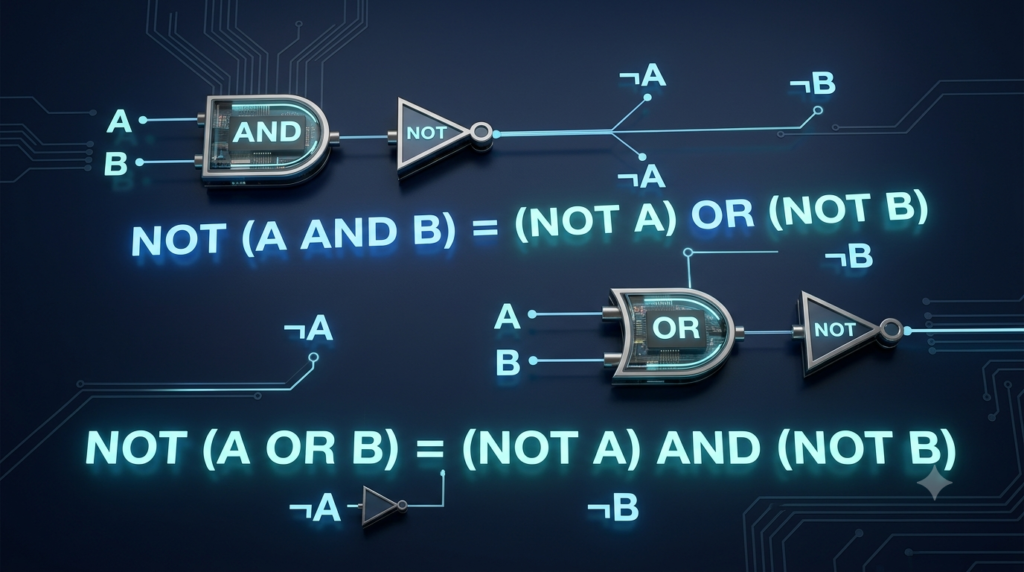
De Morgan’s laws are particularly useful when simplifying expressions involving NOT, AND, and OR.
The two laws are:
NOT (A AND B) = (NOT A) OR (NOT B)
NOT (A OR B) = (NOT A) AND (NOT B)
These laws explain how negation changes when it is applied to a combined expression.
Example of the First Law
Suppose a program needs to determine whether a user has failed at least one of two requirements.
The original expression is:
NOT (A AND B)
According to De Morgan’s first law, this is equivalent to:
NOT A OR NOT B
The program can therefore check whether either requirement is false.
Example of the Second Law
Imagine a system that allows a task to continue only when neither of two blocking conditions is present.
The expression is:
NOT (A OR B)
It can be rewritten as:
NOT A AND NOT B
This means both blocking conditions must be false.
In Python, the expressions might look like this:
if not (isBlocked or isSuspended):
An equivalent expression is:
if not isBlocked and not isSuspended:
Both expressions produce the same Boolean result when the variables contain ordinary Boolean values.
De Morgan’s laws are valuable when handling permissions, validation rules, security restrictions, and other situations in which a program must check several negative conditions.
The Distributive Law in Boolean Algebra
The distributive law allows programmers to rearrange logical expressions while preserving their meaning.
In Boolean algebra:
A AND (B OR C) = (A AND B) OR (A AND C)
Similarly:
A OR (B AND C) = (A OR B) AND (A OR C)
These rules are useful when a program combines alternative requirements with shared conditions.
Consider the expression:
isMember AND (hasCoupon OR hasGiftCard)
This means that a user must be a member and must also have either a coupon or a gift card.
Using the distributive law, it can be written as:
(isMember AND hasCoupon) OR (isMember AND hasGiftCard)
Both expressions represent the same logical rule.
The first form is often easier to understand because it clearly separates the shared membership requirement from the two payment-related alternatives. The second form may be useful when examining separate logical paths.
This illustrates an important principle: Boolean algebra offers different equivalent forms, and the clearest form depends on the purpose of the code.
Practical Example: Simplifying an Online Shopping Decision
Consider an online shopping website that provides free delivery to members who spend at least ₹1,000 or to non-members who spend at least ₹2,000.
Define the following Boolean variables:
M: The customer is a member.A: The order total is at least ₹1,000.B: The order total is at least ₹2,000.
The decision can be expressed as:
(M AND A) OR (NOT M AND B)
This expression represents two possible ways to qualify:
The customer is a member and spends at least ₹1,000.
The customer is not a member and spends at least ₹2,000.
A program could implement this rule as follows:
is_member = True
The customer qualifies because the membership condition and the minimum spending requirement are both satisfied.
For this example, the expression can also be written more clearly using a conditional statement:
if is_member:
The second version makes the two customer categories explicit. It may be easier to maintain if the rules later change.
Notice that the improvement is not necessarily a reduction in the number of characters. The goal is to express the decision in a form that is easy to understand, verify, and modify.
How Boolean Algebra Improves Code Quality
Boolean algebra offers several practical benefits beyond making individual expressions shorter.
Improved Readability
Complex conditions can be difficult to understand when they contain many repeated or nested operators. Simplifying them helps programmers recognize the essential requirements quickly.
Readable conditions are especially important when another developer must review or modify the program later.
Easier Debugging
A complicated expression may contain contradictory conditions, repeated checks, or unnecessary negations. Boolean algebra provides systematic rules for finding such problems.
For example, an expression containing A AND NOT A always evaluates to false. Recognizing this immediately can help explain why a particular branch never runs.
Easier Testing
A simplified expression is often easier to test because its logical structure is clearer.
Programmers can create test cases for true and false outcomes, examine boundary conditions, and verify that the expression behaves as intended.
For important business rules, simplification should always be followed by appropriate testing.
Easier Maintenance
Software requirements change over time. A website may introduce a new membership category, add a security requirement, or change its order eligibility rules.
Well-organized Boolean expressions are easier to update because the relationships between conditions are explicit.
Potential Performance Improvements
Removing unnecessary operations can sometimes reduce computation, especially when expressions are evaluated repeatedly or used in performance-sensitive code.
However, simplifying a Boolean expression does not automatically make an entire program noticeably faster. Modern compilers and interpreters can already optimize many simple expressions.
The greatest everyday benefit is often clearer, more reliable program logic rather than a dramatic increase in speed.
Boolean Algebra and Short-Circuit Evaluation
Boolean algebra describes the logical result of an expression. Programming languages also have evaluation rules that determine how and when its parts are evaluated.
One important concept is short-circuit evaluation.
In many programming languages, an AND expression stops evaluating as soon as one operand is false because the complete expression cannot become true. An OR expression may stop as soon as one operand is true because the complete expression is already true.
For example:
if denominator != 0 and numerator / denominator > 2:
In Python, if denominator != 0 is false, the second condition is not evaluated. This prevents division by zero in that expression.
Short-circuit evaluation can improve efficiency and help avoid certain errors. However, programmers must understand their language’s evaluation rules and should avoid relying on side effects inside complicated Boolean expressions.
Boolean simplification and short-circuit evaluation are related, but they are not identical. Simplification changes an expression into an equivalent logical form, while short-circuit evaluation determines which parts of an expression actually run.
Applications of Boolean Algebra in Computer Science
Boolean algebra is used throughout modern computing, including the following areas.
Digital Logic Circuits
Processors and electronic devices use logic gates to implement Boolean operations. AND, OR, and NOT gates form the foundation of more complex digital circuits.
Boolean algebra helps engineers simplify circuit designs, reduce unnecessary gates, and sometimes lower hardware costs and power consumption.
Database Queries
Database systems use logical conditions to select records that meet specific requirements.
For example, a query might return customers who live in a particular city and have placed an order. Conditions can be combined using AND, OR, and NOT to define the required results.
Simplifying these conditions can make queries easier to understand, although actual query performance also depends on indexes, data distribution, and the database query optimizer.
Artificial Intelligence
AI systems frequently use logical conditions in rule-based systems, decision trees, and other decision-making processes.
For example, a rule-based application might recommend a learning resource when a user has completed a prerequisite topic and has selected a related subject.
Boolean conditions help express such requirements clearly. However, modern AI systems also use probability, statistics, and other mathematical methods that go beyond basic Boolean logic.
Access Control and Security
Applications often need to verify permissions, account status, authentication requirements, and other security conditions.
Boolean algebra helps organize these rules and identify contradictory or redundant checks.
Because security decisions can have serious consequences, any simplification must preserve the intended access policy. Developers should also test important conditions carefully rather than relying only on algebraic reasoning.
Software Testing and Validation
Testing systems often use Boolean expressions to determine whether inputs are valid, whether requirements have been satisfied, and whether a particular program path should execute.
Simplified conditions can make it easier to identify the important combinations of inputs that need to be tested.
Limitations of Boolean Algebra
Although Boolean algebra is powerful, it does not solve every programming problem.
First, it primarily describes logical relationships. It does not automatically determine whether the conditions themselves accurately represent the real-world requirements.
Second, a shorter expression is not always easier to understand. In some cases, separating a complicated condition into named variables or multiple statements produces more maintainable code.
Third, programming languages may use different rules for evaluating expressions, handling missing values, or converting values into Boolean results. These differences must be considered when translating mathematical expressions into code.
Finally, Boolean algebra operates on logical values, while real programs often involve numbers, strings, objects, exceptions, and other data types. Programmers must ensure that the expressions they simplify have the intended meaning in their particular language.
The best approach is to use Boolean algebra as a foundation for reasoning about conditions, then combine it with good programming practices and appropriate testing.
Conclusion
Boolean algebra provides a mathematical foundation for the decisions made by computer programs. By using AND, OR, and NOT operations, programmers can represent conditions clearly and combine them into logical expressions. Laws such as the identity, complement, absorption, distributive, and De Morgan’s laws help remove unnecessary checks and transform complicated expressions into equivalent, more manageable forms.
These principles are useful in everyday programming, digital circuits, database queries, artificial intelligence, security systems, and software testing. Although simplification can improve readability and sometimes performance, the main objective is to preserve the intended behavior while making program logic easier to understand and maintain.
Learning Boolean algebra helps programmers think systematically about decisions. Once these logical relationships become familiar, even complicated conditions can be analyzed step by step and expressed in a clearer, more reliable form.
FAQs
1. What is Boolean algebra in computer programming?
Boolean algebra is a mathematical system that works with two logical values: true and false. It helps programmers represent conditions, combine multiple requirements, and control how a program makes decisions. The three basic operations are AND, OR, and NOT. For example, a login system can use Boolean logic to check whether a username and password are valid. Boolean algebra also provides rules for simplifying complicated logical expressions without changing their results. It is an important foundation of programming, digital electronics, database queries, and computer science because computers frequently need to evaluate conditions before performing particular actions.
2. How does Boolean algebra simplify program decisions?
Boolean algebra simplifies program decisions by removing repeated conditions, unnecessary operations, and redundant logical expressions. It uses mathematical laws to transform complicated expressions into simpler, equivalent forms. For example, the expression A AND True can be simplified to A because combining a condition with true does not change its result. Similarly, A OR A can be reduced to A. These simplifications help programmers write more readable code and identify logical errors. They can also make programs easier to test and maintain. However, programmers must ensure that every simplification preserves the original decision-making behavior.
3. What are the three basic operations of Boolean algebra?
The three basic operations of Boolean algebra are AND, OR, and NOT. AND returns true only when all its conditions are true. OR returns true when at least one condition is true. NOT reverses a Boolean value, changing true to false and false to true. For example, a website might use AND to verify a username and password, OR to accept either an email address or username as a login identifier, and NOT to check whether an account is not blocked. These operations form the foundation of logical expressions in programming and help developers create clear decision-making rules.
4. What is the difference between Boolean algebra and ordinary algebra?
Ordinary algebra generally works with numbers, variables, and mathematical operations such as addition, subtraction, multiplication, and division. Boolean algebra focuses on logical values, usually represented as true and false or 1 and 0. Its primary operations are AND, OR, and NOT. For example, ordinary algebra might simplify an expression such as 2x + 3x to 5x, whereas Boolean algebra simplifies A AND A to A. Although both systems use variables and mathematical rules, their operations and laws differ. Boolean algebra is especially useful for computer programming, digital circuit design, logical reasoning, and automated decision-making.
5. What are the most important laws of Boolean algebra?
Several Boolean algebra laws help simplify logical expressions. The identity law states that A AND True = A and A OR False = A. The idempotent law states that A AND A = A and A OR A = A. The complement law states that A AND NOT A = False. The absorption law simplifies expressions such as A OR (A AND B) to A. De Morgan’s laws explain how NOT changes expressions containing AND and OR. These laws help programmers remove redundant conditions, identify contradictions, and rewrite complex expressions into simpler forms while preserving their logical results.
6. What is a truth table in Boolean algebra?
A truth table is a table that displays the output of a logical expression for every possible combination of its Boolean inputs. It helps programmers understand and verify how a logical operation behaves. For example, an AND operation involving two variables produces true only when both inputs are true. The other three combinations produce false. Truth tables are particularly useful when simplifying complicated expressions because programmers can compare the original and simplified expressions. If both expressions produce identical outputs for every possible input combination, they are logically equivalent. Truth tables are also widely used in digital electronics, circuit design, and software testing.
7. How are De Morgan’s laws used in programming?
De Morgan’s laws help programmers rewrite logical expressions involving NOT, AND, and OR. The first law states that NOT (A AND B) is equivalent to NOT A OR NOT B. The second states that NOT (A OR B) is equivalent to NOT A AND NOT B. For example, a program checking whether an account is neither blocked nor suspended can use not (isBlocked or isSuspended). An equivalent expression is not isBlocked and not isSuspended. These transformations make certain conditions easier to understand, especially when dealing with validation rules, permissions, restrictions, and complex decision-making logic.
8. Does Boolean algebra make computer programs run faster?
Boolean algebra can sometimes improve program performance by removing unnecessary logical operations and reducing redundant calculations. However, simplification does not guarantee a noticeable speed improvement. Modern compilers and interpreters can automatically optimize many simple expressions. In some cases, a simplified condition mainly improves readability rather than execution speed. Performance also depends on the programming language, the surrounding code, the amount of data being processed, and the operations involved. Programmers should focus first on preserving correctness and making their code understandable. When speed matters, they should measure performance through appropriate testing instead of assuming that shorter expressions always execute faster.
9. Where is Boolean algebra used in real-world computer systems?
Boolean algebra is used in many areas of computer science and technology. Digital circuits rely on Boolean operations to process binary signals and implement logic gates. Websites use logical conditions to manage logins, permissions, and user interactions. Database queries combine conditions to retrieve specific records. Software testing uses Boolean expressions to validate inputs and verify program behavior. Artificial intelligence applications may use Boolean rules in decision trees and rule-based systems. Boolean algebra also helps engineers simplify digital circuit designs. These applications demonstrate how two-valued logic supports decisions at both the software and hardware levels of modern computing systems.
10. Why should beginners learn Boolean algebra?
Beginners should learn Boolean algebra because it develops logical thinking and provides a foundation for understanding how computer programs make decisions. It helps learners write conditions, combine requirements, identify logical mistakes, and simplify complicated expressions. These skills are useful when learning programming languages such as Python, Java, C++, and JavaScript. Boolean algebra also introduces concepts used in digital electronics, algorithms, databases, and computer architecture. Understanding its basic laws makes it easier to analyze why a condition evaluates to true or false. By practicing simple expressions and truth tables, beginners can gradually develop the skills needed to solve more complex programming problems.