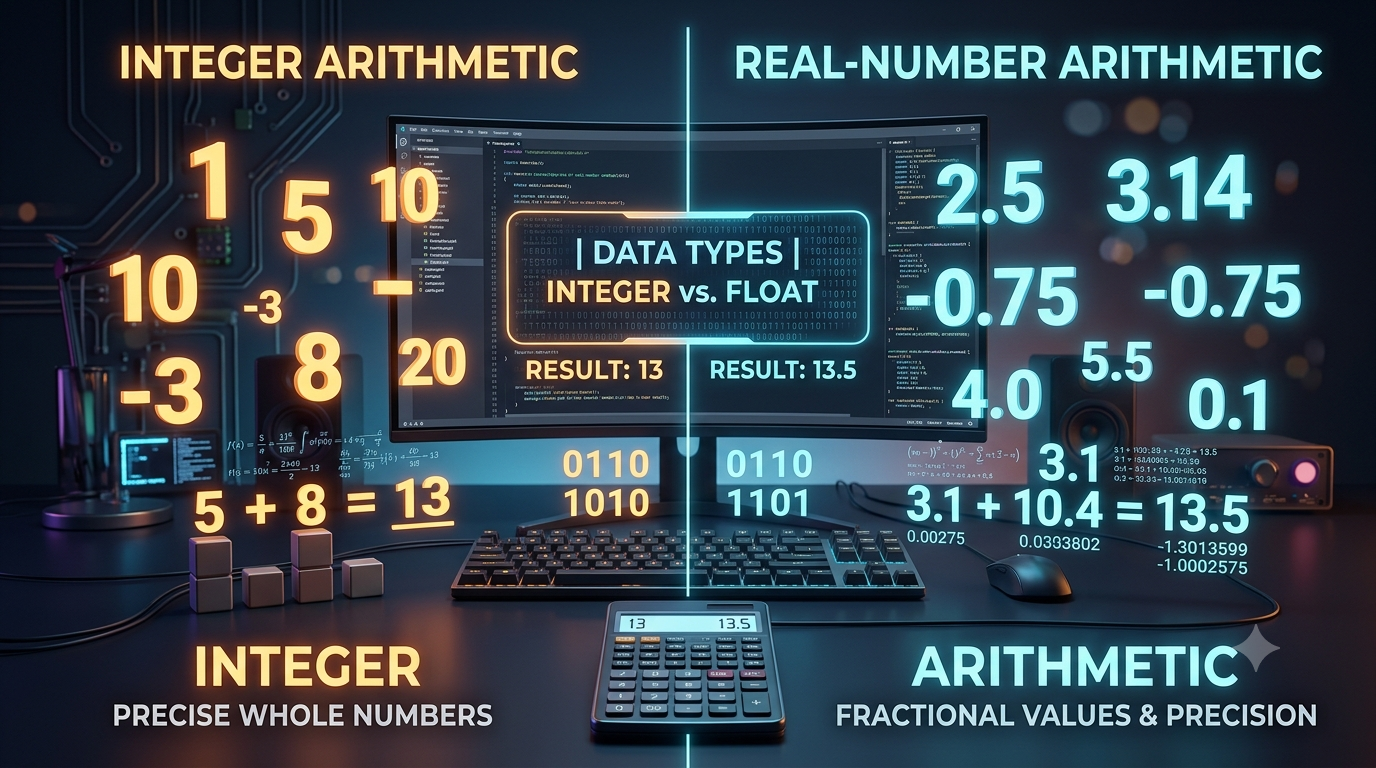
Arithmetic is one of the fundamental parts of computing. Computers perform calculations in programming, data processing, scientific simulations, financial applications, graphics, and many other areas. However, computers do not represent every number in exactly the same way. Two important types of arithmetic used in computing are integer arithmetic and real-number arithmetic. Although both involve mathematical operations such as addition, subtraction, multiplication, and division, they differ in how numbers are represented, how calculations are performed, and how results are interpreted.
Integer arithmetic works with whole numbers, including positive numbers, negative numbers, and zero. Real-number arithmetic is commonly approximated in computers using floating-point numbers, which can represent fractional values and a much wider range of magnitudes. These differences affect precision, overflow, division, comparison, and program behavior. Understanding integer and real-number arithmetic helps programmers choose appropriate data types, avoid calculation errors, and develop reliable software.
What Is Integer Arithmetic in Computing?
Integer arithmetic refers to mathematical operations performed on integers. Integers are numbers without fractional or decimal parts, such as −10, −3, 0, 4, 15, and 250.
In programming, integers are usually stored using a fixed number of binary bits. Common integer data types include 8-bit, 16-bit, 32-bit, and 64-bit integers. The available range depends on the number of bits and whether the type is signed or unsigned.
For example, a signed 32-bit integer commonly represents values from −2,147,483,648 to 2,147,483,647. An unsigned 32-bit integer represents values from 0 to 4,294,967,295.
Integer arithmetic supports operations such as:
Addition: 8 + 5 = 13
Subtraction: 12 − 7 = 5
Multiplication: 6 × 4 = 24
Division: 17 ÷ 5 may produce an integer quotient of 3, depending on the programming language and operand types.
The important point is that integer arithmetic does not preserve fractional parts when the result is stored or calculated using integer division. The exact behavior of division and certain other operations depends on the programming language.
Integers are useful when counting objects, recording quantities that must be whole numbers, representing array positions, tracking loop iterations, and performing operations involving discrete values.
What Is Real-Number Arithmetic in Computing?
Real-number arithmetic refers to calculations involving real values, including integers, fractions, terminating decimals, and non-terminating decimals. Examples include 2.5, −7.25, 0.125, and approximately 3.14159.
Mathematical real numbers include infinitely precise values. However, ordinary computers cannot store every real number exactly using a finite number of bits. Instead, they commonly use floating-point representations to approximate real values.
Programming languages provide data types such as float and double for floating-point calculations. A typical 32-bit floating-point value provides about 6–9 significant decimal digits of precision, while a typical 64-bit floating-point value provides about 15–17 significant decimal digits. These are approximate decimal precision figures, not guarantees that every number with that many digits will be represented exactly.
For example, a computer may represent 0.1 internally as a nearby binary floating-point value rather than exactly 0.1.
Real-number arithmetic is commonly used in scientific calculations, engineering simulations, measurements, computer graphics, statistical analysis, and applications that require fractional values.
Key Differences Between Integer Arithmetic and Real-Number Arithmetic
Although both forms of arithmetic use familiar mathematical operators, their behavior can differ significantly.
1. Types of Numbers Supported
Integer arithmetic operates on whole numbers without fractional parts. For example, 10, −6, and 0 are integers.
Real-number arithmetic can represent fractional values, such as 10.75, −6.25, and 0.5, using an appropriate floating-point or other numerical representation.
Consider a program that calculates the average of five measurements. If the total is 17, integer division by 5 may return 3, while floating-point division can return 3.4.
Therefore, integer arithmetic is suitable for discrete quantities, whereas real-number arithmetic is useful when fractional results matter.
2. Number Representation
Integers are generally represented using binary digits with a fixed width. Each bit contributes to the representation of a whole-number value.
Floating-point numbers use a different structure. A typical binary floating-point representation contains three main components:
Sign: Indicates whether the value is positive or negative.
Exponent: Determines the scale or magnitude of the value.
Significand: Stores the significant binary digits of the number.
This structure allows floating-point formats to represent both very small and very large values. However, because the significand has limited precision, not every value within the range can be represented exactly.
For example, a 64-bit floating-point number can represent a much wider range of magnitudes than many integer types, but it cannot distinguish every pair of consecutive integers once the values become sufficiently large.
3. Precision and Accuracy
Integer arithmetic can produce exact results when the mathematical result is representable within the integer type and no overflow or other language-specific issue occurs.
For example:
12 + 8 = 20
The result is exactly representable as an ordinary integer.
Floating-point arithmetic introduces rounding because many real values cannot be represented exactly in binary. For example, the decimal value 0.1 has a repeating binary representation. A floating-point variable therefore usually stores a nearby representable value.
A calculation such as 0.1 + 0.2 may produce a result displayed as 0.30000000000000004 in some programming environments.
This does not mean that the computer has stopped following mathematical rules. It means that the calculation is performed using finite-precision representations.
Programmers should consider the required precision when selecting a numerical type, particularly in scientific applications and systems that process sensitive measurements.
4. Division and Fractional Results
Division is one of the clearest differences between integer arithmetic and real-number arithmetic.
Consider the expression:
17 ÷ 5 = 3.4
In integer division, the fractional portion is discarded or otherwise handled according to the language’s rules. In many commonly used languages, integer division of positive operands produces 3.
In floating-point division, the result can be approximately 3.4.
For example, in a C-like programming language:
int a = 17;
The result of the first calculation is an integer, while the second preserves the fractional value.
The behavior can vary with the programming language and operand types. Some languages use different division operators for integer and floating-point calculations. Programmers should understand the rules of the language they are using.
5. Overflow and Numerical Limits
Integer types have defined limits. If a calculation exceeds the range of the selected type, the result depends on the language and implementation.
For example, adding 1 to the maximum value of a signed 32-bit integer exceeds its representable range. In some languages, such as Java, integer overflow wraps around according to defined fixed-width behavior. In C and C++, signed integer overflow is undefined behavior. Other languages may raise an exception or handle the operation differently.
Therefore, programmers must not assume that integer overflow always produces the same result.
Floating-point values also have limits. If a calculation produces a magnitude beyond the representable range, it may result in positive or negative infinity. Very small values may underflow toward zero or become subnormal values, depending on the operation and floating-point format.
The important difference is that integer overflow concerns exceeding a discrete integer range, whereas floating-point arithmetic can also lose precision when values are rounded to fit the available representation.
6. Rounding Behavior
Integer arithmetic generally does not retain fractional parts in integer results. The way division handles negative values, however, depends on the language.
For example, in languages where integer division truncates toward zero:
17 / 5 produces 3.
−17 / 5 produces −3.
Floating-point arithmetic instead rounds results to representable values according to the applicable floating-point rules. The standard IEEE 754 floating-point system commonly uses round-to-nearest, ties-to-even as its default rounding mode.
Repeated floating-point calculations can accumulate small rounding differences. These differences may become significant in long numerical computations or when two nearly equal values are compared.
When converting floating-point numbers to integers, programmers should also check whether the conversion truncates, rounds, or follows another language-specific rule.
7. Performance and Memory Usage
Integer operations are often efficient on modern processors, particularly when working with values that fit naturally into the processor’s supported integer types.
Floating-point operations are also highly optimized on modern hardware. Their performance depends on the processor, programming language, operation, data type, and workload. Consequently, it is not correct to assume that integer arithmetic is always faster than floating-point arithmetic.
Memory usage depends on the selected data type. A 32-bit integer and a 32-bit floating-point number each commonly occupy 4 bytes. A 64-bit integer and a 64-bit floating-point number commonly occupy 8 bytes.
Thus, integer and floating-point variables of the same width may use the same amount of storage while representing numbers differently.
8. Equality and Comparison
Integer values can generally be compared directly when they are represented exactly and the operations leading to them have behaved correctly.
For example:
int a = 10;
Floating-point comparisons require more care. Two calculations that are mathematically expected to produce the same value may differ slightly because of rounding.
For example, one calculation might produce a value represented as 0.3, while another produces a nearby floating-point value.
In numerical applications, programmers sometimes compare the absolute difference between two values against a suitable tolerance:
a = 0.1 + 0.2
The tolerance must be selected according to the scale of the values and the accuracy required. A single fixed tolerance is not appropriate for every numerical problem.
Integer Arithmetic vs Real-Number Arithmetic
The following table summarizes the main differences.
| Feature | Integer Arithmetic | Real-Number Arithmetic |
|---|---|---|
| Common data types | int, long | float, double |
| Typical values | −8, 0, 25 | −8.5, 0.25, 25.75 |
| Fractional values | Not preserved in ordinary integer results | Supported approximately by floating-point types |
| Representation | Binary integer representation | Usually sign, exponent, and significand |
| Exactness | Exact for representable integer operations without overflow | Many decimal fractions require approximation |
| Division | May discard the fractional part | Can produce fractional results |
| Range | Limited by integer width | Often supports a wider range of magnitudes |
| Main numerical risk | Overflow and loss of fractional information | Rounding, precision loss, overflow, and underflow |
| Common applications | Counting, indexing, discrete quantities | Measurements, simulations, graphics, numerical analysis |
Practical Examples of Integer and Real-Number Arithmetic
Understanding these differences becomes easier when they are applied to everyday computing tasks.
Example 1: Calculating an Average
Suppose a student receives scores of 70, 80, and 85. The total is 235.
The average is:
235 ÷ 3 = 78.3333…
If the calculation uses integer division, the result may be 78. If the program needs the fractional portion, it should perform floating-point division or use an appropriate exact numerical method.
total = 235
In Python, / performs true division, while // performs floor division. For these positive values, the floor-division result is 78. For negative values, Python’s floor division rounds toward negative infinity, which differs from truncation toward zero.
Example 2: Counting Items in a Store
A store has 25 boxes, and each box contains 12 products.
The total number of products is:
25 × 12 = 300
Integer arithmetic is appropriate because the products are counted as whole items. Using floating-point values would not provide a useful advantage for this calculation.
However, if the store calculates the average weight of the products, fractional values may be necessary.
Example 3: Calculating a Scientific Measurement
Suppose a sensor records a distance of 12.75 metres and a time of 2.5 seconds.
The average speed is calculated as:
Speed = Distance ÷ Time
Speed = 12.75 ÷ 2.5 = 5.1 metres per second
Floating-point arithmetic is suitable for this calculation because both measurements and the resulting speed can contain fractional values.
If the program used integer division, it could lose important information and return an incorrect value for the intended application.
Example 4: Working With Money
Financial applications require special attention because rounding differences can affect totals, balances, and transactions.
For many monetary calculations, storing amounts as integer minor units, such as paise, can avoid binary floating-point representation errors. For example, ₹25.50 can be stored as 2,550 paise.
However, calculations involving interest rates, taxes, currency conversion, and fractional minor units still require carefully defined rounding rules. Decimal arithmetic may be more appropriate when exact decimal representation is required.
The correct approach depends on the currency, application requirements, and applicable financial rules.
When Should Programmers Use Integer Arithmetic?
Integer arithmetic is generally suitable when values represent discrete quantities and fractional results are unnecessary.
Common examples include:
Counting people, products, or objects.
Managing array indexes and positions.
Tracking loop iterations.
Representing whole-number identifiers.
Performing bitwise operations and binary manipulation.
Recording quantities that must remain whole numbers.
Programmers should choose an integer type with a sufficient range and check for possible overflow. They should also avoid using ordinary integer division when the fractional result is important.
When Should Programmers Use Real-Number Arithmetic?
Floating-point arithmetic is useful when calculations involve fractions, measurements, or a broad range of numerical magnitudes.
Common applications include:
Scientific and engineering simulations.
Computer graphics and animation.
Physical measurements and sensor readings.
Statistical calculations and numerical modelling.
Machine learning and data analysis.
Calculating approximate distances, velocities, and angles.
However, floating-point arithmetic is not suitable for every problem involving decimals. Financial calculations may require decimal arithmetic, while some scientific applications need higher precision or specialized numerical methods.
Programmers should understand the limitations of the selected representation and choose a suitable approach for the task.
Common Mistakes to Avoid
Several mistakes can cause unexpected results when working with numerical data.
Using integer division accidentally: Dividing two integers may discard fractional information in languages where integer division is selected by the operand types.
Assuming decimals are always exact: Many decimal fractions cannot be represented exactly in binary floating-point formats.
Ignoring integer overflow: A calculation may exceed the range of the selected integer type.
Comparing floating-point values without considering precision: Small rounding differences may cause direct equality checks to fail.
Choosing a data type only for speed: The data type must first satisfy the application’s accuracy, range, and correctness requirements.
Using floating-point values for every decimal calculation: Financial and other precision-sensitive applications may benefit from decimal or scaled-integer representations.
Avoiding these mistakes improves the reliability of calculations and reduces unexpected program behavior.
Conclusion
Integer arithmetic and real-number arithmetic are both essential to computing, but they serve different purposes. Integer arithmetic is designed for whole-number values and is useful for counting, indexing, and discrete calculations. Real-number arithmetic is commonly implemented through floating-point representations, allowing computers to work with fractional values and a broad range of magnitudes.
The main differences involve numerical representation, precision, division, rounding, overflow, and comparison. Integer calculations can be exact when values remain within the supported range, while floating-point calculations may introduce small rounding errors. Neither approach is universally better than the other.
Programmers should select a numerical representation according to the requirements of the task. By understanding how integer and real-number arithmetic behave, they can write more accurate, efficient, and dependable programs.
FAQs
1. What is the main difference between integer arithmetic and real-number arithmetic?
Integer arithmetic performs calculations using whole numbers, including positive numbers, negative numbers, and zero. Real-number arithmetic handles values that may contain fractional parts, such as 2.5, 3.75, and −0.25. In computing, integers are generally stored as binary integer values, while real-number calculations commonly use floating-point representations. Integer operations can produce exact results when values remain within their supported range. Floating-point calculations may introduce small rounding errors because computers cannot represent every real number exactly. The appropriate arithmetic type depends on the calculation, required precision, and range of values.
2. Why does integer division produce different results from floating-point division?
Integer division and floating-point division handle fractional results differently. In many programming languages, dividing two integers produces an integer quotient, discarding the fractional portion through truncation or following the language’s specific division rules. For example, 17 divided by 5 produces 3 under truncating integer division. Floating-point division preserves the fractional result, producing approximately 3.4. This distinction matters when calculating averages, percentages, measurements, and ratios. Programmers should check the operand types and division rules of their programming language to avoid accidentally losing important fractional information during calculations.
3. Why can floating-point arithmetic produce unexpected decimal results?
Floating-point arithmetic can produce unexpected decimal results because many decimal fractions cannot be represented exactly using a finite number of binary digits. For example, the decimal number 0.1 has a repeating binary representation. A computer stores a nearby representable value instead of the exact decimal value. When calculations combine these approximations, small differences may appear in the result. For instance, adding 0.1 and 0.2 may produce 0.30000000000000004 in some programming environments. These differences are normal consequences of finite precision. Programmers can manage them by understanding floating-point limitations and using suitable comparison methods.
4. Which arithmetic is more accurate, integer arithmetic or real-number arithmetic?
Neither type is universally more accurate because accuracy depends on the calculation and the number representation. Integer arithmetic can produce exact whole-number results when the result fits within the supported range and no overflow occurs. Floating-point arithmetic supports fractional values and large numerical ranges, but rounding may introduce small errors. For example, adding two integers can produce an exact result, whereas adding certain decimal fractions may produce an approximation. However, integers cannot preserve fractional information when integer division is used. Programmers should select the representation that matches the required precision, numerical range, and purpose of the calculation.
5. What is integer overflow in computing?
Integer overflow occurs when an arithmetic operation produces a value outside the range supported by the selected integer type. For example, a signed 32-bit integer commonly has a maximum value of 2,147,483,647. Adding 1 exceeds this limit. The resulting behavior depends on the programming language: some languages define wraparound behavior, while others may treat signed overflow as an error or undefined behavior. Overflow can cause incorrect calculations, unexpected conditions, or software vulnerabilities. Programmers can reduce these risks by selecting suitable integer types, checking operation limits, and using overflow-detection techniques where necessary.
6. Can floating-point numbers represent all real numbers exactly?
No, floating-point numbers cannot represent all real numbers exactly. Computers have finite storage, while real numbers include infinitely many values with arbitrarily long decimal or binary expansions. Standard floating-point formats store numbers using a sign, exponent, and significand, providing a limited number of significant binary digits. Some values, such as 0.5, can be represented exactly in binary floating-point, while values such as 0.1 usually cannot. Consequently, calculations may require rounding. Programmers should consider this limitation when developing scientific software, simulations, and applications that require precise numerical results.
7. When should programmers use integer arithmetic?
Programmers should use integer arithmetic when calculations involve whole-number quantities or operations that require discrete values. Common examples include counting products, tracking people, managing array indexes, controlling loop iterations, and processing binary data. Integer arithmetic is particularly useful when fractional values have no meaningful role in the calculation. For example, a program counting 25 books should normally use an integer rather than a floating-point number. However, programmers must select an appropriate integer size to prevent overflow. They should also avoid integer division when a calculation requires a fractional result, such as an average or percentage.
8. When should programmers use floating-point arithmetic?
Floating-point arithmetic is useful when calculations involve fractional values, measurements, or a wide range of numerical magnitudes. Common applications include physics simulations, engineering calculations, computer graphics, machine learning, statistics, and sensor measurements. For example, calculating the speed of an object may require dividing a fractional distance by a fractional time. Floating-point arithmetic can efficiently handle such calculations, although results may contain small rounding errors. Programmers should choose an appropriate precision, such as single or double precision, according to the application’s needs. Financial applications may require decimal arithmetic or scaled integers instead when exact decimal handling is important.
9. How can programmers compare floating-point numbers safely?
Programmers should avoid assuming that two floating-point values will always be exactly equal after mathematically equivalent calculations. Rounding can produce slightly different representations of values that should be approximately equal. A common approach is to compare the absolute difference between the values against a suitable tolerance. For example, a program may consider two results approximately equal when their difference is smaller than 0.000001. However, the correct tolerance depends on the magnitude of the values and the application’s precision requirements. More demanding numerical applications may need both absolute and relative tolerances or other specialized comparison techniques.
10. Is integer arithmetic faster than floating-point arithmetic?
Integer arithmetic can be efficient for counting, indexing, and discrete calculations, but it is not always faster than floating-point arithmetic. Modern processors often include specialized hardware that performs floating-point operations efficiently. Actual performance depends on the processor, programming language, data types, operation, and workload. Memory usage also depends on the chosen type: a 32-bit integer and a 32-bit floating-point number commonly occupy four bytes each. Therefore, programmers should not select a numerical type based only on assumptions about speed. Correctness, numerical range, precision, and the requirements of the application should guide the decision.