Computers use binary numbers to store, process, and communicate information. Unlike the decimal system, which uses ten digits from 0 to 9, the binary system uses only two digits: 0 and 1. Each binary digit is called a bit, the smallest basic unit of digital information.
One interesting property of binary numbers is that adding just one extra bit doubles the number of possible combinations. For example, one bit can represent two different patterns, two bits can represent four patterns, and three bits can represent eight patterns. This pattern continues as the number of bits increases.
But why does this happen? The reason is that every additional bit introduces two possible choices, 0 or 1, for each combination that already exists. Understanding this simple principle helps explain how computers represent numbers, characters, images, instructions, and many other types of digital information.
1. What Is a Bit in Binary Computing?
A bit is short for binary digit. It is a basic unit of information in digital systems and can have one of two possible values: 0 or 1.
In electronic computers, these values can be represented by different physical states. For example, a digital circuit may interpret a low voltage as 0 and a high voltage as 1, according to its particular design and logic levels.
A bit does not have to represent a number in every situation. Depending on the application, it can represent a true-or-false condition, an enabled-or-disabled state, or one of two possible choices.
Consider a simple switch. If the switch is OFF, we can represent its state as 0. If it is ON, we can represent its state as 1.
There are only two possible states for this switch. Therefore, one bit is enough to represent its state.
When we use multiple bits together, the number of possible patterns increases. The important point is that each bit can independently take either of the two values, 0 or 1.
2. How Many Combinations Can One Bit Represent?
A single bit has two possible values:
0
1
Therefore, one bit can produce exactly two possible binary combinations.
Number of combinations = 2
We can write these possibilities as:
| Bit | Possible value |
|---|---|
| 1 bit | 0 |
| 1 bit | 1 |
There are no other possibilities because a binary digit cannot be 2, 3, or any other decimal digit.
Now imagine that we add another bit. The first bit can still be 0 or 1, but the second bit also has two possible values. This creates additional combinations.
To understand this process clearly, let us examine how the number of combinations changes as we add more bits.
3. Why Do Two Bits Produce Four Combinations?
When we have two bits, each bit can independently be either 0 or 1.
The first bit has two possibilities, and the second bit also has two possibilities. We can combine every possible value of the first bit with every possible value of the second bit.
The resulting combinations are:
| First bit | Second bit | Binary combination |
|---|---|---|
| 0 | 0 | 00 |
| 0 | 1 | 01 |
| 1 | 0 | 10 |
| 1 | 1 | 11 |
There are four different combinations: 00, 01, 10, and 11.
We can calculate the total number by multiplying the possibilities for each bit:
Total combinations = 2 × 2 = 4
Notice that adding the second bit has doubled the number of combinations from two to four.
The original combinations, 0 and 1, have each gained two possible extensions:
0 becomes 00 or 01.
1 becomes 10 or 11.
Every original combination produces two new patterns because the added bit can be either 0 or 1.
This is the fundamental reason behind the doubling effect.
4. Why Do Three Bits Produce Eight Combinations?
Now let us add a third bit to the two-bit system.
Before adding this bit, we have four combinations:
00, 01, 10, and 11.
The third bit can be either 0 or 1. Therefore, each of the four existing combinations can produce two new combinations.
The complete set of three-bit combinations is:
| First bit | Second bit | Third bit | Combination |
|---|---|---|---|
| 0 | 0 | 0 | 000 |
| 0 | 0 | 1 | 001 |
| 0 | 1 | 0 | 010 |
| 0 | 1 | 1 | 011 |
| 1 | 0 | 0 | 100 |
| 1 | 0 | 1 | 101 |
| 1 | 1 | 0 | 110 |
| 1 | 1 | 1 | 111 |
There are eight possible combinations.
The calculation is:
Total combinations = 2 × 2 × 2 = 8
Alternatively, we can multiply the four combinations available with two bits by two:
4 × 2 = 8
Once again, adding one bit doubles the number of possible patterns.
The same principle applies whether we move from one bit to two bits, two bits to three bits, or three bits to four bits.
5. The Mathematical Reason Behind the Doubling Effect
The doubling effect can be explained using the multiplication principle of counting.
Suppose a system contains (n) bits. Every bit has two possible values, 0 and 1. Because the bits can independently take either value, the total number of possible combinations is:
Number of combinations = 2ⁿ
Here, (n) represents the number of bits.
The exponent indicates how many times the number 2 is multiplied by itself.
For example:
One bit: (2^1 = 2)
Two bits: (2^2 = 4)
Three bits: (2^3 = 8)
Four bits: (2^4 = 16)
Five bits: (2^5 = 32)
This formula works because each bit contributes a factor of two to the total number of combinations.
Now suppose we increase the number of bits from (n) to (n+1).
The original number of combinations is:
(2^n)
After adding one bit, the new number becomes:
(2^{n+1})
Using the exponent rule:
(2^{n+1} = 2^n \times 2)
Therefore, the new number of combinations is exactly twice the original number.
This mathematical relationship proves that adding one bit doubles the total number of possible binary combinations.
The effect is not caused by the new bit having a greater value. It happens because every existing pattern can be extended in two different ways.
6. A Table Showing How Combinations Grow
The following table demonstrates how the number of possible combinations increases as more bits are added.
| Number of bits | Calculation | Total combinations |
|---|---|---|
| 0 | (2^0) | 1 |
| 1 | (2^1) | 2 |
| 2 | (2^2) | 4 |
| 3 | (2^3) | 8 |
| 4 | (2^4) | 16 |
| 5 | (2^5) | 32 |
| 6 | (2^6) | 64 |
| 7 | (2^7) | 128 |
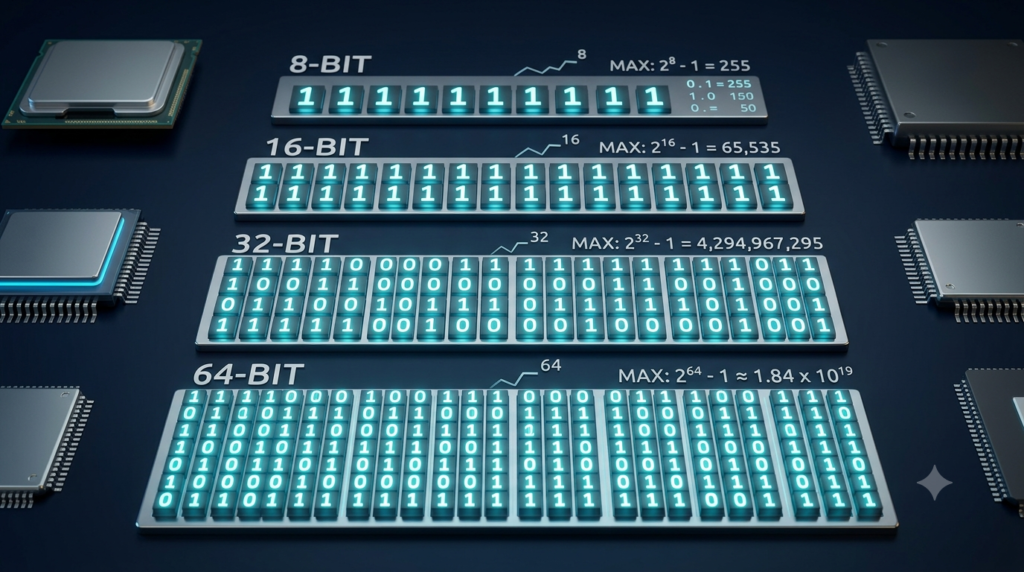
| 8 | (2^8) | 256 |
| 10 | (2^{10}) | 1,024 |
| 16 | (2^{16}) | 65,536 |
| 20 | (2^{20}) | 1,048,576 |
| 32 | (2^{32}) | 4,294,967,296 |
| 64 | (2^{64}) | 18,446,744,073,709,551,616 |
The table shows that the number of combinations grows very quickly.
For example, a 10-bit pattern can represent 1,024 different combinations, while a 20-bit pattern can represent 1,048,576 combinations.
A 32-bit pattern can represent more than four billion combinations. A 64-bit pattern can represent more than 18 quintillion combinations.
This rapid increase is an example of exponential growth.
Each additional bit doubles the number of patterns, even though the length of the binary sequence increases by only one digit.
7. Understanding the Doubling Effect With a Simple Example
Imagine that you are designing a digital system to store information about a collection of objects. Each bit can represent one of two possible states.
For example, suppose one bit indicates whether a light is OFF or ON.
With one light, there are two possible states:
OFF
ON
Now imagine that the system controls two independent lights.
Each light can be OFF or ON, giving four possible combinations:
OFF, OFF
OFF, ON
ON, OFF
ON, ON
If we add a third independent light, each of the four existing combinations can occur with the third light either OFF or ON.
This produces eight combinations.
The same reasoning applies to digital switches, binary flags, and many other systems that use independent two-state variables.
Every new independent two-state element doubles the total number of possible arrangements.
However, the doubling principle assumes that every combination is allowed. If a system imposes restrictions on the permitted states, the number of valid combinations may be smaller.
8. Does Adding One Bit Always Double the Number of Representable Values?
In a standard binary representation, adding one bit doubles the number of distinct bit patterns. Whether it also doubles the number of valid values depends on how those patterns are used.
For an unsigned binary integer with (n) bits, the possible numerical values range from 0 to (2^n-1). Therefore, the number of distinct values is (2^n).
For example, an 8-bit unsigned integer can represent values from 0 to 255, giving 256 possible values.
A 9-bit unsigned integer can represent values from 0 to 511, giving 512 possible values.
The total number of representable values has doubled.
Signed integers require additional explanation because some bit patterns are used to represent negative numbers. In the commonly used two’s complement representation, an (n)-bit signed integer has a range from (-2^{n-1}) to (2^{n-1}-1), which still contains (2^n) distinct integer values.
For example, an 8-bit two’s complement integer ranges from -128 to 127, giving 256 possible values.
Therefore, adding one bit to a conventional fixed-width integer representation doubles the number of representable integer values, although the numerical range depends on the representation.
The same principle applies to many other data types, but special formats, reserved patterns, and system restrictions can affect which values are actually permitted.
9. Why Is This Principle Important in Computer Science?
The doubling property of binary combinations is important because computers use bits to represent and process digital information.
9.1 Data Representation
Computers represent numbers, characters, instructions, and many other forms of information using binary patterns.
As more bits become available, more distinct patterns can be represented. This allows systems to store larger numbers, more identifiers, and more possible states.
For example, an 8-bit field provides 256 possible patterns, while a 16-bit field provides 65,536.
9.2 Memory and Storage
Computer memory is organized using binary information. Adding more bits to a data field can increase the number of distinct states that the field can represent.
However, adding a bit to an individual field is not the same as adding a bit of physical memory. Memory capacity depends on the total number of bits or bytes available and how they are organized.
9.3 Digital Communication
Communication systems use binary sequences to transmit information. The number of different patterns available in a fixed-length sequence determines how many distinct messages or symbols can be represented by that sequence.
For example, a sequence of 8 bits has 256 possible patterns. A sequence of 9 bits has 512.
In a communication system, extra bits may also be used for error detection, error correction, synchronization, or other purposes. Those bits can introduce overhead rather than increasing the number of available data messages.
9.4 Digital Images and Audio
Digital images and audio recordings use binary data to represent visual and sound information.
Depending on the format, additional bits allocated to a pixel or audio sample can allow more possible intensity, colour, or amplitude values.
For example, an 8-bit component can represent 256 different numerical levels, while a 10-bit component can represent 1,024 levels.
This does not mean that every additional bit doubles the quality of an entire image or recording. Actual quality also depends on resolution, sampling, compression, display or playback equipment, and other factors.
Nevertheless, the underlying reason for the increase in possible numerical levels remains the same: every additional bit doubles the number of available binary patterns.
10. Common Misunderstandings About Binary Combinations
Although the doubling principle is straightforward, several misunderstandings are common.
Misunderstanding 1: One Additional Bit Adds Only One New Combination
Adding one bit does not increase the total number of combinations by just one.
For example, two bits produce four combinations, while three bits produce eight. The increase is four combinations, not one.
The new bit creates a second version of every existing pattern, so the total doubles.
Misunderstanding 2: A Bit Can Have More Than Two Values
A standard binary bit has only two possible values: 0 and 1.
A group of bits can represent many more values, but that happens because the bits work together, not because an individual bit has additional binary values.
Misunderstanding 3: More Bits Always Mean Twice the Data Size
Adding one bit to a particular field doubles the number of possible patterns that field can represent. It does not automatically double the size of an entire file, program, or computer memory.
For example, changing one 8-bit field to a 9-bit field adds one bit to that field. The overall storage requirement depends on the complete data structure and its implementation.
Misunderstanding 4: Every Combination Represents a Different Useful Meaning
A bit pattern can exist without representing a valid or useful item in a particular application.
Some patterns may be reserved, invalid, or assigned special meanings. The formula (2^n) counts all possible patterns of (n) bits, not necessarily all permitted states in every system.
Conclusion
One additional bit doubles the number of possible binary combinations because every bit has two possible values: 0 and 1. When a new bit is added, each existing binary pattern can be extended in two ways, one ending in 0 and the other ending in 1.
The total number of combinations for (n) bits is given by the formula (2^n). Increasing the bit count by one changes the formula to (2^{n+1}), which equals twice the original total.
This simple mathematical principle explains why even a small increase in the number of bits can create an enormous increase in the number of possible patterns. It forms a fundamental part of computer science, digital electronics, data representation, memory organization, and digital communication.
FAQs
1. Why does one additional bit double the number of binary combinations?
One additional bit doubles the number of binary combinations because each bit can have two possible values: 0 or 1. When a new bit is added, every existing combination can form two new combinations. For example, two bits produce four combinations: 00, 01, 10, and 11. Adding a third bit creates eight combinations. This pattern continues as more bits are added. Mathematically, the total number of combinations for (n) bits is (2^n). Increasing the bit count by one multiplies the total by two.
2. What is the formula for calculating binary combinations?
The formula for calculating the total number of binary combinations is (2^n), where (n) represents the number of bits. The base is 2 because each bit has exactly two possible values, 0 and 1. For example, four bits produce (2^4 = 16) possible combinations, while eight bits produce (2^8 = 256). This formula counts every possible pattern of a fixed length, including patterns that might not be valid in a particular application. It is useful in computer science, digital electronics, information theory, and data representation.
3. How many combinations can 8 bits represent?
Eight bits can represent 256 different binary combinations. This result is calculated using the formula (2^n), where (n = 8). Therefore, (2^8 = 256). Each combination consists of eight binary digits, with every digit having a value of either 0 or 1. When interpreted as an unsigned binary integer, these patterns represent decimal values from 0 to 255. Eight-bit groups are commonly called bytes in modern computing. They are widely used to represent characters, numerical values, colour components, and other types of digital information.
4. Why does the number of binary combinations grow exponentially?
Binary combinations grow exponentially because every additional bit multiplies the existing number of combinations by two. If a system has three bits, it can represent eight combinations. Adding another bit increases this number to 16, and adding one more increases it to 32. The number of bits increases linearly, but the number of combinations follows the exponential formula (2^n). This explains why relatively small increases in bit length can produce enormous numbers of possible patterns. Exponential growth is an important concept in computer science, especially when studying binary representation, storage capacity, and computational problems.
5. What is the difference between a bit and a binary combination?
A bit is a single binary digit that can have one of two values, 0 or 1. A binary combination is a sequence of one or more bits arranged in a particular order. For example, 0 is a one-bit pattern, while 10 is a two-bit pattern and 101 is a three-bit pattern. Each additional bit creates more possible patterns because it can independently take either value. A single bit represents two possible patterns, whereas four bits represent 16. Understanding this difference helps explain how computers use small binary units to represent large amounts of information.
6. How many binary combinations can 16 bits represent?
Sixteen bits can represent 65,536 different binary combinations. The calculation uses the formula (2^n), where (n) is the number of bits. Therefore, (2^{16} = 65,536). If these combinations are interpreted as unsigned binary integers, they represent decimal values from 0 to 65,535. Compared with eight bits, which provide 256 combinations, sixteen bits provide 256 times as many combinations because eight additional bits double the possibilities repeatedly. Sixteen-bit representations can be useful for numerical data, audio samples, and other digital applications, depending on the system’s design and requirements.
7. Does adding one bit always double the number of representable values?
Adding one bit doubles the number of possible bit patterns in a standard binary representation. Whether it doubles the number of valid values depends on how those patterns are used. For example, an eight-bit unsigned integer represents 256 values, while a nine-bit unsigned integer represents 512. Both follow the same doubling principle. However, some applications reserve particular patterns for special purposes or restrict which combinations are allowed. In those cases, the number of valid states may be smaller than the total number of possible patterns. Therefore, the formula (2^n) counts all patterns, not necessarily every permitted application-specific value.
8. Why is the doubling property important in computer memory?
The doubling property helps explain how the number of possible states increases when additional bits are allocated to represent information. For example, an eight-bit field can represent 256 patterns, while a sixteen-bit field can represent 65,536. This allows a larger range of numerical values or a greater number of distinct identifiers. However, increasing the number of bits in one field is not the same as doubling the total capacity of computer memory. Actual memory capacity depends on the number of storage locations and the number of bits available in each location. The distinction is important when understanding computer architecture.
9. Can binary combinations represent more than just numbers?
Yes, binary combinations can represent many kinds of information, not just numbers. Computers use binary patterns to encode text, images, audio, video, instructions, and control signals. For example, an eight-bit pattern can represent a numerical value, a character under a suitable character encoding, or a colour component, depending on its interpretation. The bits themselves contain patterns of zeros and ones; the encoding rules determine what those patterns mean. Adding one bit doubles the number of available patterns, allowing more possible symbols, states, or values to be represented when the application uses the additional possibilities.
10. What happens to binary combinations when the number of bits increases from 10 to 11?
A ten-bit sequence can represent (2^{10} = 1,024) possible combinations. When one additional bit is added, the sequence becomes eleven bits long and can represent (2^{11} = 2,048) combinations. Therefore, the total increases by 1,024 combinations and becomes exactly twice the original number. This happens because every ten-bit pattern can be extended in two ways: by adding 0 or by adding 1 at the end. The same rule applies to any number of bits, making (2^n) a useful formula for calculating binary combinations in digital systems.