
Fraction Formulas and Basic Fraction Operations

Fraction formulas and basic operations for adding, subtracting, multiplying, and dividing fractions

Fractions are one of the most important parts of mathematics because they allow us to represent parts of a whole, quantities between whole numbers, and relationships between different amounts. We use fractions in everyday situations such as measuring ingredients, dividing money, comparing distances, calculating time, and working with percentages. Understanding fractions also provides a foundation for more advanced topics such as ratios, algebra, probability, decimals, and mathematical formulas.

A fraction is written using two numbers separated by a horizontal line. The number above the line is called the numerator, while the number below it is called the denominator. For example, in the fraction 3/5, 3 is the numerator and 5 is the denominator. The numerator tells us how many parts are being considered, while the denominator tells us how many equal parts make up one whole.

This article explains the basic fraction formulas and operations, including simplifying fractions, finding equivalent fractions, comparing fractions, adding and subtracting fractions, multiplying and dividing fractions, and working with mixed numbers.

What Is a Fraction?

A fraction represents a part of a whole or a number divided into equal parts. It is generally written as:

a/b

where:

  • a = numerator

  • b = denominator

  • b ≠ 0

The denominator cannot be zero because division by zero is not defined.

For example:

3/4

means that a whole has been divided into four equal parts and three of those parts are being considered.

Fractions can also represent values greater than one. For example:

7/4

is greater than one because the numerator is larger than the denominator.

Types of Fractions

Fractions can be classified into several basic types.

Proper Fractions

A proper fraction has a numerator smaller than its denominator.

Examples:

2/5, 3/8, 7/10

The value of a proper fraction is less than 1.

Improper Fractions

An improper fraction has a numerator greater than or equal to its denominator.

Examples:

7/4, 9/5, 8/8

An improper fraction can represent a value greater than or equal to 1.

Mixed Fractions

A mixed fraction, or mixed number, contains a whole number and a proper fraction.

Examples:

2 1/3, 4 2/5, 7 3/8

A mixed number can be converted into an improper fraction when performing many fraction operations.

Equivalent Fractions

Equivalent fractions have different numerators and denominators but represent the same value.

For example:

1/2 = 2/4 = 3/6 = 4/8

Equivalent fractions can be created by multiplying or dividing both the numerator and denominator by the same nonzero number.

Formula for Equivalent Fractions

a/b = (a × n)/(b × n)

where n ≠ 0.

For example:

2/3 × 2/2 = 4/6

Therefore:

2/3 = 4/6

The value does not change because both parts of the fraction are multiplied by the same number.

Simplifying Fractions

Simplifying a fraction means reducing it to its simplest form without changing its value.

To simplify a fraction, divide the numerator and denominator by their greatest common factor (GCF).

Formula for Simplifying a Fraction

Simplest fraction = (Numerator ÷ GCF)/(Denominator ÷ GCF)

For example, consider:

12/18

The GCF of 12 and 18 is 6.

Therefore:

12/18 = (12 ÷ 6)/(18 ÷ 6) = 2/3

So, the simplest form of 12/18 is:

2/3

A fraction is in simplest form when the numerator and denominator have no common factor other than 1.

Comparing Fractions

Comparing fractions tells us which fraction is greater, smaller, or equal.

When fractions have the same denominator, compare their numerators.

For example:

3/8 > 2/8

because 3 is greater than 2.

When fractions have different denominators, they can be converted to equivalent fractions with a common denominator.

For example, compare:

2/3 and 3/5

The least common denominator is 15.

Convert both fractions:

2/3 = 10/15

3/5 = 9/15

Therefore:

2/3 > 3/5

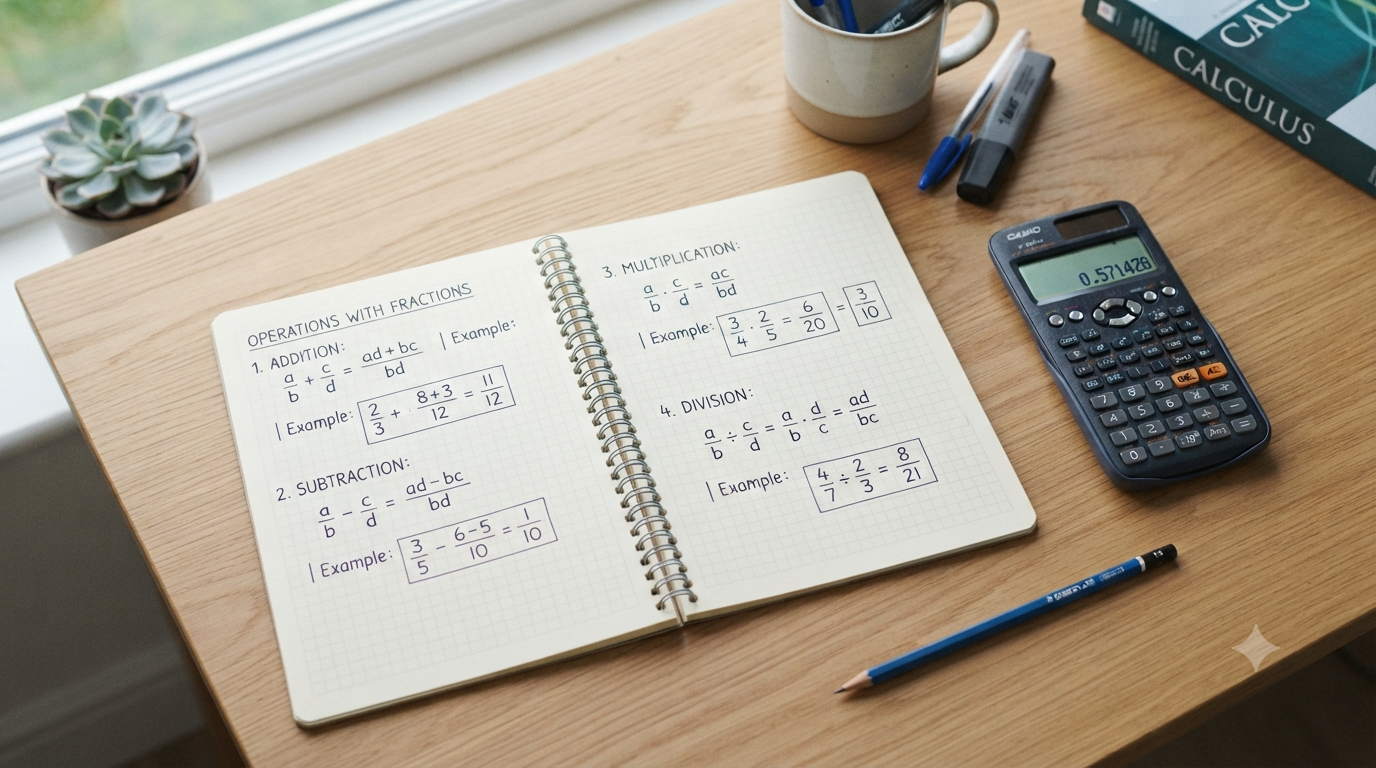
Adding Fractions

The method used to add fractions depends on whether their denominators are the same or different.

Adding Fractions With the Same Denominator

When two fractions have the same denominator, add their numerators and keep the denominator unchanged.

Formula

a/b + c/b = (a + c)/b

For example:

2/7 + 3/7 = 5/7

The denominator remains 7 because the fractions are divided into the same number of equal parts.

Adding Fractions With Different Denominators

When denominators are different, first find a common denominator, usually the least common denominator (LCD).

For example:

1/3 + 1/4

The LCD of 3 and 4 is 12.

Convert the fractions:

1/3 = 4/12

1/4 = 3/12

Now add:

4/12 + 3/12 = 7/12

Therefore:

1/3 + 1/4 = 7/12

The important rule is that fractions cannot be added by simply adding their denominators.

For example, this is incorrect:

1/3 + 1/4 ≠ 2/7

Subtracting Fractions

Fraction subtraction follows a similar process to fraction addition.

Subtracting Fractions With the Same Denominator

If the denominators are the same, subtract the numerators and keep the denominator unchanged.

Formula

a/b − c/b = (a − c)/b

For example:

6/9 − 2/9 = 4/9

The result can then be simplified if necessary.

Subtracting Fractions With Different Denominators

Find a common denominator before subtracting.

For example:

3/4 − 1/6

The LCD of 4 and 6 is 12.

Convert the fractions:

3/4 = 9/12

1/6 = 2/12

Now subtract:

9/12 − 2/12 = 7/12

Therefore:

3/4 − 1/6 = 7/12

Multiplying Fractions

Multiplication of fractions is generally straightforward. Multiply the numerators together and multiply the denominators together.

Formula

a/b × c/d = (a × c)/(b × d)

For example:

2/3 × 4/5 = 8/15

Therefore:

2/3 × 4/5 = 8/15

Unlike addition and subtraction, multiplication does not require the denominators to be the same.

Cross-Cancellation Before Multiplication

Sometimes a fraction can be simplified before multiplication. This is called cancellation.

For example:

3/4 × 8/9

We can cancel 3 with 9:

3/4 × 8/9 = 1/4 × 8/3

We can then simplify further:

1/4 × 8/3 = 2/3

So:

3/4 × 8/9 = 2/3

Cross-cancellation can make calculations easier and reduce the possibility of dealing with unnecessarily large numbers.

Dividing Fractions

To divide one fraction by another, multiply the first fraction by the reciprocal of the second fraction.

The reciprocal of a fraction is obtained by switching its numerator and denominator.

For example, the reciprocal of:

3/5

is:

5/3

Formula for Dividing Fractions

a/b ÷ c/d = a/b × d/c

Therefore:

a/b ÷ c/d = (a × d)/(b × c)

For example:

2/3 ÷ 4/5

Change division into multiplication and take the reciprocal of 4/5:

2/3 × 5/4

Multiply:

10/12

Simplify:

10/12 = 5/6

Therefore:

2/3 ÷ 4/5 = 5/6

The divisor cannot be zero because division by zero is undefined.

Converting a Mixed Number to an Improper Fraction

To convert a mixed number into an improper fraction, multiply the whole number by the denominator, add the numerator, and place the result over the original denominator.

Formula

a b/c = (a × c + b)/c

For example:

2 1/3

Multiply the whole number by the denominator:

2 × 3 = 6

Add the numerator:

6 + 1 = 7

Therefore:

2 1/3 = 7/3

Converting an Improper Fraction to a Mixed Number

To convert an improper fraction into a mixed number, divide the numerator by the denominator.

For example:

11/4

Divide 11 by 4:

11 ÷ 4 = 2 remainder 3

Therefore:

11/4 = 2 3/4

The quotient becomes the whole number, the remainder becomes the numerator, and the denominator remains the same.

Adding Mixed Numbers

Mixed numbers can be added by separating the whole-number and fractional parts or by converting the mixed numbers into improper fractions.

For example:

2 1/4 + 1 2/4

Add the whole numbers:

2 + 1 = 3

Add the fractions:

1/4 + 2/4 = 3/4

Therefore:

2 1/4 + 1 2/4 = 3 3/4

When the fractional parts have different denominators, convert them to equivalent fractions with a common denominator first.

Subtracting Mixed Numbers

Mixed numbers can also be subtracted by working with the whole and fractional parts.

For example:

4 3/5 − 2 1/5

Subtract the whole numbers:

4 − 2 = 2

Subtract the fractions:

3/5 − 1/5 = 2/5

Therefore:

4 3/5 − 2 1/5 = 2 2/5

If the fractional part of the first number is smaller than the fractional part being subtracted, borrowing may be necessary.

Multiplying Mixed Numbers

Before multiplying mixed numbers, convert them into improper fractions.

For example:

2 1/3 × 1 1/2

Convert them:

2 1/3 = 7/3

1 1/2 = 3/2

Now multiply:

7/3 × 3/2 = 21/6

Simplify:

21/6 = 7/2

Convert back to a mixed number:

7/2 = 3 1/2

Therefore:

2 1/3 × 1 1/2 = 3 1/2

Dividing Mixed Numbers

To divide mixed numbers, first convert both numbers into improper fractions. Then multiply the first fraction by the reciprocal of the second.

For example:

2 1/2 ÷ 1 1/4

Convert them:

2 1/2 = 5/2

1 1/4 = 5/4

Now divide:

5/2 ÷ 5/4

Change division to multiplication:

5/2 × 4/5

Cancel common factors:

= 2

Therefore:

2 1/2 ÷ 1 1/4 = 2

Fraction Rules to Remember

Several basic rules make fraction calculations easier to remember.

  1. The denominator cannot be zero.

  2. For addition and subtraction, use a common denominator when necessary.

  3. For multiplication, multiply numerators and denominators.

  4. For division, multiply by the reciprocal of the divisor.

  5. Simplify the final answer whenever possible.

  6. When creating equivalent fractions, multiply or divide both numerator and denominator by the same nonzero number.

  7. When converting a mixed number to an improper fraction, multiply the whole number by the denominator and add the numerator.

  8. When converting an improper fraction to a mixed number, divide the numerator by the denominator.

Common Fraction Mistakes

Fractions can become confusing when basic rules are mixed together. One common mistake is adding denominators directly. For example, 1/2 + 1/3 is not 2/5. A common denominator must be found first.

Another common mistake occurs during fraction division. Dividing by a fraction does not mean dividing the numerator and denominator separately. Instead, the second fraction must be inverted and multiplied.

Students and other learners also sometimes forget to simplify their answers. For example, 6/8 is mathematically correct, but its simplest form is 3/4.

It is also important to remember that the denominator represents the number of equal parts in one whole. Changing only the denominator changes the value of the fraction.

Quick Fraction Formula Reference

The most useful basic fraction formulas can be summarized as follows:

Equivalent fraction:

a/b = (a × n)/(b × n)

Addition with the same denominator:

a/b + c/b = (a + c)/b

Subtraction with the same denominator:

a/b − c/b = (a − c)/b

Multiplication:

a/b × c/d = (a × c)/(b × d)

Division:

a/b ÷ c/d = a/b × d/c

Mixed number to improper fraction:

a b/c = (a × c + b)/c

These formulas cover many of the basic calculations involving fractions.

Conclusion

Fractions are a fundamental part of mathematics, and understanding their basic operations makes many other mathematical topics easier to learn. The key ideas are simple: the numerator represents the selected parts, while the denominator represents the total number of equal parts. Fractions can be compared, simplified, converted, added, subtracted, multiplied, and divided using specific rules.

For addition and subtraction, a common denominator is usually required. Multiplication involves multiplying the numerators and denominators, while division requires multiplying by the reciprocal. Mixed numbers can be converted into improper fractions before multiplication or division, making calculations more systematic.

Once these basic fraction formulas become familiar, fractions become much easier to work with in arithmetic, algebra, geometry, probability, percentages, measurements, and everyday calculations.

FAQs

1. What is a fraction?

A fraction is a mathematical expression used to represent a part of a whole or a number divided into equal parts. It has two main parts: the numerator and the denominator. The numerator is the number above the fraction line and shows how many parts are being considered. The denominator is the number below the line and shows how many equal parts make up the whole. For example, in 3/5, 3 is the numerator and 5 is the denominator. Fractions can represent quantities smaller than one, equal to one, or greater than one. They are widely used in mathematics and everyday measurements.

2. What are the basic operations on fractions?

The four basic operations on fractions are addition, subtraction, multiplication, and division. Addition and subtraction usually require fractions to have a common denominator before the numerators are combined. For multiplication, multiply the numerators together and the denominators together. For division, multiply the first fraction by the reciprocal of the second fraction. For example, 2/3 ÷ 4/5 becomes 2/3 × 5/4. After performing any operation, the answer should be simplified when possible. Learning these four operations provides the foundation for solving more advanced problems involving fractions, ratios, algebra, percentages, and measurements.

3. How do you add fractions with different denominators?

To add fractions with different denominators, first find a common denominator, preferably the least common denominator (LCD). Convert each fraction into an equivalent fraction with that denominator, then add the numerators while keeping the common denominator. For example, to calculate 1/3 + 1/4, the LCD is 12. Convert the fractions: 1/3 = 4/12 and 1/4 = 3/12. Then add them: 4/12 + 3/12 = 7/12. The denominator should not be added directly. Finally, check whether the resulting fraction can be simplified further.

4. How do you subtract fractions with different denominators?

To subtract fractions with different denominators, first find a common denominator. Convert both fractions into equivalent fractions using that denominator, then subtract the numerators. For example, consider 3/4 − 1/6. The least common denominator is 12. Therefore, 3/4 becomes 9/12 and 1/6 becomes 2/12. Now subtract: 9/12 − 2/12 = 7/12. The denominator remains 12 because both fractions now represent equal-sized parts. After subtraction, simplify the result if there is a common factor between the numerator and denominator. This method works for proper, improper, and mixed fractions.

5. How do you multiply fractions?

To multiply fractions, multiply the numerator of the first fraction by the numerator of the second fraction. Then multiply the denominators together. The basic formula is a/b × c/d = (a × c)/(b × d). For example, 2/3 × 4/5 = 8/15. Unlike addition and subtraction, the denominators do not need to be the same before multiplication. You can often simplify the fractions before multiplying by cancelling common factors between a numerator and the opposite denominator. This can make calculations easier and produce smaller numbers. Always simplify the final answer whenever possible.

6. How do you divide fractions?

To divide fractions, multiply the first fraction by the reciprocal of the second fraction. The reciprocal is obtained by switching the numerator and denominator. For example, 2/3 ÷ 4/5 becomes 2/3 × 5/4. Multiplying gives 10/12, which simplifies to 5/6. The general formula is a/b ÷ c/d = a/b × d/c. The fraction being divided by, called the divisor, must not be zero. A useful way to remember the process is “keep the first fraction, change division to multiplication, and flip the second fraction.” Simplify the result after completing the calculation.

7. How do you simplify a fraction?

Simplifying a fraction means reducing it to its simplest form without changing its value. To simplify a fraction, find the greatest common factor (GCF) of the numerator and denominator. Then divide both numbers by that factor. For example, consider 12/18. The GCF of 12 and 18 is 6. Dividing both by 6 gives 2/3. Therefore, 12/18 simplifies to 2/3. A fraction is in simplest form when its numerator and denominator have no common factor greater than 1. Simplifying fractions makes answers easier to read, compare, and use in further calculations.

8. How do you convert a mixed number into an improper fraction?

To convert a mixed number into an improper fraction, multiply the whole number by the denominator of the fractional part. Then add the numerator to the result. Keep the original denominator. For example, consider 2 1/3. First multiply 2 × 3 = 6. Then add the numerator: 6 + 1 = 7. Therefore, 2 1/3 = 7/3. The formula is a b/c = (a × c + b)/c. This conversion is particularly useful when multiplying or dividing mixed numbers because improper fractions make these operations more systematic.

9. How do you convert an improper fraction into a mixed number?

To convert an improper fraction into a mixed number, divide the numerator by the denominator. The quotient becomes the whole-number part, the remainder becomes the numerator of the fractional part, and the original denominator remains unchanged. For example, consider 11/4. Dividing 11 by 4 gives 2 with a remainder of 3. Therefore, 11/4 = 2 3/4. If the numerator divides evenly by the denominator, the result is a whole number. This conversion is useful when presenting fractions in a form that is easier to understand in everyday measurements and quantities.

10. Why is the denominator important in a fraction?

The denominator tells us how many equal parts a whole has been divided into. For example, in 3/8, the denominator 8 means that the whole is divided into eight equal parts, while the numerator 3 indicates that three of those parts are being considered. The denominator also determines the size of each fractional part. A denominator of zero is not allowed because division by zero is undefined. When adding or subtracting fractions, denominators must represent the same-sized parts, which is why a common denominator is needed when the original denominators are different.

Related Posts

Leave a Comment

Your email address will not be published. Required fields are marked *

Scroll to Top