
Chemistry becomes much easier when you understand the formulas used to represent substances, reactions, quantities, and relationships between different chemical concepts. For a beginner, however, the large number of chemical formulas can feel confusing. There are symbols for elements, formulas for compounds, equations for reactions, and mathematical formulas used in calculations. Trying to memorize everything at once is neither necessary nor helpful.
The better approach is to learn the most important chemistry formulas in a logical order. Start with simple formulas that help you identify common substances, then move toward formulas used for chemical reactions, moles, concentration, gases, acids and bases, and basic calculations. Once these foundations are clear, more advanced chemistry becomes easier to understand.
Why Chemistry Formulas Are Important
A chemical formula is a short way of showing what a substance contains. It tells us which elements are present and, in many cases, the ratio in which their atoms are combined.
For example, water is represented by:
H₂O
This formula tells us that each water molecule contains two hydrogen atoms and one oxygen atom.
Similarly, carbon dioxide is represented as:
CO₂
It contains one carbon atom and two oxygen atoms.
Chemical formulas save us from writing long descriptions every time we refer to a substance. They also provide information that can be used in chemical equations and calculations.
For beginners, learning formulas is therefore not simply a matter of memorization. It is about understanding what the symbols and numbers mean.
1. Learn Element Symbols First
Before learning compound formulas, beginners should become familiar with common chemical symbols.
Some important element symbols include:
Hydrogen — H
Oxygen — O
Carbon — C
Nitrogen — N
Sodium — Na
Potassium — K
Calcium — Ca
Magnesium — Mg
Aluminium — Al
Chlorine — Cl
Sulfur — S
Iron — Fe
Copper — Cu
Zinc — Zn
Silver — Ag
Gold — Au
The first letter of an element symbol is always capitalized. If a symbol has a second letter, it is lowercase.
For example:
Co = Cobalt
CO = Carbon monoxide notation, where C and O are separate element symbols
This difference is important because changing capitalization can completely change the meaning.
2. Learn the Formulas of Common Compounds
After element symbols, beginners should learn formulas of familiar and frequently used compounds.
Water
H₂O
Water contains hydrogen and oxygen.
Carbon Dioxide
CO₂
Carbon dioxide contains carbon and oxygen.
Carbon Monoxide
CO
Carbon monoxide contains one carbon atom and one oxygen atom.
Ammonia
NH₃
Ammonia contains nitrogen and hydrogen.
Methane
CH₄
Methane contains carbon and hydrogen.
Sodium Chloride
NaCl
Sodium chloride is commonly known as table salt.
Calcium Carbonate
CaCO₃
Calcium carbonate is found in materials such as limestone and marble.
Sodium Hydroxide
NaOH
Sodium hydroxide is a strong base.
Hydrochloric Acid
HCl
Hydrochloric acid is an important acid used in chemistry.
Sulfuric Acid
H₂SO₄
Sulfuric acid is one of the most important industrial acids.
Learning these formulas gives beginners a useful foundation for understanding chemical reactions and chemical names.
3. Understand Subscripts and Coefficients
One of the most important skills in chemistry is understanding the difference between a subscript and a coefficient.
Consider:
2H₂O
The small number 2 in H₂O is a subscript. It tells us that one water molecule contains two hydrogen atoms.
The number 2 in front of H₂O is a coefficient. It tells us that there are two units of water.
Therefore:
H₂O = 2 hydrogen atoms and 1 oxygen atom
2H₂O = 4 hydrogen atoms and 2 oxygen atoms
This distinction becomes extremely important when balancing chemical equations.
4. Learn Formulas for Common Acids
Acids are an important part of basic chemistry. Beginners should become familiar with several common acids.
Hydrochloric Acid
HCl
Sulfuric Acid
H₂SO₄
Nitric Acid
HNO₃
Carbonic Acid
H₂CO₃
Acetic Acid
CH₃COOH
These formulas also help beginners recognize common polyatomic ions and understand how acids form salts.
5. Learn Formulas for Common Bases
Bases are another important group of substances.
Some common bases include:
Sodium Hydroxide
NaOH
Potassium Hydroxide
KOH
Calcium Hydroxide
Ca(OH)₂
Magnesium Hydroxide
Mg(OH)₂
The parentheses in Ca(OH)₂ and Mg(OH)₂ are important. The subscript 2 applies to the entire hydroxide group.
Understanding this notation prepares beginners for more complicated chemical formulas.
6. Learn Common Ions and Their Charges
Learning common ions is more useful than memorizing hundreds of compound formulas.
Some important positive ions are:
H⁺ — Hydrogen ion
Na⁺ — Sodium ion
K⁺ — Potassium ion
Mg²⁺ — Magnesium ion
Ca²⁺ — Calcium ion
Al³⁺ — Aluminium ion
Some important negative ions are:
Cl⁻ — Chloride ion
O²⁻ — Oxide ion
S²⁻ — Sulfide ion
OH⁻ — Hydroxide ion
NO₃⁻ — Nitrate ion
SO₄²⁻ — Sulfate ion
CO₃²⁻ — Carbonate ion
The charges help us determine how ions combine to form electrically neutral compounds.
For example, sodium has a +1 charge and chloride has a −1 charge:
Na⁺ + Cl⁻ → NaCl
Calcium has a +2 charge while chloride has a −1 charge. Therefore, two chloride ions are needed for every calcium ion:
Ca²⁺ + 2Cl⁻ → CaCl₂
7. Learn Common Oxide Formulas
Oxides are compounds containing oxygen combined with another element.
Important examples include:
CO₂ — Carbon dioxide
CO — Carbon monoxide
CaO — Calcium oxide
MgO — Magnesium oxide
Fe₂O₃ — Iron(III) oxide
CuO — Copper(II) oxide
Understanding oxide formulas helps beginners recognize how different elements combine with oxygen.
8. Learn Simple Chemical Equation Patterns
Chemical formulas become more meaningful when they are used in chemical equations.
For example, hydrogen reacts with oxygen to form water:
2H₂ + O₂ → 2H₂O
This equation shows the reactants on the left and the product on the right.
Another example is the reaction between sodium and chlorine:
2Na + Cl₂ → 2NaCl
Beginners should learn to identify three basic parts:
Reactants
Products
Coefficients
The equation must obey the law of conservation of mass, meaning the number of atoms of each element must be the same on both sides.
9. Learn the Mole Formula
Once basic chemical formulas are understood, beginners can start learning formulas used in quantitative chemistry.
The most important relationship is:
n = m/M
where:
n = number of moles
m = mass of substance
M = molar mass
For example, if a substance has a mass of 18 g and its molar mass is 18 g/mol:
n = 18/18 = 1 mol
The mole is one of the central concepts in chemistry because it connects microscopic particles with measurable laboratory quantities.
10. Learn the Formula for Number of Particles
The number of particles can be related to the number of moles using Avogadro’s constant.
N = nNₐ
where:
N = number of particles
n = number of moles
Nₐ = Avogadro constant
The Avogadro constant is approximately:
Nₐ = 6.022 × 10²³ mol⁻¹
This relationship can be used to calculate the number of atoms, molecules, or ions present in a given amount of substance.
11. Learn Molarity
Concentration is another important beginner-level chemistry concept.
The formula for molarity is:
M = n/V
where:
M = molarity
n = moles of solute
V = volume of solution in litres
For example, if 1 mole of a substance is dissolved to make 1 litre of solution:
M = 1/1 = 1 mol/L
Molarity is commonly used when studying solutions and chemical reactions.
12. Learn Density
Density is useful in chemistry, especially when working with liquids and solids.
The basic formula is:
ρ = m/V
where:
ρ = density
m = mass
V = volume
This formula can also be rearranged:
m = ρV
and:
V = m/ρ
Understanding how to rearrange formulas is an important mathematical skill for chemistry calculations.
13. Learn the Gas Law Formulas
Gas behavior is another area where mathematical formulas become important.
A useful beginner formula is the ideal gas equation:
PV = nRT
where:
P = pressure
V = volume
n = number of moles
R = gas constant
T = absolute temperature
Beginners do not need to memorize every gas relationship immediately. It is more important to understand what each variable represents and how changing one quantity can affect another.
14. Learn the pH Formula
Acids and bases introduce another important formula:
pH = −log[H⁺]
This formula relates pH to the hydrogen ion concentration of a solution.
For example, if:
[H⁺] = 1 × 10⁻³ mol/L
then:
pH = 3
At the beginner level, the main idea is that pH provides a numerical way to describe the acidity of a solution.
15. Learn the Relationship Between pH and pOH
Another useful relationship is:
pH + pOH = 14
This relationship applies to aqueous solutions under the usual standard conditions associated with introductory chemistry.
The corresponding formula for hydroxide concentration is:
pOH = −log[OH⁻]
These formulas become useful when solving acid-base problems.
16. Learn Percentage Composition
Chemical formulas can also be used to determine the percentage by mass of an element in a compound.
The basic formula is:
Percentage of element = (mass of element in one mole of compound / molar mass of compound) × 100
For example, the formula of water is H₂O. Its molar mass is approximately 18 g/mol. The mass contributed by hydrogen is approximately 2 g/mol.
Therefore:
Percentage of hydrogen = (2/18) × 100 ≈ 11.1%
This concept is useful when studying chemical composition and empirical formulas.
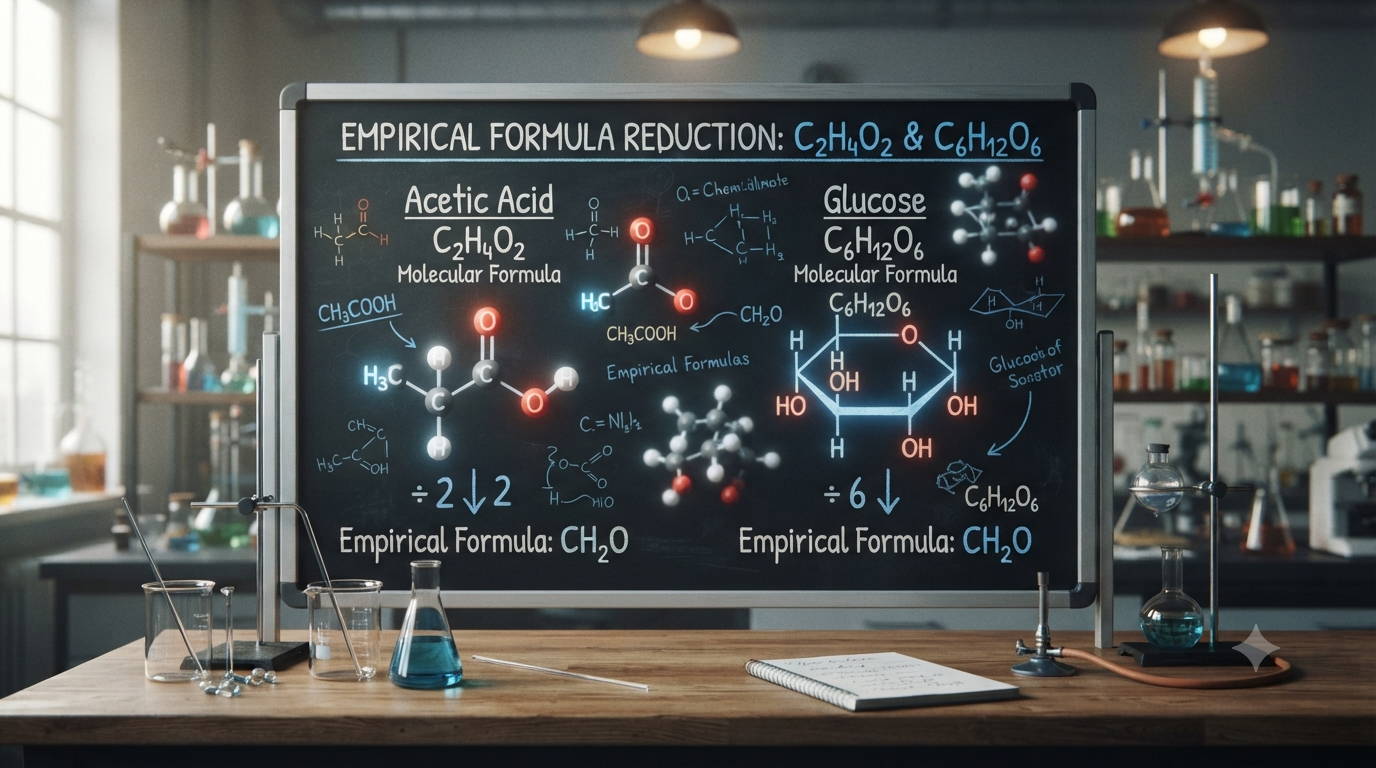
17. Learn Empirical and Molecular Formula Relationships
An empirical formula represents the simplest whole-number ratio of atoms in a compound.
For example:
CH₂O
can represent the empirical formula of a compound.
The molecular formula may be a multiple of the empirical formula:
C₆H₁₂O₆
Here, the molecular formula is six times the empirical formula:
6 × CH₂O = C₆H₁₂O₆
Understanding this relationship helps beginners move from simple chemical formulas to chemical composition calculations.
18. Learn Formula Mass and Molar Mass
Formula mass is obtained by adding the atomic masses of all atoms represented in a chemical formula.
For example, for water:
H₂O
Formula mass:
(2 × 1) + 16 = 18 u
The molar mass of water is approximately:
18 g/mol
Although formula mass and molar mass use different units, their numerical values are closely related when expressed in the standard way.
19. A Practical Order for Learning Chemistry Formulas
Beginners do not need to learn all chemistry formulas at the same time. A step-by-step order is more effective.
A useful sequence is:
Element symbols
Common compound formulas
Subscripts and coefficients
Common ions and their charges
Acids and bases
Oxides and salts
Chemical equations
Balancing equations
Mole formula
Molar mass
Number of particles
Concentration and molarity
Density
Gas laws
pH and pOH
Percentage composition
Empirical and molecular formulas
This sequence moves from simple chemical notation toward calculations and quantitative chemistry.
How to Learn Chemistry Formulas Without Memorizing Everything
Memorization has a role in chemistry, but understanding should come first.
Start by learning the symbols of common elements. Then learn why particular ions have particular charges. Once you understand charges, many ionic compound formulas can be worked out instead of memorized individually.
For example, knowing:
Na⁺
and:
Cl⁻
allows you to construct:
NaCl
Similarly, knowing:
Ca²⁺
and:
Cl⁻
allows you to determine:
CaCl₂
Practice writing formulas from names and names from formulas. This two-way practice strengthens recognition.
It is also useful to keep a small formula sheet while studying. Group formulas into categories such as acids, bases, salts, ions, mole calculations, and gas laws. Review them regularly rather than trying to memorize a large list in one sitting.
Common Mistakes Beginners Should Avoid
One common mistake is confusing element symbols with compound formulas. For example, O represents oxygen, while O₂ represents an oxygen molecule.
Another mistake is changing subscripts when balancing equations. When balancing an equation, coefficients should normally be changed rather than subscripts because changing a subscript changes the identity of the substance.
Beginners may also confuse molarity with moles. Moles measure the amount of substance, while molarity describes concentration.
Another common problem is forgetting units. A numerical answer in chemistry is often incomplete without the correct unit.
Finally, avoid learning formulas only through repetition. Ask what every symbol, number, subscript, coefficient, and unit represents.
Conclusion
The most important chemistry formulas for beginners are not necessarily the largest collection of formulas. They are the formulas that build a strong foundation for understanding chemical substances and calculations. Start with element symbols and common compound formulas, then learn ions, acids, bases, chemical equations, and basic quantitative relationships such as moles, molar mass, molarity, density, gas laws, and pH.
The goal is not to memorize chemistry like a list of unrelated facts. Each formula represents a chemical idea. When you understand what the formula means and how it is constructed, remembering it becomes much easier. With these essential formulas as a foundation, beginners can approach more advanced chemistry topics with greater confidence and clarity.
FAQs
1. Which chemistry formulas should beginners learn first?
Beginners should first learn formulas that appear frequently in basic chemistry. Start with common substances such as H₂O, CO₂, O₂, H₂, NaCl, NH₃, CH₄, HCl, H₂SO₄, and NaOH. After that, learn common ions and their charges because they help you understand how ionic compounds are formed. Basic mathematical formulas such as n = m/M, M = n/V, ρ = m/V, and PV = nRT are also important. It is better to understand what each symbol and number represents instead of simply memorizing formulas. Learning formulas step by step makes chemical equations and calculations much easier to understand.
2. Why are chemical formulas important in chemistry?
Chemical formulas provide a compact way to represent substances and show which elements they contain. For example, H₂O represents water and indicates that each molecule contains two hydrogen atoms and one oxygen atom. Chemical formulas are also essential for writing chemical equations, calculating molar masses, determining the composition of compounds, and solving numerical problems. They allow chemists to communicate chemical information clearly without writing lengthy descriptions. For beginners, understanding chemical formulas creates a foundation for topics such as chemical reactions, stoichiometry, acids and bases, solutions, and molecular structure. Learning how formulas work is therefore more useful than memorizing a long list.
3. What is the difference between a chemical formula and a chemical equation?
A chemical formula represents a single substance, while a chemical equation represents a chemical reaction. For example, H₂O is the chemical formula for water. It tells us what elements are present and their ratio in the substance. A chemical equation shows reactants changing into products. For example, 2H₂ + O₂ → 2H₂O represents the reaction between hydrogen and oxygen to form water. Chemical equations use chemical formulas along with coefficients to show the quantities involved in a reaction. Understanding this difference helps beginners read chemical reactions correctly and recognize whether a chemical expression represents a substance or a complete reaction.
4. What are subscripts in chemical formulas?
Subscripts are small numbers written after an element symbol in a chemical formula. They show how many atoms of that element are present in one molecule or formula unit. For example, H₂O contains a subscript 2 after H, meaning there are two hydrogen atoms for every one oxygen atom. In CO₂, the subscript 2 indicates two oxygen atoms. If no subscript is written, the number is understood to be one. Subscripts are important because changing them can change the identity of a substance. Beginners should carefully distinguish subscripts from coefficients, which are numbers placed before formulas to indicate quantities.
5. What are coefficients in chemical equations?
A coefficient is a number placed before a chemical formula in an equation. It indicates how many molecules, formula units, or moles of that substance are involved in the reaction. For example, in 2H₂O, the coefficient 2 means two units of water. This gives a total of four hydrogen atoms and two oxygen atoms. Coefficients are especially important when balancing chemical equations because they allow the number of atoms on both sides of an equation to be made equal. Beginners should remember that coefficients can be changed when balancing equations, while subscripts should not normally be changed because doing so changes the chemical substance itself.
6. Which common compound formulas should beginners memorize?
Beginners should become familiar with frequently encountered compounds rather than attempting to memorize hundreds of formulas. Important examples include H₂O for water, CO₂ for carbon dioxide, CO for carbon monoxide, NH₃ for ammonia, CH₄ for methane, NaCl for sodium chloride, NaOH for sodium hydroxide, HCl for hydrochloric acid, H₂SO₄ for sulfuric acid, HNO₃ for nitric acid, and CaCO₃ for calcium carbonate. Understanding how these formulas are constructed is even more valuable than memorizing them. Learning common element symbols, ion charges, and chemical naming patterns allows students to work out many unfamiliar formulas logically.
7. What is the mole formula in chemistry?
The basic mole relationship is n = m/M, where n represents the number of moles, m represents the mass of the substance, and M represents its molar mass. This formula connects the measurable mass of a substance with the amount of chemical substance present. For example, if a sample has a mass of 20 g and its molar mass is 10 g/mol, the amount is n = 20/10 = 2 mol. The mole is important because chemical reactions occur between particles, while laboratory measurements commonly involve grams. The mole provides a practical connection between microscopic particles and measurable quantities.
8. What is the formula for molarity?
The formula for molarity is M = n/V, where M represents molarity, n represents the number of moles of solute, and V represents the volume of the solution in litres. Molarity describes the concentration of a solution. For example, if 2 moles of solute are present in 1 litre of solution, the molarity is 2 mol/L. Beginners should pay attention to the volume unit because the standard formula uses litres. Molarity is widely used in solution chemistry, dilution calculations, acid-base reactions, and laboratory experiments. Understanding this formula makes it easier to calculate and compare the concentrations of different solutions.
9. Which chemistry formulas are used for acids and bases?
Several formulas are commonly used when studying acids and bases. Important chemical formulas include HCl for hydrochloric acid, H₂SO₄ for sulfuric acid, HNO₃ for nitric acid, NaOH for sodium hydroxide, KOH for potassium hydroxide, and Ca(OH)₂ for calcium hydroxide. Beginners should also learn the formulas pH = −log[H⁺] and pOH = −log[OH⁻]. Under the standard conditions used in introductory aqueous chemistry, pH + pOH = 14. These formulas help describe acidity and basicity quantitatively. However, beginners should first understand what acids, bases, hydrogen ions, and hydroxide ions represent before focusing heavily on numerical calculations.
10. How can beginners remember chemistry formulas more easily?
The easiest way to remember chemistry formulas is to understand their patterns instead of relying entirely on memorization. Begin with common element symbols and learn the charges of frequently used ions. Then practice combining ions to form neutral compounds. Group formulas into categories such as acids, bases, salts, oxides, and calculation formulas. Write formulas from chemical names and identify names from formulas regularly. When studying numerical formulas, learn what every symbol and unit represents. Short, repeated practice sessions are usually more effective than trying to memorize everything at once. As your understanding improves, many formulas become easier to recall naturally.
Related Posts
What Is Formula Mass in Chemistry?
Chemistry often deals with substances that are made of atoms joined together in specific proportions. To understand how much matter […]
Read MoreCommon Polyatomic Ions and Their Formulas
Polyatomic ions are groups of two or more atoms that are chemically bonded together and carry an overall electrical charge. […]
Read MoreHow can you count atoms from a chemical formula?
A chemical formula tells us much more than the name of a substance. It also gives information about the types […]
Read MoreWhat Is Measurement in Physics?
Measurement is one of the most important foundations of physics. Almost every idea in physics is connected to measurement in […]
Read MoreBasic Types of Chemistry Formulas Explained
Chemistry formulas are one of the simplest ways scientists describe substances, reactions, and relationships between different particles. A formula can […]
Read MoreCommon Formulas of Important Inorganic Compounds
Inorganic compounds are found everywhere around us, from table salt and baking soda to fertilizers, minerals, medicines, cleaning products, and […]
Read MoreScientific Notation in Physics: A Beginner’s Guide
Physics deals with quantities that can be extremely large or incredibly small. The distance between stars, the mass of planets, […]
Read MoreWhy do some physical quantities have no units?

When we study physics, we usually encounter quantities such as length, mass, time, speed, force, and energy. Each of these […]
Read MoreWhat Is Energy in Physics?
Energy is one of the most important ideas in physics. We use the word “energy” in everyday life when talking […]
Read MoreHow to Read and Understand Chemistry Formulas
Chemistry formulas may look like a collection of letters, numbers, and symbols, but they are actually a simple language used […]
Read MoreWhat does a subscript mean in a chemical formula?
A chemical formula is a short way of showing what a substance is made of. Instead of writing the names […]
Read MoreWhat Is Work in Physics?
In everyday life, the word “work” usually means doing something that requires effort. We may say that carrying a heavy […]
Read MoreSI Unit of Temperature Kelvin and Its Meaning
Temperature is one of the most important physical quantities in science. It helps us understand how hot or cold an […]
Read MoreHow to Write Formulas for Molecular Compounds
Writing the formula of a molecular compound is an important skill in chemistry. A chemical formula tells us which elements […]
Read MoreFundamental and Derived Physical Quantities Explained

Physics is the science of understanding how the natural world works. To describe motion, matter, energy, forces, electricity, and many […]
Read MoreWhat Is Dimensional Consistency in Physics?
Physics uses mathematical equations to describe how different physical quantities are related. When scientists write an equation, every quantity in […]
Read MoreHow Chemical Formulas Are Used in Chemical Calculations
Chemical formulas are one of the most useful tools in chemistry. They provide a compact way to represent substances and […]
Read MoreWhat Is Acceleration in Physics?
Acceleration is one of the most important concepts in physics because it describes how the velocity of an object changes […]
Read MoreCommon Mistakes When Using Physics Formulas
Physics formulas help us describe motion, forces, energy, electricity, heat, waves, and many other phenomena using mathematical relationships. A formula […]
Read MoreWhen Should You Simplify Chemical Formula Ratios?
Chemical formulas are more than collections of symbols and numbers. They show which elements are present in a substance and, […]
Read MoreHow to Understand Units in Physics Formulas
Physics formulas are more than mathematical expressions. They describe relationships between physical quantities, and units help us understand what those […]
Read MoreWhy Is Displacement Different From Distance?
When we describe the motion of an object, we often want to know how far it has moved. Two important […]
Read MoreSI Unit of Luminous Intensity Candela Explained
Luminous intensity is an important physical quantity used to describe how strongly a light source emits visible light in a […]
Read MoreHow to Identify Constants in Physics Equations
Physics equations often contain several symbols, numbers, and quantities. To understand an equation correctly, it is important to know which […]
Read MoreCommon Formulas of Bases in Chemistry
Bases are an important group of chemical substances that we encounter in laboratories, industries, medicines, agriculture, and everyday life. They […]
Read MoreHow to Organize Physics Formulas for Easy Revision
Physics becomes much easier when formulas are organized in a clear and meaningful way. Many learners struggle not because they […]
Read MoreSI Unit of Electric Current Ampere Explained
Electric current is one of the most important physical quantities in electricity and magnetism. Whenever electric charge moves through a […]
Read MoreWhy Do Some Physics Problems Need More Than One Formula?
Physics problems often look simple at first. You may be given a few values, asked to find an unknown quantity, […]
Read MoreWhat Do Coefficients Mean in Chemistry Formulas?

When you look at a chemical equation, you may notice numbers written before chemical formulas. These numbers are called coefficients. […]
Read MoreWhy does every physical quantity need a unit?
Imagine someone tells you that a table is “2” long. Does that tell you how long the table actually is? […]
Read More