
When we study chemical compounds, we often use ratios to describe how their elements are combined. Two important types of ratios are atomic ratios and mass ratios. Although both describe the composition of a compound, they answer different questions. An atomic ratio tells us how many atoms of one element are present compared with another element, while a mass ratio tells us how much mass each element contributes to the compound.
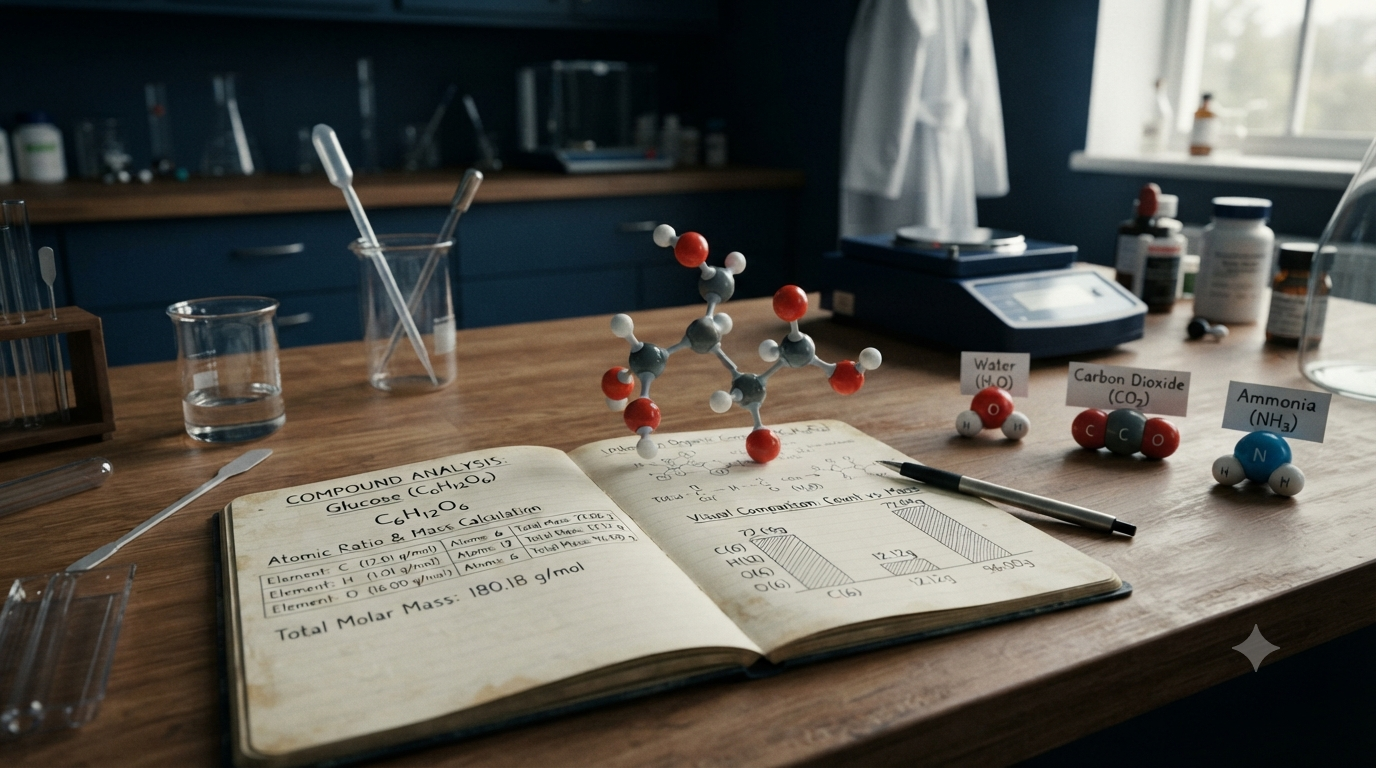
Understanding the difference between these two ratios is essential for learning chemical formulas, molecular composition, stoichiometry, and quantitative chemistry. For example, water has the formula H₂O. This formula tells us that hydrogen and oxygen are present in an atomic ratio of 2:1. However, because oxygen atoms are much heavier than hydrogen atoms, their mass ratio is not 2:1. The mass contribution of hydrogen and oxygen is very different.
What Is an Atomic Ratio?
An atomic ratio compares the number of atoms of different elements present in a compound. It is obtained directly from the subscripts in a chemical formula after simplifying the ratio when necessary.
Consider water, H₂O. The subscript 2 after H means that there are two hydrogen atoms for every one oxygen atom.
Therefore:
Atomic ratio of H : O = 2 : 1
The atomic ratio answers the question:
“How many atoms of one element are present compared with another element?”
It does not consider the masses of the atoms.
For example, in carbon dioxide, CO₂, there is one carbon atom and two oxygen atoms in each molecule.
Therefore:
Atomic ratio of C : O = 1 : 2
Similarly, ammonia, NH₃, contains one nitrogen atom and three hydrogen atoms.
Atomic ratio of N : H = 1 : 3
These ratios describe the relative numbers of atoms, not their relative masses.
What Is a Mass Ratio?
A mass ratio compares the masses contributed by different elements in a compound.
To calculate a mass ratio, we need two pieces of information:
The number of atoms of each element.
The relative atomic mass of each element.
The atomic ratio tells us the number of atoms, while the atomic masses tell us how much each of those atoms contributes to the total mass.
The general relationship is:
Mass contribution = Number of atoms × Atomic mass
Therefore, if a compound contains two elements A and B:
Mass ratio of A : B = (Number of A atoms × Atomic mass of A) : (Number of B atoms × Atomic mass of B)
This is why an atomic ratio and a mass ratio for the same compound are usually different.
Atomic Ratio and Mass Ratio in Water
Water provides one of the simplest examples.
The chemical formula of water is:
H₂O
The formula shows that one molecule contains:
2 hydrogen atoms
1 oxygen atom
So the atomic ratio is:
H : O = 2 : 1
Now consider their approximate atomic masses:
Hydrogen = 1
Oxygen = 16
The total mass contributed by hydrogen is:
2 × 1 = 2
The total mass contributed by oxygen is:
1 × 16 = 16
Therefore, the mass ratio is:
H : O = 2 : 16 = 1 : 8
So water has:
Atomic ratio = 2 : 1
Mass ratio = 1 : 8
This example clearly shows why the two ratios cannot be treated as the same thing.
Why Are Atomic and Mass Ratios Different?
The main reason is that atoms of different elements do not have the same mass.
An atomic ratio only counts atoms. It does not ask how heavy those atoms are.
Suppose a compound contains two atoms of element X and one atom of element Y. Its atomic ratio is:
X : Y = 2 : 1
If X has an atomic mass of 10 and Y has an atomic mass of 30, the mass contributions are:
X = 2 × 10 = 20
Y = 1 × 30 = 30
Therefore:
Mass ratio of X : Y = 20 : 30 = 2 : 3
The atomic ratio is 2:1, but the mass ratio is 2:3.
The difference occurs because the single Y atom is three times as massive as one X atom.
Using the Chemical Formula to Find Atomic Ratios
Chemical formulas are the starting point for finding atomic ratios.
Consider carbon dioxide:
CO₂
The absence of a subscript means one atom.
Therefore:
Carbon = 1 atom
Oxygen = 2 atoms
Atomic ratio:
C : O = 1 : 2
Now consider sulfur trioxide:
SO₃
There is one sulfur atom and three oxygen atoms.
Atomic ratio of S : O = 1 : 3
For calcium chloride:
CaCl₂
There is one calcium atom and two chlorine atoms.
Atomic ratio of Ca : Cl = 1 : 2
For aluminum oxide:
Al₂O₃
There are two aluminum atoms and three oxygen atoms.
Atomic ratio of Al : O = 2 : 3
These ratios come directly from the chemical formula.
Finding Mass Ratios From Atomic Ratios
Once the atomic ratio is known, the mass ratio can be calculated by multiplying each atomic amount by the corresponding atomic mass.
Consider carbon dioxide, CO₂.
The atomic ratio is:
C : O = 1 : 2
Approximate atomic masses are:
Carbon = 12
Oxygen = 16
Mass contributed by carbon:
1 × 12 = 12
Mass contributed by oxygen:
2 × 16 = 32
Therefore:
Mass ratio of C : O = 12 : 32
Simplifying:
C : O = 3 : 8
So carbon dioxide has:
Atomic ratio = 1 : 2
Mass ratio = 3 : 8
Again, the two ratios are clearly different.
Example With Calcium Carbonate
Calcium carbonate has the formula:
CaCO₃
The formula contains:
1 calcium atom
1 carbon atom
3 oxygen atoms
Therefore, the atomic ratio is:
Ca : C : O = 1 : 1 : 3
Using approximate atomic masses:
Calcium = 40
Carbon = 12
Oxygen = 16
Mass contributions are:
Ca = 1 × 40 = 40
C = 1 × 12 = 12
O = 3 × 16 = 48
Therefore:
Mass ratio of Ca : C : O = 40 : 12 : 48
This can be simplified by dividing by 4:
Mass ratio = 10 : 3 : 12
Notice that the atomic ratio and mass ratio are very different:
Atomic ratio = 1 : 1 : 3
Mass ratio = 10 : 3 : 12
The three oxygen atoms make a large contribution to the total mass because each oxygen atom has a relatively high atomic mass.
Example With Ammonia
Ammonia has the formula:
NH₃
Its atomic ratio is:
N : H = 1 : 3
Approximate atomic masses are:
Nitrogen = 14
Hydrogen = 1
Mass contributions:
N = 1 × 14 = 14
H = 3 × 1 = 3
Therefore:
Mass ratio of N : H = 14 : 3
Here, three hydrogen atoms are present for every one nitrogen atom, but nitrogen contributes much more mass.
This is a useful reminder that a larger number of atoms does not necessarily mean a larger mass contribution.
Atomic Ratio Does Not Give Mass Ratio Directly
One common mistake is to assume that the atomic ratio can simply be converted into a mass ratio without considering atomic masses.
For example, if the atomic ratio is:
A : B = 2 : 1
It would be incorrect to conclude automatically that the mass ratio is also 2:1.
The correct calculation requires the atomic masses.
If the atomic mass of A is 5 and the atomic mass of B is 20:
Mass ratio = (2 × 5) : (1 × 20)
= 10 : 20
= 1 : 2
Thus:
Atomic ratio = 2 : 1
Mass ratio = 1 : 2
The same atomic ratio can produce different mass ratios depending on the atomic masses of the elements involved.
Atomic Ratio and Mass Ratio in Ionic Compounds
Atomic ratios are also important in ionic compounds, even though ionic compounds do not usually exist as separate molecules.
Consider sodium chloride:
NaCl
The formula indicates a 1:1 ratio of sodium ions to chloride ions.
Therefore:
Atomic ratio of Na : Cl = 1 : 1
Using approximate atomic masses:
Sodium = 23
Chlorine = 35.5
Mass ratio:
Na : Cl = 23 : 35.5
This is clearly not 1:1 by mass.
The formula tells us the relative number of ions in the simplest repeating ratio, while the mass ratio tells us how much each element contributes to the compound’s mass.
Why These Ratios Matter in Chemistry
Both atomic ratios and mass ratios are useful, but they are used for different purposes.
Atomic ratios are important when:
Writing and interpreting chemical formulas
Understanding the composition of compounds
Determining empirical formulas
Comparing numbers of atoms
Understanding molecular structures
Studying chemical reactions
Mass ratios are important when:
Calculating the mass of elements in compounds
Performing stoichiometric calculations
Determining percentage composition
Finding empirical formulas from experimental data
Calculating reactant and product quantities
Analyzing chemical samples
A strong understanding of both ratios makes quantitative chemistry much easier.
Atomic Ratio and Mass Ratio Are Connected
Although atomic and mass ratios are different, they are closely related.
The chemical formula provides the atomic ratio. The atomic masses then allow us to convert that atomic information into a mass ratio.
The basic process is:
Chemical formula → Atomic ratio → Multiply by atomic masses → Mass ratio
For a compound AₓBᵧ:
Atomic ratio = x : y
The corresponding mass ratio is:
A : B = (x × Atomic mass of A) : (y × Atomic mass of B)
This relationship connects the microscopic composition of a compound with its measurable mass.
Atomic Ratio Versus Mass Ratio
The difference can be summarized clearly.
| Feature | Atomic Ratio | Mass Ratio |
|---|---|---|
| What it compares | Number of atoms | Mass contributed by elements |
| Based on | Chemical formula | Chemical formula and atomic masses |
| Uses atomic masses? | No | Yes |
| Example for H₂O | H = 2:1 | H = 1:8 |
| Main purpose | Shows relative numbers of atoms | Shows relative masses of elements |
The two ratios describe the same compound from different perspectives.
A Simple Method to Solve Ratio Problems
When asked to determine both ratios for a compound, follow these steps.
Step 1 Identify the Chemical Formula
Write the formula clearly.
For example:
H₂SO₄
Step 2 Count the Atoms
The formula contains:
2 hydrogen atoms
1 sulfur atom
4 oxygen atoms
Therefore:
Atomic ratio = H : S : O = 2 : 1 : 4
Step 3 Find the Atomic Masses
Use the relative atomic masses:
H = 1
S = 32
O = 16
Step 4 Calculate Mass Contributions
Hydrogen:
2 × 1 = 2
Sulfur:
1 × 32 = 32
Oxygen:
4 × 16 = 64
Step 5 Write the Mass Ratio
H : S : O = 2 : 32 : 64
Divide by 2:
Mass ratio = 1 : 16 : 32
Thus, for sulfuric acid:
Atomic ratio = 2 : 1 : 4
Mass ratio = 1 : 16 : 32
This method works for compounds containing two, three, or more elements.
Connection With Percentage Composition
Mass ratios are also directly connected to percentage composition.
Once the mass contribution of each element is known, the total mass can be calculated. The percentage of an element is then found using:
Percentage by mass = (Mass contribution of element ÷ Total mass of compound) × 100
For water, the mass contributions are:
Hydrogen = 2
Oxygen = 16
Total mass:
2 + 16 = 18
Percentage of hydrogen:
(2 ÷ 18) × 100 ≈ 11.1%
Percentage of oxygen:
(16 ÷ 18) × 100 ≈ 88.9%
The atomic ratio tells us there are twice as many hydrogen atoms as oxygen atoms, while the mass ratio and percentage composition show that oxygen contributes most of the compound’s mass.
Common Mistakes to Avoid
Mistake 1 Treating Atomic Ratio as Mass Ratio
A ratio such as 2:1 describes atom numbers, not necessarily masses.
Mistake 2 Ignoring Subscripts
In H₂O, the subscript 2 must be included when counting hydrogen atoms.
Mistake 3 Forgetting Atomic Masses
Mass ratios require multiplication by the appropriate atomic masses.
Mistake 4 Forgetting to Simplify Ratios
After calculating mass contributions, simplify the ratio when possible.
Mistake 5 Confusing Coefficients With Subscripts
In the expression:
2H₂O
the coefficient 2 means there are two water molecules. Each molecule contains two hydrogen atoms and one oxygen atom. Therefore, two molecules contain four hydrogen atoms and two oxygen atoms.
Coefficients affect the total number of atoms in a collection of particles, while subscripts describe the composition of each chemical formula unit or molecule.
Conclusion
Atomic ratios and mass ratios are two different ways of describing the composition of a chemical compound. An atomic ratio compares the numbers of atoms, while a mass ratio compares the masses contributed by those atoms. The atomic ratio can usually be obtained directly from the chemical formula, but the mass ratio requires the atomic masses of the elements.
For example, water has an atomic ratio of H = 2:1, but its mass ratio is H = 1:8. This difference exists because hydrogen and oxygen atoms have very different masses.
Learning to move from chemical formulas to atomic ratios and then to mass ratios provides an important foundation for stoichiometry, percentage composition, empirical formulas, and many other areas of chemistry. Once this relationship is understood, chemical formulas become more than symbols—they become a quantitative description of how matter is built.
FAQs
1. What is an atomic ratio in a compound?
An atomic ratio compares the numbers of atoms of different elements present in a compound. It is usually obtained from the subscripts in the chemical formula. For example, water has the formula H₂O, which contains two hydrogen atoms and one oxygen atom. Therefore, its atomic ratio of hydrogen to oxygen is 2:1. Similarly, carbon dioxide, CO₂, has an atomic ratio of carbon to oxygen of 1:2. Atomic ratios describe the relative numbers of atoms and do not consider the different masses of those atoms.
2. What is a mass ratio in a compound?
A mass ratio compares the masses contributed by different elements in a compound. To calculate it, the number of atoms of each element is multiplied by its relative atomic mass. For example, water contains two hydrogen atoms and one oxygen atom. Using atomic masses of approximately 1 for hydrogen and 16 for oxygen, their mass contributions are 2 and 16. Therefore, the mass ratio of hydrogen to oxygen is 2:16, or 1:8. Unlike an atomic ratio, a mass ratio considers both the number of atoms and their individual atomic masses.
3. Why are atomic ratios and mass ratios different?
Atomic ratios and mass ratios are different because atoms of different elements have different masses. An atomic ratio only compares the number of atoms, whereas a mass ratio considers how much those atoms weigh. For example, water has an atomic ratio of hydrogen to oxygen of 2:1. However, hydrogen has an atomic mass of about 1, while oxygen has an atomic mass of about 16. Consequently, two hydrogen atoms contribute a mass of about 2, while one oxygen atom contributes about 16. This gives a mass ratio of 1:8 rather than 2:1.
4. How can you find an atomic ratio from a chemical formula?
To find an atomic ratio, examine the subscripts in the chemical formula and use them as the relative numbers of atoms. If an element has no subscript, its number is understood to be one. For example, calcium chloride is CaCl₂. The formula contains one calcium atom and two chlorine atoms, so its atomic ratio is Ca = 1:2. For aluminum oxide, Al₂O₃, the atomic ratio is Al = 2:3. This method works directly for most chemical formulas and provides the simplest numerical relationship between the atoms of the elements.
5. How do you calculate a mass ratio from an atomic ratio?
To calculate a mass ratio, multiply the number of atoms of each element by its relative atomic mass. For example, carbon dioxide, CO₂, has an atomic ratio of C = 1:2. Carbon has an approximate atomic mass of 12, while oxygen has an atomic mass of 16. Therefore, carbon contributes 1 × 12 = 12 units of mass, while oxygen contributes 2 × 16 = 32 units. The mass ratio is therefore 12:32, which simplifies to 3:8. This method can be applied to compounds containing two or more elements.
6. What is the atomic ratio and mass ratio of water?
Water has the chemical formula H₂O. The formula contains two hydrogen atoms and one oxygen atom, so its atomic ratio is H = 2:1. Using approximate atomic masses of hydrogen = 1 and oxygen = 16, the hydrogen mass contribution is 2 × 1 = 2, while the oxygen contribution is 1 × 16 = 16. Therefore, the mass ratio is H = 2:16, which simplifies to 1:8. Thus, water demonstrates clearly that the atomic ratio and mass ratio of a compound can be very different.
7. Can the atomic ratio be used directly as the mass ratio?
No. An atomic ratio cannot normally be used directly as a mass ratio because different elements have different atomic masses. The atomic ratio only tells us how many atoms of each element are present relative to one another. To determine the mass ratio, each atomic amount must be multiplied by the corresponding atomic mass. For example, ammonia, NH₃, has an atomic ratio of nitrogen to hydrogen of 1:3. However, nitrogen has an atomic mass of about 14, while hydrogen has an atomic mass of about 1. Its mass ratio is therefore 14:3.
8. What is the difference between atomic ratio and mass ratio?
The main difference is what each ratio measures. An atomic ratio compares the relative numbers of atoms of different elements in a compound. It is generally obtained from the chemical formula. A mass ratio compares the relative masses contributed by those elements and requires their atomic masses. For example, CO₂ has an atomic ratio of C = 1:2. Its mass ratio is 12:32, or 3:8. Therefore, atomic ratios describe the numerical composition of atoms, while mass ratios describe the contribution of those atoms to the total mass of the compound.
9. Why are mass ratios important in chemistry?
Mass ratios are important because many chemical calculations involve measurable quantities of matter. They help determine the amount of each element present in a compound and are useful in percentage composition, stoichiometry, empirical formula calculations, and chemical analysis. For example, knowing the mass ratio of hydrogen to oxygen in water allows chemists to understand how much of each element contributes to a given mass of water. Mass ratios connect the microscopic composition represented by chemical formulas with quantities that can be measured in the laboratory, making them an important part of quantitative chemistry.
10. How are atomic ratios related to chemical formulas?
A chemical formula provides information about the relative number of atoms or ions present in a compound. The subscripts indicate the atomic ratio. For example, H₂SO₄ contains two hydrogen atoms, one sulfur atom, and four oxygen atoms, giving an atomic ratio of H:S = 2:1:4. These numbers can then be combined with the atomic masses of the elements to calculate their mass contributions. Therefore, a chemical formula provides the starting point for determining both atomic ratios and mass ratios, connecting the symbolic representation of a compound with its quantitative composition.
Related Posts
Different Forms of Energy Explained
Energy is one of the most important ideas in science. It is involved in almost everything that happens around us, […]
Read MoreWhat Is Pressure in Physics?
Pressure is one of the most common physical quantities we experience in everyday life, even though we may not always […]
Read MoreHow to Read and Understand Chemistry Formulas
Chemistry formulas may look like a collection of letters, numbers, and symbols, but they are actually a simple language used […]
Read MoreHow to Write Simple Chemical Formulas
Chemical formulas are a simple way to represent substances using symbols and numbers. Instead of writing the full name of […]
Read MoreSpeed and Velocity: Understanding the Difference
When we describe how fast something is moving, we often use the word “speed.” In everyday conversation, speed and velocity […]
Read MoreHow to Calculate Formula Mass From a Chemical Formula
Formula mass is an important concept in chemistry because it connects a chemical formula with the masses of the atoms […]
Read MoreMolecular Mass vs Formula Mass
When studying chemistry, you often come across terms such as atomic mass, molecular mass, and formula mass. These terms may […]
Read MoreWork, Energy and Power: Understanding Their Relationship
Work, energy, and power are three closely connected concepts in physics that help us understand how objects move, how forces […]
Read MoreCommon Formulas of Important Inorganic Compounds
Inorganic compounds are found everywhere around us, from table salt and baking soda to fertilizers, minerals, medicines, cleaning products, and […]
Read MoreHow Elements Are Represented in Chemical Formulas
Chemistry deals with many different substances, from the oxygen we breathe to the water we drink and the minerals found […]
Read MoreHow can you count atoms from a chemical formula?
A chemical formula tells us much more than the name of a substance. It also gives information about the types […]
Read MoreHow to Determine the Charge of an ion
An ion is an atom or group of atoms that carries an electrical charge. Atoms are normally neutral because they […]
Read MoreWhy does every physical quantity need a unit?
Imagine someone tells you that a table is “2” long. Does that tell you how long the table actually is? […]
Read MoreWhat Is Friction and Why Is It Important?
Friction is one of the most common forces we experience in everyday life. Whenever you walk, write with a pencil, […]
Read MoreWhy the SI System Has Exactly Seven Base Units
When scientists measure the world, they need a common language for describing quantities such as time, length, mass, temperature, and […]
Read MoreHow can chemical formulas be used to understand chemical reactions?
Chemical reactions are processes in which substances change into new substances. We can observe some reactions through changes in color, […]
Read MoreHow Are Derived Units Built From Fundamental Units?
Physics uses units to make measurements meaningful. Saying that a car travels at a speed of 20 does not tell […]
Read MoreHow to Identify Constants in Physics Equations
Physics equations often contain several symbols, numbers, and quantities. To understand an equation correctly, it is important to know which […]
Read MoreHow to Learn Physics Formulas Without Rote Memorization
Physics formulas can seem difficult when there are dozens of equations to remember. Students often try to memorize formulas repeatedly, […]
Read MoreHow to Name a Compound From Its Chemical Formula
A chemical formula tells us which elements are present in a compound and how many atoms of each element are […]
Read MoreDistance and Displacement: Definition and Differences
When an object moves from one place to another, we often describe its motion by saying how far it has […]
Read MoreHow are element symbols used to write chemical formulas?
Chemical formulas are one of the simplest and most useful ways to represent substances in chemistry. Instead of writing the […]
Read MoreWhat Is the Meaning of Formula Units in Chemistry?
In chemistry, substances are often represented using chemical formulas. A chemical formula tells us which elements are present and, in […]
Read MoreWhat Is Rest and How Is It Defined in Physics?
When we look at an object that appears to be stationary, we naturally say that it is at rest. A […]
Read MoreHow does physics connect mathematics with reality?
Physics is often described as the science of matter, energy, motion, space, and time. But behind almost every physical idea […]
Read MoreHow to Understand Physics Formulas as a Beginner
Physics formulas can look difficult when you first start learning physics. You may see letters, symbols, numbers, powers, and mathematical […]
Read MoreHow Chemical Formulas Show the Composition of Compounds
Everyday substances are made from atoms, but atoms rarely exist alone. They usually combine with other atoms to form molecules, […]
Read MoreCommon Formulas of Bases in Chemistry
Bases are an important group of chemical substances that we encounter in laboratories, industries, medicines, agriculture, and everyday life. They […]
Read MoreHow to Interpret the Ratio of Elements in a Compound
When a chemical compound is represented by a chemical formula, the symbols and numbers in that formula contain important information […]
Read MoreHow can beginners memorize important chemical formulas without confusion?
Learning chemical formulas can feel confusing when you are just starting chemistry. There may be many formulas to remember, different […]
Read More