
Physics formulas provide a simple way to describe relationships between different physical quantities. However, knowing a formula is only part of solving a physics problem. You also need to substitute the given values correctly and calculate the answer without making mistakes. This process is called substitution.
Substituting values into a physics formula means replacing the symbols in the formula with their known numerical values. Although the process may look simple, errors can occur when units are ignored, signs are missed, or mathematical operations are performed in the wrong order. Learning a clear substitution method makes physics problems easier, faster, and more reliable.
What Does Substitution Mean in Physics?
A physics formula usually contains symbols that represent physical quantities. For example, the formula for speed is:
v = s/t
Here, v represents speed, s represents distance, and t represents time.
Suppose an object travels a distance of 100 m in 20 s. The given values are:
To find speed, replace the symbols with their values:
v = 100/20
Therefore:
v = 5 m/s
The important idea is that the formula remains unchanged until the values are substituted. This helps keep the calculation organized.
Why Correct Substitution Is Important
A correct formula can still produce a wrong answer if the values are substituted incorrectly. For example, placing a value in the wrong position can completely change the result.
Consider:
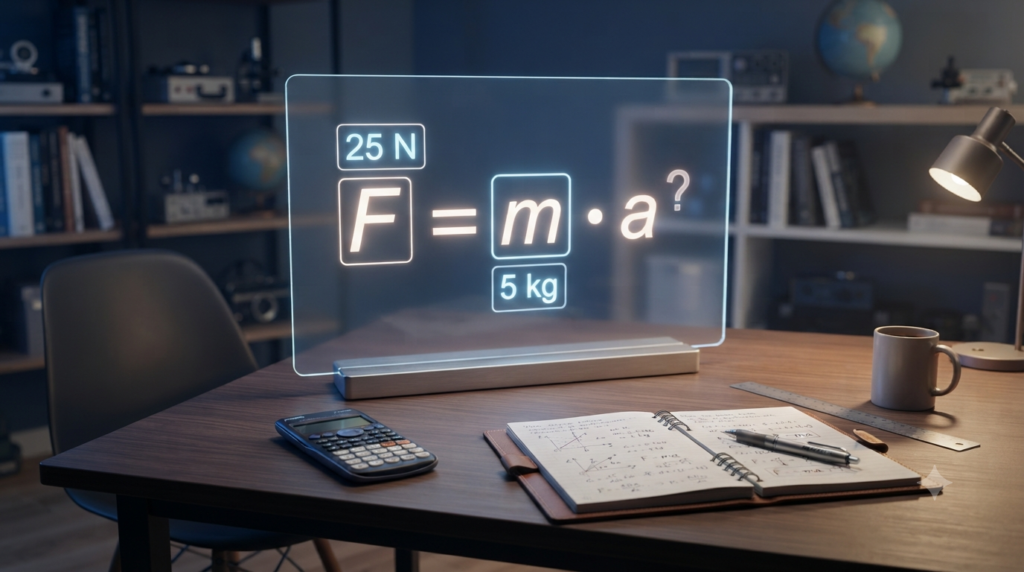
F = ma
If the mass is 4 kg and acceleration is 3 m/s², substitute the values as:
F = 4 × 3
So:
F = 12 N
If the values were accidentally reversed or one quantity was omitted, the calculation would not represent the original physical relationship.
Correct substitution helps you:
avoid calculation mistakes
keep track of physical quantities
maintain correct units
understand the structure of a formula
check whether the final answer makes physical sense
Step 1 Identify the Required Quantity
Before substituting anything, determine what the question is asking you to find.
For example, if a problem asks:
“Calculate the acceleration of an object.”
You should identify acceleration as the unknown quantity.
If the formula is:
a = (v – u)/t
then a is the quantity you need to calculate.
This first step prevents you from using a formula without knowing what result you are trying to obtain.
Step 2 Write the Formula
Always write the relevant formula before putting in the numerical values.
Suppose an object changes its velocity from 10 m/s to 30 m/s in 5 s.
The acceleration formula is:
a = (v – u)/t
Writing the formula first makes it easier to identify where each value belongs.
Step 3 List the Given Values
Write down the known quantities and their units.
For the example above:
This step is especially useful when a problem contains several numbers. It prevents confusion about which number belongs to which physical quantity.
Step 4 Check the Units
Before substitution, check whether the units are compatible with the formula.
For example, the formula:
v = s/t
requires distance and time in suitable units if you want the answer in a particular unit.
If distance is given as 2 km and time as 10 s, you can substitute directly to obtain:
v = 2 km/10 s = 0.2 km/s
But if you want the answer in m/s, convert 2 km to 2000 m first:
v = 2000 m/10 s = 200 m/s
Unit conversion can therefore be an important part of substitution.
Step 5 Replace Symbols With Values
Now replace each symbol with its corresponding value.
For the acceleration example:
a = (v – u)/t
Substitute:
a = (30 – 10)/5
Then simplify:
a = 20/5
Therefore:
a = 4 m/s²
Keeping the formula and substitution on separate lines makes the solution easier to follow and check.
Step 6 Follow the Correct Order of Operations
Physics calculations follow the same mathematical rules used in mathematics.
Consider:
s = ut + ½at²
Suppose:
Substitute:
s = (5)(4) + ½(2)(4²)
First calculate the power:
4² = 16
Then:
s = 20 + ½(2)(16)
Next:
s = 20 + 16
Therefore:
s = 36 m
Do not simply calculate the numbers from left to right without considering brackets, powers, multiplication, and addition.
Using Brackets During Substitution
Brackets are particularly important when a value is negative.
For example:
v = u + at
Suppose:
Substitute the values carefully:
v = (-5) + (2)(3)
Then:
v = -5 + 6
Therefore:
v = 1 m/s
Writing (-5) rather than simply -5 makes the substitution clearer and reduces the chance of sign errors.
Brackets are also useful when substituting values into expressions containing subtraction.
For example:
K = ½mv²
If v = -4 m/s, write:
K = ½m(-4)²
The square applies to the entire value, so:
(-4)² = 16
The negative sign does not remain in the final squared value.
Substituting Values With Units
Units should not be treated as optional information. They are part of the physical answer.
For example:
F = ma
If:
then:
F = (6 kg)(4 m/s²)
Therefore:
F = 24 kg·m/s²
Since:
1 N = 1 kg·m/s²
the answer is:
F = 24 N
Keeping units during the calculation helps you identify the final physical quantity.
Substituting Decimal Values
Physics problems often contain decimal numbers. These should be substituted carefully.
For example:
P = W/t
Suppose:
Then:
P = 250.5/5.0
Therefore:
P = 50.1 W
Avoid unnecessarily rounding values during intermediate steps because early rounding can affect the final answer.
Substituting Values in Scientific Notation
Very large and very small quantities are often written in scientific notation.
For example:
E = mc²
Suppose:
Substitute:
E = (2 × 10⁻³)(3 × 10⁸)²
First calculate the square:
(3 × 10⁸)² = 9 × 10¹⁶
Then:
E = (2 × 10⁻³)(9 × 10¹⁶)
Therefore:
E = 18 × 10¹³ J
This can be written in standard scientific notation as:
E = 1.8 × 10¹⁴ J
When using scientific notation, carefully handle both the numerical coefficients and powers of ten.
Rearranging a Formula Before Substitution
Sometimes the quantity you need is not isolated in the original formula.
For example:
v = u + at
If you need to find acceleration, rearrange the formula first:
a = (v – u)/t
Then substitute the values.
Suppose:
Then:
a = (20 – 8)/4
Therefore:
a = 3 m/s²
It is usually easier to rearrange the formula before substitution rather than trying to manipulate the equation after inserting several numbers.
A Complete Example
Consider the problem:
“An object starts from rest and accelerates at 3 m/s² for 6 s. Find its final velocity.”
The formula is:
v = u + at
Since the object starts from rest:
u = 0 m/s
Other values are:
Substitute:
v = 0 + (3)(6)
Calculate:
v = 18 m/s
Therefore, the final velocity is 18 m/s.
Notice the sequence:
Identify → Write → List → Check units → Substitute → Calculate → Write the unit
This simple sequence can be applied to many physics problems.
Common Mistakes During Substitution
Several mistakes occur frequently when substituting values into formulas.
Using the Wrong Value
A problem may contain several numbers, but not every number belongs in the formula. Always identify which physical quantity each number represents.
Forgetting Units
Writing only a numerical answer can make it unclear what physical quantity has been calculated. Include the appropriate unit.
Ignoring Negative Signs
A negative value must be substituted with its sign. Using brackets makes this safer.
Substituting Before Rearranging
If the required quantity is not isolated, rearrange the formula first.
Rounding Too Early
Keep enough digits during intermediate calculations and round the final answer appropriately.
Using Incompatible Units
Values such as kilometres and metres or hours and seconds may need conversion before substitution.
How to Check Your Substitution
After calculating an answer, take a moment to check it.
Ask yourself:
Did I use the correct formula?
Did I put each value in the correct position?
Did I include all required values?
Are the units compatible?
Did I handle negative signs correctly?
Did I follow the order of operations?
Does the final unit match the quantity I calculated?
Does the answer seem physically reasonable?
These checks take only a few seconds but can catch many common mistakes.
Conclusion
Substituting values into physics formulas is a basic skill that supports almost every type of numerical physics problem. The process becomes much easier when you follow a consistent method: identify the required quantity, write the formula, list the given values, check the units, substitute carefully, calculate in the correct order, and include the final unit. Brackets are especially useful for negative values, while formula rearrangement may be necessary before substitution. With regular practice, substitution becomes a natural part of solving physics problems and helps you focus more on understanding the physical situation behind the mathematics.
FAQs
1. What does substituting values into a physics formula mean?
Substituting values into a physics formula means replacing the symbols representing physical quantities with their known numerical values. For example, in the formula v = s/t, if distance is 100 m and time is 20 s, replace s with 100 and t with 20. The calculation becomes v = 100/20, giving v = 5 m/s. Substitution is an important step in solving numerical physics problems because it connects the general mathematical relationship expressed by a formula with the specific information given in a problem. Correct substitution also helps maintain the proper units and reduces calculation errors.
2. Why should I write the formula before substituting values?
Writing the formula before substitution helps you understand the relationship between the physical quantities involved. It also provides a clear structure for placing each given value in the correct position. For example, if you need to calculate force using F = ma, writing the formula first shows that mass must be multiplied by acceleration. If the values are 5 kg and 4 m/s², you can then write F = (5)(4). This approach makes your solution easier to follow, check, and correct. It also reduces the chance of accidentally using a number for the wrong physical quantity.
3. Should units be included when substituting values?
Yes, units should be included when substituting values into physics formulas. Units provide important information about the physical quantities being used and help determine the unit of the final answer. For example, in F = ma, substituting m = 5 kg and a = 2 m/s² gives F = (5 kg)(2 m/s²) = 10 N. Keeping units visible can also reveal problems such as incompatible measurements. If one value is given in kilometres while another requires metres, conversion may be necessary before substitution. Therefore, units are an essential part of a correct physics calculation.
4. What should I do if a value is negative?
When a given physical quantity is negative, include the negative sign during substitution. Using brackets is a good way to prevent mistakes. For example, if u = -6 m/s and the formula is v = u + at, write v = (-6) + (2)(4). This gives v = -6 + 8 = 2 m/s. The negative sign may represent direction or another physical meaning, depending on the problem. Never remove or ignore a negative sign simply because it looks inconvenient. Carefully substituting negative values is especially important in problems involving velocity, displacement, acceleration, electric charge, or potential.
5. When should I convert units before substitution?
You should convert units when the values are not compatible with the formula or when a particular unit is required for the final answer. For example, if distance is given in kilometres but you need speed in metres per second, convert the distance from kilometres to metres before calculating. Similarly, time may need to be converted from hours to seconds. Consider v = s/t. If s = 2 km and t = 10 s, you can calculate in km/s, but converting 2 km to 2000 m gives v = 2000/10 = 200 m/s. Always check units before substitution.
6. Should I rearrange a physics formula before substituting values?
Usually, yes. If the quantity you need is not already isolated, rearranging the formula first makes substitution simpler and less confusing. For example, the formula v = u + at can be rearranged to find acceleration as a = (v - u)/t. If v = 20 m/s, u = 8 m/s, and t = 4 s, substitute directly into the rearranged formula: a = (20 - 8)/4 = 3 m/s². Rearranging first reduces the amount of algebra you need to perform after inserting numbers and makes it easier to identify exactly what you are calculating.
7. How do brackets help when substituting values?
Brackets make substitutions clearer and help prevent mathematical errors, particularly when values are negative, decimal, or part of a larger expression. For example, if v = -5 m/s, a = 2 m/s², and t = 3 s, then the formula v = u + at can be written as v = (-5) + (2)(3). Brackets clearly show that -5 is the complete value being substituted for the variable. They are also useful when substituting into formulas involving powers, fractions, or differences. Careful use of brackets makes complex substitutions easier to read and calculate correctly.
8. What is the correct order for solving a formula after substitution?
After substitution, follow the normal mathematical order of operations. Generally, calculate values inside brackets first, then powers or exponents, followed by multiplication and division, and finally addition and subtraction. For example, in s = ut + ½at², if u = 5 m/s, a = 2 m/s², and t = 4 s, write s = (5)(4) + ½(2)(4²). First calculate 4², then multiplication, and finally addition. Following this order prevents errors and ensures that the numerical calculation correctly represents the original physics formula.
9. How can I avoid mistakes when substituting values?
A consistent step-by-step method can prevent most substitution mistakes. First, identify what the question asks you to find. Then write the correct formula and list the given values with their units. Check whether unit conversions are needed. Next, substitute each value carefully, using brackets where appropriate. Perform the calculation according to the order of operations and include the correct unit in the final answer. Finally, check whether the result is reasonable. Reviewing each step is particularly helpful when a problem contains several values, negative numbers, powers, fractions, or unit conversions.
10. How do I know if my final answer is correct?
You can check your final answer in several ways. First, make sure you used the correct formula and substituted every value into the appropriate position. Check the units to confirm that they match the quantity being calculated. Review signs, powers, brackets, and arithmetic operations for possible mistakes. You can also estimate the expected size of the answer to see whether the result is reasonable. For example, if a calculation involves multiplying 5 by 4, an answer of 200 would immediately suggest an arithmetic error. These checks help verify both the mathematical calculation and the physical meaning of your answer.
Related Posts
What Do Coefficients Mean in Chemistry Formulas?
When you look at a chemical equation, you may notice numbers written before chemical formulas. These numbers are called coefficients. […]
Read MoreHow to Read Subscripts in Chemical Formulas
Chemical formulas are a simple way to represent substances using symbols and numbers. When you look at a formula such […]
Read MoreHow to Identify Elements in a Chemical Formula
Chemical formulas provide a simple way to describe the substances that make up the world around us. A formula may […]
Read MoreHow Elements Are Represented in Chemical Formulas
Chemistry deals with many different substances, from the oxygen we breathe to the water we drink and the minerals found […]
Read MoreChemical Symbols and Their Role in Chemistry Formulas
Chemistry is often described as the science of matter, but understanding chemistry also means learning how scientists communicate information about […]
Read MoreHow Chemical Formulas Represent Substances
Chemical formulas are one of the simplest ways scientists communicate information about matter. A substance may contain millions or billions […]
Read MoreWhat Is a Chemical Formula in Chemistry?
Chemistry is the study of substances, their properties, and the changes they undergo. To describe these substances clearly, chemists need […]
Read MoreBasic Types of Chemistry Formulas Explained
Chemistry formulas are one of the simplest ways scientists describe substances, reactions, and relationships between different particles. A formula can […]
Read MoreHow to Read and Understand Chemistry Formulas
Chemistry formulas may look like a collection of letters, numbers, and symbols, but they are actually a simple language used […]
Read MoreWhat Are Chemistry Formulas and Why Are They Important?
Chemistry is the science of substances, their properties, and the changes they undergo. To describe these substances clearly, chemists use […]
Read MoreHow to Verify an Answer Using Units
In physics, getting a numerical answer is only part of solving a problem. The next question is whether that answer […]
Read MoreHow to Check Whether a Physics Formula Is Correct
A physics formula is more than a collection of symbols and numbers. It represents a relationship between physical quantities and […]
Read MoreHow to Avoid Unit Conversion Mistakes in Physics
Unit conversion is one of the most common sources of mistakes in physics. A formula may be correct, the calculation […]
Read MoreHow to Avoid Sign Errors in Physics Calculations
Physics calculations are not only about choosing the correct formula and putting numbers into it. The signs of physical quantities […]
Read MoreCommon Mistakes When Using Physics Formulas
Physics formulas help us describe motion, forces, energy, electricity, heat, waves, and many other phenomena using mathematical relationships. A formula […]
Read MoreHow to Study Physics Formulas Step by Step
Physics formulas are an important part of learning physics, but simply memorizing them is not enough. A formula represents a […]
Read MoreHow to Organize Physics Formulas for Easy Revision
Physics becomes much easier when formulas are organized in a clear and meaningful way. Many learners struggle not because they […]
Read MoreHow to Build a Physics Formula Sheet
Physics involves many formulas, and remembering all of them can become difficult as you move from basic concepts to more […]
Read More