
Chemical formulas provide a compact way to describe what a substance is made of. A formula tells us which elements are present and how many atoms of each element are included. However, counting atoms from a chemical formula can sometimes seem confusing, especially when subscripts, coefficients, parentheses, and brackets appear together.
Learning how to count atoms correctly is an important chemistry skill. It helps you understand the composition of compounds, balance chemical equations, calculate molar masses, and interpret chemical reactions. The basic idea is simple: element symbols identify the atoms, while subscripts and coefficients tell us how many atoms are present.
Once you understand how these numbers work, even complicated formulas can be broken down step by step.
What Does a Chemical Formula Tell Us?
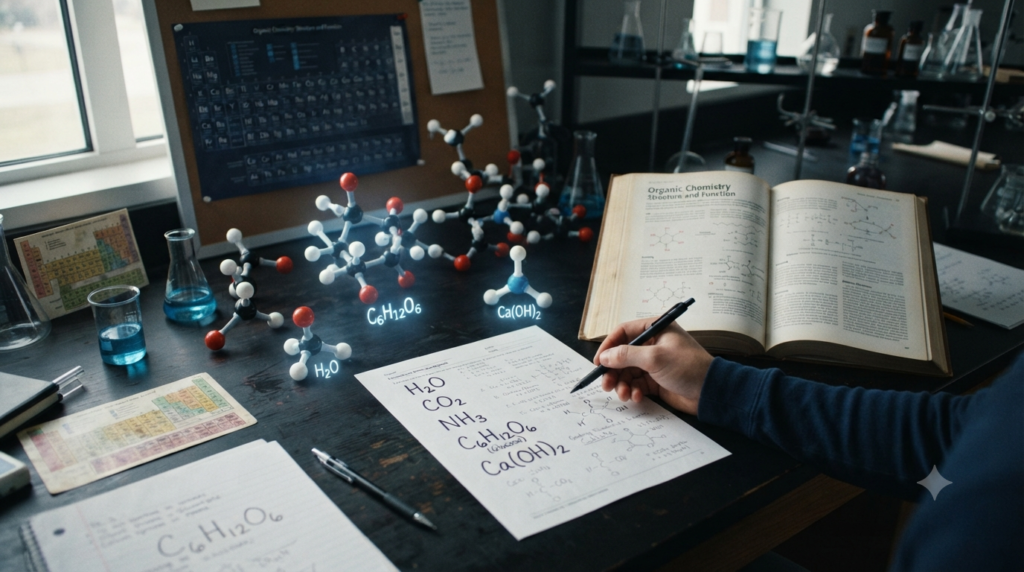
A chemical formula uses element symbols and numbers to represent the composition of a substance. For example, water is represented by H₂O.
The symbols H and O represent hydrogen and oxygen. The subscript ₂ after H means that there are two hydrogen atoms. Since O has no subscript, it represents one oxygen atom.
Therefore:
H₂O = 2 hydrogen atoms + 1 oxygen atom
The total number of atoms in one molecule of water is 3.
The same principle applies to other chemical formulas, although more complicated formulas may contain several elements and groups of atoms.
Understanding Element Symbols
The first step in counting atoms is to identify every element symbol in the formula.
An element symbol usually contains one or two letters. The first letter is always uppercase, while the second letter, if present, is lowercase.
For example:
H = hydrogen
O = oxygen
Na = sodium
Cl = chlorine
Ca = calcium
Al = aluminum
Fe = iron
It is important to recognize two-letter element symbols correctly. For example, Na represents one sodium element, not separate nitrogen and oxygen elements.
Consider the formula NaCl. It contains:
1 sodium atom
1 chlorine atom
The absence of a subscript means the number is understood to be 1.
What Do Subscripts Mean?
A subscript is a small number written at the lower right of an element symbol. It tells you how many atoms of that element are present.
For example, in CO₂, the subscript ₂ belongs to oxygen.
Therefore:
CO₂ = 1 carbon atom + 2 oxygen atoms
The total number of atoms is:
1 + 2 = 3 atoms
If a formula contains H₂S, the subscript ₂ applies only to hydrogen.
H₂S = 2 hydrogen atoms + 1 sulfur atom
If an element has no subscript, always remember that its count is 1.
For example:
NH₃ = 1 nitrogen atom + 3 hydrogen atoms
Counting Atoms in Simple Formulas
For formulas without parentheses or coefficients, counting atoms is straightforward.
Consider calcium chloride:
CaCl₂
Calcium has no subscript, so there is 1 calcium atom. Chlorine has a subscript of 2, so there are 2 chlorine atoms.
Therefore:
Calcium = 1 atom
Chlorine = 2 atoms
Total = 3 atoms
Now consider sulfuric acid:
H₂SO₄
The formula contains:
H = 2 atoms
S = 1 atom
O = 4 atoms
So the total number of atoms is:
2 + 1 + 4 = 7 atoms
The key is to read each element separately and assign a count based on its subscript.
What Happens When a Coefficient Appears?
A coefficient is a number placed in front of a chemical formula. Unlike a subscript, a coefficient applies to the entire formula.
For example:
3H₂O
The formula H₂O contains 2 hydrogen atoms and 1 oxygen atom. The coefficient 3 means there are three H₂O molecules.
Therefore, multiply every atom count by 3:
Hydrogen = 2 × 3 = 6 atoms
Oxygen = 1 × 3 = 3 atoms
So:
3H₂O = 6 hydrogen atoms + 3 oxygen atoms
The total number of atoms is:
6 + 3 = 9 atoms
This distinction is extremely important. A subscript changes the number of atoms of the element immediately before it, while a coefficient multiplies the entire formula.
Counting Atoms Inside Parentheses
Some chemical formulas contain groups of atoms enclosed in parentheses. A subscript outside the parentheses applies to every element inside the parentheses.
Consider calcium hydroxide:
Ca(OH)₂
The subscript ₂ outside the parentheses applies to both O and H.
First, count the atoms inside one OH group:
O = 1
H = 1
Then multiply both by 2:
O = 1 × 2 = 2
H = 1 × 2 = 2
Calcium has no subscript, so:
Ca = 1
Therefore:
Ca(OH)₂ = 1 calcium atom + 2 oxygen atoms + 2 hydrogen atoms
The total is:
1 + 2 + 2 = 5 atoms
Counting Atoms in More Complex Formulas
Let’s consider aluminum sulfate:
Al₂(SO₄)₃
This formula contains aluminum and a sulfate group.
Start with aluminum:
Al₂ = 2 aluminum atoms
Now examine the group:
(SO₄)₃
The subscript ₃ applies to the entire SO₄ group.
Inside one sulfate group:
S = 1
O = 4
Multiply each by 3:
S = 1 × 3 = 3
O = 4 × 3 = 12
Therefore:
Al = 2
S = 3
O = 12
The total number of atoms is:
2 + 3 + 12 = 17 atoms
Breaking the formula into smaller parts makes the calculation much easier.
Counting Atoms With a Coefficient and Parentheses
Now consider a formula that contains both a coefficient and parentheses:
2Al(OH)₃
First analyze one unit of Al(OH)₃.
Al has no subscript:
Al = 1
The OH group has a subscript ₃:
O = 3
H = 3
So one Al(OH)₃ unit contains:
1 aluminum atom
3 oxygen atoms
3 hydrogen atoms
Now multiply everything by the coefficient 2:
Al = 1 × 2 = 2
O = 3 × 2 = 6
H = 3 × 2 = 6
Therefore:
2Al(OH)₃ = 2 aluminum atoms + 6 oxygen atoms + 6 hydrogen atoms
The total number of atoms is:
2 + 6 + 6 = 14 atoms
A Simple Method for Counting Atoms
You can use a four-step method for almost any chemical formula.
Step 1: Identify Every Element
Write down each different element symbol in the formula.
Step 2: Read the Subscripts
Determine how many atoms of each element are present. If there is no subscript, use 1.
Step 3: Apply Parentheses
If a group is followed by a subscript, multiply every atom inside that group by the subscript.
Step 4: Apply the Coefficient
If there is a coefficient in front of the formula, multiply the entire atom count by that coefficient.
This method helps prevent mistakes because each part of the formula is handled separately.
Common Mistakes When Counting Atoms
One common mistake is ignoring an implied 1. For example, in CO₂, carbon is present as one atom, not zero.
Another mistake is applying a subscript only to the first element inside parentheses. In Ca(OH)₂, the ₂ applies to both oxygen and hydrogen.
A third mistake is confusing coefficients with subscripts. In 2CO₂, the coefficient 2 multiplies both carbon and oxygen. Therefore, there are 2 carbon atoms and 4 oxygen atoms.
It is also important not to change subscripts while counting. Changing a subscript changes the chemical formula itself and can represent a different substance.
Why Is Counting Atoms Important?
Counting atoms is more than an exercise in reading numbers. It is an important foundation for understanding chemical composition and reactions.
Knowing the number of atoms in a formula helps when calculating molecular or formula mass. It is also essential when balancing chemical equations because the same number of atoms of each element must appear on both sides of a balanced equation.
Atom counting also helps you understand ratios within compounds. For example, H₂O always represents a 2:1 ratio of hydrogen atoms to oxygen atoms.
Conclusion
Counting atoms from a chemical formula becomes much easier once you understand the roles of element symbols, subscripts, parentheses, and coefficients. Element symbols tell you which elements are present, subscripts tell you how many atoms are associated with an element or group, and coefficients multiply the entire formula.
Start with simple formulas such as H₂O and CO₂, then move to formulas containing parentheses and coefficients such as Ca(OH)₂ and Al₂(SO₄)₃. By breaking each formula into smaller parts and calculating one step at a time, you can accurately determine the number of atoms present in even complex chemical formulas. This basic skill provides a strong foundation for learning chemical equations, molecular masses, and many other concepts in chemistry.
FAQs
1. How do you count atoms in a chemical formula?
To count atoms, identify each element symbol and look for its subscript. A subscript tells you how many atoms of that element are present. If there is no subscript, the number is understood to be one. For example, H₂O contains two hydrogen atoms and one oxygen atom. If parentheses are present, multiply every atom inside the parentheses by the subscript outside them. If a coefficient appears before the formula, multiply the entire formula by that coefficient. For example, 2H₂O contains four hydrogen atoms and two oxygen atoms. Breaking the formula into smaller parts makes atom counting easier.
2. What does a subscript mean in a chemical formula?
A subscript is a small number written after an element symbol. It tells you how many atoms of that element are present in one molecule or formula unit. For example, CO₂ contains one carbon atom and two oxygen atoms because the subscript ₂ belongs to oxygen. If an element has no subscript, its count is one. In H₂SO₄, hydrogen has two atoms, sulfur has one atom, and oxygen has four atoms. Subscripts are important because they describe the fixed atomic ratio within a compound. Changing a subscript changes the chemical formula and can create a different substance.
3. What does a coefficient mean when counting atoms?
A coefficient is a number placed before a chemical formula. It tells you how many molecules or formula units are represented and multiplies every atom in the formula. For example, 3H₂O means three water molecules. One H₂O molecule contains two hydrogen atoms and one oxygen atom. Therefore, 3H₂O contains six hydrogen atoms and three oxygen atoms. The coefficient affects the entire formula, unlike a subscript, which normally applies only to the element or group immediately before it. Remembering this difference is essential when counting atoms and balancing chemical equations.
4. How do you count atoms in formulas with parentheses?
When a chemical formula contains parentheses, a subscript outside the parentheses applies to every element inside the parentheses. For example, Ca(OH)₂ contains one calcium atom, two oxygen atoms, and two hydrogen atoms. The subscript ₂ multiplies both O and H. To count atoms, first identify the elements inside the parentheses, determine their individual counts, and then multiply those counts by the outside subscript. This method also works for larger groups. For example, Al₂(SO₄)₃ contains two aluminum atoms, three sulfur atoms, and twelve oxygen atoms.
5. How many atoms are in H₂O?
One H₂O molecule contains three atoms in total. The subscript ₂ after H means there are two hydrogen atoms. Oxygen has no subscript, so there is one oxygen atom. Therefore, H₂O contains two hydrogen atoms and one oxygen atom. Adding them gives a total of three atoms. The formula also shows that hydrogen and oxygen occur in a 2:1 atomic ratio. If a coefficient is placed before H₂O, the total changes. For example, 2H₂O contains four hydrogen atoms and two oxygen atoms, giving six atoms altogether.
6. How many atoms are in CO₂?
One molecule of CO₂ contains three atoms in total. Carbon has no subscript, so there is one carbon atom. Oxygen has the subscript ₂, meaning there are two oxygen atoms. Therefore, CO₂ contains one carbon atom and two oxygen atoms. The total is three atoms. The formula also shows a carbon-to-oxygen ratio of 1:2. If a coefficient is added, multiply both counts by that coefficient. For example, 3CO₂ contains three carbon atoms and six oxygen atoms, for a total of nine atoms.
7. How do you count atoms in Ca(OH)₂?
To count atoms in Ca(OH)₂, start with calcium. Calcium has no subscript, so there is one calcium atom. Next, examine the OH group inside the parentheses. It contains one oxygen atom and one hydrogen atom. The subscript ₂ outside the parentheses means the entire OH group occurs twice. Therefore, oxygen has two atoms and hydrogen has two atoms. The complete formula contains one calcium atom, two oxygen atoms, and two hydrogen atoms. Adding them gives five atoms in total. This example demonstrates why parentheses must be considered carefully when counting atoms.
8. How do coefficients and subscripts work together?
Coefficients and subscripts both affect atom counts, but they do so differently. A subscript tells you the number of atoms in a particular element or group, while a coefficient multiplies the entire formula. For example, 2Al₂O₃ contains two formula units of Al₂O₃. One unit contains two aluminum atoms and three oxygen atoms. Multiplying by the coefficient 2 gives four aluminum atoms and six oxygen atoms. Therefore, the total is ten atoms. A useful strategy is to calculate the atom counts inside one formula first and then multiply every count by the coefficient.
9. Why is counting atoms important in chemistry?
Counting atoms helps you understand the composition of compounds and chemical reactions. It is especially important when calculating molecular or formula masses and balancing chemical equations. A chemical equation is balanced only when the number of atoms of each element is the same on both sides. For example, understanding that H₂O contains two hydrogen atoms and one oxygen atom helps you correctly interpret reactions involving water. Atom counting also helps explain the ratios between elements in compounds. Learning this skill provides a foundation for more advanced chemistry topics, including stoichiometry, molar mass, and chemical equations.
10. What is the easiest way to count atoms in a complex formula?
The easiest method is to break the formula into smaller parts. First, identify every element symbol. Next, read the subscripts and assign the correct number to each element. If parentheses are present, multiply the atoms inside them by the subscript outside the parentheses. Finally, if there is a coefficient before the formula, multiply every atom count by that coefficient. For example, in 2Al(OH)₃, first count one Al(OH)₃ unit, then multiply all counts by two. This step-by-step approach reduces mistakes and works for both simple and complex chemical formulas.
Related Posts
What Is Valency in Chemistry?
Valency is one of the basic concepts in chemistry that helps us understand how atoms combine with one another to […]
Read MoreHow Valency Helps in Writing Chemical Formulas
Writing a chemical formula is not simply a matter of putting element symbols together. A correct formula must show how […]
Read MoreHow to Write Formulas Using Valency
Writing chemical formulas becomes much easier when you understand valency. A chemical formula tells us which elements are present in […]
Read MoreHow to Write Formulas for Molecular Compounds
Writing the formula of a molecular compound is an important skill in chemistry. A chemical formula tells us which elements […]
Read MoreHow to Write Formulas for Ionic Compounds
Writing formulas for ionic compounds is an important skill in chemistry because a chemical formula tells us which ions are […]
Read MoreHow to Write Simple Chemical Formulas
Chemical formulas are a simple way to represent substances using symbols and numbers. Instead of writing the full name of […]
Read MoreChemical Formula vs Chemical Equation
Chemistry uses symbols, numbers, and formulas to describe substances and chemical changes. Two important ways of representing chemical information are […]
Read MoreWhat Is a Condensed Chemical Formula?
A condensed chemical formula is a convenient way of writing the structure of an organic compound without drawing every bond […]
Read MoreWhat Is a Structural Formula?
A structural formula is a way of representing a chemical compound by showing how its atoms are arranged and connected […]
Read MoreMolecular Formula vs Empirical Formula
Chemical formulas give us a simple way to represent substances using the symbols of elements and numbers. However, not all […]
Read MoreWhat Is an Empirical Formula?
An empirical formula is a simple way of representing the composition of a chemical compound. It shows the simplest whole-number […]
Read MoreWhat Is a Molecular Formula?
A molecular formula is a way of representing a substance using chemical symbols and numbers. It tells us which elements […]
Read MoreHow to Calculate the Total Number of Atoms in a Formula
Chemical formulas provide a compact way to show which elements are present in a substance and how many atoms of […]
Read MoreHow to Count Atoms From a Chemical Formula
Chemical formulas provide a compact way to describe what a substance is made of. A formula tells us which elements […]
Read MoreSubscripts vs Coefficients in Chemical Formulas
Chemical formulas may look like simple combinations of letters and numbers, but every symbol and number has a specific meaning. […]
Read MoreWhat Do Coefficients Mean in Chemistry Formulas?
When you look at a chemical equation, you may notice numbers written before chemical formulas. These numbers are called coefficients. […]
Read MoreHow to Read Subscripts in Chemical Formulas
Chemical formulas are a simple way to represent substances using symbols and numbers. When you look at a formula such […]
Read MoreHow to Identify Elements in a Chemical Formula
Chemical formulas provide a simple way to describe the substances that make up the world around us. A formula may […]
Read More