The International System of Units, known as the SI system, provides a common language for measuring physical quantities. Whether scientists measure the mass of a particle, the distance between planets, or the time taken by a moving object, they need standardized units that everyone can understand. SI base units form the foundation of this measurement system. They are used to define many other units, such as the newton, joule, and pascal.
Learning the seven SI base units and their official symbols is an important step toward understanding physics, chemistry, engineering, and other scientific fields. These units make measurements consistent, help scientists compare experimental results, and allow researchers around the world to communicate accurately.
What Are SI Base Units?
SI base units are seven fundamental measurement units used to describe seven carefully defined base quantities. These quantities are considered independent within the SI system. Other measurement units, called derived units, are formed by combining base units according to mathematical relationships.
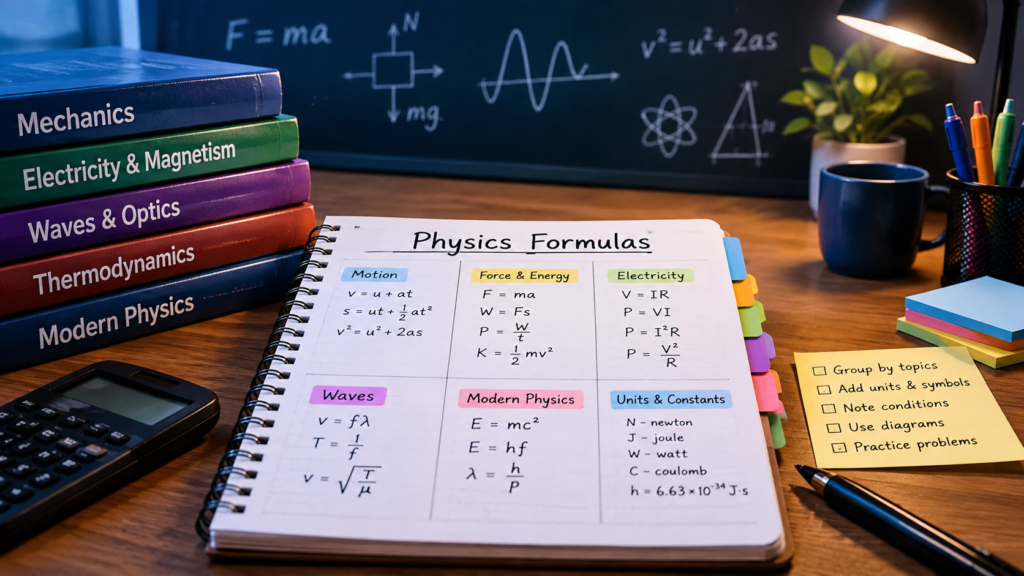
For example, speed is calculated by dividing distance by time. Since distance is measured in metres and time is measured in seconds, the SI unit of speed is metres per second, written as m/s. Similarly, force is measured in newtons, which can be expressed in terms of kilograms, metres, and seconds.
The seven SI base units provide the foundation for these and many other measurements. Each has an official name and a specific symbol that is used internationally.
The Seven SI Base Units and Their Official Symbols
The SI system contains exactly seven base units. Each one corresponds to a particular base quantity.
| Base quantity | SI base unit | Official symbol |
|---|
| Time | Second | s |
| Length | Metre | m |
| Mass | Kilogram | kg |
| Electric current | Ampere | A |
| Thermodynamic temperature | Kelvin | K |
| Amount of substance | Mole | mol |
| Luminous intensity | Candela | cd |
These units are used in scientific measurements throughout the world. Although some units may have different names in everyday language, the official SI symbols remain standardized.
1. Second and Its Official Symbol s
The second is the SI base unit of time, and its official symbol is s.
Time is used to describe the duration of events and the order in which they occur. It is essential for studying motion, oscillations, waves, reactions, and changes in physical systems.
In the modern SI system, the second is defined using the frequency of radiation associated with a specific transition in the caesium-133 atom. This atomic definition allows highly precise and reproducible measurements of time.
The second is used in many familiar units, including minutes and hours, although these are not SI base units. It also appears in derived units such as metres per second for speed and seconds squared in acceleration formulas.
For example:
Time = 10 s
Here, the number 10 represents the measured value, while s represents the unit.
2. Metre and Its Official Symbol m
The metre is the SI base unit of length, and its official symbol is m.
Length describes the distance between two points or the size of an object in a particular direction. Scientists use the metre to measure the dimensions of objects, distances travelled, wavelengths, and many other quantities.
The metre is defined using the speed of light in a vacuum. The speed of light has an exact fixed value of 299,792,458 metres per second. This definition connects the measurement of length with the measurement of time.
The metre is commonly used in physics, construction, astronomy, engineering, and everyday measurements. Larger and smaller lengths can be expressed using SI prefixes.
Examples include:
1 kilometre = 1,000 m
1 centimetre = 0.01 m
1 millimetre = 0.001 m
For example, a table with a length of 2 m has a numerical value of 2 and the unit symbol m.
3. Kilogram and Its Official Symbol kg
The kilogram is the SI base unit of mass, and its official symbol is kg.
Mass represents the amount of matter in an object and is also a measure of its resistance to changes in motion. It is an important quantity in mechanics, chemistry, astronomy, and many other areas of science.
The kilogram is unique among the seven SI base units because it is the only base unit whose name already contains an SI prefix, kilo-. Its symbol is written as kg, not simply g.
The modern definition of the kilogram is based on the fixed numerical value of the Planck constant. This definition allows the unit to be realized through precise physical experiments rather than depending on a particular physical object.
Examples of mass measurements include:
1 kg = 1,000 g
0.5 kg = 500 g
2 kg = 2,000 g
The kilogram is also used in the definition of the newton, the SI derived unit of force.
4. Ampere and Its Official Symbol A
The ampere is the SI base unit of electric current, and its official symbol is A.
Electric current describes the rate at which electric charge flows through a conductor or another part of an electrical circuit. It is essential for understanding electricity, electronic devices, motors, generators, and electrical power systems.
The ampere is defined using the elementary charge, which is the magnitude of the electric charge of a proton or electron. The elementary charge has an exact fixed numerical value in the SI system.
When a current flows through a circuit, its value can be measured in amperes. Smaller currents are often expressed using milliamperes or microamperes.
Examples include:
1 A = 1,000 mA
0.5 A = 500 mA
2 A = 2,000 mA
The ampere is represented by a capital A. It should not be confused with the symbol for area or other physical quantities.
5. Kelvin and Its Official Symbol K
The kelvin is the SI base unit of thermodynamic temperature, and its official symbol is K.
Temperature describes the thermal state of a system. It is important in the study of heat, thermodynamics, gases, chemical reactions, climate, and many natural processes.
The kelvin is defined using the fixed numerical value of the Boltzmann constant. This connects temperature with the energy associated with microscopic particles.
Unlike degrees Celsius, the kelvin is written without a degree symbol. For example, the correct form is 300 K, not 300°K.
The Kelvin and Celsius scales have the same size of temperature interval, but their zero points are different. A temperature of 0 °C is equal to approximately 273.15 K.
The conversion between the two scales is:
Temperature in kelvins = Temperature in degrees Celsius + 273.15
For example:
25 °C = 298.15 K
Kelvin is widely used in scientific and engineering calculations, especially when studying thermodynamic processes.
6. Mole and Its Official Symbol mol
The mole is the SI base unit of amount of substance, and its official symbol is mol.
Amount of substance is a physical quantity used to express how many specified elementary entities are present in a sample. These entities may be atoms, molecules, ions, electrons, or other microscopic particles.
One mole contains exactly 6.02214076 × 10²³ specified elementary entities. This number is known as the Avogadro constant when expressed in entities per mole.
For example, one mole of water molecules contains 6.02214076 × 10²³ water molecules. One mole of carbon atoms contains the same number of carbon atoms.
The mole is particularly important in chemistry because individual atoms and molecules are extremely small and cannot usually be counted directly in ordinary laboratory work. Instead, scientists use mass measurements and chemical calculations to determine the amount of substance.
The mole helps connect the microscopic world of particles with measurable quantities in the laboratory.
7. Candela and Its Official Symbol cd
The candela is the SI base unit of luminous intensity, and its official symbol is cd.
Luminous intensity describes the strength of visible light emitted by a source in a particular direction. It is used in photometry, which is the science of measuring light according to the response of the human eye.
The candela is defined using a specified frequency of visible electromagnetic radiation and a fixed value for the luminous efficacy of that radiation. This definition establishes a precise reference for measuring luminous intensity.
Luminous intensity is different from total light output. A light source may emit light in many directions, while luminous intensity describes how strong the light is in one particular direction.
The candela is used in lighting technology, optical instruments, display design, and other applications involving visible light.
For example, the brightness characteristics of lamps, signal lights, and other sources can be studied using photometric quantities related to the candela.
Why Are SI Base Units Important?
SI base units are important because they establish a consistent foundation for scientific measurement. Without standardized units, measurements made in different laboratories or countries would be difficult to compare.
1. They Improve Measurement Consistency
Scientists can use the same base units to report experimental results. A length measured in metres has the same meaning regardless of where the measurement is made.
2. They Support Derived Units
Many important physical units are created from SI base units. For example, force is measured in newtons, and one newton is equal to:
1 N = 1 kg·m/s²
Energy is measured in joules:
1 J = 1 kg·m²/s²
Pressure is measured in pascals:
1 Pa = 1 kg/(m·s²)
These relationships show how the seven base units support a much larger system of scientific measurements.
3. They Help Avoid Confusion
Official symbols reduce confusion between different units and quantities. For example, m represents metre, while kg represents kilogram and K represents kelvin. Using the correct symbols makes scientific writing clearer.
4. They Support International Science and Technology
Research, engineering, manufacturing, medicine, and trade often involve cooperation between countries. A common measurement system makes it easier to share data, design equipment, and reproduce experiments.
Official Rules for Writing SI Unit Symbols
Correctly writing SI symbols is just as important as knowing their names. A few simple rules help maintain consistency.
Symbols are not normally followed by full stops. For example, write 5 kg rather than 5 kg.
Symbols are not pluralized. Write 10 m, not 10 ms or 10 m’s to mean ten metres. The correct symbol remains m regardless of the numerical value.
A space is normally placed between the numerical value and the unit symbol. For example, write 25 kg, 8 m, and 300 K.
Capitalization matters. The symbol for the ampere is A, while the symbol for the metre is m. The symbol for kelvin is K, and the symbol for candela is cd.
The kilogram is written as kg. Although kilo- is a prefix, kg is the official symbol of the base unit of mass. Prefixes are added to the gram when expressing smaller or larger masses, such as mg or Mg.
Conclusion
The seven SI base units provide the foundation of modern scientific measurement. They represent time, length, mass, electric current, thermodynamic temperature, amount of substance, and luminous intensity. Their official symbols—s, m, kg, A, K, mol, and cd—allow scientists and engineers to communicate measurements clearly and consistently.
Understanding these units is essential for learning physics and other scientific subjects because many derived units and formulas depend on them. By using the correct names, symbols, and measurement rules, anyone studying science can develop a stronger understanding of how physical quantities are measured and compared throughout the world.