
How Chemical Formulas Help Calculate Composition

Chemical formulas showing molecular composition, molar mass, element ratios, and percentage composition calculations in chemistry.

Chemical formulas are much more than short combinations of element symbols. They provide a compact way to describe what a substance contains and, importantly, allow chemists to calculate its composition. A formula such as H₂O immediately tells us that water contains hydrogen and oxygen in a fixed ratio. From this information, we can determine the number of atoms present, the relative amount of each element, the molar mass of the compound, and even the percentage by mass contributed by each element.

Understanding how chemical formulas reveal composition is an important foundation of chemistry. It connects symbols and subscripts with measurable quantities such as moles and grams. Once this connection is clear, many chemistry calculations become easier to understand.

What a Chemical Formula Tells Us

A chemical formula represents the elements present in a substance and the relative number of atoms of each element.

For example, the formula H₂O contains two different element symbols:

  • H represents hydrogen.

  • O represents oxygen.

  • The subscript ₂ shows that there are two hydrogen atoms for every one oxygen atom.

Therefore, one molecule of water contains two hydrogen atoms and one oxygen atom.

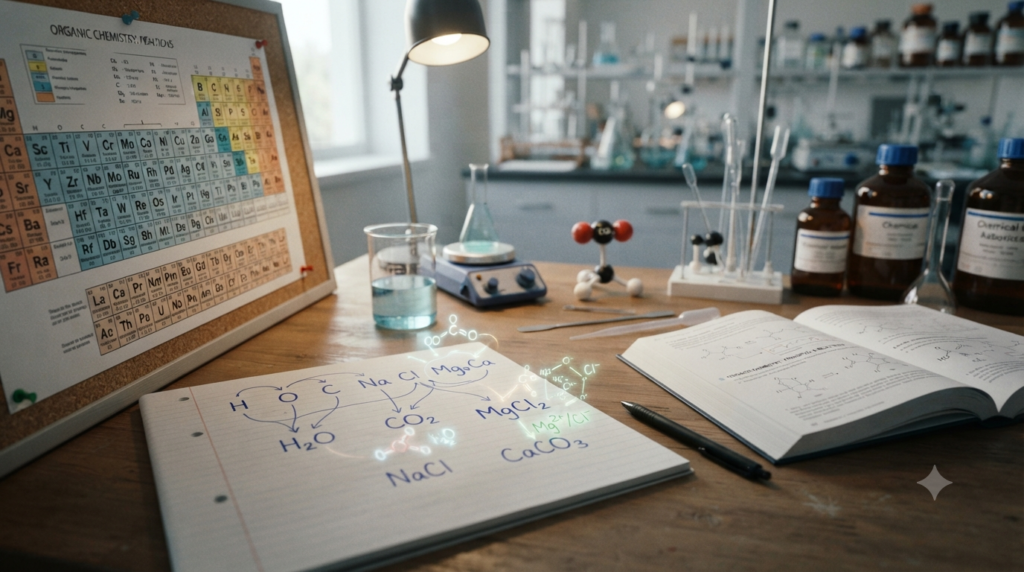
Similarly, CO₂ contains one carbon atom and two oxygen atoms. The formula does not simply name the substance; it provides quantitative information about its composition.

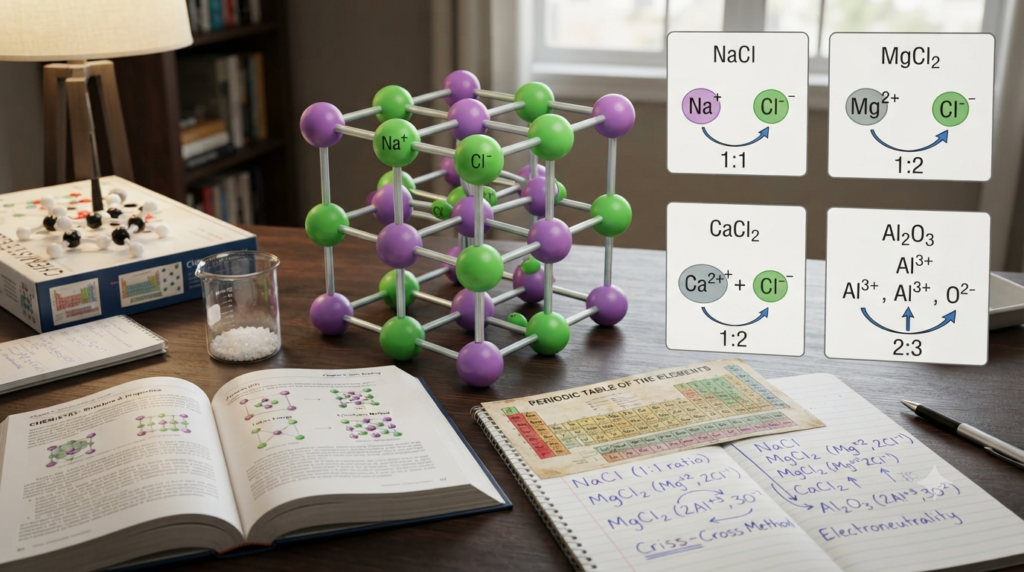
For ionic compounds, the formula represents the simplest whole-number ratio of ions rather than individual molecules. For example, NaCl represents a 1:1 ratio of sodium ions to chloride ions.

Why Subscripts Are Important

The small numbers written after element symbols are called subscripts. They are essential for determining the composition of a compound.

Consider the formula H₂SO₄. It contains:

  • 2 hydrogen atoms

  • 1 sulfur atom

  • 4 oxygen atoms

The total number of atoms in one molecule is therefore 2 + 1 + 4 = 7 atoms.

Now consider Al₂(SO₄)₃. The subscript outside the parentheses applies to every element inside them. Therefore, the formula contains:

  • 2 aluminum atoms

  • 3 sulfur atoms

  • 12 oxygen atoms

This gives a total of 17 atoms in one formula unit.

Correctly reading subscripts and parentheses is the first step toward calculating composition.

Chemical Formulas and Atomic Ratios

A chemical formula gives the ratio in which atoms are combined.

For example, methane has the formula CH₄. This means that carbon and hydrogen are present in a ratio of 1:4.

Ammonia, NH₃, has nitrogen and hydrogen in a ratio of 1:3.

Calcium chloride, CaCl₂, contains calcium and chlorine in a 1:2 ratio.

These ratios are fixed for a particular pure compound. This fixed composition is related to the law of definite proportions, which states that a given compound contains its constituent elements in definite proportions by mass.

However, an atomic ratio is not the same as a mass ratio because different elements have different atomic masses. To calculate mass composition, we need to combine the chemical formula with atomic masses.

Using Chemical Formulas to Calculate Molar Mass

One of the most useful applications of a chemical formula is calculating molar mass.

Molar mass is the mass of one mole of a substance, usually expressed in grams per mole (g/mol). We calculate it by adding the atomic masses of all the atoms represented in the chemical formula.

For example, consider water, H₂O.

Approximate atomic masses are:

  • Hydrogen = 1 g/mol

  • Oxygen = 16 g/mol

Therefore:

Molar mass of H₂O = (2 × 1) + (1 × 16) = 18 g/mol

So, one mole of water has a mass of approximately 18 g.

The formula tells us how many atoms of each element must be included in this calculation.

Calculating the Composition of Carbon Dioxide

Consider carbon dioxide, CO₂.

The approximate atomic masses are:

  • Carbon = 12 g/mol

  • Oxygen = 16 g/mol

The molar mass is:

Molar mass of CO₂ = 12 + (2 × 16) = 44 g/mol

This means one mole of CO₂ has a mass of 44 g.

The 44 g consists of:

  • 12 g from carbon

  • 32 g from oxygen

Therefore, the chemical formula allows us to connect the atomic composition with the mass composition.

What Is Percentage Composition

Percentage composition tells us what percentage of a compound’s total mass comes from each element.

The general formula is:

Percentage of an element = (Mass contributed by the element ÷ Molar mass of the compound) × 100

For carbon dioxide, the total molar mass is 44 g/mol.

Percentage of Carbon

Percentage of carbon = (12 ÷ 44) × 100

Percentage of carbon ≈ 27.27%

Percentage of Oxygen

The compound contains two oxygen atoms, contributing 32 g/mol.

Percentage of oxygen = (32 ÷ 44) × 100

Percentage of oxygen ≈ 72.73%

Therefore, carbon dioxide is approximately 27.27% carbon and 72.73% oxygen by mass.

Notice how the formula CO₂ provides the information needed to perform the calculation.

Calculating Percentage Composition of Water

Water provides another simple example.

The formula is H₂O.

Using H = 1 g/mol and O = 16 g/mol:

Molar mass = (2 × 1) + 16 = 18 g/mol

Hydrogen contributes 2 g/mol.

Percentage of hydrogen = (2 ÷ 18) × 100 ≈ 11.11%

Oxygen contributes 16 g/mol.

Percentage of oxygen = (16 ÷ 18) × 100 ≈ 88.89%

Thus, water is approximately 11.11% hydrogen and 88.89% oxygen by mass.

This demonstrates an important idea: an element can have more atoms in a compound without necessarily contributing the greatest percentage of its mass. Oxygen contributes more mass in water because each oxygen atom is much heavier than a hydrogen atom.

Chemical Formulas and Mole Ratios

Chemical formulas also help chemists work with moles.

Suppose we have one mole of H₂O. It contains two moles of hydrogen atoms and one mole of oxygen atoms.

This follows directly from the subscripts in the formula.

For H₂SO₄:

  • 1 mole of H₂SO₄ contains 2 moles of hydrogen atoms.

  • 1 mole of H₂SO₄ contains 1 mole of sulfur atoms.

  • 1 mole of H₂SO₄ contains 4 moles of oxygen atoms.

This relationship becomes extremely useful in chemical calculations.

For example, if we have 3 moles of H₂SO₄, then the amount of each type of atom is:

  • Hydrogen = 3 × 2 = 6 moles

  • Sulfur = 3 × 1 = 3 moles

  • Oxygen = 3 × 4 = 12 moles

The chemical formula therefore acts as a conversion tool between the amount of a compound and the amount of its constituent elements.

Chemical Formulas and Mass Calculations

Once the molar mass is known, chemical formulas can also help determine how much of each element is present in a given mass of a compound.

Suppose we have 18 g of water. Since the molar mass of H₂O is approximately 18 g/mol, this corresponds to about 1 mole of water.

That mole contains:

  • 2 moles of hydrogen atoms

  • 1 mole of oxygen atoms

The corresponding masses are approximately:

  • Hydrogen = 2 g

  • Oxygen = 16 g

So, in 18 g of water, approximately 2 g is hydrogen and 16 g is oxygen.

The same principle can be applied to larger or smaller quantities.

Empirical Formula and Composition

Chemical composition can also be used to determine an empirical formula.

An empirical formula shows the simplest whole-number ratio of atoms in a compound.

For example, suppose analysis shows that a compound contains carbon and oxygen in an atomic ratio of 1:2. Its empirical formula would be CO₂.

In experimental chemistry, scientists may first determine the mass percentages of different elements. These percentages can then be converted into moles and simplified into the smallest whole-number ratio.

This process shows the reverse relationship between composition and chemical formulas. A known formula can be used to calculate composition, while experimentally measured composition can help determine a formula.

Molecular Formula and Actual Composition

An empirical formula does not always show the actual number of atoms in a molecule.

For example, the empirical formula of glucose is CH₂O, but its molecular formula is C₆H₁₂O₆.

Both formulas give the same simplest atomic ratio:

C:H = 1:2:1

However, the molecular formula shows that one glucose molecule contains six carbon atoms, twelve hydrogen atoms, and six oxygen atoms.

The molecular formula therefore provides more detailed information about the actual molecular composition.

Chemical Formulas in Chemical Equations

Chemical formulas are also essential for understanding chemical reactions.

Consider the formation of water:

2H₂ + O₂ → 2H₂O

The formulas show which substances participate in the reaction, while the coefficients show the relative amounts involved.

Two molecules of hydrogen react with one molecule of oxygen to produce two molecules of water.

At the mole level, the equation means:

2 moles H₂ + 1 mole O₂ → 2 moles H₂O

This allows chemists to calculate how much reactant is needed and how much product can be formed.

Therefore, chemical formulas and balanced equations work together to connect composition with quantitative chemical reactions.

Why Chemical Composition Matters

Knowing the composition of a substance is important in many areas of science and technology.

In medicine, the composition of compounds is important when studying drugs and biological molecules. In materials science, composition can influence properties such as strength, conductivity, hardness, and resistance to corrosion.

In environmental science, determining the composition of pollutants helps scientists identify their sources and understand their effects. In agriculture, chemical composition is important when studying fertilizers and nutrients.

Even everyday products depend on chemical composition. The properties of substances are strongly connected to the elements they contain and the proportions in which those elements are combined.

Common Mistakes When Calculating Composition

Several mistakes can make composition calculations incorrect.

One common error is ignoring subscripts. In CO₂, for example, there are two oxygen atoms, not one.

Another mistake is forgetting parentheses. In Ca(OH)₂, the subscript ₂ applies to both oxygen and hydrogen. Therefore, the compound contains one calcium atom, two oxygen atoms, and two hydrogen atoms.

A further mistake is using atomic ratios directly as mass percentages. Two hydrogen atoms and one oxygen atom do not contribute equal masses because hydrogen and oxygen have different atomic masses.

It is also important to calculate the complete molar mass before finding percentage composition.

A Simple Method for Composition Calculations

A reliable method can make these calculations easier.

First, write the correct chemical formula.

Second, identify every element and count its atoms using the subscripts and parentheses.

Third, find the atomic mass of each element.

Fourth, multiply each atomic mass by the number of atoms present.

Fifth, add these values to obtain the molar mass.

Finally, for percentage composition, divide the mass contribution of each element by the total molar mass and multiply by 100.

This method can be applied to simple compounds as well as more complex formulas.

Conclusion

Chemical formulas provide a powerful link between the microscopic world of atoms and measurable quantities such as moles and grams. The symbols identify the elements in a compound, while subscripts show their relative numbers. By using these details with atomic masses, we can calculate molar mass, mass contribution, percentage composition, and mole ratios.

Chemical formulas also support more advanced calculations, including empirical formula determination and stoichiometry. Learning to read formulas accurately is therefore one of the most useful skills in chemistry. A short expression such as H₂O or CO₂ may look simple, but it contains enough quantitative information to reveal exactly how the elements of a compound are combined.

FAQs

1. How do chemical formulas show the composition of a compound?

A chemical formula shows which elements are present in a compound and the relative number of atoms of each element. For example, H₂O contains hydrogen and oxygen. The subscript ₂ indicates that two hydrogen atoms are combined with one oxygen atom. Similarly, CO₂ contains one carbon atom and two oxygen atoms. By reading the symbols and subscripts, we can determine the atomic ratio of the elements. This information can then be used to calculate molar mass, mass contribution, percentage composition, and mole ratios. Therefore, a chemical formula provides both qualitative and quantitative information about a compound’s composition.

2. How do subscripts help calculate chemical composition?

Subscripts tell us how many atoms of each element are represented in a chemical formula. For example, in H₂SO₄, the subscript ₂ means there are two hydrogen atoms, while the subscript ₄ means there are four oxygen atoms. Sulfur has no subscript, so one sulfur atom is present. These numbers are essential when calculating the molar mass of a compound because the atomic mass of each element must be multiplied by the number of atoms present. Subscripts also help determine mole ratios and the mass contribution of individual elements within a compound.

3. How is molar mass calculated from a chemical formula?

Molar mass is calculated by adding the atomic masses of all the atoms represented in a chemical formula. First, identify each element and count its atoms using the subscripts. Then multiply each element’s atomic mass by its number of atoms and add the results. For example, H₂O contains two hydrogen atoms and one oxygen atom. Using approximate atomic masses of 1 g/mol for hydrogen and 16 g/mol for oxygen, its molar mass is (2 × 1) + 16 = 18 g/mol. Thus, the chemical formula directly provides the information needed to calculate molar mass.

4. How can chemical formulas be used to calculate percentage composition?

Chemical formulas allow us to calculate the percentage by mass of each element in a compound. First, calculate the compound’s total molar mass. Then calculate how much mass each element contributes according to the number of atoms shown in the formula. The percentage composition is found using: Percentage of an element = (Mass contributed by the element ÷ Molar mass of the compound) × 100. For example, CO₂ has a molar mass of 44 g/mol, with carbon contributing 12 g/mol. Therefore, carbon makes up approximately 27.27% of CO₂ by mass.

5. What is the difference between atomic ratio and mass ratio?

An atomic ratio describes the relative number of atoms of different elements in a compound, while a mass ratio describes the relative masses contributed by those elements. For example, H₂O has a hydrogen-to-oxygen atomic ratio of 2:1. However, the mass ratio is 2:16, which simplifies to 1:8, because oxygen atoms are much heavier than hydrogen atoms. Therefore, the number of atoms does not directly represent the mass contribution. Chemical formulas provide the atomic ratio, while atomic masses are needed to convert that information into a mass ratio.

6. How do chemical formulas help calculate the amount of each element in a compound?

A chemical formula provides the number of atoms of each element in one formula unit or molecule. These ratios can also be applied to moles. For example, one mole of H₂SO₄ contains two moles of hydrogen atoms, one mole of sulfur atoms, and four moles of oxygen atoms. If there are three moles of H₂SO₄, there are six moles of hydrogen atoms, three moles of sulfur atoms, and twelve moles of oxygen atoms. Therefore, the subscripts in a chemical formula provide a direct relationship between the amount of a compound and its constituent elements.

7. How do parentheses affect composition calculations in chemical formulas?

Parentheses indicate that the subscript following them applies to every element or group inside the parentheses. For example, Ca(OH)₂ contains one calcium atom, two oxygen atoms, and two hydrogen atoms. The subscript ₂ applies to both O and H. Similarly, Al₂(SO₄)₃ contains two aluminum atoms, three sulfur atoms, and twelve oxygen atoms. Correctly interpreting parentheses is important when calculating molar mass and percentage composition. Ignoring the subscript outside parentheses can produce an incorrect atom count and therefore an incorrect molar mass and composition.

8. What is the difference between an empirical formula and a molecular formula?

An empirical formula shows the simplest whole-number ratio of atoms in a compound, while a molecular formula shows the actual number of atoms in one molecule. For example, glucose has the molecular formula C₆H₁₂O₆. Its empirical formula is CH₂O because the subscripts can be divided by six to obtain the simplest ratio. Both formulas describe the same relative elemental composition, but the molecular formula provides more detailed information about the actual molecule. Chemical composition data can be used to determine an empirical formula, while additional information is required to determine the molecular formula.

9. How are chemical formulas used in stoichiometric calculations?

Chemical formulas are essential for stoichiometry because they provide the identities and ratios of substances involved in chemical reactions. When chemical formulas are placed into a balanced equation, the coefficients establish the mole ratios between reactants and products. For example, in 2H₂ + O₂ → 2H₂O, two moles of hydrogen react with one mole of oxygen to produce two moles of water. These ratios allow chemists to calculate the amount of reactants required or products produced. Therefore, chemical formulas form the foundation for quantitative calculations involving chemical reactions.

10. Why is understanding chemical composition important in chemistry?

Understanding chemical composition helps explain what substances contain and how much of each element is present. Chemical formulas make it possible to calculate molar mass, percentage composition, mole ratios, and the quantities of individual elements in compounds. These calculations are important in laboratory chemistry, materials science, environmental studies, medicine, agriculture, and many other fields. For example, scientists can use composition calculations to analyze substances, prepare solutions, study reactions, and determine the proportions of elements in materials. Learning to interpret chemical formulas accurately therefore provides an essential foundation for understanding quantitative chemistry.

Related Posts

Leave a Comment

Your email address will not be published. Required fields are marked *

Scroll to Top