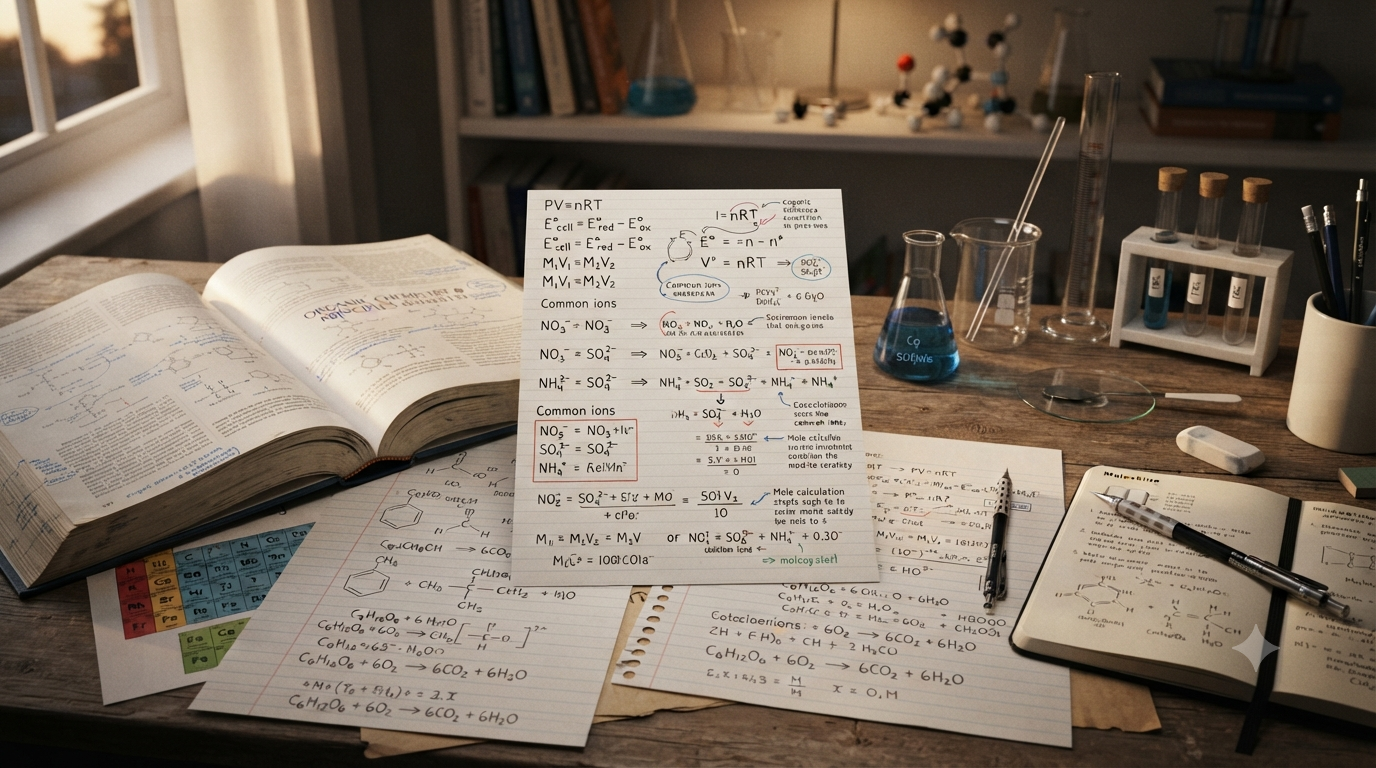
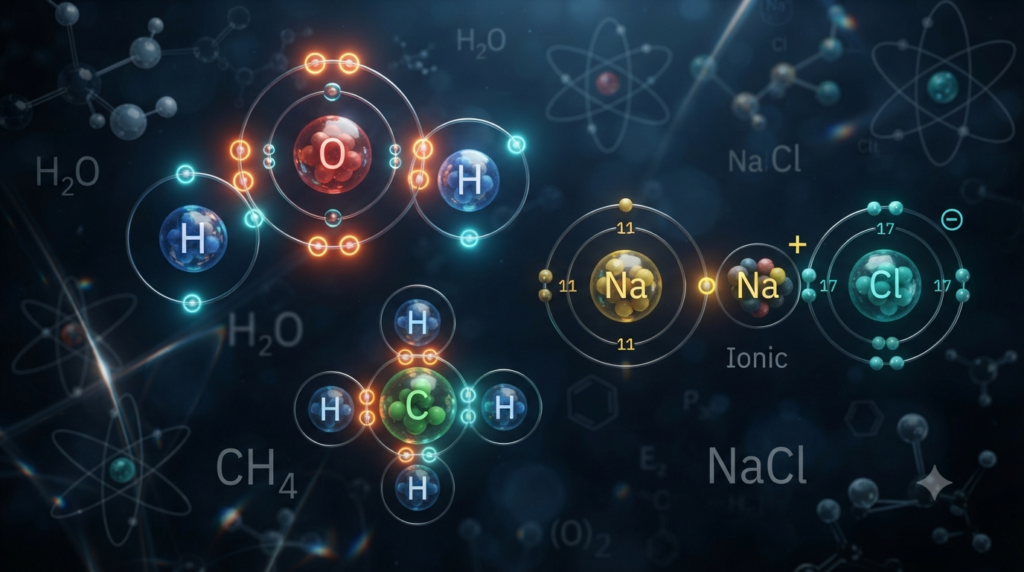
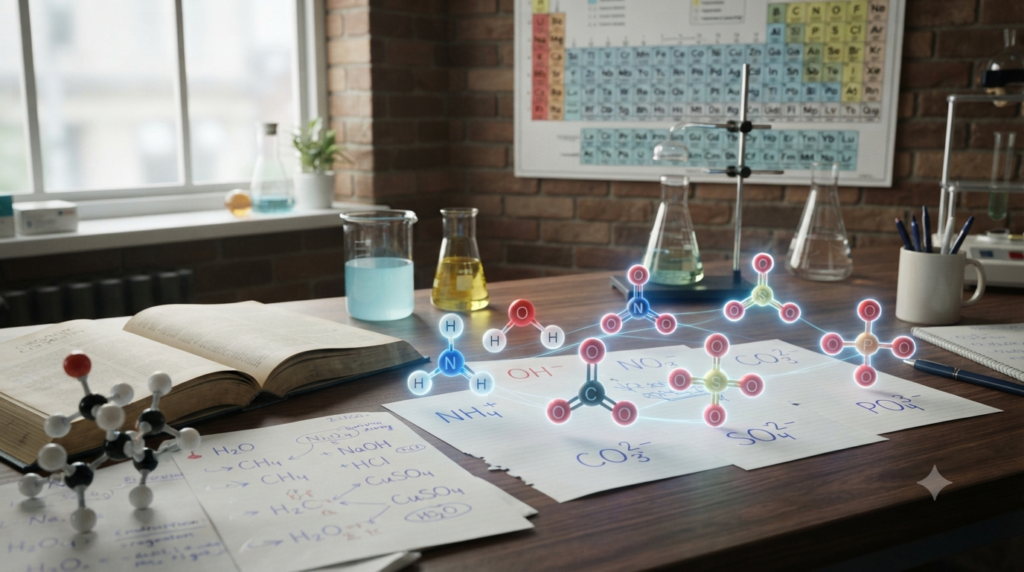
Chemistry involves many formulas, symbols, equations, names, and relationships that are useful for solving problems and understanding chemical reactions. As the number of topics increases, remembering every formula can become difficult. A well-organized chemistry formula reference sheet can make this process much easier. Instead of searching through different chapters or notes, you can keep important formulas in one clear and accessible place.
A chemistry formula reference sheet is not simply a collection of formulas. It is a structured summary that helps you quickly identify what a formula means, when it is used, and what each symbol represents. A good reference sheet can include chemical formulas, important equations, common ions, units, constants, mole relationships, concentration formulas, gas laws, and other essential relationships.
In this article, we will learn how to build a basic chemistry formula reference sheet, how to organize it by topic, what information to include, and how to make it useful for learning and problem-solving.
What Is a Chemistry Formula Reference Sheet?
A chemistry formula reference sheet is a compact collection of important chemical formulas, equations, symbols, constants, and relationships arranged in an organized way.
For example, a basic sheet might contain formulas such as:
Moles = Given mass / Molar mass
Number of particles = Moles × Avogadro constant
Molarity = Moles of solute / Volume of solution in litres
Density = Mass / Volume
These formulas are much easier to use when their meanings and units are written next to them.
The purpose of the sheet is not to replace understanding. Instead, it provides a quick reference while studying, revising, or solving chemistry problems.
Why Should You Create a Chemistry Formula Sheet?
Chemistry covers many interconnected concepts. A formula that appears in one chapter may become useful again in another chapter. A reference sheet helps organize these relationships.
One major benefit is faster revision. Rather than reading an entire chapter to find one equation, you can locate the required formula quickly.
It can also help identify patterns. For example, formulas involving density, mass, and volume are related:
Density = Mass / Volume
Mass = Density × Volume
Volume = Mass / Density
Seeing these relationships together makes them easier to understand.
A formula sheet can also help reduce mistakes. Writing the units, definitions, and conditions alongside formulas reminds you to use the correct quantities.
Start With the Main Chemistry Topics
Before writing formulas, divide the reference sheet into major chemistry topics. This prevents the sheet from becoming a random collection of equations.
A basic chemistry formula reference sheet can include sections such as:
Chemical formulas and symbols
Atomic and molecular quantities
Mole concept
Molar mass
Stoichiometry
Concentration
Gas laws
Thermochemistry
Acids and bases
Solutions
Chemical equilibrium
Electrochemistry
Common constants and units
You do not need to include every advanced formula immediately. Start with the formulas that you frequently use and gradually expand the sheet.
Chemical Symbols and Formulas
The first section can contain important chemical symbols and common chemical formulas.
For example:
Hydrogen = H
Oxygen = O
Nitrogen = N
Carbon = C
Sodium = Na
Potassium = K
Calcium = Ca
Chlorine = Cl
Magnesium = Mg
Common compounds can also be included:
Water = H₂O
Carbon dioxide = CO₂
Ammonia = NH₃
Methane = CH₄
Sodium chloride = NaCl
Calcium carbonate = CaCO₃
Sulfuric acid = H₂SO₄
Hydrochloric acid = HCl
Sodium hydroxide = NaOH
This section becomes especially useful when learning how chemical formulas represent the composition of substances.
Common Ions and Their Charges
A useful formula sheet should also include frequently encountered ions and their charges.
Some common positive ions are:
Na⁺ — sodium ion
K⁺ — potassium ion
Mg²⁺ — magnesium ion
Ca²⁺ — calcium ion
Al³⁺ — aluminium ion
NH₄⁺ — ammonium ion
Some common negative ions are:
Cl⁻ — chloride ion
OH⁻ — hydroxide ion
NO₃⁻ — nitrate ion
SO₄²⁻ — sulfate ion
CO₃²⁻ — carbonate ion
HCO₃⁻ — hydrogen carbonate ion
PO₄³⁻ — phosphate ion
Writing the charge beside each ion makes it easier to construct ionic formulas.
For example, calcium has a charge of 2+ and chloride has a charge of 1−. Their charges combine to form:
Ca²⁺ + 2Cl⁻ → CaCl₂
This demonstrates why charges are important when writing chemical formulas.
Atomic and Molecular Quantities
Another important section should contain formulas related to atomic and molecular quantities.
Relative atomic mass is used to compare the masses of atoms based on a standard reference. Relative molecular mass can be obtained by adding the relative atomic masses of all atoms present in a molecule.
For example:
Relative molecular mass of H₂O = 2(1) + 16 = 18
A formula sheet can include:
Relative molecular mass = Sum of relative atomic masses of all atoms in the molecule
For ionic compounds, the corresponding quantity is often called relative formula mass.
Mole Concept Formulas
The mole concept is one of the most important areas of chemistry because it connects microscopic particles with measurable quantities.
Important formulas include:
Moles = Given mass / Molar mass
Mass = Moles × Molar mass
Molar mass = Given mass / Moles
The relationship between moles and particles can also be included:
Number of particles = Moles × Avogadro constant
Moles = Number of particles / Avogadro constant
Avogadro constant is approximately:
Nₐ = 6.022 × 10²³ mol⁻¹
The word “particles” may refer to atoms, molecules, ions, or other specified particles.
Molar Mass
Molar mass connects the mass of a substance with the amount of substance measured in moles.
Its common unit is:
g mol⁻¹
For example, the molar mass of water is approximately:
M(H₂O) = 18 g mol⁻¹
A formula sheet should remind you that molar mass is calculated from the chemical formula and the atomic masses of its constituent elements.
For a compound:
Molar mass = Sum of atomic masses of all atoms in one formula unit
Stoichiometry Formulas
Stoichiometry deals with quantitative relationships between reactants and products in a chemical reaction.
The first step in many stoichiometric calculations is balancing the chemical equation.
For a general reaction:
aA + bB → cC + dD
The coefficients a, b, c, and d represent the mole relationships between the substances.
For example:
2H₂ + O₂ → 2H₂O
This equation shows that:
2 mol H₂ : 1 mol O₂ : 2 mol H₂O
A formula sheet should include the idea that balanced-equation coefficients provide mole ratios.
Percentage Composition
Percentage composition is useful for determining how much of an element is present in a compound.
The general relationship is:
Percentage of an element = (Mass of element in one mole of compound / Molar mass of compound) × 100
For example, this formula can be used to determine the percentage of oxygen in water.
A clear reference sheet should include both the formula and a short description of what it calculates.
Empirical and Molecular Formulas
For compounds, empirical and molecular formulas are important concepts.
The empirical formula represents the simplest whole-number ratio of atoms in a compound.
The molecular formula represents the actual number of atoms of each element in a molecule.
The relationship is:
Molecular formula = (Empirical formula) × n
where:
n = Molecular mass / Empirical formula mass
The value of n should be a whole number.
This is an example of why a reference sheet should include definitions alongside equations.
Concentration Formulas
Concentration formulas are commonly used when working with solutions.
One important formula is molarity:
Molarity = Moles of solute / Volume of solution in litres
It can also be rearranged as:
Moles of solute = Molarity × Volume of solution in litres
When dilution is involved, a commonly used relationship is:
M₁V₁ = M₂V₂
Here, M represents molarity and V represents volume, provided the quantities are expressed consistently.
Always write the units beside the formula or in a separate unit column.
Density Formula
Density is another useful relationship in chemistry.
Density = Mass / Volume
The formula can be rearranged:
Mass = Density × Volume
Volume = Mass / Density
Common units include g/cm³, g/mL, and kg/m³.
Because unit conversions are often necessary, keeping common unit relationships near this formula can be helpful.
For example:
1 mL = 1 cm³
Gas Law Formulas
Gas laws form another important section of a chemistry reference sheet.
Boyle’s law can be written as:
P₁V₁ = P₂V₂
Charles’s law can be written as:
V₁/T₁ = V₂/T₂
The combined gas law is:
P₁V₁/T₁ = P₂V₂/T₂
The ideal gas equation is:
PV = nRT
Here:
P = Pressure
V = Volume
n = Amount of gas in moles
R = Gas constant
T = Absolute temperature
Temperature should generally be expressed in kelvin when using gas-law equations involving absolute temperature.
Acids and Bases
A basic reference sheet can include common relationships used for acids and bases.
For pH:
pH = −log[H⁺]
For pOH:
pOH = −log[OH⁻]
At appropriate conditions, the relationship between pH and pOH can be written as:
pH + pOH = 14
The sheet should also include a reminder that logarithmic relationships require careful attention to units, concentration, and the conditions under which the equation is being applied.
Thermochemistry Formulas
Thermochemistry involves heat and energy changes.
One common equation is:
q = mcΔT
where:
q = Heat transferred
m = Mass
c = Specific heat capacity
ΔT = Change in temperature
The temperature change is:
ΔT = Tfinal − Tinitial
Another important relationship is:
ΔH = Hproducts − Hreactants
Depending on the context, enthalpy changes may be calculated using reaction data, bond energies, or Hess’s law.
Electrochemistry Formulas
If your chemistry course includes electrochemistry, create a separate section for its important relationships.
For cell potential:
E°cell = E°cathode − E°anode
The formula sheet can also include:
Charge = Current × Time
Q = It
where:
Q = Electric charge
I = Current
t = Time
Keeping symbols and units beside these equations makes the section much easier to use.
Include Units With Every Formula
One of the most useful habits when building a formula sheet is to include units.
For example:
Density = Mass / Volume
Possible units:
g/mL
g/cm³
kg/m³
For molarity:
Molarity = mol/L
For pressure, common units may include:
Pa
atm
bar
mmHg
Units are not just labels. They help you check whether your calculation is physically consistent.
Add Formula Rearrangements
Many chemistry formulas can be rearranged to solve for different quantities. Instead of writing the same relationship in several places, you can show the original formula and its rearrangements together.
For example:
Density = Mass / Volume
Mass = Density × Volume
Volume = Mass / Density
Similarly:
Moles = Mass / Molar mass
Mass = Moles × Molar mass
Molar mass = Mass / Moles
This arrangement makes the relationships easier to remember.
Add Definitions Beside Difficult Formulas
A formula without an explanation can become confusing. For important equations, include a short definition of each symbol.
For example:
PV = nRT
P = Pressure
V = Volume
n = Amount of gas
R = Gas constant
T = Absolute temperature
This takes very little space but makes the reference sheet much more useful.
Organize the Sheet for Quick Searching
A good reference sheet should be easy to scan.
You can organize it into tables with columns such as:
| Formula | Meaning | Symbols | Common Units |
|---|
| Density = Mass / Volume | Density calculation | m, V | g/mL, kg/m³ |
| Moles = Mass / Molar mass | Finds amount of substance | m, M | mol |
| Molarity = Moles / Volume | Solution concentration | n, V | mol/L |
| q = mcΔT | Heat calculation | m, c, ΔT | J |
| PV = nRT | Ideal gas relationship | P, V, n, R, T | SI units |
A table format is particularly useful when you want to revise quickly.
Keep Important Constants Together
A separate constants section can prevent repeated searching.
For example:
Nₐ = 6.022 × 10²³ mol⁻¹
R ≈ 8.314 J mol⁻¹ K⁻¹
You can add other constants required by your particular chemistry course.
Do not fill the sheet with constants that you rarely use. The goal is to make the reference sheet useful rather than unnecessarily large.
Add Common Unit Conversions
Unit conversions can make chemistry calculations easier.
Some useful relationships include:
1 L = 1000 mL
1 mL = 1 cm³
1 kg = 1000 g
1 g = 1000 mg
1 atm ≈ 101325 Pa
For temperature:
T(K) = T(°C) + 273.15
Including conversions in a dedicated section can save time during calculations.
Keep Formulas and Chemical Equations Separate
A chemistry formula reference sheet can contain both mathematical formulas and chemical formulas, but they should be clearly separated.
For example:
Chemical formula:
H₂O
Mathematical relationship:
n = m/M
Chemical equation:
2H₂ + O₂ → 2H₂O
This distinction prevents confusion between a formula that represents a substance and an equation used for calculation or reaction representation.
Update the Reference Sheet Gradually
You do not need to create a complete chemistry reference sheet in one sitting.
Start with the formulas from the topics you are currently studying. Whenever you encounter an important equation, add it to the appropriate section.
Remove formulas that are duplicated or rarely useful. Correct mistakes as soon as you find them.
Over time, your reference sheet can become a personalized chemistry resource.
What Should You Avoid?
A formula reference sheet can become less useful if it contains too much information.
Avoid copying entire textbook explanations into the sheet. Keep explanations short.
Avoid writing formulas without defining unfamiliar symbols.
Avoid mixing units without indicating which unit system is being used.
Avoid adding advanced equations before understanding their meaning.
Most importantly, do not rely on the sheet as a substitute for learning the concepts. A formula is useful only when you understand what it represents and when it should be applied.
A Simple Structure for Your Chemistry Formula Sheet
A practical basic structure could look like this:
Section 1: Chemical Basics
Element symbols
Common chemical formulas
Common ions
Ionic charges
Section 2: Mole Concept
Moles
Molar mass
Number of particles
Avogadro constant
Section 3: Stoichiometry
Mole ratios
Mass relationships
Percentage composition
Empirical formula
Molecular formula
Section 4: Solutions
Section 5: Gases
Boyle’s law
Charles’s law
Combined gas law
Ideal gas equation
Section 6: Acids and Bases
Section 7: Energy
Heat equation
Temperature change
Enthalpy relationships
Section 8: Electrochemistry
Section 9: Units and Constants
Common units
Unit conversions
Important constants
This structure provides a simple starting point that can be expanded as your chemistry knowledge grows.
How to Make the Reference Sheet More Effective
The most useful reference sheet is one that matches the way you study.
You can use different sections, boxes, tables, or symbols to separate topics. Keep the layout consistent so that you can find information quickly.
Write formulas clearly and preserve subscripts, superscripts, mathematical symbols, and chemical charges correctly.
For example, these are different:
H₂O
H2O
The first correctly represents the chemical formula using a subscript.
Similarly:
SO₄²⁻
contains both a subscript and an ionic charge. Accurate notation matters in chemistry because small changes in symbols can change the meaning.
Conclusion
Building a basic chemistry formula reference sheet is a simple way to organize important chemical knowledge. Instead of treating formulas as isolated equations, arrange them according to topics such as chemical formulas, ions, mole concept, stoichiometry, concentration, gases, acids and bases, thermochemistry, and electrochemistry.
Include the formula, define its symbols, add appropriate units, and provide important rearrangements where useful. Keep common constants and unit conversions in separate sections so they can be found quickly.
A good reference sheet should remain simple, accurate, and easy to scan. More importantly, it should support understanding rather than replace it. When you regularly update the sheet while learning new concepts, it can become a valuable tool for revision, calculations, and building confidence in chemistry.