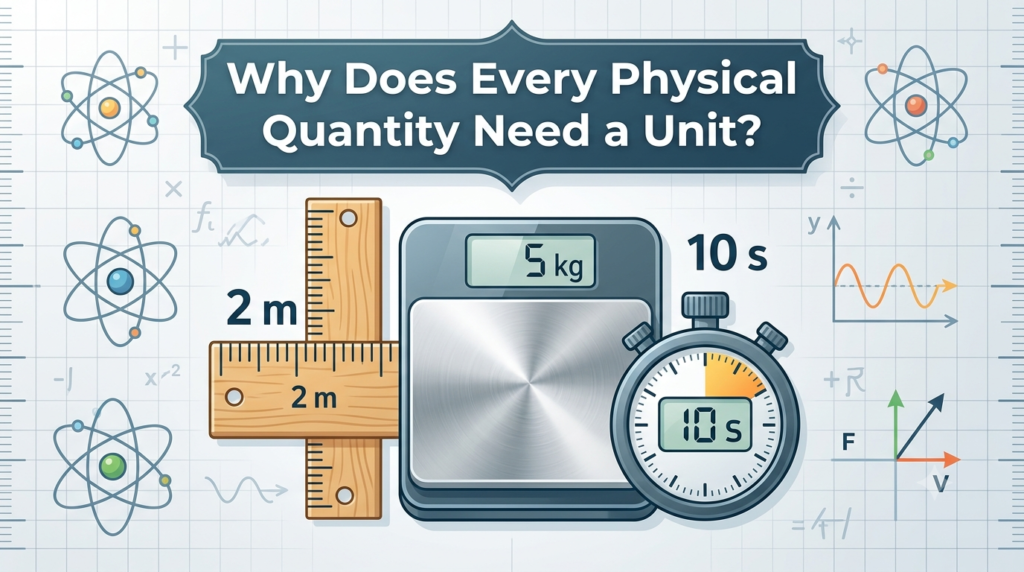
Unit conversion is one of the most important skills in physics. Measurements are expressed using units such as metres, kilometres, seconds, kilograms, grams, and many others. However, the same physical quantity can be represented using different units. For example, a distance can be written as 2 kilometres or 2,000 metres. Both values describe the same distance, but they use different units.
Learning how to convert units correctly helps you solve physics problems, understand formulas, compare measurements, and avoid calculation errors. The basic idea is simple: change the unit without changing the actual physical quantity. Once you understand conversion factors and how they work, unit conversion becomes a straightforward mathematical process.
Why Unit Conversion Is Important in Physics
Physics uses a wide variety of units because different situations require different scales of measurement. Scientists commonly use the International System of Units, known as the SI system. The SI system provides standard units for physical quantities such as length, mass, time, temperature, and electric current.
For example, the SI unit of length is the metre (m), while kilometres (km), centimetres (cm), and millimetres (mm) are commonly used multiples or submultiples of the metre.
A physics formula may require quantities to be expressed in particular units. If the units are not compatible, the calculation can produce an incorrect result.
For instance, if velocity is calculated using distance divided by time, using kilometres for distance and seconds for time gives kilometres per second. If the required answer is in metres per second, the distance must first be converted into metres.
Understanding Conversion Factors
A conversion factor is a ratio that represents the relationship between two different units of the same quantity.
For example:
1 kilometre = 1,000 metres
This relationship can be written in two ways:
1 km / 1,000 m = 1
or
1,000 m / 1 km = 1
Because both ratios equal one, multiplying a measurement by the appropriate conversion factor changes its unit without changing its physical value.
Suppose you want to convert 3 km into metres. Since 1 km equals 1,000 m:
3 km × (1,000 m / 1 km) = 3,000 m
The kilometre units cancel, leaving metres.
This method is called dimensional or factor-label conversion and is one of the safest ways to convert units.
Converting Length Units
Length is one of the most frequently converted quantities in physics.
Some common relationships are:
1 kilometre = 1,000 metres
1 metre = 100 centimetres
1 metre = 1,000 millimetres
1 centimetre = 10 millimetres
Example of Kilometres to Metres
Convert 4.5 km into metres.
Since:
1 km = 1,000 m
Therefore:
4.5 km × 1,000 m/km = 4,500 m
So, 4.5 km is equal to 4,500 m.
Example of Centimetres to Metres
Convert 250 cm into metres.
Since:
1 m = 100 cm
Therefore:
250 cm × 1 m/100 cm = 2.5 m
The centimetre units cancel, leaving metres.
Converting Mass Units
Mass is another important quantity in physics. The SI unit of mass is the kilogram (kg).
Common relationships include:
1 kilogram = 1,000 grams
1 gram = 1,000 milligrams
To convert 2.5 kg into grams:
2.5 kg × 1,000 g/kg = 2,500 g
Therefore, 2.5 kg equals 2,500 g.
When converting from a larger unit to a smaller unit, the numerical value generally becomes larger. When converting from a smaller unit to a larger unit, the numerical value generally becomes smaller.
For example:
5 kg = 5,000 g
but
5,000 g = 5 kg
The physical mass remains exactly the same.
Converting Time Units
Time conversions are also common in physics.
Important relationships include:
1 minute = 60 seconds
1 hour = 60 minutes
1 hour = 3,600 seconds
For example, convert 2 hours into seconds.
First:
2 hours × 60 minutes/hour = 120 minutes
Then:
120 minutes × 60 seconds/minute = 7,200 seconds
Therefore:
2 hours = 7,200 seconds
You can also combine the conversion factors directly:
2 h × 3,600 s/h = 7,200 s
Converting Speed Units
Speed and velocity often require more careful unit conversion because they contain two units.
A common conversion is from kilometres per hour to metres per second.
Suppose a car travels at 72 km/h. To convert this into m/s:
72 km/h × 1,000 m/km × 1 h/3,600 s
The kilometre and hour units cancel:
72 × 1,000/3,600 m/s
= 20 m/s
Therefore:
72 km/h = 20 m/s
A useful shortcut is:
km/h × 5/18 = m/s
and:
m/s × 18/5 = km/h
These shortcuts work because they are based on the same conversion factors.
Converting Area Units
Area conversion is slightly different from ordinary length conversion because area involves squared units.
For example:
1 m = 100 cm
But:
1 m² = 10,000 cm²
This happens because the conversion factor must be squared:
1 m² = (100 cm)²
= 10,000 cm²
Suppose an area is 3 m². Converting it into square centimetres gives:
3 m² × 10,000 cm²/m² = 30,000 cm²
It is important not to use 100 instead of 10,000 when converting square metres into square centimetres.
Converting Volume Units
Volume involves cubed units, so the conversion factor must be cubed.
Since:
1 m = 100 cm
then:
1 m³ = (100 cm)³
= 1,000,000 cm³
Therefore:
1 m³ = 10⁶ cm³
For example, converting 0.5 m³ into cm³:
0.5 × 1,000,000 = 500,000 cm³
Thus:
0.5 m³ = 500,000 cm³
This is why area and volume conversions require extra attention.
Using SI Prefixes
SI prefixes make it easier to express very large or very small measurements.
Some commonly used prefixes are:
kilo (k) = 10³
hecto (h) = 10²
deca (da) = 10¹
deci (d) = 10⁻¹
centi (c) = 10⁻²
milli (m) = 10⁻³
micro (µ) = 10⁻⁶
nano (n) = 10⁻⁹
For example:
1 km = 10³ m
1 mm = 10⁻³ m
1 µm = 10⁻⁶ m
1 nm = 10⁻⁹ m
If a length is 7.2 mm, it can be converted into metres as:
7.2 mm = 7.2 × 10⁻³ m
= 0.0072 m
Using powers of ten is particularly useful when working with scientific notation.
Converting Units in Physics Formulas
Unit conversion becomes especially important when using equations.
Consider the speed formula:
v = d/t
Suppose a distance is given as 2 km and the time is 100 seconds. Before calculating the speed in metres per second, convert 2 km into metres:
2 km = 2,000 m
Now use the equation:
v = 2,000 m / 100 s
v = 20 m/s
The final answer is therefore 20 m/s.
Converting the quantities before substituting them into a formula reduces the possibility of unit-related errors.
Dimensional Analysis and Unit Conversion
Dimensional analysis is a powerful technique used to check equations and calculations. It involves examining the units or dimensions of physical quantities.
For example, acceleration is measured in metres per second squared:
m/s²
If a calculation produces kg instead of m/s² for acceleration, something has gone wrong.
Dimensional analysis can therefore help determine whether a unit conversion or mathematical operation has been performed correctly.
It is also useful for complicated conversions involving several units.
Common Mistakes to Avoid
One common mistake is multiplying when you should divide, or dividing when you should multiply. Writing the conversion factor as a fraction and cancelling units helps prevent this problem.
Another mistake is forgetting that squared and cubed units require squared and cubed conversion factors. For example, converting metres to centimetres is different from converting square metres to square centimetres.
It is also important to keep track of prefixes. A millimetre is not the same as a metre, and a milligram is not the same as a kilogram.
Finally, always check whether the final unit matches what the question asks for.
A Simple Method for Converting Units
You can follow these steps for almost any unit conversion in physics:
Identify the given quantity and its unit.
Identify the required unit.
Write the relationship between the two units.
Create a conversion factor so the unwanted unit cancels.
Multiply and simplify.
Check the final unit and numerical value.
For more complicated problems, you may need to use several conversion factors one after another.
Conclusion
Unit conversion is a fundamental skill that makes physics calculations accurate and meaningful. The key is to understand the relationship between units and use conversion factors so that unwanted units cancel. Length, mass, time, speed, area, and volume all follow the same basic principle, although squared and cubed quantities require special care.
By practising SI prefixes, factor-label conversion, and dimensional analysis, you can convert units confidently and avoid many common mistakes. Once unit conversion becomes familiar, solving physics problems becomes much easier because you can focus on the physical ideas rather than worrying about incompatible units.
FAQs
Unit conversion is important because physics calculations often involve quantities expressed in different units. A formula generally requires compatible units to produce a meaningful result. For example, if distance is given in kilometres while time is given in seconds, the distance may need to be converted into metres before calculating speed in metres per second. Converting units also makes it easier to compare measurements and communicate scientific results consistently. Using the SI system helps maintain consistency across physics calculations. Correct unit conversion reduces calculation errors and makes the final answer easier to understand and verify.
A conversion factor is a ratio that shows the relationship between two units of the same physical quantity. For example, because 1 kilometre equals 1,000 metres, you can use either 1 km/1,000 m or 1,000 m/1 km as a conversion factor. The correct form depends on the unit you want to obtain. When the conversion factor is multiplied by a measurement, the unwanted unit cancels and the desired unit remains. Conversion factors are useful because they allow measurements to be changed from one unit to another without changing the actual physical quantity being measured.
To convert kilometres to metres, multiply the value in kilometres by 1,000 because one kilometre equals 1,000 metres. For example, to convert 3.5 km into metres, calculate 3.5 × 1,000, which gives 3,500 m. Using a conversion factor makes the process even clearer: 3.5 km × 1,000 m/km = 3,500 m. The kilometre units cancel, leaving metres. Remember that when converting from a larger unit to a smaller unit, the numerical value usually becomes larger. The physical distance itself does not change; only the way it is expressed changes.
To convert metres per second (m/s) into kilometres per hour (km/h), multiply the speed by 3.6. This comes from converting metres to kilometres and seconds to hours. For example, 10 m/s × 3.6 = 36 km/h. Therefore, 10 m/s is equal to 36 km/h. The reverse conversion is also useful: to convert km/h into m/s, multiply by 5/18 or divide by 3.6. These conversions are commonly used in physics problems involving speed and velocity. Always check the units after conversion to make sure the final answer matches what the question requires.
Area units must be converted using the square of the length conversion factor because area has dimensions of length squared. For example, 1 metre equals 100 centimetres, but 1 square metre equals 10,000 square centimetres. This is because (100 cm)² equals 10,000 cm². Therefore, converting 4 m² into cm² gives 4 × 10,000 = 40,000 cm². A common mistake is to use the ordinary length conversion factor instead of squaring it. Whenever a unit contains a power such as m², remember that the conversion factor must also be raised to that power.
Volume units require the cube of the length conversion factor because volume has dimensions of length cubed. Since 1 metre equals 100 centimetres, 1 cubic metre equals (100 cm)³, which is 1,000,000 cm³. For example, 2 m³ equals 2,000,000 cm³. This is different from ordinary length conversion because the conversion factor is applied three times. The same principle applies to other cubic units. When converting volume, carefully identify whether the unit is written as m³, cm³, or another cubic unit. This prevents large numerical errors in physics and scientific calculations.
SI prefixes represent powers of ten and make it easier to express very large or very small measurements. Common prefixes include kilo, which represents 10³, centi, which represents 10⁻², milli, which represents 10⁻³, micro, which represents 10⁻⁶, and nano, which represents 10⁻⁹. For example, 1 kilometre equals 1,000 metres, while 1 millimetre equals 0.001 metres. Understanding SI prefixes allows you to convert measurements quickly without memorising every individual conversion. They are widely used in physics, engineering, chemistry, electronics, and other scientific fields where measurements can vary across many orders of magnitude.
Yes. Unit conversion and dimensional analysis can help identify mistakes in physics calculations and equations. Every physical quantity has appropriate dimensions and units. For example, velocity has units of metres per second, while acceleration has units of metres per second squared. If a calculation intended to find acceleration produces kilograms, there is likely an error somewhere. Checking units after each major step can reveal incorrect conversions, missing factors, or inappropriate substitutions. This makes dimensional analysis a valuable checking method. However, matching units alone does not prove that an equation is physically correct.
The easiest and safest method is to use conversion factors and cancel units step by step. First, identify the given unit and the required unit. Then write a conversion factor that places the unwanted unit in the denominator and the desired unit in the numerator. Multiply and cancel the units. For example, 5 km × 1,000 m/km = 5,000 m. For more complicated conversions, use multiple conversion factors. This approach is more reliable than simply guessing whether to multiply or divide because the units themselves show which operation is required.
Common mistakes include multiplying instead of dividing, using the wrong conversion factor, forgetting SI prefixes, and mixing incompatible units in a formula. Another important error occurs when converting area or volume because the conversion factor must be squared or cubed. Students may also forget to convert all quantities into compatible units before substituting them into a physics equation. To avoid these problems, write the conversion factor explicitly, cancel units carefully, and check the final unit. Estimating whether the numerical answer should become larger or smaller can also provide a useful final check.
Related Post
What Is Power in Physics?
Power is an important concept in physics that tells us how quickly work is done or energy is transferred. Two […]
Read MoreKinetic and Potential Energy: Basic Concepts
Energy is one of the most important ideas in physics. It helps us understand how objects move, how machines work, […]
Read MoreDifferent Forms of Energy Explained
Energy is one of the most important ideas in science. It is involved in almost everything that happens around us, […]
Read MoreWhat Is Energy in Physics?
Energy is one of the most important ideas in physics. We use the word “energy” in everyday life when talking […]
Read MoreWhat Is Momentum in Physics?
Momentum is one of the fundamental concepts in physics used to describe the motion of an object. It helps us […]
Read MoreWhat Is Inertia and Why Does It Matter?
Have you ever noticed how your body moves forward when a bus suddenly stops? Or why you feel pushed backward […]
Read MoreWhat Is Rest and How Is It Defined in Physics?
When we look at an object that appears to be stationary, we naturally say that it is at rest. A […]
Read MoreMass and Weight: What Is the Difference?
Have you ever wondered why an object can have the same amount of matter but weigh differently in different places? […]
Read MoreHow Does Force Affect the Motion of an Object?
Force is one of the most important ideas in physics because it helps explain why objects start moving, stop moving, […]
Read MoreWhat Is Force in Physics?
Force is one of the most important ideas in physics. We experience forces every day, even when we do not […]
Read MoreWhat Is Acceleration in Physics?
Acceleration is one of the most important concepts in physics because it describes how the velocity of an object changes […]
Read MoreSpeed and Velocity: Understanding the Difference
When we describe how fast something is moving, we often use the word “speed.” In everyday conversation, speed and velocity […]
Read MoreDistance and Displacement: Definition and Differences
When an object moves from one place to another, we often describe its motion by saying how far it has […]
Read MoreWhat Is Motion in Physics?
Motion is one of the most basic and important ideas in physics. Everything around us is in some form of […]
Read MoreWhat Is a Reference Frame in Physics?
When we describe the motion of an object, we usually say whether it is moving, how fast it is moving, […]
Read MoreWhat Is a Reference Point in Physics?
In physics, we often describe where an object is, how it moves, or how far it has traveled. But to […]
Read MoreScalar vs Vector Quantities: Key Differences
In physics, we use physical quantities to describe measurable properties such as mass, time, speed, force, and velocity. However, not […]
Read MoreWhat Are Scalars and Vectors in Physics?
Physics is all about describing how things behave. We talk about the mass of an object, its speed, the distance […]
Read More