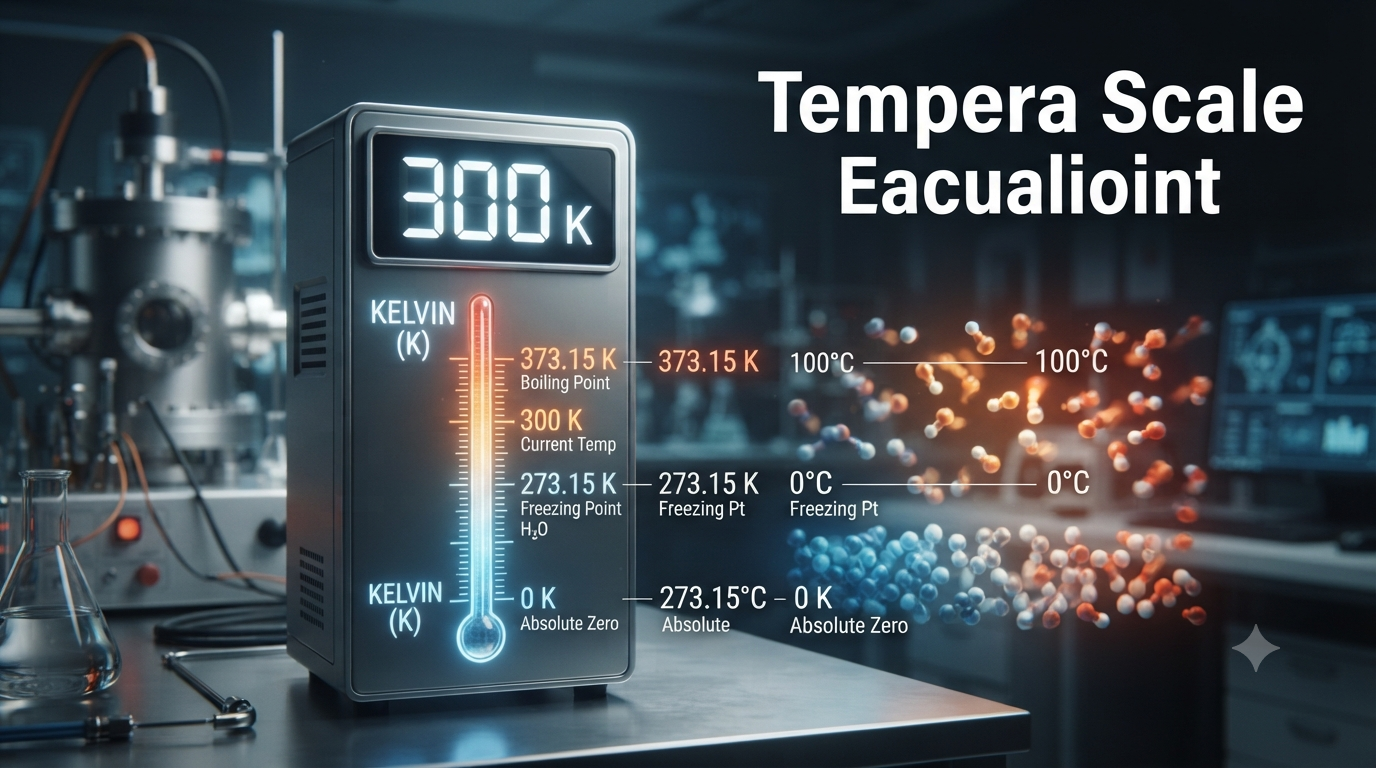
Temperature is one of the most important physical quantities in science. It helps us understand how hot or cold an object is and explains many natural phenomena, from the freezing of water to the behavior of gases and the energy of particles. To measure temperature accurately, scientists use standard units. The kelvin (K) is the SI base unit of thermodynamic temperature and plays a central role in physics, chemistry, astronomy, and engineering.
Unlike degrees Celsius and degrees Fahrenheit, the kelvin scale begins at absolute zero, the lowest possible temperature according to thermodynamics. Understanding the kelvin unit helps us explore thermal energy, scientific measurements, and the behavior of matter under different conditions.
What Is the SI Unit of Temperature?
The SI unit of thermodynamic temperature is the kelvin, represented by the symbol K. It is one of the seven SI base units used throughout science and technology.
The kelvin measures thermodynamic temperature, which describes the thermal state of a system. It is particularly useful for studying heat, energy transfer, gases, chemical reactions, and microscopic particles.
For example, scientists use kelvin when describing the temperature of stars, the behavior of gases in laboratories, and the operating conditions of scientific instruments. Because it is an internationally accepted SI unit, measurements made in kelvin can be compared consistently across different countries and scientific fields.
Why Is Kelvin Written as K?
The unit is named after William Thomson, who was later known as Lord Kelvin. He made important contributions to thermodynamics and developed the concept of an absolute temperature scale.
The symbol for kelvin is K, without a degree sign. Therefore, scientists write:
300 K, not 300° K
273.15 K, not 273.15° K
The word kelvin is written in lowercase when used as a unit name, even though it is named after a person. Its symbol, however, is an uppercase K.
What Does Kelvin Mean?
Kelvin is an absolute temperature scale. This means that its zero point is based on the lowest possible thermodynamic temperature, known as absolute zero.
At absolute zero, a system has its minimum possible thermal energy under the laws of quantum physics. In real physical systems, reaching absolute zero exactly is not possible through a finite number of cooling processes, although scientists can approach it extremely closely.
The kelvin scale is useful because it connects temperature with the microscopic behavior of matter. As temperature changes, the distribution of energy among particles also changes. This relationship makes kelvin especially important in thermodynamics and statistical physics.
For example, when the temperature of a gas increases, its particles generally have greater average kinetic energy. When the temperature decreases, the average kinetic energy generally becomes smaller, provided the type of system and conditions are properly considered.
What Is Absolute Zero?
Absolute zero is the reference point of the kelvin temperature scale. It corresponds to:
0 K = −273.15°C
This is the lowest possible thermodynamic temperature. It does not mean that all motion inside matter completely stops. Quantum effects, including zero-point motion in many systems, can remain even at absolute zero.
Absolute zero is important because it provides a natural starting point for measuring thermodynamic temperature. Instead of using an arbitrary reference such as the freezing point of water, the kelvin scale is connected to fundamental physical principles.
As temperature rises above absolute zero, the thermal energy available in a system generally increases. This makes the kelvin scale particularly valuable when studying extremely cold environments, high-temperature plasmas, and the early universe.
How Is the Kelvin Scale Related to Celsius?
The kelvin and Celsius scales have the same size for one degree of temperature difference. Their zero points are different.
The relationship between the two scales is:
T(K) = t(°C) + 273.15
Here, T represents the temperature in kelvin, while t represents the temperature in degrees Celsius.
For example, if the temperature is 25°C:
T = 25 + 273.15
T = 298.15 K
Therefore, room temperature, often approximated as 25°C, is approximately 298.15 K.
Another example is the freezing point of pure water at standard atmospheric pressure. It is 0°C, which corresponds to 273.15 K.
The boiling point of pure water at standard atmospheric pressure is 100°C, equivalent to 373.15 K.
Important Difference Between Kelvin and Celsius
Although their temperature intervals are equal, their zero points are not the same.
A change of 1°C is equal in size to a change of 1 K.
0°C is equal to 273.15 K.
0 K is equal to −273.15°C.
Kelvin temperatures are not written with a degree symbol.
This distinction is important when converting temperatures or using formulas in physics and chemistry.
Why Is Kelvin an SI Base Unit?
The SI system contains seven base units, each associated with a fundamental physical quantity. Thermodynamic temperature is one of these quantities, and its SI base unit is the kelvin.
The kelvin is important because temperature is connected to many other physical processes. For example, temperature appears in equations involving gas pressure, volume, thermal energy, entropy, and radiation.
Using a common base unit makes scientific calculations more consistent. Researchers working in different laboratories can compare their results without confusion caused by different temperature scales.
The kelvin is also widely used in scientific equations because absolute temperature is required in many thermodynamic relationships. Using Celsius directly in such equations can produce incorrect results when the formula depends on temperature measured from absolute zero.
The Modern Definition of the Kelvin
Since 2019, the kelvin has been defined using a fixed numerical value for the Boltzmann constant, represented by k.
The exact value is:
k = 1.380649 × 10⁻²³ J K⁻¹
The Boltzmann constant connects temperature with energy at the microscopic level. It describes how thermal energy relates to temperature and helps establish the kelvin through the fundamental principles of physics.
This definition means that the kelvin is no longer defined by the freezing or triple point of water. Instead, it is based on a fundamental constant of nature.
The modern definition improves the stability and universality of temperature measurement. Scientists can realize the kelvin using advanced measurement techniques and suitable physical systems.
Where Is Kelvin Used?
The kelvin unit is used in many scientific and technological fields.
1. Physics
Physicists use kelvin to study thermodynamics, heat transfer, gases, phase changes, and the behavior of matter. Absolute temperature is essential in many physical equations.
2. Chemistry
Chemists use kelvin when investigating reaction rates, gas behavior, equilibrium, and temperature-dependent chemical processes. Many gas-law calculations require temperature in kelvin.
3. Astronomy
Astronomers use kelvin to describe the surface temperatures of stars and other astronomical objects. For example, the surface temperature of the Sun is approximately 5,800 K, although the exact value depends on the definition and region being measured.
4. Engineering
Engineers use kelvin in thermal design, refrigeration, energy systems, electronics, and materials science. It helps them analyze how systems respond to changes in temperature.
5. Lighting and Color Science
Kelvin is also used to describe the color temperature of light sources. A light source with a lower color temperature may appear warmer or more yellow, while a higher color temperature may appear cooler or more bluish. In this context, color temperature describes the color of light in relation to the radiation of an ideal blackbody.
Kelvin and Temperature Differences
One important property of the kelvin scale is that a temperature interval of one kelvin has the same magnitude as an interval of one degree Celsius.
For example, if the temperature of an object increases from 290 K to 300 K, the increase is:
ΔT = 300 − 290
ΔT = 10 K
The same temperature change is equal to 10°C.
This property makes kelvin convenient in scientific calculations involving temperature differences. However, when a formula uses absolute temperature itself rather than a temperature change, the temperature must be expressed on an absolute scale.
Common Kelvin Temperature Values
Some useful temperature values on the kelvin scale include:
| Temperature | Kelvin |
|---|
| Absolute zero | 0 K |
| Freezing point of water at standard pressure | 273.15 K |
| Approximate room temperature | 293–298 K |
| Boiling point of water at standard pressure | 373.15 K |
| Approximate surface temperature of the Sun | 5,800 K |
These values provide a basic understanding of how the kelvin scale represents different thermal conditions.
Why Is Kelvin Important in Science?
Kelvin is more than just another temperature unit. It provides a connection between measurable temperature and the fundamental behavior of matter and energy.
When scientists study the properties of gases, they need an absolute temperature scale to establish meaningful relationships between pressure, volume, and temperature. In thermodynamics, kelvin is essential for understanding efficiency, entropy, and heat engines. In astronomy, it helps describe the thermal conditions of stars and cosmic objects.
Kelvin also makes it easier to compare temperatures across different scientific disciplines. Whether a researcher is studying a chemical reaction, a refrigeration system, or a distant galaxy, the same SI temperature unit can be used.
Conclusion
The kelvin is the SI base unit of thermodynamic temperature and is represented by the symbol K. It is an absolute temperature unit that begins at absolute zero, equal to −273.15°C. Unlike Celsius, kelvin does not use a degree symbol, and its scale is based on fundamental physical principles.
The modern definition of the kelvin uses the fixed value of the Boltzmann constant, connecting temperature with microscopic energy. From physics and chemistry to astronomy and engineering, kelvin helps scientists measure and understand thermal phenomena accurately. Learning the meaning of kelvin is an important step toward understanding temperature, energy, and the laws of thermodynamics.