In physics, we use physical quantities to describe measurable properties such as mass, time, speed, force, and velocity. However, not all physical quantities behave in the same way. Some can be completely described by a numerical value and a unit, while others also require information about direction. This difference leads to two important categories: scalar quantities and vector quantities.
Understanding the difference between scalars and vectors is essential because many physical concepts, equations, and laws depend on whether a quantity has direction. For example, saying that a car is moving at 60 km/h tells us its speed, but it does not tell us where the car is moving. If we say the car is moving at 60 km/h toward the north, we are describing its velocity.
Let us explore scalar and vector quantities, their properties, examples, and the key differences between them.
What Is a Scalar Quantity?
A scalar quantity is a physical quantity that has only magnitude and no direction. Magnitude tells us how much of a quantity is present. A scalar can usually be described using a numerical value and an appropriate unit.
For example, if the mass of an object is 5 kg, the value 5 tells us the magnitude of the mass, while kg is its unit. There is no need to specify a direction for mass.
Other common examples of scalar quantities include time, temperature, distance, speed, energy, and volume.
Suppose a room has a temperature of 25°C. The temperature can be described completely by stating its value and unit. We do not need to say that the temperature is toward the north or south.
Examples of Scalar Quantities
Some important scalar quantities in physics are:
Mass
Time
Temperature
Distance
Speed
Energy
Work
Power
Volume
Density
Pressure
Electric charge
These quantities may increase, decrease, or change during a physical process, but they do not require direction for their basic description.
What Is a Vector Quantity?
A vector quantity is a physical quantity that has both magnitude and direction. Knowing only the numerical value of a vector is not enough to completely describe it.
For example, suppose a person walks 10 m. If we only know the distance traveled, we have a scalar quantity. But if we say that the person moves 10 m toward the east, we have specified both magnitude and direction, making it a vector displacement.
Common vector quantities include displacement, velocity, acceleration, force, and momentum.
Consider a force of 20 N acting toward the right. The value 20 N represents the magnitude of the force, while “toward the right” represents its direction. Both pieces of information are necessary to describe the force completely.
Examples of Vector Quantities
Important vector quantities include:
Displacement
Velocity
Acceleration
Force
Momentum
Weight
Electric field
Gravitational field
Vectors are especially important when direction affects the outcome of a physical situation.
Scalar vs Vector Quantities
The most important difference between scalar and vector quantities is the information needed to describe them completely.
| Scalar Quantity | Vector Quantity |
|---|
| Has magnitude only | Has magnitude and direction |
| Does not require direction | Requires direction |
| Usually represented by a number and unit | Represented by magnitude, direction, and unit |
| Added using ordinary algebra in many cases | Added using vector addition |
| Examples include mass and temperature | Examples include force and velocity |
This distinction becomes particularly important when studying motion and forces.
Magnitude and Direction
Magnitude is the numerical size of a physical quantity. For example, a velocity of 15 m/s has a magnitude of 15 m/s.
For a scalar quantity, this magnitude is sufficient to describe the quantity. For a vector quantity, however, direction must also be given.
For example:
Speed: 50 km/h
Velocity: 50 km/h toward the east
Both statements contain the same numerical value, but the second includes direction. Therefore, speed is scalar while velocity is vector.
Direction can be expressed using words such as north, south, east, and west, or using angles and coordinate systems.
How Scalars Are Added
Scalar quantities that represent the same type of physical quantity can often be added using ordinary arithmetic.
For example, if a person walks 3 km and then walks another 2 km, the total distance traveled is:
3 km + 2 km = 5 km
Distance is a scalar, so the two values can be added directly.
Similarly, if two time intervals are 20 seconds and 30 seconds, their total duration is 50 seconds.
However, scalar quantities still need to have compatible units and represent quantities that can meaningfully be combined.
How Vectors Are Added
Vectors cannot always be added by simply adding their numerical values because their directions matter.
Imagine two forces acting on an object. One force is 10 N toward the right, while another force is 10 N toward the left. Although their magnitudes are equal, they act in opposite directions.
The resultant force is therefore:
10 N − 10 N = 0 N
If both forces acted in the same direction, the resultant would instead be:
10 N + 10 N = 20 N
This shows why vector addition must consider both magnitude and direction.
Vectors can be added using methods such as the head-to-tail method, the parallelogram method, or mathematical component methods.
Speed and Velocity as a Simple Comparison
Speed and velocity provide one of the easiest ways to understand scalar and vector quantities.
Speed tells us how fast an object is moving. It does not tell us the direction of motion, so it is a scalar quantity.
Velocity tells us both how fast an object is moving and the direction in which it is moving. Therefore, velocity is a vector quantity.
For example, a car traveling at 80 km/h has a speed of 80 km/h. If it travels at 80 km/h toward the west, its velocity is 80 km/h westward.
An object can even have constant speed while its velocity changes. This happens when the direction of motion changes, such as when a car travels around a curved road.
Distance and Displacement
Distance and displacement are another useful pair for understanding the difference.
Distance is the total path traveled by an object. Since it only requires magnitude, it is a scalar quantity.
Displacement is the change in an object’s position from its initial point to its final point. It has both magnitude and direction, so it is a vector quantity.
Suppose someone walks 5 m east and then 5 m west, returning to the starting point. The total distance traveled is 10 m. However, the displacement is zero because the person’s initial and final positions are the same.
This example clearly shows why distance and displacement cannot be treated as the same physical quantity.
Force as a Vector Quantity
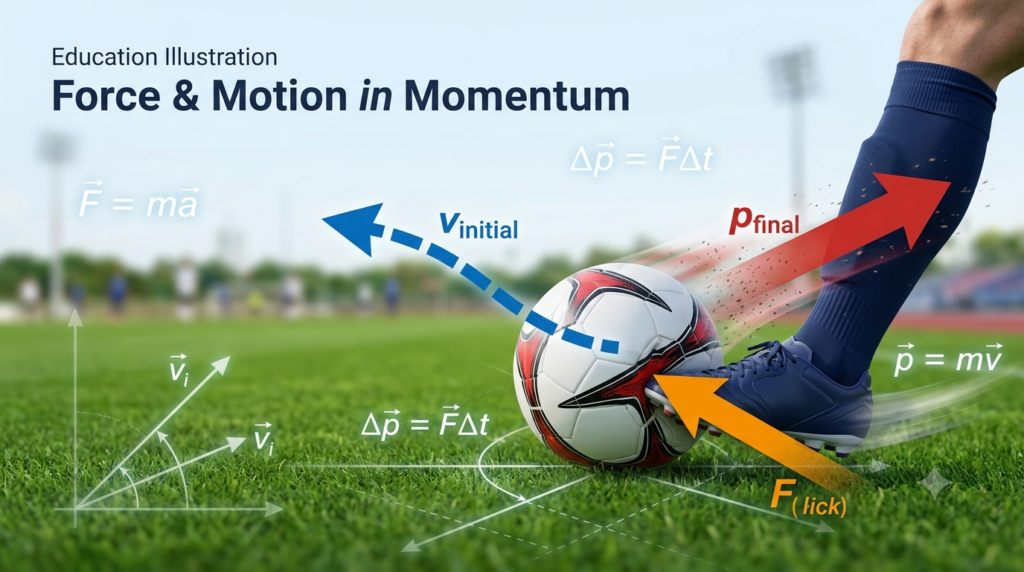
Force is one of the most important vector quantities in physics. A force can change an object’s motion, direction, or shape, and its effect depends on the direction in which it acts.
For example, pushing a box toward the right produces a different effect from pushing it toward the left. Similarly, two forces acting at different angles can produce a resultant force whose magnitude and direction must be calculated.
Because force has both magnitude and direction, it is represented as a vector.
This is why diagrams involving forces often use arrows. The length of the arrow can represent magnitude, while the arrowhead indicates direction.
Why the Difference Matters in Physics
The distinction between scalar and vector quantities is not just a matter of classification. It affects how physical problems are solved.
When dealing with scalar quantities, ordinary numerical calculations are often sufficient. When dealing with vectors, direction must be considered during calculations.
This becomes especially important in mechanics, where displacement, velocity, acceleration, and force interact. It is also important in fields such as electromagnetism, fluid mechanics, engineering, and space science.
Ignoring direction when working with vectors can produce an incorrect result even when the numerical calculations appear correct.
Conclusion
Scalar and vector quantities are two fundamental categories of physical quantities. A scalar has magnitude only, while a vector has both magnitude and direction. Mass, temperature, distance, speed, and energy are common examples of scalars, whereas displacement, velocity, acceleration, force, and momentum are vectors.
The difference becomes clear through everyday examples such as speed versus velocity and distance versus displacement. Scalars can often be combined using ordinary arithmetic, while vectors require methods that account for direction. Understanding this distinction provides a strong foundation for studying motion, forces, and many other areas of physics.