Energy is one of the most important ideas in science. We use energy to move objects, produce light, heat homes, power machines, run computers, and support life. Yet energy often seems to disappear. A moving ball eventually stops. A hot cup of tea becomes cold. A car slows down after the engine is turned off. When a battery runs out, the stored energy appears to be gone.
But energy does not actually disappear. According to the law of conservation of energy, energy cannot be created or destroyed. It can only be transferred from one object or system to another, or transformed from one form into another.
Understanding this idea helps explain many everyday events that might otherwise seem mysterious.
What Does Conservation of Energy Mean?
The conservation of energy means that the total amount of energy in an isolated system remains constant. Energy can change its form, but the overall quantity is conserved.
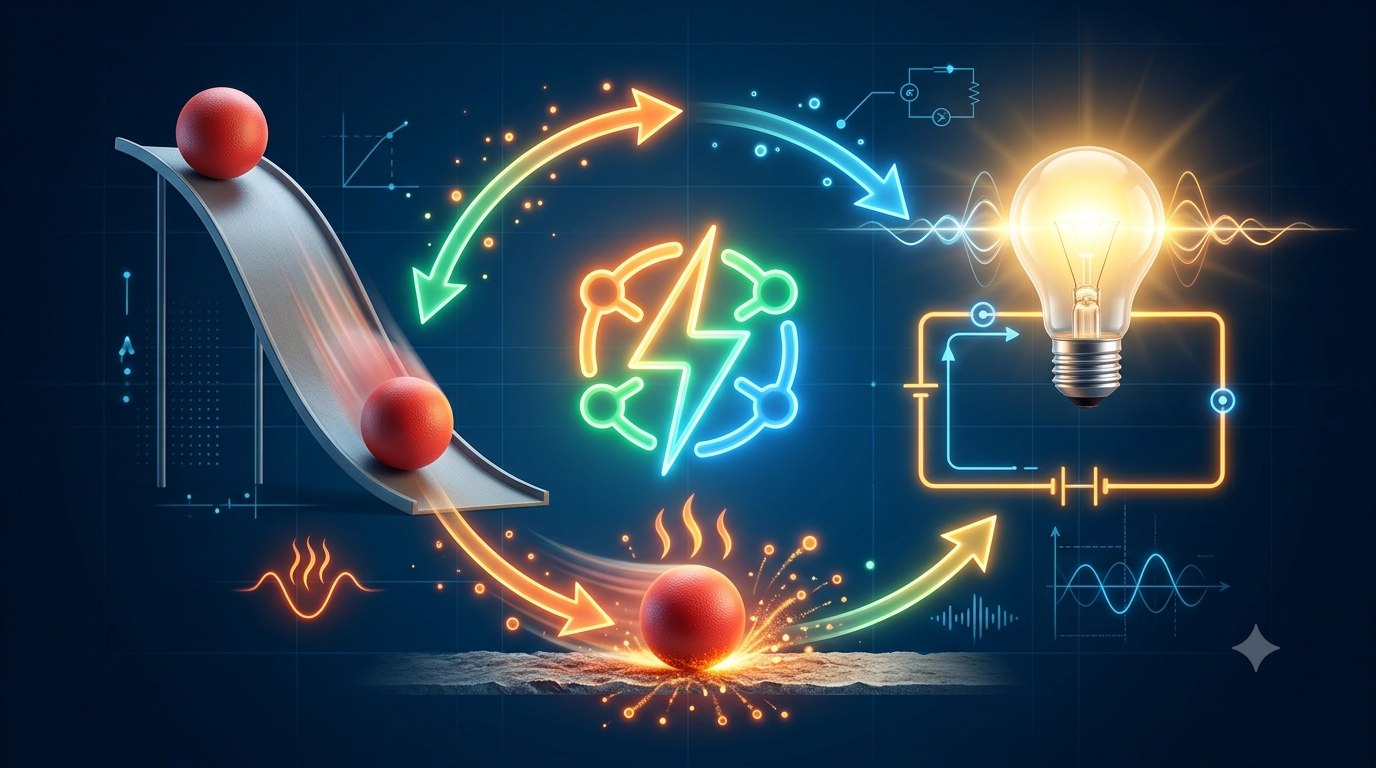
For example, consider a ball held above the ground. It has gravitational potential energy because of its position. When the ball is released, that potential energy is gradually transformed into kinetic energy as the ball speeds up.
Just before hitting the ground, much of its original potential energy has become kinetic energy. When the ball strikes the ground, its energy does not vanish. Some becomes sound, some becomes thermal energy, and some may cause the ball and ground to deform.
The energy has simply moved into different forms.
Why Does Energy Sometimes Seem to Disappear?
The main reason energy appears to disappear is that it often changes into forms that are difficult to notice.
Human senses are much better at detecting certain forms of energy than others. We can easily see light, hear sound, and feel heat, but we cannot directly observe many microscopic energy transfers.
Imagine pushing a book across a table. You give the book kinetic energy, so it begins moving. Eventually, friction slows it down until it stops.
It may seem that the book’s kinetic energy has disappeared. In reality, friction converts much of that kinetic energy into thermal energy in the book, table, and surrounding air. The surfaces may become slightly warmer, although the temperature increase is usually too small to notice.
So the energy has not disappeared. It has simply become less obvious.
Energy Changes Form
Energy exists in many different forms. Some important forms include kinetic, potential, thermal, chemical, electrical, radiant, nuclear, and sound energy.
These forms can transform into one another.
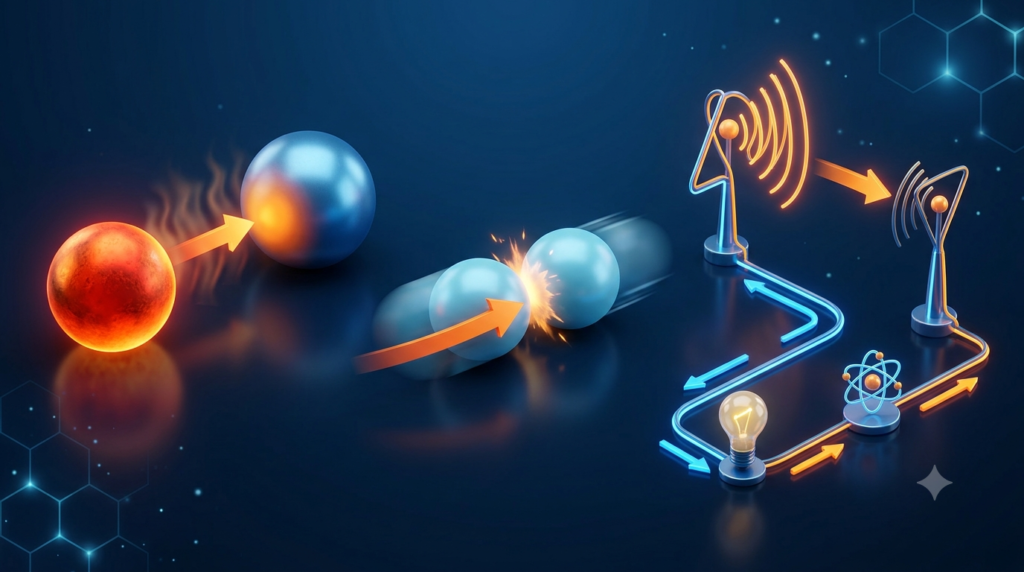
For example, when you eat food, the chemical energy stored in the food can eventually be converted into movement and thermal energy. When a battery powers a flashlight, chemical energy is transformed into electrical energy, which then becomes light and thermal energy.
A solar panel provides another example. Radiant energy from sunlight is converted into electrical energy. Some of the incoming energy also becomes thermal energy.
These transformations can happen continuously. What looks like energy loss is often simply energy becoming distributed among different forms and objects.
What Happens to Energy During Friction?
Friction is one of the clearest examples of apparent energy loss.
Suppose you slide a block across a rough surface. At first, the block has kinetic energy. Friction acts against its motion and eventually brings it to rest.
Where did the kinetic energy go?
At the microscopic level, the surfaces are not perfectly smooth. Their tiny irregularities interact, causing atoms and molecules to vibrate more strongly. As a result, some of the organized kinetic energy of the moving block is transformed into thermal energy.
The surroundings receive this energy as heat.
This is why rubbing your hands together makes them warm. Mechanical energy from your hand movements is transformed into thermal energy because of friction.
Why Does a Moving Object Eventually Stop?
Consider a bicycle moving along a road. If you stop pedaling, the bicycle gradually slows down.
Several forces are responsible, including friction in the moving parts, friction between the tires and road, and air resistance.
The bicycle’s kinetic energy is transformed into thermal energy and, to a smaller extent, sound and other forms of energy.
The important point is that the bicycle’s kinetic energy does not need to remain as kinetic energy. Conservation of energy applies to the entire system, not just to the moving bicycle.
If we looked only at the bicycle, it would appear that energy had been lost. If we include the road, tires, air, bicycle components, and surroundings, the energy can be accounted for.
What Happens When a Hot Object Cools?
A hot cup of tea provides another familiar example.
When the tea is first prepared, it contains a relatively large amount of thermal energy. Over time, the tea becomes cooler.
It might seem as though the thermal energy has disappeared.
Instead, thermal energy has been transferred from the hot tea to the cooler surroundings. Heat moves through the cup, into the surrounding air, and can also be transferred through radiation.
Eventually, the tea and its surroundings approach thermal equilibrium. The energy has spread out rather than being destroyed.
This illustrates an important distinction: energy conservation does not mean that energy always remains concentrated or useful.
Useful Energy and Less Useful Energy
Although the total amount of energy is conserved, the ability to use that energy for a particular purpose can decrease.
For example, gasoline contains chemical energy that can be converted into mechanical energy in a car engine. During combustion, some of the energy becomes thermal energy and is transferred to the surroundings.
The total energy is still conserved, but the dispersed thermal energy is not as easy to convert back into useful mechanical work.
This is closely related to the second law of thermodynamics, which describes how energy transformations tend to increase the overall dispersal of energy and entropy.
Therefore, saying that energy is “lost” in everyday language usually means that energy has become less useful for the intended task, not that it has ceased to exist.
Is Energy Conserved in a Battery?
A battery is another good example of energy transformation.
A charged battery stores energy chemically. When connected to a circuit, chemical reactions inside the battery transfer energy to electrical components.
A lamp may transform some of that electrical energy into light and thermal energy. In a motor, electrical energy can become mechanical energy, along with some thermal and sound energy.
When the battery can no longer provide enough electrical energy for the device, its original chemical state has changed. The energy has been transferred and transformed throughout the system.
The battery has not destroyed energy. It has changed how the stored energy is distributed.
What About Energy in the Human Body?
The human body also demonstrates energy conservation.
Food contains chemical energy. During digestion and metabolism, this energy becomes available for biological processes. Some supports movement, while much is released as thermal energy. Energy is also used for maintaining body functions and building or repairing biological structures.
When a person runs, chemical energy is transformed into mechanical energy and thermal energy. The body becomes warmer because not all of the chemical energy is converted into useful external motion.
Again, the energy does not vanish. It changes form and moves between different parts of the body and environment.
Does Energy Conservation Apply Everywhere?
Yes, conservation of energy is a fundamental principle of physics. It applies to mechanical systems, electrical circuits, chemical reactions, biological processes, and many other physical situations.
In modern physics, energy conservation is deeply connected to the symmetry of physical laws over time. In simple terms, because the fundamental laws of physics do not depend on a particular moment in time, energy emerges as a conserved quantity.
For everyday situations, however, it is usually enough to remember that the total energy of a properly defined closed system remains constant while energy is transferred or transformed.
Why Is Energy Conservation So Important?
The conservation of energy allows scientists and engineers to predict what can happen in physical systems.
Engineers use energy conservation when designing engines, power plants, batteries, electrical devices, buildings, and transportation systems. Scientists use it to understand processes ranging from the motion of objects to chemical reactions and astronomical events.
It also helps us identify mistakes. If an energy calculation suggests that more energy comes out of a system than was supplied without an appropriate energy source, something is missing from the analysis.
Energy conservation provides a powerful accounting system for nature.
Energy Does Not Disappear, It Becomes Distributed
The next time a moving object stops, a battery runs down, or a hot object cools, remember that the energy has not simply vanished.
The moving object’s kinetic energy may have become thermal energy. The battery’s chemical energy may have been transferred to electrical components. The hot object’s thermal energy may have moved into the surrounding environment.
In many cases, energy becomes spread across a much larger number of particles and objects. Because it is dispersed, it becomes harder to observe and harder to use for a specific purpose.
That is why energy can seem to disappear even though it is still present.
Conclusion
Energy conservation is one of the fundamental principles that helps us understand the physical world. Energy cannot simply appear from nowhere or disappear into nothing. Instead, it is transferred between objects and transformed from one form into another.
Friction can turn motion into heat. A battery can turn chemical energy into electrical energy. A falling object can transform gravitational potential energy into kinetic, thermal, and sound energy. A hot drink can transfer thermal energy to its surroundings.
So when energy appears to disappear, the better question is not “Where did the energy go?” but “What form did the energy take, and where was it transferred?”
Once we start looking at energy this way, many everyday mysteries become easier to understand. What seems like energy loss is usually a transformation, transfer, or spreading of energy that is still part of the physical world.