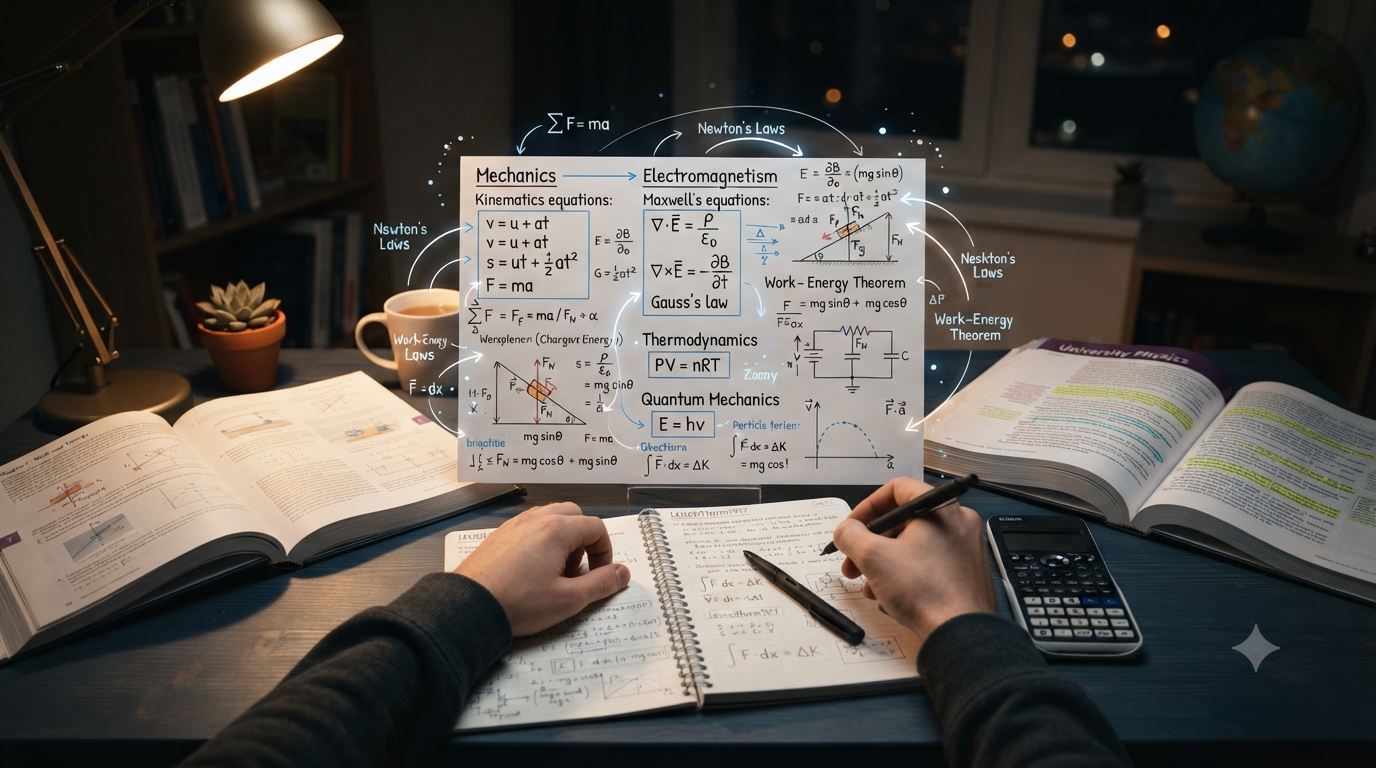

Physics involves many formulas, and remembering all of them can become difficult as you move from basic concepts to more advanced topics. However, a good physics formula sheet is not simply a collection of equations. It is a structured tool that helps you understand relationships between physical quantities, recall important formulas quickly, and choose the correct equation when solving problems.
Building your own formula sheet can also improve your understanding of physics. Instead of copying formulas from a textbook, you organize them according to topics, identify the meaning of each symbol, and connect equations with the concepts behind them. A well-designed formula sheet can therefore become a useful reference for learning, revision, and problem-solving.
Start With Physics Topics
The first step is to divide your formula sheet into clear physics topics. Avoid putting every formula into one long list because it becomes difficult to find what you need.
For example, a basic physics formula sheet can have sections such as:
Units and Measurements
Motion
Force and Laws of Motion
Work, Energy and Power
Gravitation
Properties of Matter
Heat and Thermodynamics
Waves
Electricity
Magnetism
Optics
Modern Physics
The exact topics will depend on what you are studying. The important point is to keep related formulas together.
When formulas are organized by topic, your brain can associate an equation with a particular physical idea. This makes recall easier than memorizing formulas randomly.
Write the Formula Clearly
Once you choose a topic, list the important formulas under it. Write each equation clearly and avoid unnecessary decoration.
For example, under motion, you might include:
v = u + at
s = ut + ½at²
v² = u² + 2as
s = ½(u + v)t
These equations describe relationships between displacement, initial velocity, final velocity, acceleration, and time.
Do not fill your formula sheet with every equation you find. Include formulas that are important, frequently used, or directly connected to the concepts you are studying.
A shorter formula sheet is often more useful than a crowded one.
Add the Meaning of Every Symbol
A formula without the meaning of its symbols can become confusing.
For example:
F = ma
Here:
F = force
m = mass
a = acceleration
This may seem obvious, but adding symbol meanings becomes increasingly important when formulas become more complicated.
For a formula such as:
P = W/t
you should know that P represents power, W represents work, and t represents time.
Writing these meanings beside the formula helps you avoid mistakes caused by confusing similar symbols.
Include SI Units
Units are an important part of physics. A formula sheet becomes much more useful when the SI unit of each physical quantity is included.
For example:
Including units helps you check whether an answer makes physical sense. It also makes unit conversion and dimensional analysis easier.
Mention What Each Formula Finds
Sometimes several formulas appear similar, but they are used in different situations. A short note about what a formula calculates can make your sheet much more useful.
For example:
These short descriptions turn your formula sheet into a problem-solving guide rather than a simple list of equations.
Group Related Formulas Together
Many physics formulas are connected to one another. Keeping related equations together can help you understand their relationships.
For example, in the work, energy, and power section:
W = Fs
P = W/t
K = ½mv²
U = mgh
The formulas describe different aspects of mechanical energy and its transfer.
Similarly, in electricity, related formulas can be grouped together:
V = IR
P = VI
P = I²R
P = V²/R
When related formulas appear together, it becomes easier to recognize which equation may be useful in a particular problem.
Include Important Constants
Some areas of physics frequently use physical constants. If you regularly work with them, keep a small constants section on your formula sheet.
For example:
Speed of light: c ≈ 3 × 10⁸ m/s
Gravitational constant: G ≈ 6.67 × 10⁻¹¹ N m²/kg²
Acceleration due to gravity near Earth: g ≈ 9.8 m/s²
Planck constant: h ≈ 6.626 × 10⁻³⁴ J·s
The exact constants you need will depend on your level and syllabus.
Always use the values and units appropriate to the problems you are solving.
Add Conditions and Special Cases
A formula may not work in every situation. Some equations depend on particular assumptions or conditions.
For example, the familiar equations of uniformly accelerated motion are generally used when acceleration remains constant.
Similarly, formulas involving ideal conditions may have limitations in real-world situations.
Adding a small note such as “constant acceleration” beside a formula can prevent incorrect application.
This is one of the most valuable features of a good formula sheet because it reminds you that physics formulas describe specific physical relationships under particular conditions.
Use Dimensional Analysis as a Check
Dimensions can help you check whether a formula is physically consistent.
For example, consider:
v = s/t
The dimension of displacement is [L], while time has dimension [T]. Therefore:
[v] = [L][T⁻¹]
which is the correct dimension for velocity.
You do not need to perform dimensional analysis for every formula, but including important dimensional relationships can be useful when studying physics.
It can also help you identify mistakes when rearranging or deriving equations.
Keep Derivations Separate From the Main Sheet
A formula sheet should remain easy to scan. Long derivations can make it difficult to find important equations quickly.
Instead, keep the main formula sheet focused on formulas, symbols, units, conditions, and short explanations.
If you need derivations, maintain a separate section or notebook.
For example, you may have a formula sheet containing:
v² = u² + 2as
and a separate page showing how the equation can be derived from other equations of motion.
This keeps your reference sheet compact while still supporting deeper learning.
Use Consistent Formatting
Consistency makes a formula sheet easier to read.
Use the same format for every entry. For example:
You do not have to follow this exact format, but using a consistent structure helps you find information quickly.
Avoid using too many colors, fonts, or decorative elements. The purpose of the sheet is clarity, not decoration.
Review and Update Your Formula Sheet
Your formula sheet should develop as your understanding of physics grows.
After studying a new chapter, add the important formulas and remove unnecessary ones. If you repeatedly make a mistake with a particular equation, add a short warning or condition beside it.
You can also mark formulas that you frequently forget.
Over time, the sheet becomes personalized to your own learning needs.
It is also useful to review the formula sheet regularly rather than looking at it only before an examination. Frequent review helps you recognize formulas naturally and understand when they should be applied.
A Formula Sheet Should Support Understanding
A formula sheet is most effective when it supports understanding rather than replacing it. Memorizing an equation without knowing what it represents can make physics problems difficult.
For every important formula, ask yourself three questions:
What physical relationship does this formula describe?
What does each symbol represent?
When should I use this formula?
If you can answer these questions, you are doing more than memorizing equations. You are learning how physics describes the behavior of the physical world.
Conclusion
Building a physics formula sheet is a simple but powerful way to organize your learning. Start by dividing physics into topics, then add important formulas along with symbols, SI units, applications, conditions, and related equations. Keep the layout clear and avoid turning the sheet into a crowded collection of formulas.
The best formula sheet is not necessarily the longest one. It is the one that helps you quickly understand what a formula means, recognize when it should be used, and apply it correctly. When combined with conceptual understanding and regular problem-solving, a well-organized formula sheet can become one of the most useful tools in learning physics.
FAQs
1. What is a physics formula sheet?
A physics formula sheet is a structured collection of important equations used in physics. It usually includes formulas, the meaning of symbols, SI units, conditions, and short notes about when each formula should be used. Instead of searching through textbooks for equations, you can use the sheet as a quick reference during study and revision. A good formula sheet organizes formulas according to topics such as motion, force, work, energy, electricity, magnetism, waves, and optics. It should focus on useful formulas rather than including every equation you encounter. When properly organized, a formula sheet can make revision faster and help connect formulas with physical concepts.
2. Why should I make my own physics formula sheet?
Making your own physics formula sheet can improve both organization and understanding. When you write a formula yourself, you have an opportunity to think about what each symbol means and how the equation is used. Organizing formulas by topic also helps you recognize relationships between different physical quantities. A personal formula sheet can be adjusted according to the areas you find difficult or formulas you frequently forget. It also provides a quick reference during revision, reducing the time spent searching through textbooks or notes. The main purpose is not simply memorization but creating a useful tool that supports understanding, recall, and problem-solving.
3. What should I include in a physics formula sheet?
A useful physics formula sheet should contain important formulas along with the meaning of their symbols and SI units. You can also include short notes explaining what each formula calculates and the conditions under which it applies. Related formulas should be grouped together under clear topic headings. Important physical constants can be added in a separate section when necessary. You may also include dimensions for selected quantities as a checking tool. Avoid filling the sheet with unnecessary information. The goal is to make the sheet easy to scan and understand. A concise collection of important equations is usually more useful than a crowded list of formulas.
4. How should I organize physics formulas?
The simplest approach is to organize formulas according to physics topics. For example, you can create sections for motion, force, work and energy, gravitation, heat, waves, electricity, magnetism, optics, and modern physics. Within each section, place related formulas together. You can arrange them from basic relationships to more advanced ones. It is also useful to keep formulas that are commonly used together in the same area. For each formula, add symbols, units, and a brief note about its application. Consistent formatting makes the sheet easier to read. Good organization allows you to find a required formula quickly without searching through a long, unstructured list.
5. Should I memorize every formula on my physics formula sheet?
No, you do not necessarily need to memorize every formula. Understanding the physical relationship represented by an equation is more important than memorizing a large collection of formulas without context. Some basic and frequently used formulas are useful to remember, while more complicated equations may be easier to recall through their derivation or connection to fundamental principles. Your formula sheet should help you recognize these relationships. When studying a formula, understand what each symbol means, what quantities are related, and when the equation can be applied. Regularly solving problems will naturally strengthen your ability to remember and use important formulas.
6. Should I include SI units on my physics formula sheet?
Yes, including SI units can make a physics formula sheet much more useful. Units help you understand the physical meaning of quantities and provide a simple way to check calculations. For example, force is measured in newtons, work in joules, power in watts, and velocity in metres per second. Writing units beside important quantities can also help with unit conversions and dimensional analysis. When solving numerical problems, checking the units can sometimes reveal an incorrect substitution or calculation. You do not need to write every possible unit conversion on the sheet, but keeping the standard SI units of important quantities is highly useful for learning and revision.
7. Should I include derivations on a physics formula sheet?
Long derivations are usually better kept separate from the main formula sheet. A formula sheet should allow you to find important equations quickly, so filling it with lengthy mathematical steps can make it difficult to use. However, you can include a very short note showing the relationship between formulas when that helps you remember them. For example, you might note that a particular equation of motion can be obtained from two other equations. Detailed derivations can be maintained in a separate notebook or study document. This approach keeps the formula sheet compact while still allowing you to study the reasoning behind important equations when needed.
8. How many formulas should a physics formula sheet contain?
There is no fixed number of formulas that every physics formula sheet should contain. The number depends on your level of study, syllabus, and the topics you are learning. A beginner may need only the essential equations for basic motion, force, energy, heat, waves, and electricity. As you study more advanced physics, the sheet can grow to include additional relationships. However, adding every formula you encounter can make the sheet difficult to use. Focus on important, frequently used, or easily forgotten equations. If a formula can be derived quickly from a more fundamental relationship, you may not need to give it as much space.
9. How can a formula sheet help with physics problems?
A formula sheet can help you identify the mathematical relationship needed to solve a physics problem. After understanding the given information, you can look at the relevant topic and compare the known quantities with the variables in different equations. This can help you select an appropriate formula instead of trying equations randomly. A well-designed sheet can also remind you of units, conditions, and related formulas. However, the sheet cannot replace conceptual understanding. You still need to understand the problem, identify the physical situation, substitute values correctly, and check the final answer. Its main role is to support organized thinking and efficient problem-solving.
10. How often should I update my physics formula sheet?
You should update your physics formula sheet whenever you learn an important new concept or discover a formula that is useful for solving problems. After completing each topic or chapter, review the sheet and add essential equations, symbols, units, and conditions. You can also remove formulas that are unnecessary or combine related information to keep the sheet organized. If you repeatedly make mistakes with a particular formula, adding a short reminder can be helpful. Reviewing the sheet regularly is more effective than creating it once and forgetting about it. Over time, your formula sheet can become a personalized reference that reflects your growing understanding of physics.
Related Posts
Why does XOR behave differently from OR when both inputs are true?
Logical operators are essential in computer science because they help computers make decisions, compare conditions, and process information. Among the […]
Read MoreHow are Boolean algebra and digital logic gates related?
Boolean algebra and digital logic gates are two fundamental concepts in computer science and digital electronics. They work together to […]
Read MoreWhy can Boolean expressions be simplified without changing their logical result?

Boolean expressions are an essential part of computer science, digital electronics, programming, and information technology. They are used to represent […]
Read MoreHow does Boolean algebra simplify decisions made by computer programs?

Every computer program makes decisions. A website decides whether to allow a user to log in, a mobile application checks […]
Read MoreWhy does character encoding affect the amount of storage required for text?

Text may look simple when we read it on a screen, but computers must represent every character using numerical data. […]
Read MoreHow can the size of a file be estimated from the number of stored bytes?

Every digital file occupies a certain amount of storage space on a computer, smartphone, or other digital device. Whether it […]
Read MoreWhy are storage measurements sometimes calculated differently using decimal and binary units?

Have you ever purchased a 500 GB hard drive and noticed that your computer reports a slightly different storage capacity? […]
Read MoreWhat happens when a numerical value exceeds the range available in its data representation?

Computers store numerical values using a limited number of bits. Every data type, such as an 8-bit integer, a 32-bit […]
Read MoreWhy does the maximum value of a fixed-width integer depend on its number of bits?

Computers store and process information using binary digits, commonly called bits. Each bit can hold one of two values: 0 […]
Read MoreHow does a signed number differ from an unsigned number at a fundamental level?

Computers use binary numbers to represent and process information. Every number stored in a computer occupies a certain number of […]
Read MoreWhy are powers of two so common in computer memory and digital systems?

Computers store, process, and transmit information using binary digits, commonly known as bits. Unlike the decimal number system, which uses […]
Read MoreHow can the same number of bits represent different types of information?

Computers process many different types of information, including numbers, letters, images, sounds, videos, and instructions. Although these forms of information […]
Read MoreWhy does one additional bit double the number of possible binary combinations?

Computers use binary numbers to store, process, and communicate information. Unlike the decimal system, which uses ten digits from 0 […]
Read MoreHow does increasing the number of binary digits affect the range of representable values?

Binary is the number system used by digital computers to represent and process information. It uses only two digits, 0 […]
Read MoreWhy does digital hardware use binary instead of the decimal system?

Digital devices are part of almost every aspect of modern life. Computers, smartphones, calculators, televisions, digital cameras, and communication systems […]
Read MoreHow does a computer represent zero and other numbers using binary?

Computers perform calculations, store information, and process instructions using a system called binary. Unlike humans, who commonly use decimal numbers […]
Read MoreWhy does the order of operations matter when a computer evaluates an expression?
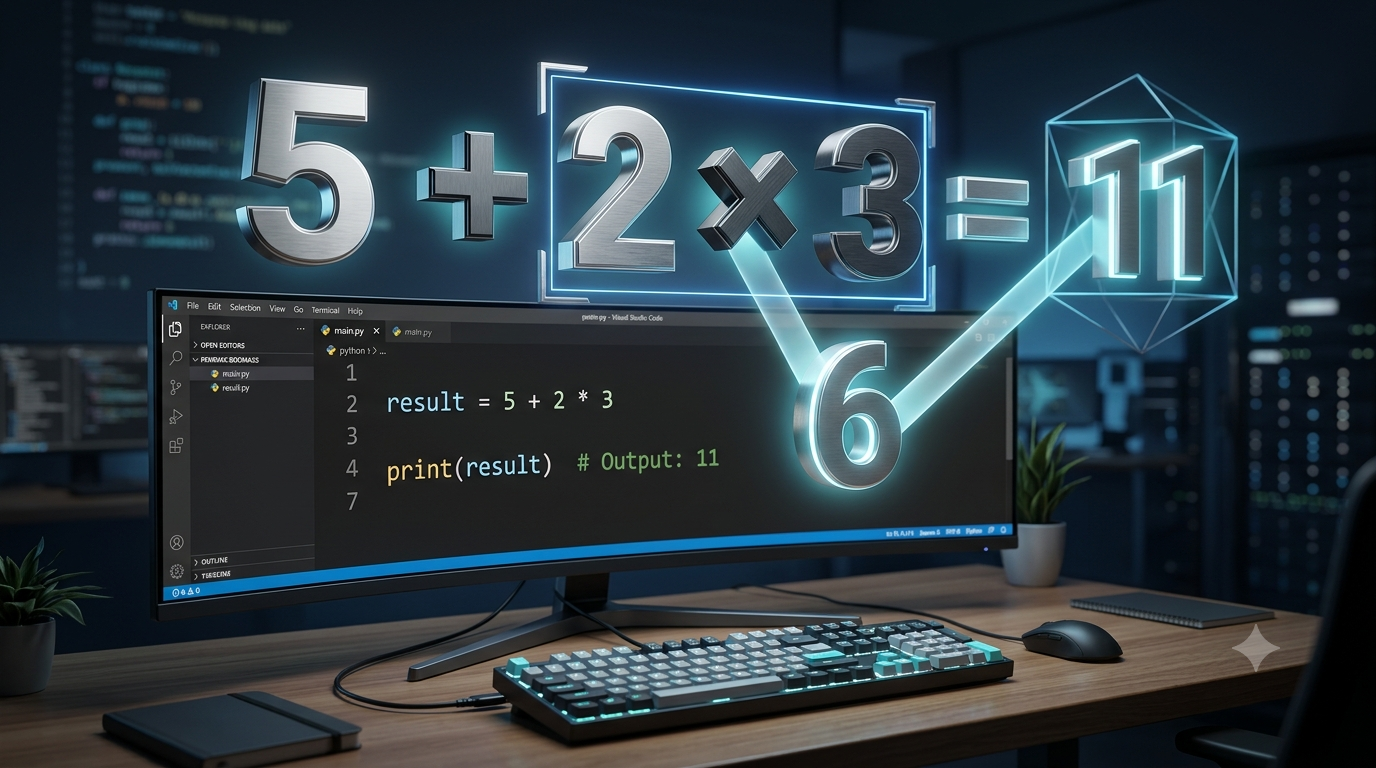
Computers perform millions of calculations every second, from calculating the total cost of an online purchase to processing scientific data […]
Read MoreHow does integer arithmetic differ from real-number arithmetic in computing?
Arithmetic is one of the fundamental parts of computing. Computers perform calculations in programming, data processing, scientific simulations, financial applications, […]
Read More