When an object moves from one place to another, we often describe its motion by saying how far it has traveled. In physics, however, there are two different quantities used to describe motion: distance and displacement. Although they are related, they do not mean the same thing.
Distance tells us the total length of the path traveled by an object, while displacement tells us how much the object’s position has changed in a particular direction. Understanding the difference between distance and displacement is important because these concepts form the foundation of motion, velocity, acceleration, and many other topics in physics.
What Is Distance?
Distance is the total length of the actual path traveled by an object during its motion.
It does not matter which direction the object moves. Every part of the path is added together to find the total distance.
For example, imagine a person walks 5 meters east and then 3 meters west. The person has traveled:
Distance = 5 m + 3 m = 8 m
Therefore, the distance traveled is 8 meters.
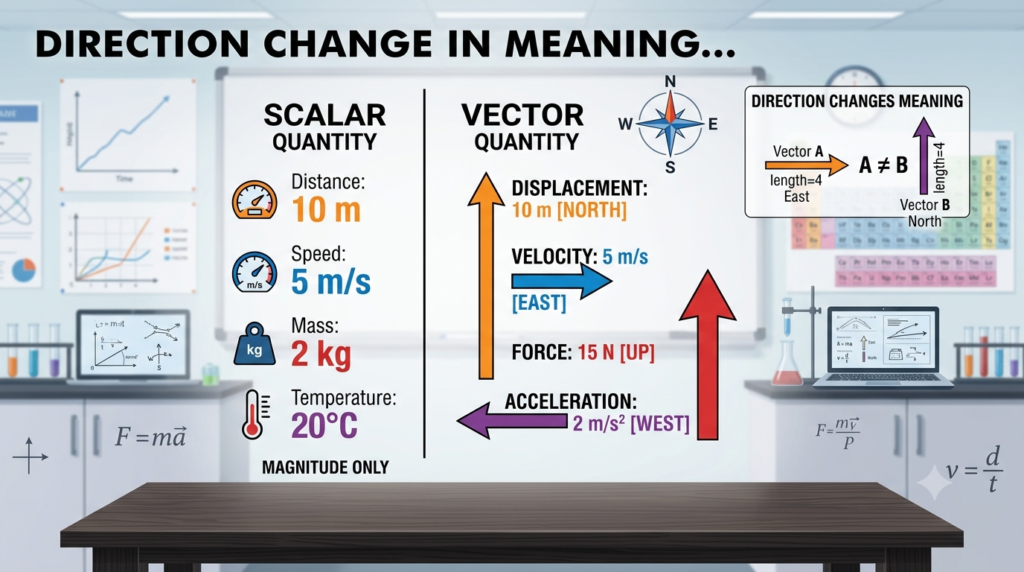
Distance is a scalar quantity, which means it has magnitude but no direction. We can say that a car traveled 50 kilometers, but we do not need to specify a direction when describing its distance.
The SI unit of distance is the meter (m). Other commonly used units include kilometers, centimeters, and millimeters.
What Is Displacement?
Displacement is the change in the position of an object from its initial position to its final position.
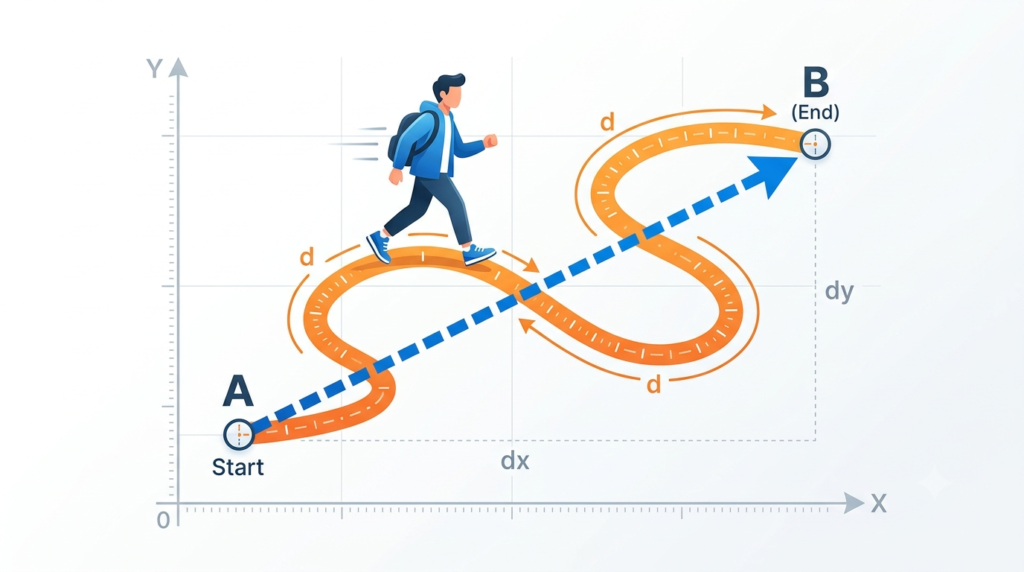
Unlike distance, displacement considers both magnitude and direction. It is represented by the shortest straight-line path between the starting point and the final point.
For example, suppose a person walks 5 meters east and then 3 meters west. The person’s final position is 2 meters east of the starting point.
Therefore:
Displacement = 2 m east
Displacement is a vector quantity, which means it has both magnitude and direction.
The SI unit of displacement is also the meter (m).
Distance and Displacement With an Example
Consider a student walking from point A to point B. Suppose the student walks 10 meters east and then 6 meters north.
The total distance traveled is:
Distance = 10 m + 6 m = 16 m
However, the displacement is the straight-line distance from point A to point B.
Using the Pythagorean theorem:
Displacement = √(10² + 6²)
Displacement = √136 ≈ 11.66 m
The direction is also important, so the displacement can be described as approximately 11.66 meters in a direction northeast of the starting point.
This example shows why distance and displacement can have different values even though they describe the same motion.
Key Differences Between Distance and Displacement
Distance and displacement differ in several important ways.
| Distance | Displacement |
|---|
| Distance is the total path traveled. | Displacement is the change in position. |
| It is a scalar quantity. | It is a vector quantity. |
| It has magnitude only. | It has magnitude and direction. |
| It depends on the actual path followed. | It depends only on the initial and final positions. |
| Distance is always positive or zero. | Displacement can be positive, negative, or zero depending on the chosen direction. |
| Distance can never be less than the magnitude of displacement. | The magnitude of displacement can be equal to or less than distance. |
| It does not require a reference direction. | It requires a reference direction. |
Distance Depends on the Path
One of the most important features of distance is that it depends on the actual path followed by an object.
Suppose a person needs to travel from home to a shop located 1 kilometer away in a straight line. If the person takes a longer road and walks 1.5 kilometers, the distance traveled is 1.5 kilometers.
If another person walks along a shorter route of 1.2 kilometers, the distance traveled is 1.2 kilometers.
The initial and final locations are the same, but the distances are different because the paths are different.
Displacement Depends on Initial and Final Positions
Displacement does not depend on the complete path followed by an object. It depends only on its initial position and final position.
Imagine two runners start at the same point and finish at the same point. One runner follows a straight path while the other follows a curved and longer path.
Their distances may be different, but their displacements are the same because their starting and ending positions are identical.
This is one of the easiest ways to remember the difference:
Distance depends on the path. Displacement depends on the change in position.
When Are Distance and Displacement Equal?
Distance and displacement are equal in magnitude when an object moves along a straight line in one direction without changing direction.
For example, if a cyclist moves 20 meters east without turning or moving backward:
Distance = 20 m
Magnitude of displacement = 20 m east
In this situation, the distance and magnitude of displacement are equal.
However, once the cyclist changes direction or follows a curved path, the distance will generally become greater than the magnitude of displacement.
When Can Displacement Be Zero?
Displacement can be zero even when an object has traveled a significant distance.
Consider a person who walks 500 meters east and then returns 500 meters west to the starting point.
The total distance is:
Distance = 500 m + 500 m = 1000 m
But the final position is the same as the initial position.
Therefore:
Displacement = 0 m
This is an important example because it demonstrates that an object can move and still have zero displacement.
A similar situation occurs when a runner completes one full lap of a circular track and finishes at the starting point. The runner has traveled a nonzero distance, but the displacement is zero.
Can Displacement Be Greater Than Distance?
No. The magnitude of displacement can never be greater than the distance traveled.
This is because displacement represents the shortest straight-line separation between the initial and final positions, while distance represents the actual path length.
Mathematically:
Magnitude of displacement ≤ Distance
The two quantities are equal only when the object travels directly from its initial position to its final position without changing direction.
In most other situations, the distance is greater than the magnitude of displacement.
Positive and Negative Displacement
Displacement can have a positive or negative value when motion occurs along a chosen one-dimensional axis.
For example, suppose east is defined as the positive direction. If a car moves 10 meters east, its displacement is:
+10 m
If it moves 10 meters west, its displacement is:
−10 m
The negative sign does not mean that the car traveled a negative distance. It simply indicates that the displacement is in the direction opposite to the chosen positive direction.
Distance, on the other hand, does not use positive or negative direction because it is a scalar quantity.
Why Are Distance and Displacement Important?
Distance and displacement are fundamental concepts for describing motion. They are used to understand quantities such as speed and velocity.
Average speed is calculated using total distance traveled:
Average speed = Total distance / Total time
Average velocity, however, is calculated using displacement:
Average velocity = Displacement / Total time
This difference explains why an object can have a nonzero average speed but zero average velocity. For example, if a runner completes a full lap and returns to the starting point, the runner has traveled a certain distance, so the average speed is not zero. But the displacement is zero, so the average velocity is zero.
Real-Life Examples of Distance and Displacement
Distance and displacement appear in everyday situations.
A person walking around a park travels a certain distance based on the entire path they follow. Their displacement depends only on where they started and where they finished.
Similarly, a car traveling through several streets may cover many kilometers. Its distance is the total length of those roads, while its displacement is the direct change in position from the starting location to the destination.
In air travel, a plane may follow a curved route between two cities. The flight distance depends on the route, while the displacement represents the change in position between the departure and arrival locations.
Conclusion
Distance and displacement are two essential quantities used to describe motion, but they describe different aspects of an object’s movement. Distance is the total length of the actual path traveled and is a scalar quantity, while displacement is the change in position from the initial point to the final point and is a vector quantity.
Distance depends on the path taken, whereas displacement depends only on the starting and ending positions. Distance is always greater than or equal to the magnitude of displacement. In a round trip, distance can be large while displacement is zero.
Once this distinction is clear, many other concepts in mechanics, including speed, velocity, and motion graphs, become much easier to understand.