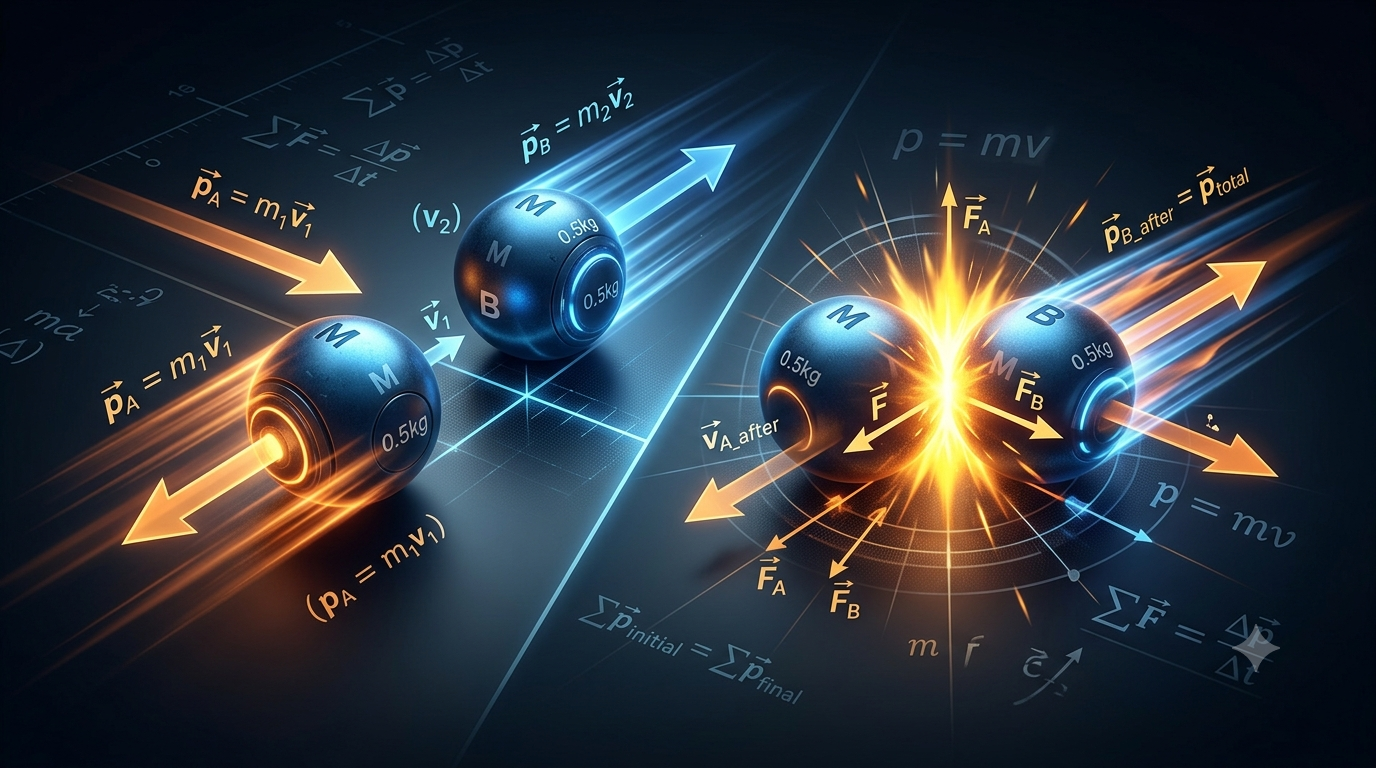
When two objects collide, many things can happen. A moving ball can hit another ball and send it in a different direction. A car can crash into another vehicle and change its speed. A tennis racket can strike a ball and make it move rapidly in the opposite direction. Although these events look very different, they are all connected by one important idea in physics: momentum.
Momentum helps physicists understand what happens during collisions. It tells us how much motion an object has and helps predict how that motion will be shared, transferred, or changed when objects interact.
What Is Momentum?
Momentum is a physical quantity associated with the motion of an object. It depends on two things: the object’s mass and its velocity.
The equation for momentum is:
p = mv
where p represents momentum, m represents mass, and v represents velocity.
Because velocity has both magnitude and direction, momentum is also a vector quantity. This means that the direction of motion matters when calculating the total momentum of a system.
For example, a 2 kg object moving at 3 m/s has a momentum of 6 kg·m/s. If the same object moves at 3 m/s in the opposite direction, its momentum has the same magnitude but the opposite direction.
This becomes especially important during collisions because objects can change direction as well as speed.
Why Is Momentum Important in Collisions?
The main reason momentum matters is that momentum is conserved in an isolated system.
The law of conservation of momentum states that the total momentum before a collision is equal to the total momentum after the collision, provided no significant external force acts on the system.
In simple terms:
Total momentum before collision = Total momentum after collision
This powerful idea allows physicists to predict what will happen after objects collide, even when the details of the collision are complicated.
Suppose one ball is moving toward another ball that is initially at rest. When they collide, the first ball may slow down while the second ball starts moving. Momentum has not simply disappeared. Instead, it has been transferred between the objects.
Momentum Transfer During a Collision
Imagine pushing a shopping cart into another stationary cart. Before the collision, the moving cart has momentum while the stationary cart has almost none.
During the collision, the moving cart exerts a force on the stationary cart. The stationary cart begins to move, while the first cart changes its motion.
The momentum of one cart decreases while the momentum of the other increases. If the carts and their surroundings can be treated as an isolated system, the total momentum remains constant.
This is why momentum is often described as being transferred during a collision.
The same principle applies to many everyday situations, including billiards, sports, vehicle crashes, and objects interacting in space.
Momentum Depends on Mass and Velocity
Momentum is useful because it combines mass and velocity into one quantity.
A heavy object moving slowly can have the same momentum as a light object moving quickly.
For example, consider two objects:
Although their masses and speeds are very different, their momenta are equal in magnitude.
This helps explain why collisions involving heavy objects can be very different from collisions involving lightweight objects. A large mass can carry substantial momentum even when its speed is relatively low.
What Happens in an Elastic Collision?
Not all collisions behave in the same way. In an elastic collision, momentum is conserved and kinetic energy is also conserved.
A useful example is an idealized collision between billiard balls. If one ball strikes another, the balls may move apart with speeds and directions determined by their masses and initial velocities.
Real collisions are rarely perfectly elastic, but some systems can behave approximately this way.
Momentum conservation remains one of the key tools for analyzing such collisions.
What Happens in an Inelastic Collision?
In an inelastic collision, momentum is still conserved if the system is isolated, but kinetic energy is not conserved.
Some of the initial kinetic energy can be transformed into other forms of energy, such as heat, sound, vibration, or deformation.
A particularly important case is a perfectly inelastic collision, where two objects stick together after colliding.
For example, imagine a moving object colliding with a stationary object and remaining attached to it. The two objects then move together with a common velocity.
Even though kinetic energy has changed, total momentum before and after the collision remains the same.
This distinction is important: momentum conservation and kinetic-energy conservation are not the same thing.
Why Do Objects Sometimes Change Direction?
Momentum also helps explain changes in direction.
Consider a ball bouncing off a wall. Before hitting the wall, the ball has momentum toward the wall. After the collision, it moves away from the wall, so its momentum points in the opposite direction.
The ball’s momentum has therefore changed significantly.
A force must act on the ball to produce this change. The wall exerts a force on the ball during the collision, changing its velocity and therefore its momentum.
This is why a collision can involve a large force even when an object’s speed before and after the collision is similar.
Impulse and Change in Momentum
The connection between force and momentum becomes especially useful during collisions.
A force acting over a period of time produces an impulse. Impulse is equal to the change in momentum:
Impulse = Change in momentum
or
FΔt = Δp
for a constant force.
This relationship explains why collision time matters.
Suppose a person jumps from a height and lands on a hard surface. Their momentum must change as they come to rest. If the stopping time is very short, the average force can be very large.
If the person bends their knees while landing, the stopping time increases. The same overall change in momentum occurs over a longer time, reducing the average force.
This principle is also used in safety equipment such as airbags, helmets, and padded surfaces.
How Momentum Helps in Car Safety
Momentum is especially important when studying vehicle collisions.
A moving car has momentum. During a crash, that momentum must change. The vehicle may slow down rapidly, stop, or change direction.
Safety systems are designed to manage this change in momentum and reduce the forces experienced by passengers.
Seat belts hold passengers in place, while airbags provide additional cushioning. Crumple zones allow parts of a vehicle to deform during a crash, increasing the time over which the vehicle and its occupants slow down.
The goal is not to eliminate the change in momentum. That change must occur. Instead, safety engineering aims to control how quickly the change happens and how the resulting forces are distributed.
Momentum in Sports
Sports provide many easy-to-see examples of momentum.
When a baseball player hits a ball, the bat transfers momentum to the ball. A fast-moving tennis racket can transfer momentum to a tennis ball. In football, a player can change the motion of the ball by applying a force during contact.
Even catching a ball involves momentum.
When a goalkeeper catches a fast-moving ball, the ball’s momentum must be reduced to zero relative to the goalkeeper. Pulling the hands backward while catching can increase the time over which the ball stops, reducing the average force on the hands.
Thus, momentum is not just a mathematical concept. It directly affects how sports equipment is designed and how athletes move safely.
Momentum in Space
Momentum is also essential for understanding motion in space.
Rocket propulsion provides a famous example. A rocket moves forward by expelling gases backward at high speed. The total momentum of the rocket and expelled gases remains consistent with conservation of momentum when external forces are negligible.
Spacecraft can therefore change their motion without pushing against the ground or against the air.
This principle is also important when studying satellites, spacecraft docking, explosions, and the movement of objects in space.
Why Momentum Is More Useful Than Speed Alone
Speed tells us how fast an object is moving, but it does not tell us everything about how difficult its motion is to change.
Momentum includes both mass and velocity, making it much more useful for collision analysis.
A lightweight tennis ball and a massive truck can have very different effects even if they happen to move at similar speeds. Their masses are dramatically different, so their momenta are also very different.
Momentum therefore gives us a better way to describe the motion involved in interactions between objects.
The Bigger Idea Behind Momentum Conservation
The conservation of momentum is more than a convenient formula for solving physics problems. It reflects a fundamental property of nature.
Whenever objects interact within an isolated system, momentum can move from one object to another, but the total amount remains constant.
This idea allows physicists to analyze events before they happen, during the interaction, and afterward.
Even when a collision produces complicated results such as deformation, heat, sound, and fragments moving in different directions, momentum conservation provides a powerful framework for understanding the overall event.
Conclusion
Momentum matters in collisions because it tells us how motion is distributed and how that motion changes when objects interact. Since momentum depends on both mass and velocity, it provides information that speed alone cannot provide.
The conservation of momentum allows physicists to predict the results of collisions, while the relationship between impulse and momentum explains why forces can become large when motion changes rapidly.
From billiard balls and sports to car safety and rocket propulsion, momentum appears throughout the physical world. Understanding it gives us a clearer picture of what really happens when objects collide—and why the effects of those collisions can be so different.