
How to Calculate Percentage Composition From a Formula

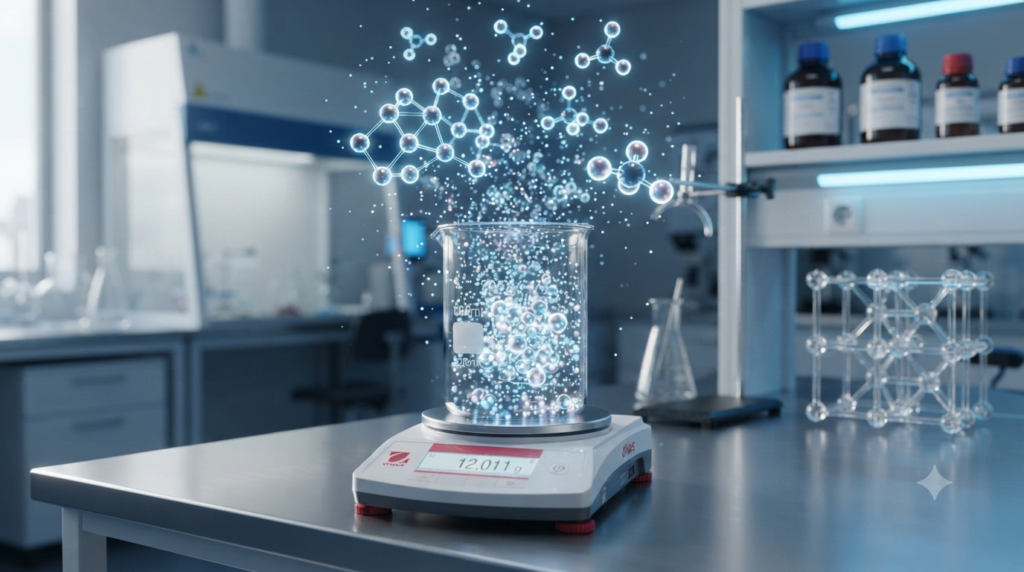
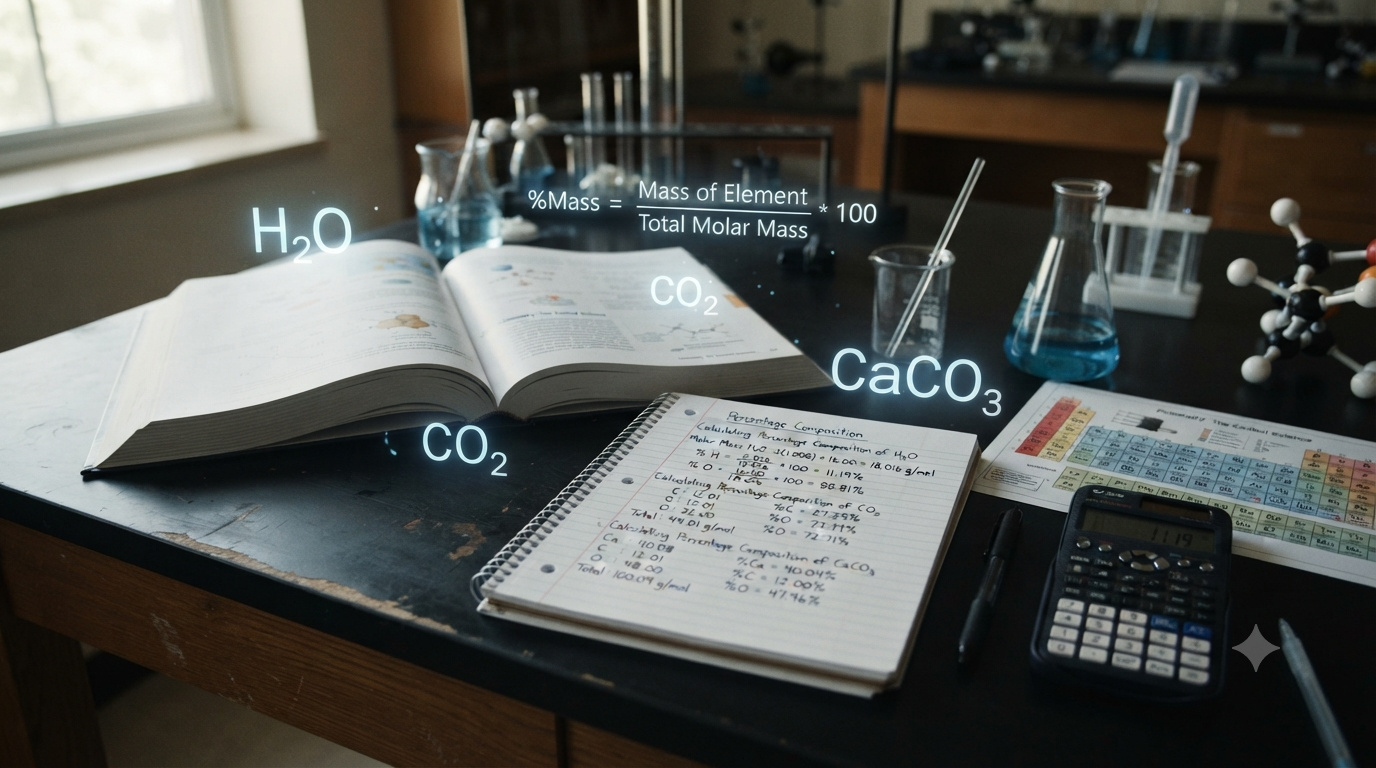
Chemistry study scene showing percentage composition calculations using chemical formulas, atomic masses, and molar mass

Percentage composition is a useful concept in chemistry that tells us how much of each element is present in a compound. Instead of simply knowing which elements make up a substance, percentage composition allows us to determine the relative amount of each element by mass. This makes it easier to compare compounds, analyze chemical substances, and understand their composition quantitatively.

The calculation is based on the chemical formula of a compound and the atomic masses of the elements present in it. Once the formula is known, the process involves finding the total molar mass of the compound and then determining what fraction of that mass comes from each element. That fraction is finally converted into a percentage.

Understanding this method is important because the same basic calculation can be applied to simple compounds such as water as well as more complex substances containing several elements.

What Is Percentage Composition?

Percentage composition is the percentage by mass of each element present in a compound.

For a particular element, the general formula is:

Percentage composition = (Mass of the element in one mole of compound ÷ Molar mass of the compound) × 100

This means that we compare the total mass contributed by an element with the total mass of the compound.

For example, water has the chemical formula H₂O. It contains hydrogen and oxygen. However, hydrogen and oxygen do not contribute equal masses to the compound. Oxygen has a much greater atomic mass than hydrogen, so oxygen makes up a larger percentage of the mass of water.

Percentage composition therefore gives us a quantitative picture of a compound’s composition.

Why Is Percentage Composition Important?

Percentage composition has several applications in chemistry. It helps scientists determine how much of a particular element is present in a substance and allows different compounds to be compared based on their elemental composition.

It is also useful when analyzing unknown substances. If the percentages of elements in a compound are known experimentally, those values can help determine the compound’s empirical formula.

Percentage composition is also closely connected with molar mass. To calculate the percentage of an element, we first need to know how much that element contributes to the total mass of one mole of the compound.

Information Needed for the Calculation

Before calculating percentage composition, you need two main pieces of information:

  1. The chemical formula of the compound.

  2. The atomic masses of the elements in the compound.

The chemical formula tells us which elements are present and how many atoms of each element occur in one formula unit.

For example:

H₂O

The subscript 2 after H means that one molecule of water contains two hydrogen atoms. There is no subscript after O, which means there is one oxygen atom.

Similarly:

CO₂

This formula contains one carbon atom and two oxygen atoms.

The atomic masses are obtained from the periodic table. For example, approximate atomic masses are:

  • Hydrogen (H) = 1

  • Carbon (C) = 12

  • Oxygen (O) = 16

  • Nitrogen (N) = 14

  • Calcium (Ca) = 40

The exact values used may vary slightly depending on the periodic table and the required level of precision.

Step 1 Find the Atomic Mass of Each Element

The first step is to identify every element in the chemical formula and find its atomic mass.

Consider water:

H₂O

The compound contains:

  • 2 hydrogen atoms

  • 1 oxygen atom

Using approximate atomic masses:

Hydrogen = 1

Oxygen = 16

The atomic masses alone are not enough. We must account for the number of atoms of each element.

Step 2 Calculate the Mass Contribution of Each Element

Multiply the atomic mass of each element by the number of atoms of that element in the formula.

For H₂O:

Mass contributed by hydrogen:

2 × 1 = 2

Mass contributed by oxygen:

1 × 16 = 16

Therefore, the total mass of one mole of H₂O is:

2 + 16 = 18

So the molar mass of water is approximately:

18 g/mol

The same approach works for every compound, regardless of how complicated its formula is.

Step 3 Calculate the Molar Mass of the Compound

The molar mass is the total mass of all the atoms represented by the chemical formula.

In general:

Molar mass = Sum of the mass contributions of all elements

For H₂O:

Molar mass = 2(1) + 1(16)

= 2 + 16

= 18 g/mol

The molar mass becomes the denominator when calculating the percentage composition.

Step 4 Calculate the Percentage of Each Element

Once the mass contribution of an element and the total molar mass are known, use:

Percentage composition = (Mass contribution of element ÷ Total molar mass) × 100

For hydrogen in H₂O:

Percentage of H = (2 ÷ 18) × 100

= 11.11%

For oxygen:

Percentage of O = (16 ÷ 18) × 100

= 88.89%

Therefore, water contains approximately:

Hydrogen = 11.11%

Oxygen = 88.89%

The percentages add up to approximately 100%.

A Complete Example Using Carbon Dioxide

Let’s calculate the percentage composition of carbon dioxide.

The chemical formula is:

CO₂

Carbon dioxide contains:

  • 1 carbon atom

  • 2 oxygen atoms

Using approximate atomic masses:

Carbon = 12

Oxygen = 16

Calculate the Mass of Carbon

There is one carbon atom:

1 × 12 = 12

Calculate the Mass of Oxygen

There are two oxygen atoms:

2 × 16 = 32

Calculate the Total Molar Mass

12 + 32 = 44 g/mol

Therefore, the molar mass of CO₂ is approximately 44 g/mol.

Calculate the Percentage of Carbon

Percentage of C = (12 ÷ 44) × 100

= 27.27%

Calculate the Percentage of Oxygen

Percentage of O = (32 ÷ 44) × 100

= 72.73%

Therefore, the percentage composition of carbon dioxide is approximately:

  • Carbon = 27.27%

  • Oxygen = 72.73%

Adding them:

27.27% + 72.73% = 100%

This provides a useful check that the calculation has been performed correctly.

Example With a Compound Containing Three Elements

Percentage composition becomes slightly more involved when a compound contains three or more elements, but the basic method remains exactly the same.

Consider calcium carbonate:

CaCO₃

It contains:

  • 1 calcium atom

  • 1 carbon atom

  • 3 oxygen atoms

Using approximate atomic masses:

Calcium = 40

Carbon = 12

Oxygen = 16

Mass Contribution of Calcium

1 × 40 = 40

Mass Contribution of Carbon

1 × 12 = 12

Mass Contribution of Oxygen

3 × 16 = 48

Total Molar Mass

40 + 12 + 48 = 100 g/mol

Now calculate the percentage of each element.

For calcium:

Percentage of Ca = (40 ÷ 100) × 100 = 40%

For carbon:

Percentage of C = (12 ÷ 100) × 100 = 12%

For oxygen:

Percentage of O = (48 ÷ 100) × 100 = 48%

Therefore:

Calcium = 40%

Carbon = 12%

Oxygen = 48%

The total is:

40% + 12% + 48% = 100%

This example shows why counting the atoms correctly is essential.

How Subscripts Affect Percentage Composition

Subscripts in a chemical formula are extremely important because they determine how many atoms of each element are present.

Consider:

SO₂

The subscript 2 means there are two oxygen atoms.

If sulfur has an atomic mass of 32 and oxygen has an atomic mass of 16:

Sulfur contribution:

1 × 32 = 32

Oxygen contribution:

2 × 16 = 32

Total molar mass:

32 + 32 = 64 g/mol

Percentage of sulfur:

(32 ÷ 64) × 100 = 50%

Percentage of oxygen:

(32 ÷ 64) × 100 = 50%

Therefore, SO₂ contains equal mass percentages of sulfur and oxygen when these approximate atomic masses are used.

Ignoring the subscript would give an incorrect result because it would underestimate the contribution of oxygen.

What About Parentheses in Chemical Formulas?

Some chemical formulas contain groups of atoms inside parentheses. In such cases, the subscript outside the parentheses applies to every atom inside the group.

Consider:

Ca(OH)₂

The subscript 2 outside the parentheses means there are two hydroxide groups.

Therefore, the formula contains:

  • 1 calcium atom

  • 2 oxygen atoms

  • 2 hydrogen atoms

Using approximate atomic masses:

Calcium = 40

Oxygen = 16

Hydrogen = 1

Mass contribution of calcium:

1 × 40 = 40

Mass contribution of oxygen:

2 × 16 = 32

Mass contribution of hydrogen:

2 × 1 = 2

Total molar mass:

40 + 32 + 2 = 74 g/mol

Percentage of calcium:

(40 ÷ 74) × 100 ≈ 54.05%

Percentage of oxygen:

(32 ÷ 74) × 100 ≈ 43.24%

Percentage of hydrogen:

(2 ÷ 74) × 100 ≈ 2.70%

The percentages add to approximately 100%, allowing for rounding.

A General Method for Any Chemical Formula

For any compound, the calculation can be organized into a simple sequence.

Identify the Elements

Write down every element present in the formula.

Count the Atoms

Determine the number of atoms of each element using subscripts and parentheses.

Find Atomic Masses

Use the periodic table to obtain the atomic mass of every element.

Calculate Mass Contributions

Multiply each atomic mass by the number of atoms of that element.

Find the Total Molar Mass

Add all the mass contributions together.

Calculate Each Percentage

For every element, use:

Percentage = (Element’s mass contribution ÷ Total molar mass) × 100

Check the Answer

Add all the percentages. The result should be approximately 100%.

Common Mistakes in Percentage Composition

Several mistakes can lead to incorrect answers.

Forgetting Subscripts

A common mistake is to use the atomic mass only once even when the formula contains multiple atoms of an element.

For example, in CO₂, oxygen contributes:

2 × 16 = 32

not simply 16.

Misreading Parentheses

In Ca(OH)₂, the 2 applies to both O and H. It does not apply only to hydrogen.

Using the Wrong Total Mass

The denominator must be the total molar mass of the entire compound, not the mass contribution of one element.

Rounding Too Early

Rounding intermediate calculations too much can slightly affect the final percentages. It is generally better to keep additional digits during the calculation and round the final answers.

Forgetting to Check the Total

Adding the calculated percentages provides a simple way to identify errors. Because of rounding, the total may be slightly different from exactly 100%, but it should be very close.

Percentage Composition and Chemical Formulas

Percentage composition connects a chemical formula with measurable mass. The formula tells us the relative number of atoms, while atomic masses allow those numbers to be converted into mass contributions.

For example, a formula may contain equal numbers of two different elements, but their percentage masses may not be equal because the elements can have different atomic masses.

This is an important idea in chemistry. Chemical formulas describe particles and ratios, while percentage composition describes the mass distribution within the compound.

Percentage Composition vs Percentage by Mass

The terms percentage composition and percentage by mass are often used in closely related ways when discussing the elemental composition of a compound.

When calculating elemental percentage composition, we are asking:

What percentage of the compound’s total mass comes from each element?

For example, if an element contributes 20 g to a compound with a total molar mass of 100 g/mol, its percentage composition is:

(20 ÷ 100) × 100 = 20%

This means that 20% of the compound’s mass is contributed by that element.

Why the Percentages Should Add Up to 100%

A compound’s total mass is made up of the masses contributed by all of its elements. Therefore, the elemental percentages should account for the entire mass of the compound.

For example, suppose a compound contains three elements with percentages of 25%, 35%, and 40%.

Their total is:

25% + 35% + 40% = 100%

This means the entire mass has been accounted for.

If the total is significantly different from 100%, there is probably an error in counting atoms, calculating atomic masses, finding the molar mass, or performing the percentage calculation.

A Simple Formula to Remember

The entire process can be summarized with one important equation:

Percentage composition of an element = (Number of atoms × Atomic mass ÷ Molar mass of compound) × 100

This formula works because:

Number of atoms × Atomic mass = Mass contribution of the element

and the mass contribution is then compared with the total molar mass.

Final Summary

Calculating percentage composition from a chemical formula is a straightforward process once the formula is understood. First, identify all the elements in the compound and count the number of atoms of each element. Then use their atomic masses to calculate the mass contribution of each element. Add these contributions to determine the total molar mass of the compound. Finally, divide the mass contribution of each element by the total molar mass and multiply by 100.

The key formula is:

Percentage composition = (Mass contribution of element ÷ Molar mass of compound) × 100

Always pay attention to subscripts and parentheses because they determine the number of atoms present. Finally, check that the percentages of all elements add up to approximately 100%. With this method, percentage composition can be calculated for simple and complex chemical formulas alike.

FAQs

1. What is percentage composition in chemistry?

Percentage composition is the percentage by mass of each element present in a compound. It shows how much of the compound’s total mass comes from each element. To calculate it, first determine the mass contribution of the element by multiplying its atomic mass by the number of atoms shown in the chemical formula. Then divide this value by the compound’s total molar mass and multiply by 100. For example, percentage composition helps determine the proportions of hydrogen and oxygen in water. The percentages of all elements in a pure compound should add up to approximately 100%.

2. What is the formula for calculating percentage composition?

The basic formula is: Percentage composition = (Mass contribution of element ÷ Molar mass of compound) × 100. The mass contribution is found by multiplying the number of atoms of an element by its atomic mass. For example, if an element contributes 20 g/mol to a compound with a molar mass of 100 g/mol, its percentage composition is (20 ÷ 100) × 100 = 20%. This calculation is repeated for every element in the chemical formula. The resulting percentages describe the mass distribution of the elements within the compound.

3. How do you calculate the molar mass of a compound?

To calculate molar mass, identify every element in the chemical formula and count its atoms. Then multiply the number of atoms of each element by its atomic mass. Finally, add all the mass contributions together. For example, H₂O contains two hydrogen atoms and one oxygen atom. Using approximate atomic masses of 1 for hydrogen and 16 for oxygen, the molar mass is 2(1) + 16 = 18 g/mol. This total molar mass is then used as the denominator when calculating the percentage composition of each element in the compound.

4. How do subscripts affect percentage composition?

Subscripts tell you how many atoms of an element are present in a chemical formula, so they directly affect percentage composition. For example, CO₂ contains one carbon atom and two oxygen atoms. Therefore, carbon contributes 1 × 12 = 12, while oxygen contributes 2 × 16 = 32. The total molar mass is 44 g/mol. If the subscript 2 were ignored, the oxygen contribution would be calculated incorrectly. Always read every subscript carefully before beginning a percentage composition calculation. A correct atom count is essential for obtaining accurate mass contributions and final percentages.

5. How do parentheses in a chemical formula affect the calculation?

Parentheses indicate that a group of atoms is repeated according to the subscript outside the parentheses. For example, Ca(OH)₂ contains one calcium atom, two oxygen atoms, and two hydrogen atoms. The subscript 2 applies to both O and H because they are inside the parentheses. To calculate percentage composition, count the atoms after expanding the group, determine each element’s mass contribution, and then calculate the total molar mass. Misreading parentheses can cause several errors because it changes the number of atoms included in the compound and therefore changes both the molar mass and percentages.

6. Why should the percentage composition add up to 100%?

The percentages of all elements in a pure compound should add up to approximately 100% because they represent the entire mass of the compound. Each element contributes a certain portion of the total molar mass. When those contributions are converted into percentages and added together, they account for the complete composition. For example, if a compound contains elements with percentages of 25%, 35%, and 40%, their total is 100%. A small difference from 100% can occur because of rounding. A large difference usually indicates an error in counting atoms, calculating molar mass, or performing the percentage calculations.

7. Can percentage composition be calculated for compounds with three or more elements?

Yes. The same method works for compounds containing two, three, or many different elements. First, identify every element in the formula and determine how many atoms of each are present. Next, multiply each atom count by the corresponding atomic mass. Add all contributions to find the total molar mass. Then calculate the percentage of each element using the percentage composition formula. For example, CaCO₃ contains calcium, carbon, and oxygen. Each element has a different mass contribution, so its percentage is calculated separately. The method remains the same regardless of how many elements the compound contains.

8. What is the difference between atomic mass and molar mass?

Atomic mass refers to the mass of an individual atom expressed in atomic mass units, while molar mass refers to the mass of one mole of a substance, usually expressed in grams per mole. When calculating percentage composition, atomic masses are multiplied by the number of atoms in the formula to determine each element’s mass contribution. These contributions are then added to obtain the compound’s molar mass. For example, oxygen has an atomic mass of approximately 16, while one mole of oxygen atoms contributes approximately 16 g/mol to a compound’s molar mass when one oxygen atom is represented.

9. What are common mistakes when calculating percentage composition?

Common mistakes include ignoring subscripts, misreading parentheses, using an incorrect atomic mass, and calculating the wrong molar mass. Another frequent error is dividing an element’s atomic mass by the total molar mass without first multiplying by the number of atoms represented in the formula. Rounding numbers too early can also slightly affect the final answer. To reduce errors, carefully count every atom, calculate each mass contribution separately, add all contributions to find the total molar mass, and then calculate each percentage. Finally, check whether the resulting percentages add up to approximately 100%.

10. Why is percentage composition useful in chemistry?

Percentage composition provides quantitative information about the elements that make up a compound. Instead of simply knowing which elements are present, it tells us the percentage of the compound’s mass contributed by each element. This makes it useful for comparing substances, analyzing chemical samples, and connecting chemical formulas with measurable mass. Percentage composition is also related to empirical formulas because experimental elemental percentages can be used to determine the simplest whole-number ratio of atoms in a compound. By understanding this calculation, learners can connect atomic masses, chemical formulas, molar mass, and quantitative chemical analysis in a clear and practical way.

Related Posts

Leave a Comment

Your email address will not be published. Required fields are marked *

Scroll to Top