Physics formulas are an important part of learning physics, but simply memorizing them is not enough. A formula represents a relationship between physical quantities, and understanding that relationship makes it easier to remember and use correctly. Many learners find physics difficult because they try to memorize a large number of formulas without knowing where they come from, what the symbols mean, or when a formula should be used.
A better approach is to study formulas step by step. By understanding the quantities, units, meaning, derivation, and practical application of a formula, you can develop stronger problem-solving skills and recall formulas more naturally. Whether you are learning basic mechanics, electricity, waves, heat, or modern physics, the same systematic method can help you study formulas with greater confidence.
Start by Understanding the Physical Quantity
Before studying a formula, understand what physical quantity it describes. For example, consider the formula for speed:
v = s/t
Here, v represents speed, s represents distance, and t represents time. Instead of immediately trying to memorize the equation, first understand what speed means. Speed tells us how much distance an object covers in a given amount of time.
When the meaning of each quantity is clear, the formula becomes easier to understand. Ask simple questions such as:
What does this quantity measure?
What does each symbol represent?
Is the quantity scalar or vector?
What is its SI unit?
What does the quantity tell us about a physical situation?
Understanding these basics creates a foundation for learning the formula.
Learn the Meaning of Every Symbol
Physics formulas often contain several symbols, and confusing even one symbol can lead to an incorrect answer. Therefore, learn every symbol before using a formula.
For example, the equation
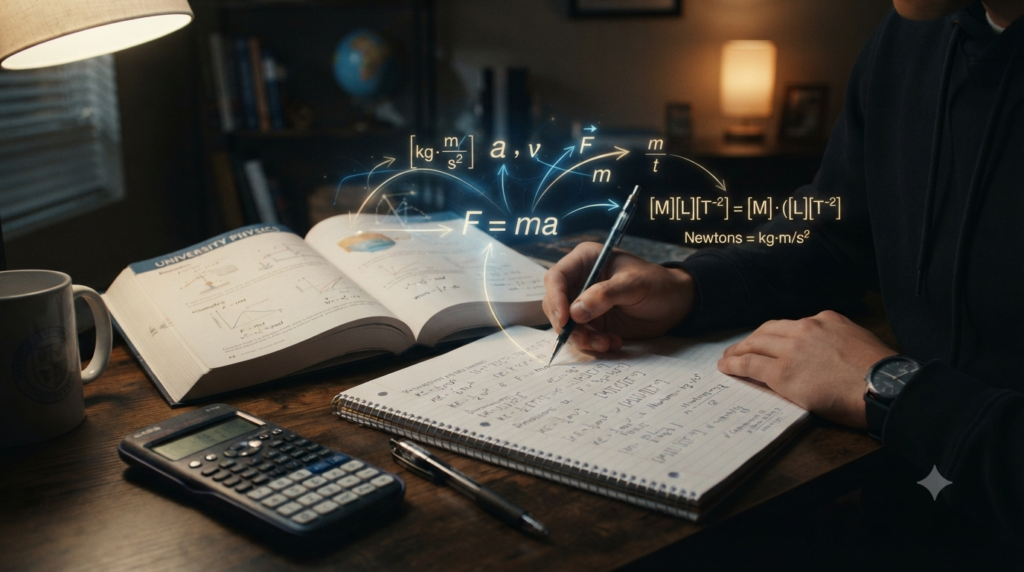
F = ma
contains three quantities. F represents force, m represents mass, and a represents acceleration. The equation tells us that the force acting on an object depends on its mass and acceleration.
Do not memorize F = ma as a collection of three letters. Understand the relationship: greater mass requires greater force for the same acceleration, while greater acceleration requires greater force for the same mass.
This approach makes formulas meaningful rather than purely memorized.
Understand the Units
Units provide another powerful way to understand physics formulas. Every physical quantity has an appropriate unit, and the units in an equation must be consistent.
For example:
v = s/t
Distance is measured in metres (m), and time is measured in seconds (s). Therefore, speed has the unit:
m/s
Similarly, from
F = ma
mass has the unit kilogram (kg), while acceleration has the unit metre per second squared (m/s²). Therefore:
N = kg·m/s²
Studying units helps you check whether a formula and your final answer make physical sense. It can also help you remember relationships between quantities.
Understand Where the Formula Comes From
Whenever possible, learn how a formula is derived. Derivation shows the logical steps that connect different physical quantities.
For example, acceleration is defined as the change in velocity divided by the time taken:
a = (v − u)/t
From this relationship, we can rearrange the equation to obtain:
v = u + at
Here, u is initial velocity, v is final velocity, a is acceleration, and t is time.
When you understand how the equation is obtained, you do not have to depend entirely on memorization. Even if you forget part of the formula later, you may be able to reconstruct it from the underlying relationship.
Connect Formulas With Concepts
A formula should always be connected to the physical concept behind it. This is one of the most effective ways to study physics.
For example, consider the kinetic energy formula:
K = ½mv²
The formula tells us that kinetic energy depends on mass and the square of velocity. The squared velocity is especially important because doubling the velocity does not simply double the kinetic energy. It makes the kinetic energy four times greater.
Understanding this relationship helps you interpret the formula instead of treating it as something that must be memorized.
Try asking:
What happens if one quantity increases?
What happens if one quantity decreases?
Which quantity has the greatest effect?
These questions turn formula learning into conceptual learning.
Rearrange Formulas Correctly
Physics problems do not always provide the quantity that appears alone on the left side of a formula. Sometimes you need to rearrange the equation.
For example:
v = u + at
If you need acceleration, rearrange the equation:
a = (v − u)/t
If you need time:
t = (v − u)/a
Learning how to rearrange formulas gives you flexibility when solving numerical problems. Instead of memorizing several versions of the same equation separately, understand how one equation can be transformed into different forms.
Practice With Simple Problems First
After understanding a formula, solve a few simple numerical problems. Start with direct substitution before moving to complicated questions.
For example, if an object travels 100 m in 20 s, its speed is:
v = s/t
v = 100/20 = 5 m/s
The purpose of an easy problem is not simply to obtain the answer. It is to practice identifying the correct formula, selecting the correct quantities, substituting values, calculating carefully, and writing the correct unit.
Once this process becomes comfortable, move to more challenging problems.
Learn When to Use Each Formula
Knowing a formula is different from knowing when to use it. Physics problems may contain several quantities and multiple formulas, so identifying the correct relationship is an important skill.
Suppose a problem gives mass and acceleration and asks for force. The relevant relationship is:
F = ma
If a problem gives work done, force, and displacement in the direction of the force, you may use:
W = Fs
The key is to identify the physical situation before choosing an equation.
A useful habit is to write down the given quantities and the quantity to find. Then look for a formula that connects them.
Use Formula Sheets Wisely
A formula sheet can be useful, especially when studying a large chapter. However, it should not become a replacement for understanding.
Organize formulas according to topics such as:
Motion
Force
Work and energy
Momentum
Gravitation
Heat
Waves
Electricity
Magnetism
Optics
For each formula, include the meaning of the symbols and their SI units. You can also write a short note describing when the formula is normally used.
This creates a compact reference that can help during revision.
Revise Formulas at Regular Intervals
Formula learning becomes easier when revision is spread over time. Instead of trying to memorize dozens of equations in one sitting, review a smaller number regularly.
During revision, cover the formula and try to recall it. Then check whether you remembered it correctly. After that, solve one or two problems using it.
You can also practice writing formulas from memory without looking at your notes. This helps strengthen recall and reveals which formulas still need attention.
Check Your Formula With Dimensions
Dimensional analysis can be a useful way to check whether an equation is physically consistent.
For example, the dimensional formula of velocity is:
[LT⁻¹]
For acceleration:
[LT⁻²]
For the equation:
v = u + at
the dimensions of u are [LT⁻¹], while the dimensions of at are:
[LT⁻²][T] = [LT⁻¹]
Both terms therefore have the same dimensions.
Dimensional analysis cannot prove that every formula is correct, but it can help identify many incorrect relationships and calculation mistakes.
Avoid Memorizing Without Understanding
One of the most common mistakes in studying physics formulas is trying to memorize everything mechanically. This may work temporarily, but formulas can quickly become confusing when a problem is presented in an unfamiliar way.
Instead, use this sequence:
Understand → Identify → Derive → Practice → Recall → Apply
First understand the concept. Then identify the quantities and their relationship. Learn the derivation where appropriate. Practice simple and challenging problems. Test your memory regularly. Finally, apply the formula to real physical situations.
This approach develops both memory and understanding.
Build a Formula Learning Routine
A consistent routine can make formula study much easier. When starting a new chapter, first learn the important concepts. Next, create a list of the formulas introduced in that chapter. For each formula, learn the symbols, units, meaning, conditions, and derivation if applicable.
Then solve several problems using the formulas. At the end of the study session, close your notes and try to recall the equations. During later revision sessions, focus more on formulas that you frequently forget or misuse.
The goal is not to memorize the largest possible number of formulas. The goal is to understand the relationships that allow you to solve physics problems.
Conclusion
Studying physics formulas step by step is much more effective than memorizing equations without understanding them. Start by learning the physical quantities and symbols, then understand the units, concept, derivation, and conditions of use. Practice rearranging formulas and solving numerical problems from simple to challenging. Regular revision, dimensional analysis, and active recall can further strengthen your understanding.
A physics formula is more than a mathematical expression. It describes a relationship between physical quantities. Once you understand what that relationship means and how it works, remembering and applying the formula becomes much easier. With consistent practice and a clear study method, formulas can become useful tools for understanding physics rather than difficult equations to memorize.
FAQs
1. What is the best way to study physics formulas?
The best way to study physics formulas is to understand them rather than memorize them blindly. Start by learning what each physical quantity and symbol represents. Then understand the units, meaning, and relationship between the quantities. If possible, study how the formula is derived and identify the conditions under which it is used. After that, solve simple numerical problems before moving to more difficult ones. Regularly recalling formulas without looking at your notes can improve memory. Connecting formulas with physical situations also makes them easier to remember. A combination of understanding, practice, revision, and application is more effective than memorization alone.
2. Should I memorize physics formulas?
Memorization can be useful, but it should come after understanding. A physics formula represents a relationship between physical quantities, so knowing what that relationship means makes the formula easier to remember and apply. For example, understanding that speed is distance divided by time gives meaning to v = s/t. You should learn important formulas, but also understand their symbols, units, derivations, and applications. When you understand a formula, you may also be able to reconstruct it if you forget it. Therefore, use memorization as one part of studying physics rather than depending on it as the entire method.
3. How can I remember physics formulas easily?
You can remember physics formulas more easily by connecting them with concepts, units, and examples. First understand what the formula describes. Then write the formula and explain the meaning of every symbol in your own words. Practice using it in numerical problems and review it regularly. You can create a formula sheet organized by topics such as motion, force, energy, electricity, and waves. Active recall is also helpful: close your notes and try to write the formula from memory. Instead of studying many formulas at once, learn a small group and revisit them at regular intervals. Consistent practice makes recall stronger.
4. Why do I forget physics formulas after studying them?
You may forget physics formulas when you study them only through repeated reading or last-minute memorization. Formulas are easier to remember when they are connected to concepts and used in actual problems. Another reason may be that similar formulas are being confused with one another. To improve recall, understand the meaning of each formula, practice writing it without looking at your notes, and solve different types of questions using it. Regular revision is also important because information becomes easier to recall when it is reviewed over time. If you repeatedly forget a formula, focus on understanding its derivation and physical meaning.
5. Should I learn the derivation of physics formulas?
Learning derivations can be very useful because they show how a formula is obtained from known physical relationships. A derivation can help you understand why the equation has its particular form instead of treating it as a fact that must simply be memorized. For example, understanding how v = u + at follows from the definition of acceleration gives the formula a logical structure. You do not necessarily need to derive every formula repeatedly, especially when revising, but understanding important derivations can improve conceptual knowledge and recall. It can also help you recognize which formulas are related and how they can be rearranged.
6. How do units help in learning physics formulas?
Units help you understand and check physics formulas because every physical quantity has a specific unit. For example, speed has the SI unit metre per second, written as m/s, because speed is distance divided by time. Units can help you identify relationships between quantities and detect calculation mistakes. Dimensional analysis can also be used to check whether the quantities on both sides of an equation are dimensionally consistent. When studying a formula, learn the SI unit of each quantity along with its symbol and meaning. This connects the mathematical expression with the physical quantity it represents and makes the formula easier to understand.
7. How should I practice physics formulas?
Start by solving simple problems where the required formula is obvious. Write down the quantities given in the question, identify what needs to be calculated, select the appropriate formula, substitute the values, and include the correct unit. Once you become comfortable with direct problems, practice questions where you must identify the formula yourself or rearrange it first. Try solving problems without immediately checking the solution. Afterward, review your mistakes and determine whether the problem involved a formula, unit, substitution, calculation, or concept error. Regular practice with different question types helps you learn how formulas work in real physics problems.
8. How can I know which physics formula to use?
To choose the correct formula, first understand what the problem is asking. Write down the known quantities and the unknown quantity. Then identify the physical concept involved, such as motion, force, energy, momentum, electricity, or waves. Look for a formula that connects the known quantities with the quantity you need. For example, if a problem gives mass and acceleration and asks for force, F = ma connects those quantities. Avoid selecting a formula simply because it contains one familiar number from the question. Understanding the physical situation helps you choose formulas correctly and reduces unnecessary memorization.
9. Is making a physics formula sheet useful?
Yes, a physics formula sheet can be useful for organizing important equations and supporting revision. Instead of writing only the equations, include the meaning of the symbols, SI units, and a short note about when each formula is used. Organize the sheet by topics such as kinematics, force, work and energy, gravitation, electricity, and optics. You can also include related formulas together so that their connections are easier to see. However, a formula sheet should support understanding rather than replace it. Before using the sheet for revision, try recalling formulas from memory and then use it to check your answers.
10. How long should I study physics formulas each day?
There is no single study duration that works for everyone. What matters most is consistent and focused practice. Instead of spending a long period only memorizing formulas, divide your study time between understanding concepts, reviewing formulas, solving problems, and recalling equations from memory. For example, you could spend part of a study session reviewing previously learned formulas and another part applying them to numerical problems. Short, regular revision sessions can be more useful than trying to learn many formulas in one sitting. Adjust your study time according to the difficulty of the topic, your learning pace, and the amount of practice you need.
Related Posts
What Do Coefficients Mean in Chemistry Formulas?
When you look at a chemical equation, you may notice numbers written before chemical formulas. These numbers are called coefficients. […]
Read MoreHow to Read Subscripts in Chemical Formulas
Chemical formulas are a simple way to represent substances using symbols and numbers. When you look at a formula such […]
Read MoreHow to Identify Elements in a Chemical Formula
Chemical formulas provide a simple way to describe the substances that make up the world around us. A formula may […]
Read MoreHow Elements Are Represented in Chemical Formulas
Chemistry deals with many different substances, from the oxygen we breathe to the water we drink and the minerals found […]
Read MoreChemical Symbols and Their Role in Chemistry Formulas
Chemistry is often described as the science of matter, but understanding chemistry also means learning how scientists communicate information about […]
Read MoreHow Chemical Formulas Represent Substances
Chemical formulas are one of the simplest ways scientists communicate information about matter. A substance may contain millions or billions […]
Read MoreWhat Is a Chemical Formula in Chemistry?
Chemistry is the study of substances, their properties, and the changes they undergo. To describe these substances clearly, chemists need […]
Read MoreBasic Types of Chemistry Formulas Explained
Chemistry formulas are one of the simplest ways scientists describe substances, reactions, and relationships between different particles. A formula can […]
Read MoreHow to Read and Understand Chemistry Formulas
Chemistry formulas may look like a collection of letters, numbers, and symbols, but they are actually a simple language used […]
Read MoreWhat Are Chemistry Formulas and Why Are They Important?
Chemistry is the science of substances, their properties, and the changes they undergo. To describe these substances clearly, chemists use […]
Read MoreHow to Verify an Answer Using Units
In physics, getting a numerical answer is only part of solving a problem. The next question is whether that answer […]
Read MoreHow to Check Whether a Physics Formula Is Correct
A physics formula is more than a collection of symbols and numbers. It represents a relationship between physical quantities and […]
Read MoreHow to Avoid Unit Conversion Mistakes in Physics
Unit conversion is one of the most common sources of mistakes in physics. A formula may be correct, the calculation […]
Read MoreHow to Avoid Sign Errors in Physics Calculations
Physics calculations are not only about choosing the correct formula and putting numbers into it. The signs of physical quantities […]
Read MoreCommon Mistakes When Using Physics Formulas
Physics formulas help us describe motion, forces, energy, electricity, heat, waves, and many other phenomena using mathematical relationships. A formula […]
Read MoreHow to Study Physics Formulas Step by Step
Physics formulas are an important part of learning physics, but simply memorizing them is not enough. A formula represents a […]
Read MoreHow to Organize Physics Formulas for Easy Revision
Physics becomes much easier when formulas are organized in a clear and meaningful way. Many learners struggle not because they […]
Read MoreHow to Build a Physics Formula Sheet
Physics involves many formulas, and remembering all of them can become difficult as you move from basic concepts to more […]
Read More