
How to Organize Physics Formulas for Easy Revision

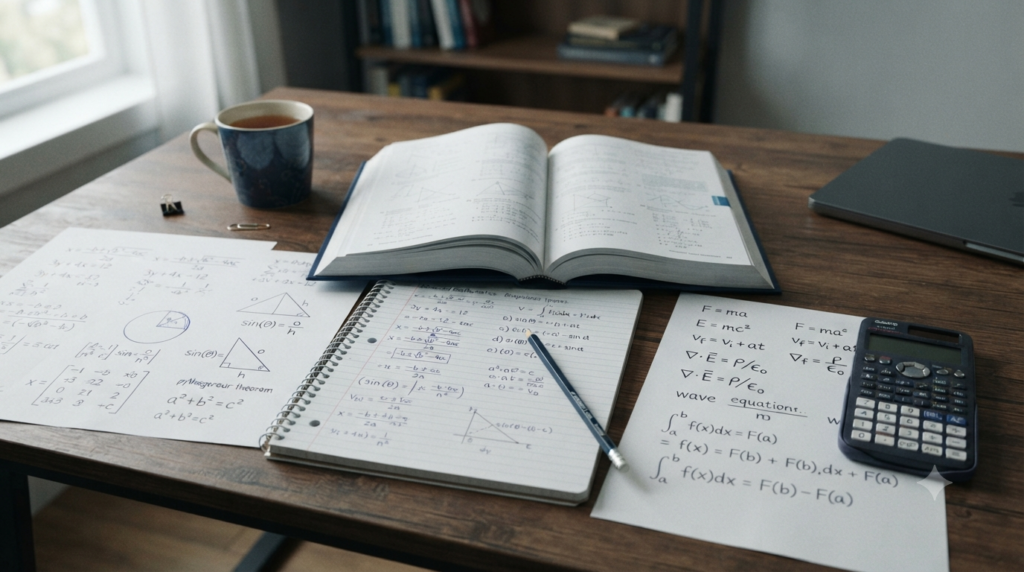
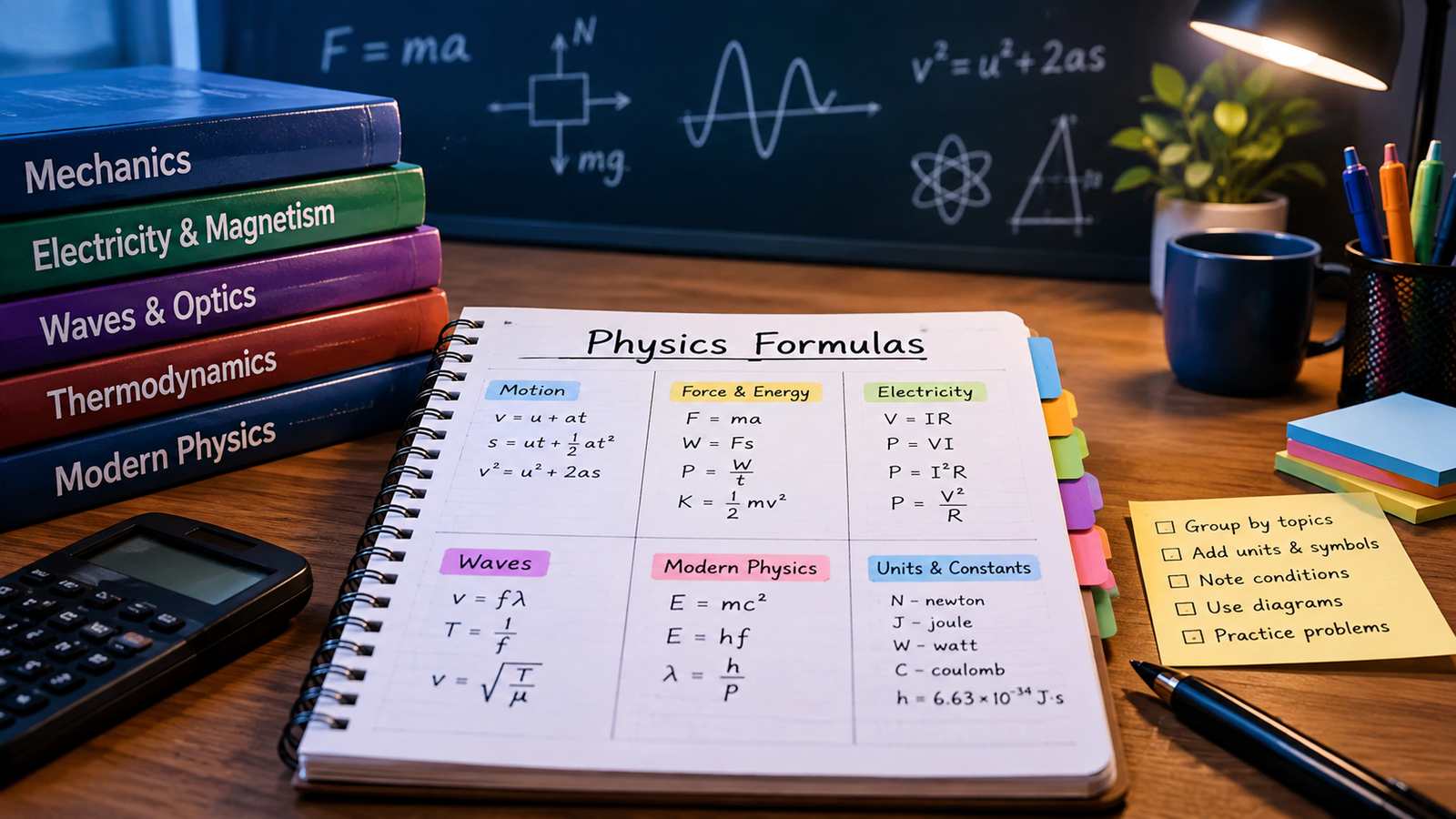
Organized physics formulas, equations, diagrams, and notes arranged for easy revision and quick study

Physics becomes much easier when formulas are organized in a clear and meaningful way. Many learners struggle not because they cannot understand physics, but because they have difficulty remembering which formula to use, what each symbol means, and how different formulas are connected. A long list of equations can quickly become confusing, especially during exam preparation.

A well-organized physics formula system can solve this problem. Instead of memorizing formulas randomly, you can arrange them according to topics, physical quantities, relationships, and applications. This makes revision faster and helps you understand the logic behind each equation. Whether you are reviewing mechanics, electricity, waves, thermodynamics, or modern physics, a structured formula sheet can become a useful tool for regular study.

Start by Dividing Physics Into Topics

The first step is to organize formulas according to major physics topics. Avoid keeping every formula on one large page because formulas from different chapters can easily get mixed together.

For example, mechanics can include motion, force, work, energy, momentum, circular motion, and gravitation. Electricity can include electric charge, current, resistance, electrical power, and circuits. Similarly, waves can include frequency, wavelength, wave speed, and sound.

A simple structure might look like this:

  • Measurement and Units

  • Motion

  • Force and Laws of Motion

  • Work, Energy and Power

  • Momentum

  • Gravitation

  • Properties of Matter

  • Heat and Thermodynamics

  • Waves and Sound

  • Electricity

  • Magnetism

  • Optics

  • Modern Physics

This arrangement allows you to find a formula quickly when revising a particular topic.

Group Formulas by Physical Quantity

Another useful method is to group formulas according to the quantity you are studying. This helps you understand how different equations describe the same physical idea.

For example, when studying speed, you may organize related equations together:

Speed = Distance ÷ Time

v = s/t

For acceleration:

a = Change in velocity ÷ Time

a = (v − u)/t

For uniformly accelerated motion, related equations can then be placed together:

v = u + at

s = ut + ½at²

v² = u² + 2as

This approach is more useful than simply memorizing equations separately. You begin to see how velocity, acceleration, displacement, and time are connected.

Write What Each Symbol Means

A formula becomes much easier to revise when every symbol has a clear meaning. Do not write only the equation. Add a short explanation below it.

For example:

F = ma

Where:

F = force
m = mass
a = acceleration

You can also include the SI unit:

Force → newton (N)

This small addition can prevent confusion between similar symbols and quantities. It also helps you remember the relationship between a physical quantity, its formula, and its unit.

Keep Related Formulas Together

Some physics formulas are closely connected and should be placed together. Keeping related equations in the same section makes revision more logical.

For example, the formulas for work and power can be grouped together:

Work = Force × Displacement

W = Fs

Power = Work ÷ Time

P = W/t

Similarly, kinetic and potential energy can be placed in the same energy section:

Kinetic Energy = ½mv²

Potential Energy = mgh

Mechanical Energy = Kinetic Energy + Potential Energy

When formulas are arranged this way, revision becomes a process of understanding relationships rather than memorizing isolated equations.

Organize Formulas From Basic to Advanced

Within each topic, arrange formulas from simple relationships to more advanced ones. Start with definitions and basic equations before moving to equations that require multiple quantities.

For example, in electricity, you might begin with:

Current = Charge ÷ Time

I = Q/t

Then move to Ohm’s law:

V = IR

After that, include electrical power:

P = VI

Then add equivalent forms:

P = I²R

P = V²/R

This order helps you understand where more advanced formulas come from. It also makes it easier to reconstruct a formula if you forget it.

Include Units With Important Formulas

Units are an important part of physics. Adding units to your formula notes can help you identify mistakes and remember physical quantities more effectively.

For example:

Force → N
Work → J
Power → W
Energy → J
Pressure → Pa
Electric charge → C
Potential difference → V
Resistance → Ω

You do not need to write the unit beside every equation if your formula sheet becomes crowded. However, including units for important quantities is particularly useful during problem-solving and dimensional analysis.

Use Formula Tables

A formula table can make revision much faster. Instead of reading several paragraphs, you can quickly scan the information.

QuantityFormulaSI Unit
Speedv = s/tm/s
Accelerationa = (v − u)/tm/s²
ForceF = maN
WorkW = FsJ
PowerP = W/tW
Momentump = mvkg·m/s

A table is especially useful when you need a quick review before solving numerical problems.

Add Conditions and Limitations

Some formulas are valid only under particular conditions. Writing these conditions beside the formula can prevent incorrect applications.

For example, the equations of uniformly accelerated motion such as:

v = u + at

are used when acceleration is constant.

Similarly, Ohm’s law applies to an ohmic conductor when physical conditions such as temperature remain constant.

Adding a short note such as “constant acceleration” or “under specified conditions” can make your formula sheet much more reliable.

Use Diagrams Where They Help

Not every formula needs a diagram, but diagrams can be extremely useful for formulas involving geometry, forces, circuits, waves, or optics.

For example, when revising force problems, a small free-body diagram can remind you how forces act on an object. In optics, a ray diagram can help connect formulas with lenses and mirrors. In electricity, a simple circuit diagram can make relationships between current, voltage, and resistance easier to understand.

The goal is not to decorate the formula sheet. Use diagrams only when they improve understanding.

Keep a Separate Formula Mistake List

One of the most effective revision techniques is to record formulas that you frequently forget or misuse.

For example, if you repeatedly confuse:

P = VI

with:

P = I²R

write both together and note the relationship between them.

You can also record common mistakes such as using distance instead of displacement or confusing mass with weight.

This personal mistake list becomes more valuable over time because it focuses on the areas that actually cause problems for you.

Revise Formulas Through Problems

A formula sheet should support problem-solving, not replace it. Simply reading formulas repeatedly may create the feeling that you know them without proving that you can use them.

After revising a group of formulas, solve a few problems related to them. Ask yourself:

  • What quantity is given?

  • What quantity needs to be found?

  • Which formula connects them?

  • Are the units consistent?

  • Can the answer be checked using another relationship?

For example, after studying F = ma, solve problems involving different combinations of force, mass, and acceleration. This helps the formula become connected to actual physical situations.

Create a One-Page Final Revision Sheet

After organizing all your formulas, create a condensed version containing only the most important equations. This should not be your first formula sheet. It should be the result of several rounds of study.

Your final revision sheet might contain definitions, essential equations, important constants, units, and a few conditions. Keep it simple enough to review within a few minutes.

The purpose of this page is quick recall, not detailed learning.

Update Your Formula Sheet Regularly

A formula sheet should change as your understanding improves. When you learn a new relationship, discover a useful derivation, or identify a common mistake, update your notes.

Avoid continuously adding unnecessary formulas. A crowded sheet can become difficult to use. Keep the formulas that are genuinely useful for understanding concepts and solving problems.

You can also reorganize sections whenever you discover a better structure. The best formula sheet is not necessarily the one with the most equations. It is the one that helps you find and use the right equation quickly.

Conclusion

Organizing physics formulas is more effective than trying to memorize a long collection of equations. Start by dividing formulas into topics, group related quantities together, define every symbol, include important units, and note the conditions under which formulas apply. Tables, diagrams, mistake lists, and practice problems can make revision even more useful.

Most importantly, treat formulas as connected descriptions of physical relationships rather than isolated expressions. When you understand how equations relate to concepts, you can remember them more naturally and choose the appropriate formula with greater confidence. A well-organized formula sheet can therefore turn revision from a confusing task into a clear and efficient part of learning physics.

FAQs

1. What is the best way to organize physics formulas?

The best way to organize physics formulas is to group them by topic and arrange related equations together. Start with major areas such as motion, force, work, energy, electricity, waves, optics, and modern physics. For each formula, write the meaning of every symbol and include the SI unit of the quantity when useful. You can also add conditions under which the formula applies. Keeping formulas in tables or sections makes them easier to find during revision. Instead of creating one large list, build separate topic-wise sections and gradually create a shorter sheet containing only the formulas you use most often.

2. Should physics formulas be memorized or understood?

Physics formulas should be understood before they are memorized. Understanding what a formula represents helps you remember it and use it correctly in different situations. For example, knowing that F = ma describes the relationship between force, mass, and acceleration is more useful than remembering the three symbols without understanding them. Learn what each quantity means, how the quantities are related, and what conditions apply. After understanding the formula, repeated practice can strengthen recall. Derivations can also help when appropriate. The goal is not simply to memorize equations but to understand the physical relationships they describe.

3. How can I remember physics formulas easily?

You can remember physics formulas more easily by connecting them with concepts, units, diagrams, and practice problems. Group related formulas together instead of learning them randomly. For example, keep equations for velocity, acceleration, and displacement in the same section. Write the meaning of each symbol and review the units regularly. Try recalling formulas without looking at your notes, then check your answers. Solving numerical problems is also important because it shows when and how a formula should be used. Regular short revision sessions are usually more useful than trying to memorize a large number of equations in one sitting.

4. Should I make a separate formula sheet for each physics chapter?

Making separate formula sheets for each major physics chapter can make revision more organized. A chapter-specific sheet allows you to focus on the formulas needed for that particular topic without searching through a long collection of equations. For example, you can create separate sections for motion, force, energy, electricity, and optics. After completing your chapter-wise sheets, combine the most important formulas into one shorter revision sheet. This gives you both detailed notes and a quick-reference resource. Keep each sheet simple and include only useful formulas, symbol meanings, important units, and conditions that help you apply the equations correctly.

5. Why should I include units with physics formulas?

Including units helps you understand physical quantities and identify possible mistakes while solving problems. For example, force is measured in newtons, energy in joules, and acceleration in metres per second squared. Units can also help you check whether an equation is dimensionally consistent. If your calculated answer has an unexpected unit, it may indicate a mistake in the calculation or formula selection. Writing important units beside formulas therefore provides an additional way to check your work. It also strengthens your understanding of the connection between mathematical expressions and the physical quantities they represent.

6. How can I organize formulas for numerical problems?

To organize formulas for numerical problems, group equations according to the quantities they connect. First identify common variables such as distance, time, velocity, mass, force, energy, voltage, current, and resistance. Then place formulas involving those quantities together. For each equation, note what information is required before it can be used. For example, F = ma connects force, mass, and acceleration. When solving a problem, identify the known quantities, determine the unknown quantity, and select a formula connecting them. This approach helps you choose formulas logically instead of trying to remember every equation at once.

7. What should a physics formula revision sheet contain?

A useful physics formula revision sheet should contain the most important equations from each topic, along with the meaning of symbols and important SI units. You can also include short notes about conditions, common relationships, and formulas that are frequently confused. Avoid filling the sheet with every equation you have ever encountered. The purpose of a revision sheet is quick recall. Organize formulas into clear sections and use tables when they improve readability. You may also include a few important diagrams where they help explain forces, circuits, waves, optics, or other physical situations.

8. How often should I revise physics formulas?

The frequency of formula revision depends on how familiar you are with the topic. When learning a new chapter, review its formulas regularly while solving related problems. After becoming familiar with them, use spaced revision rather than repeatedly studying the same formulas in one session. You can briefly test yourself after a day, several days later, and again after a longer interval. During revision, try recalling formulas before looking at your notes. If you forget an equation or repeatedly make the same mistake, add it to a personal revision list and practice it through suitable problems.

9. Can solving problems help me remember physics formulas?

Yes, solving problems can make physics formulas easier to remember because you repeatedly connect equations with physical situations. Instead of seeing F = ma as an isolated expression, for example, you use it to calculate force, mass, or acceleration in different situations. This develops both recall and application skills. While solving problems, pay attention to why a particular formula is appropriate and check whether the units are consistent. When you make a mistake, identify whether the problem was caused by formula selection, substitution, units, or calculation. This process can make your formula knowledge more practical and reliable.

10. How can I revise physics formulas quickly before an exam?

For quick revision before an exam, use a concise formula sheet rather than reading entire chapters. Divide the sheet into major topics and review the most important equations, symbols, units, and conditions. Focus especially on formulas you frequently forget or confuse. Try writing important equations from memory and then checking them against your notes. Reviewing a few representative numerical problems can also remind you how the formulas are applied. Avoid trying to learn a large number of unfamiliar formulas immediately before an exam. A well-organized formula sheet prepared during regular study can make final revision much faster and clearer.

Related Post

Leave a Comment

Your email address will not be published. Required fields are marked *

Scroll to Top